


The best way to Follow-Up Rules for Outreach without being annoying is to send fewer, better messages. Give the recipient reasonable time, add something useful with each follow-up, ask for one clear decision, and make it easy to decline.
For most cold outreach, an initial email followed by two thoughtful reminders is enough. If those messages produce no response, close the loop.
Silence does not always mean rejection. Your email may have arrived during a deadline, a business trip, a budget review, or an unusually crowded morning. A relevant follow-up can recover an opportunity that would otherwise be lost.
But silence is not permission to repeat the same request indefinitely.
A follow-up becomes annoying when it restates the sender’s need without making the recipient’s decision any easier. Before sending one, ask whether it provides context, adds useful information, answers a concern, simplifies the next step, or offers a comfortable exit.
If it does none of those things, it probably does not deserve another place in the inbox.
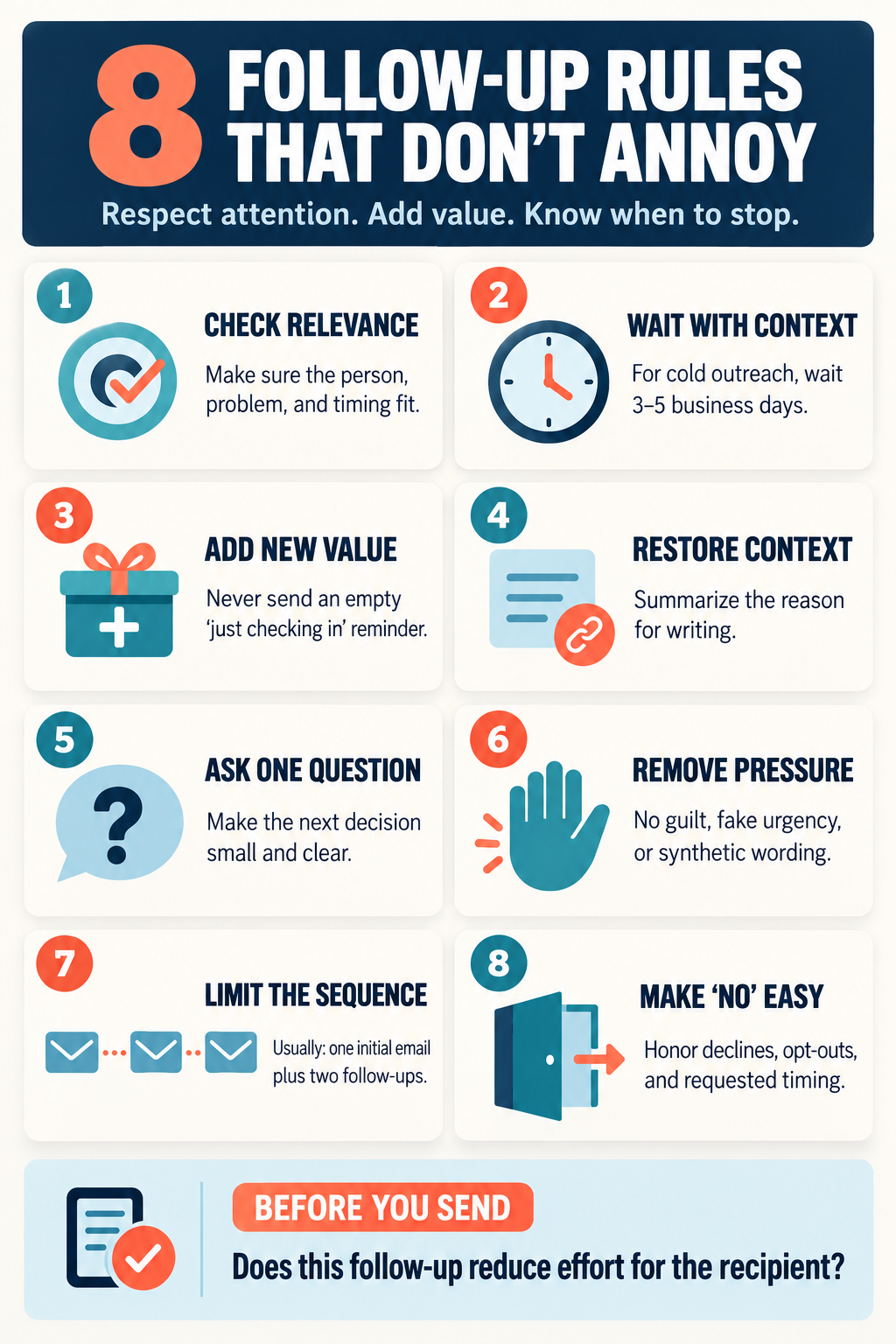
1. Confirm the outreach is relevant before sending more of it
No follow-up technique can rescue a badly targeted message.
Before writing again, check the premise of the outreach. Is this person responsible for the problem you mentioned? Does your offer fit the company’s size, market, or current priorities? Do you have a credible reason to contact them now?
Hunter’s 2026 outreach report, based on 31 million emails sent during 2025, found that 61% of surveyed decision-makers objected to irrelevant cold emails. An even larger share, 65%, said cold emails fail because they feel too focused on making a sale.
That is a targeting problem before it is a writing problem. Personalization should explain why the message belongs in that person’s inbox. Mentioning someone’s university, hometown, or old social media post does not automatically make an email relevant.
Compare these two approaches:
I saw your recent LinkedIn post and thought I would reach out.
And:
Your team is hiring six account executives while entering a new market, so keeping sales onboarding consistent may be becoming more difficult.
The second message presents a relevant business hypothesis. The first merely proves that the sender can browse LinkedIn. If you cannot explain the fit in one honest sentence, do more research or stop the sequence.
2. Let the situation determine when you follow up
There is no universal best day to follow up after no response. The right delay depends on the relationship, the request, and any deadline already discussed.
A journalist considering a time-sensitive pitch is not in the same position as a buyer reviewing a major proposal. A colleague who promised a document by Friday is not the same as a stranger who never asked to hear from you.
These ranges provide a sensible starting point:
| Outreach situation | Recommended timing |
| Cold sales or partnership email | Follow up after 3–5 business days; send a final note 5–7 business days later |
| Warm introduction or networking request | Follow up after 3–5 business days; send one final note after another 7–10 business days |
| Post-meeting recap | Send it the same day or within 24 hours |
| Proposal with an agreed decision date | Follow up on that date; if missed, wait another 3–5 business days |
| Media or journalist pitch | Send one follow-up after 3–7 days, then stop |
| Time-sensitive request | Base the timing on the real deadline and leave enough time to act |
| “Not now” response | Reconnect when the recipient asked you to |
| Out-of-office response | Wait until after the stated return date |
Media outreach deserves particular restraint. Muck Rack’s 2026 State of Journalism report found that half of journalists considered one follow-up ideal. Most of those who expressed a timing preference wanted it within three to seven days.
Sales cadences should not be copied blindly into public relations, recruitment, partnerships, or professional networking.
The recipient’s own instructions should always overrule your automated sequence. If someone says, “Try me next quarter,” contacting them again next Tuesday is not persistence. It is a failure to listen.
3. Never send an empty reminder
“Just following up” describes what you are doing. It gives the recipient no new reason to care.
The weakest follow-up emails merely push the original message back to the top of the inbox:
- Just checking in.
- Bumping this.
- Did you see my previous email?
- Any thoughts?
- Putting this back on your radar.
These messages transfer all the work to the recipient. They must find the earlier email, remember the offer, reconsider it, and decide what kind of answer to provide.
In Gong’s analysis of more than 300,000 follow-up emails, short “bubble-up” messages were 15 times less likely to help book a meeting. The issue was not brevity alone. It was the absence of substance.
Give every follow-up a specific job. It might add a relevant example, address a likely objection, clarify the expected result, provide a useful resource, or suggest a smaller next step.
Instead of writing:
Just checking whether you saw my last email.
Try:
One detail may help you assess this: the process works with your existing CRM, so it would not require a full migration. Would a two-minute overview be useful?
The second version earns its place by removing uncertainty.
4. Make every follow-up understandable on its own
Most follow-ups should remain in the original email thread. The subject line and message history preserve context and make the exchange easier to manage.
However, do not make the recipient reread the entire conversation. A good follow-up briefly explains why you contacted them, what is relevant to their situation, and what you want them to decide.
For example:
I wrote last week because your team is expanding its partner program. We help SaaS companies review partner applications without adding more manual checks. I prepared a one-page example based on a similar workflow. Would you like me to send it?
This message works even if the recipient barely remembers the original email. Start a new thread only when the subject has materially changed, a long period has passed, or you have a genuinely new reason to make contact. Never add a false “Re:” to create the impression of an existing conversation.
A deceptive subject line may win an open. It loses trust at the same time.
5. Ask for one small, clear decision
“Let me know your thoughts” sounds like a low-pressure request. In practice, it gives the recipient another task: deciding which part of the email to consider and what kind of response you expect.
Gong found that using “Thoughts?” could generate replies while being associated with 20% fewer booked meetings. Not every response represents progress. An irritated refusal still counts as a reply.
Make the next decision obvious:
- Is reducing onboarding time a priority this quarter?
- Would a one-page breakdown be useful?
- Is Tuesday at 2:00 or Thursday at 11:00 better?
- Does someone else on your team manage this?
- Should I close this for now?
Match the size of the request to the trust you have earned. Asking a stranger to schedule a 30-minute meeting is a substantial first step. Asking whether the problem is relevant or whether they want a short resource is easier to answer.
One email should usually contain one decision. Three questions, two links, a calendar, a presentation, and a request for a referral do not create more opportunities to respond. They create more reasons to postpone the response.
6. Remove guilt and manufactured urgency
Some follow-ups try to make the recipient uncomfortable:
- I have emailed you three times.
- I never heard back.
- I assume this is not important to you.
- This is my final attempt.
- I know you are busy, but…
The recipient does not owe you a response because you spent time researching or writing. Calling attention to your effort creates pressure without adding value.
Gong found that “never heard back” could provoke responses while being associated with fewer meetings. This is another reason to separate reply rate from useful outcomes.
Use neutral language instead:
I have not heard back, so I will close the loop after this note. If improving reporting accuracy becomes a priority later, I would be glad to reconnect.
Real urgency is useful. If registration closes Friday, a proposal expires on a stated date, or availability has genuinely changed, explain that clearly. If there is no external deadline, do not manufacture one with “last chance” language.
Automated and AI-assisted messages also require human review. In Hunter’s survey, 69% of decision-makers said AI use bothered them when the resulting email felt synthetic. Tools can help organize research or prepare a draft, but they cannot be allowed to invent familiarity, misunderstand context, or continue a sequence after the recipient has declined.
7. Limit your attempts and change channels carefully
For ordinary cold outreach, two follow-ups after the original email are usually enough. Hunter found that sequences containing three total messages averaged a 6.8% reply rate, compared with 3.3% for a single email. Sequences became less effective as additional follow-ups were added.
The sensible lesson is that one or two useful reminders can recover overlooked opportunities. It is not that senders should continue until the recipient finally responds.
You may have seen the claim that 80% of sales require five follow-ups. It is repeated widely, but its original evidence is unclear and does not provide a reliable basis for modern outreach decisions.
RAIN Group has reported that securing an initial meeting takes an average of eight touchpoints, with top-performing sellers averaging five. However, a touchpoint is not the same as a follow-up email.
A touchpoint could be a referral, a phone conversation, an event, a useful article, a social interaction, or another relevant contact during a longer sales process. “Eight touchpoints” should never be translated into “send eight emails.”
Changing channels can be appropriate when the new channel suits the relationship. A short LinkedIn message may make sense if the recipient is active there. A phone call may be reasonable after a scheduled proposal discussion.
What you should not do is send an email, connection request, direct message, and voicemail on the same day with the same request. That does not feel coordinated to the recipient. It feels like being surrounded.
8. Make “no” easy, and respect it immediately
A respectful follow-up gives the recipient control.
That can be as simple as:
If this is not a priority, tell me, and I will close the loop.
Or:
If someone else owns this, would you point me in the right direction? If not, no problem.
An easy exit does not weaken your outreach. It filters out poor-fit opportunities, protects your reputation, and makes a genuine yes more meaningful.
Stop after a clear refusal or unsubscribe request. If the recipient says “not now,” ask when another conversation would be welcome and respect that date. If they are not the right contact, request a referral once rather than repeatedly asking them to solve your targeting problem.
Opt-outs are also a legal and deliverability issue. In the United States, CAN-SPAM requires commercial senders to provide a working opt-out process and honor requests within 10 business days. Other countries have their own rules governing consent, sender identification, and unsubscribing.
Large senders must also meet the authentication and unsubscribe requirements imposed by inbox providers such as Google. These rules vary by volume and jurisdiction, so international outreach programs need proper compliance review.
Respectful outreach is not merely a matter of tone. It helps protect your ability to reach the inbox at all.
A three-email outreach sequence that respects the recipient
The following sequence shows how the eight rules can work together.
1. Initial email
Subject: Reducing approval delays at Northstar
Hi Maya,
I noticed Northstar is adding regional marketing teams. Approval workflows often become harder to manage at that stage, particularly when briefs and feedback sit in different tools.
We help distributed teams keep requests, reviews, and final assets in one workflow. Is approval speed something your team is working on this quarter?
—Sam
2. First follow-up: four business days later
Hi Maya,
One detail may be useful: teams can keep their existing storage and project-management tools. The workflow only standardizes the approval stage, so adoption is lighter than a full migration.
Would a one-page example be useful?
—Sam
3. Final follow-up: six business days later
Hi Maya,
I will close the loop after this note. If approval delays are not a current priority, no reply is needed. If they are, I can send the short workflow example; no meeting required.
—Sam
The sequence does not become louder with each message. It becomes easier to evaluate. Each email restores context, adds information, reduces the size of the request, or provides a clean exit.
What to say instead of “just following up”
| Avoid | Try instead |
| Just checking in | One detail may help you evaluate this… |
| Did you see my email? | The short version is… |
| Any thoughts? | Is option A or option B closer to what you need? |
| I never heard back | Should I close this for now or reconnect next quarter? |
| Bumping this to the top of your inbox | I found an example that matches the issue I mentioned… |
| This is my last attempt | I will close the loop after this note. |
These are not magic phrases. They work only when the message behind them is relevant. The better standard is straightforward: restore context, add information, narrow the decision, and remove unnecessary pressure.
Measure outcomes, not activity
A busy outreach sequence can look successful inside a dashboard while producing little business value. Track delivered emails, total replies, positive replies, qualified meetings, unsubscribe requests, negative responses, spam complaints, and bounce rates. Compare performance by audience segment and by stage in the sequence.
Treat open rates cautiously. Image blocking, privacy protections, and automated security scans make them unreliable. An open cannot tell you whether the offer was relevant, and a missing open does not always mean that a human ignored the email.
Be clear about denominators as well. “Five percent of people who opened replied” and “less than one percent of delivered recipients replied” can describe the same campaign.
The most useful question is not how many follow-ups your team sent. It is whether each one added enough value to justify another interruption.
Respect is the strategy
Persistent outreach respects the possibility that a worthwhile message was missed. Annoying outreach treats silence as a debt the recipient must repay.
The difference is visible in every follow-up. Relevance shows that you selected the recipient carefully. Good timing demonstrates awareness of context. New information gives the message a purpose. A small question reduces the effort required to decide. An easy exit preserves the other person’s control.
Follow up when you can make the decision easier. When all you can add is another reminder that you want a response, stop.
Frequently Asked Questions on Follow-Up Rules for Outreach
How long should I wait before following up after no response?
For cold sales or partnership outreach, wait around three to five business days before the first follow-up. Wait another five to seven business days before sending a final note. Proposals, warm conversations, media pitches, and time-sensitive requests should follow their own context.
How many follow-up emails are too many?
For most cold outreach, more than two follow-ups begin to create more fatigue than value. Complex sales may involve additional touchpoints over a longer period, but those should not be a string of repeated emails.
Is saying “just following up” rude?
It is not necessarily rude, but it is usually weak. The phrase focuses on the sender’s action and provides no new reason to respond. Replace it with the useful detail, clarification, or decision that prompted the email.
Should I follow up in the same email thread?
Usually, yes. The existing thread preserves context and makes the exchange easier to understand. Briefly restate the important point so the recipient does not have to reread every earlier message.
Should I switch from email to LinkedIn or phone?
Only when the new channel is appropriate for the relationship and offers a legitimate reason to make contact. Do not use several channels at once to repeat the same request. One respectful change of channel may help; a same-day pile-on will usually feel intrusive.
When should I stop following up?
Stop after an explicit no, an unsubscribe request, or confirmation that the offer is irrelevant. With unanswered cold outreach, stop after one or two useful follow-ups unless a genuinely new reason to contact the person emerges later.























