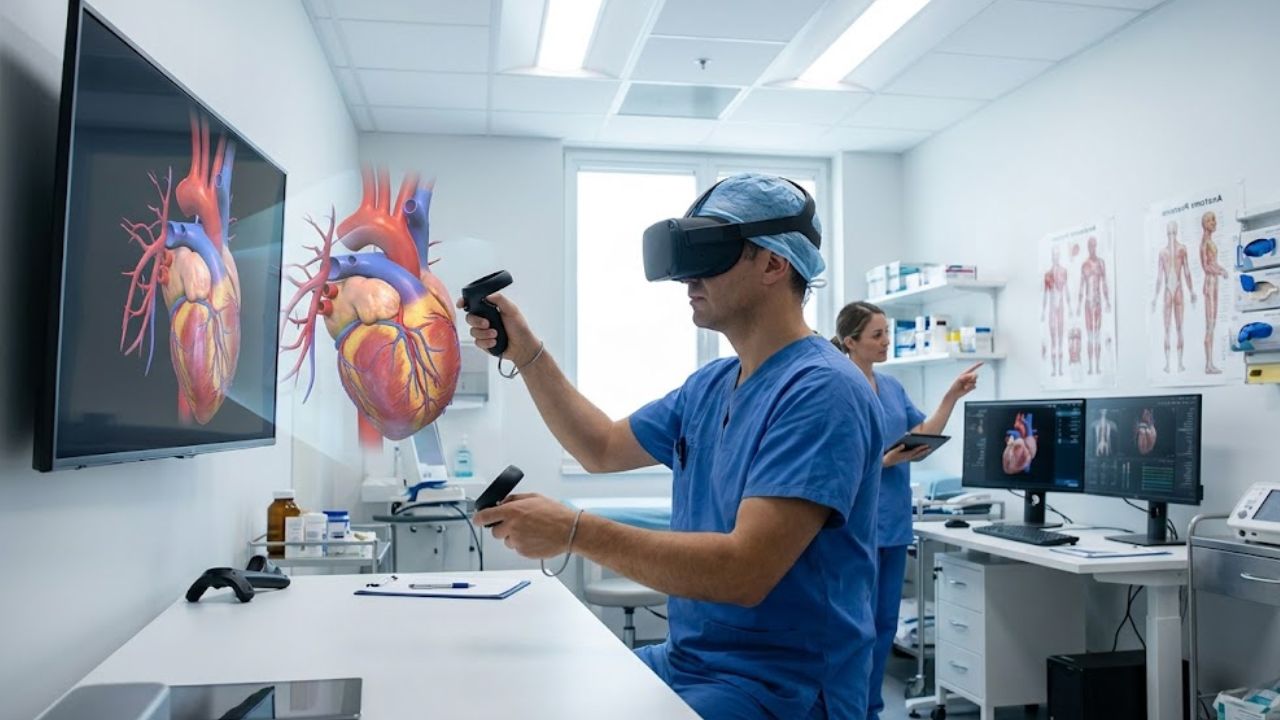
A headset can distract a child during a needle procedure, give a stroke survivor a way to practise reaching, or let a surgical trainee rehearse a task. Those are very different jobs. The phrase virtual reality in healthcare covers all of them, but the evidence and clinical purpose vary from one use to the next.
Some programs support treatment; others are tools for education or practice. A medical headset is not automatically a proven therapy, and a successful simulation does not prove that a clinician is ready to perform a procedure. Here are nine current uses, with the practical limits that patients and providers should keep in view.
1. Helping Patients Cope with Pain During Procedures
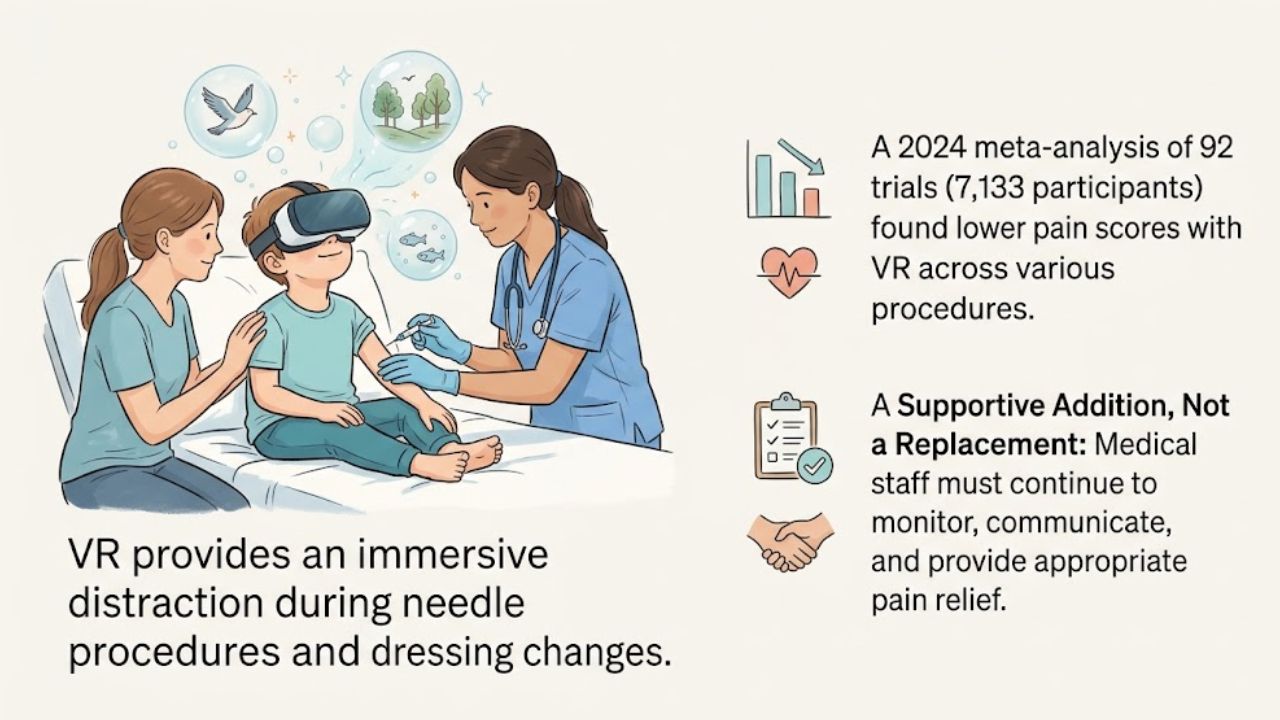
During a needle procedure or burn dressing change, VR can give a patient something engaging to focus on. A headset may show a calm scene or an interactive activity while clinical staff continue the treatment.
A 2024 systematic review and meta-analysis of 92 randomized trials, involving 7,133 participants, found lower pain scores with VR across a range of medical procedures. The researchers also reported substantial variation among the studies. That makes the findings encouraging, but not a promise that VR will work for every patient, age group, or procedure.
In practice, virtual reality in healthcare is better considered a possible addition to pain care than a replacement for it. Staff still need to monitor the patient, provide appropriate pain relief, and make sure the headset does not interfere with communication or treatment.
2. Offering Structured Support for Chronic Pain
Some VR programs are designed to deliver behavioral therapy rather than momentary distraction. They may guide users through breathing, relaxation, or cognitive behavioral therapy skills, with the aim of reducing the impact of pain on daily life.
EaseVRx is a specific example. In 2021, the U.S. Food and Drug Administration granted it a De Novo classification as a prescription-use device for adults with chronic lower back pain. Its intended use is at home, and its program includes cognitive behavioral therapy skills. This authorization applies to that device and indication; it does not mean that general VR headsets or wellness apps are approved treatments for chronic pain.
This is one of the more clearly defined examples of virtual reality in healthcare, but patients should still talk with a qualified clinician before using a program to manage persistent pain—particularly if they are considering changing another treatment.
3. Supporting Exposure Therapy
In exposure therapy, a clinician helps a patient approach a feared situation gradually and safely. VR can recreate settings that might be hard to access in a clinic, such as a plane cabin or a public-speaking environment. A therapist can adjust the scenario and help the patient practise coping strategies.
The headset does not provide therapy on its own. The clinician must decide whether exposure is appropriate, tailor the experience, and respond if it becomes distressing.
Evidence also depends on the condition being treated. A 2025 U.S. Department of Veterans Affairs review found that VR exposure therapy for PTSD may be less effective—or have little to no difference in effect—compared with non-VR exposure therapy. That is a useful caution against treating virtual reality in healthcare as an automatic upgrade to established care.
4. Making Rehabilitation Practice more Engaging
Rehabilitation often asks patients to repeat movements many times. VR can turn some of that practice into interactive tasks: reaching for a virtual object, shifting weight to maintain balance, or moving an arm to complete an activity. A therapist can guide the exercise and adjust its difficulty.
After a stroke, VR may be used alongside conventional rehabilitation to practise upper-limb movement, balance, and other functional tasks. A 2025 Cochrane review found moderate- to low-certainty evidence of small benefits for some outcomes, including upper-limb function, balance, and activity limitation. Adding VR to usual care may improve upper-limb function, partly by increasing therapy time. The review found uncertain evidence for some other outcomes, including gait speed.
That makes virtual reality in healthcare a possible way to add structured practice, not a reason to replace a therapist’s assessment. A high game score does not necessarily mean that everyday movement has improved.
5. Letting Surgical Trainees Practise in Simulation
VR simulators give trainees a repeatable place to practise parts of a procedure. Depending on the system, they may work on instrument control, hand-eye coordination, or the order of steps without operating on a patient.
The practical value is the chance to rehearse and receive feedback. The limit is that a simulation cannot reproduce every part of surgery: unexpected anatomy, team communication, and decisions made under pressure all matter. Completing a virtual procedure is not, by itself, proof of readiness to operate. VR belongs alongside supervised practice and other forms of assessment.
6. Rehearsing Emergencies and Team Decisions
Medical and nursing learners can practise responding to simulated emergencies, such as a patient whose condition is worsening. A scenario can be repeated for different learners, giving instructors a chance to review decisions, roles, and communication.
A review of VR in medical education describes uses ranging from surgical practice to emergency scenarios and clinical decision-making. The benefit depends on the quality of the scenario and the feedback afterward. A realistic-looking simulation can still teach poor priorities if the clinical content is not carefully designed.
7. Exploring Anatomy Before a Procedure
Medical scans usually show anatomy in slices. VR can present some imaging data as a three-dimensional model that clinicians can explore together. This may help a team discuss spatial relationships or rehearse a plan for a complex case.
A systematic review found that visualizing patient-specific anatomy in VR may help surgical teams plan and communicate. However, just 13 studies met the review’s criteria, and the authors rated the evidence as low to moderate in methodological quality. A virtual model also depends on the quality of the source images and how the model was created; it should support, not replace, review of the original scans and clinical judgment.
Here, virtual reality in healthcare should not be confused with augmented reality. VR immerses the user in a digital environment; augmented reality overlays digital information on the physical world. Their clinical uses and risks can differ.
8. Helping Patients Understand Procedures and Care Plans
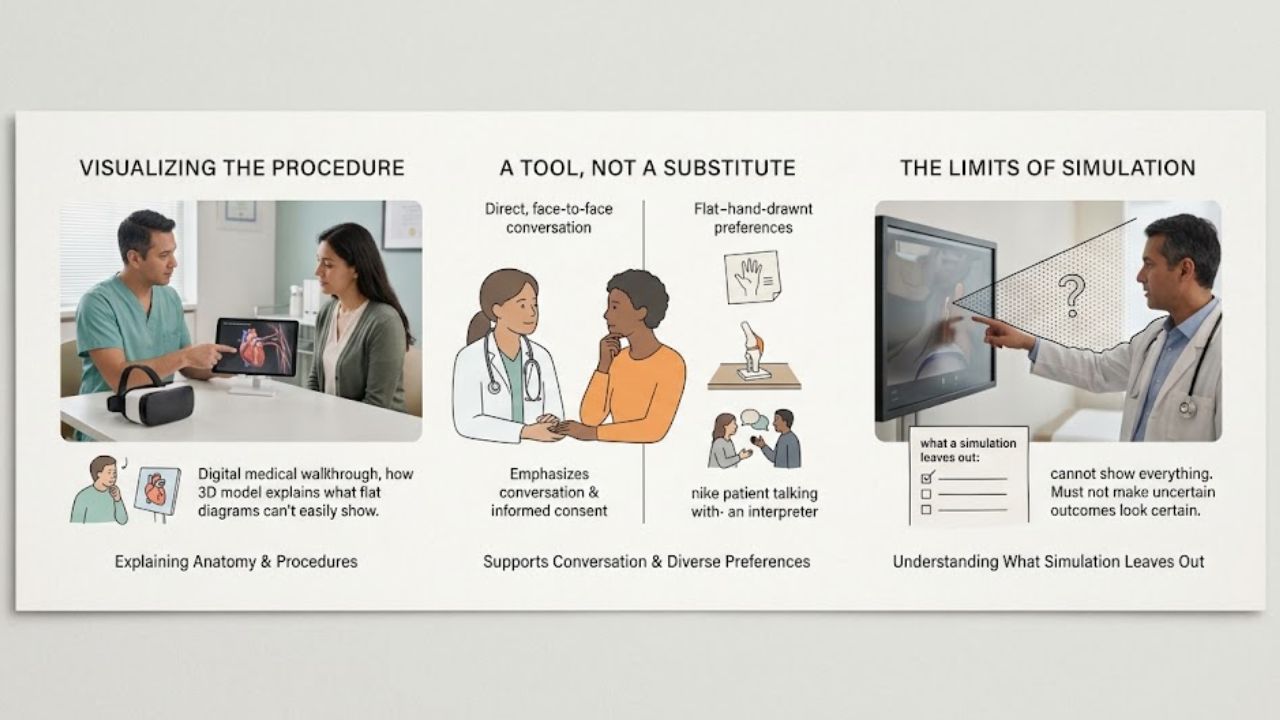
A clinician can use a virtual model or walkthrough to explain anatomy, show how a procedure is expected to unfold, or help a patient picture a treatment plan. A three-dimensional view may be useful when a flat diagram or verbal explanation is difficult to follow.
It should remain one way to explain care, not a substitute for conversation or informed consent. Some patients may prefer a diagram, a physical model, an interpreter, or a plain-language discussion. Providers should also explain what a simulation leaves out: a clear visual can still mislead if it makes an uncertain outcome look certain.
9. Extending Rehabilitation into the Home
Some VR rehabilitation programs can be used between clinic visits or at home. This may help patients who have difficulty travelling, but remote use needs a plan. Does the patient have room to move safely? Can they use the headset comfortably? Who will review progress or respond if an exercise causes discomfort?
Virtual reality in healthcare is not a substitute for in-person assessment when a patient needs hands-on care or close supervision. Before starting a home program, the patient and clinician should agree on its goal, how progress will be checked, and when to pause or seek help.
What Patients and Providers Should Check
The FDA lists uses of augmented and virtual reality medical devices in areas including pain management, mental health, rehabilitation, surgery planning, and virtual care. It also identifies possible risks such as dizziness, fatigue, visual effects, and neck strain from headset weight.
Before using a VR program, check:
- Purpose: Is it designed for entertainment, education, rehabilitation, or a specific medical use?
- Evidence and authorization: Has this particular program been studied or authorized for the intended use in your country?
- Clinical oversight: Who will assess suitability and respond if the patient feels unwell?
- Comfort and access: Can the patient wear the headset, see the content, and use the controls comfortably?
- Safety: Is the surrounding space clear, especially if the activity involves movement?
The FDA’s device list covers products authorized for marketing in the United States; it is not a global approval list. Patients elsewhere should check the relevant national regulator and ask their care team about the program’s intended use.
Final Thoughts
Virtual reality in healthcare can help with a specific task: distracting a patient during a procedure, adding movement practice, supporting therapy, or letting a team rehearse. Its value depends on whether the program suits the patient and has evidence for that use. Before trying or paying for a treatment program, ask what it is meant to improve, who will supervise it, and how progress will be measured. Those answers matter more than how immersive the headset feels.
Frequently Asked Questions (FAQs) About Virtual Reality in Healthcare
Is every VR health app a medical treatment?
No. A wellness or relaxation app may be designed for general use, while a medical device has a specific intended use and may be subject to regulatory requirements. Check the product’s claims and the rules in your country.
Can VR replace physical therapy after a stroke?
VR may add practice to a rehabilitation plan, but it does not replace individualized assessment or a therapist’s guidance. The evidence shows benefits for some outcomes, while others remain uncertain.
What should a patient do if VR causes dizziness?
Stop using the headset and tell the clinician or caregiver. The FDA lists dizziness and fatigue among possible AR/VR risks. A program should make it easy to pause, and patients should not continue through discomfort just to finish a session.