A fingerprint login or face scan may save a few seconds. It can also create a lasting privacy problem if the data is collected without a clear purpose, sent to the wrong place or kept longer than necessary. Biometric privacy laws for app developers shape decisions about consent, storage, security and deletion—and the rules vary by market.
There is no single global biometric privacy law. Some jurisdictions regulate biometric identifiers directly; others cover them through broader data protection, health or artificial intelligence rules. This guide looks at key examples from the European Union, the United States and India, then offers practical steps for product teams. It is general information, not legal advice.
What Counts as Biometric Data?
Biometric data comes from physical, physiological or behavioral traits. Examples include fingerprints, face geometry, iris patterns, voiceprints, gait and typing patterns.
A photograph is not automatically biometric data under every law. Purpose and processing matter. A profile picture differs from a face template created to identify or authenticate someone. Under the GDPR, photographs are not automatically special-category data; biometric data enters that category when processed to uniquely identify a person.
For a developer, the label on a feature is less useful than its data flow. What does the app capture? What does it derive from that input? Can the result identify or verify someone? Does it leave the device? Those answers help determine which rules to review.
Why Biometric Privacy Laws Deserve Early Attention
A person can reset a password after a breach. They cannot readily replace a fingerprint or face. That makes access controls, retention limits and incident planning central to any biometric feature.
The applicable rules may depend on the user’s location, the business’s operations and the feature’s purpose. A face scan in an employee attendance tool raises different questions from a phone’s built-in unlock function or a health app that analyzes voice. A global product may need different notices or data flows in different markets.
Biometric Privacy Laws for App Developers: Major Frameworks
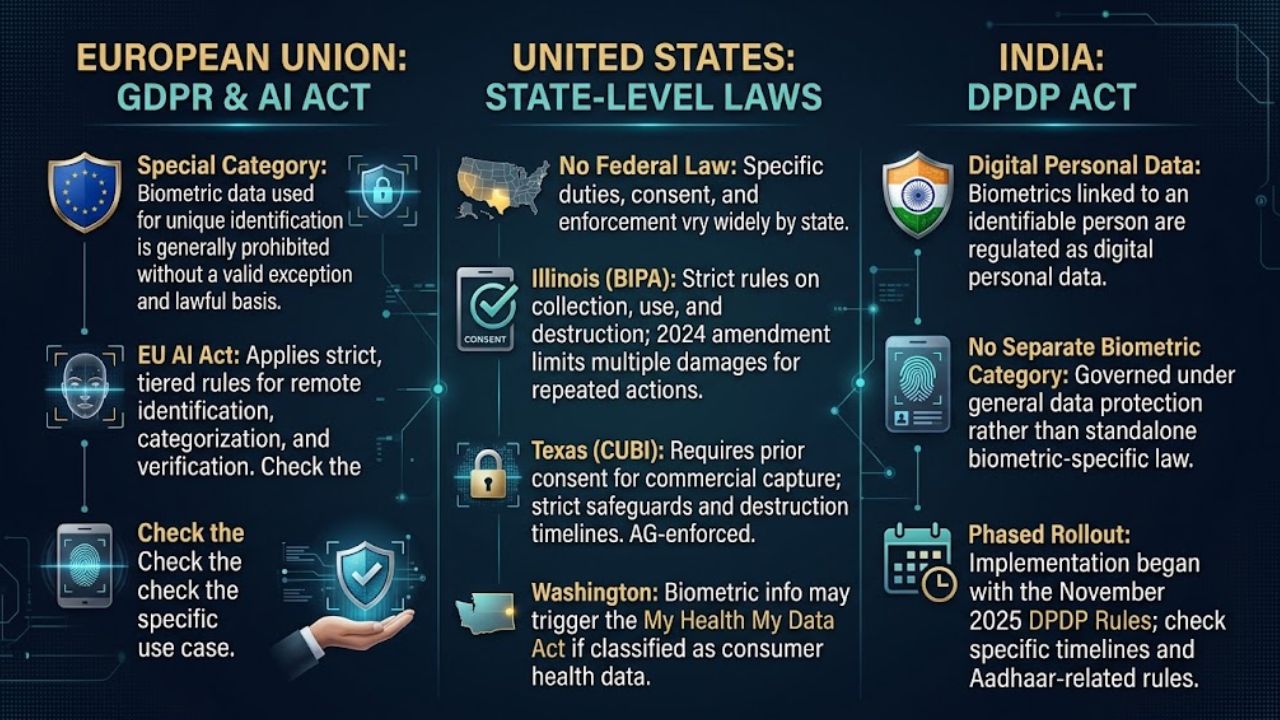
These examples show how approaches differ. They are not a complete survey of every country, state or sector-specific rule.
European Union: GDPR and the AI Act
The GDPR treats biometric data processed to uniquely identify a person as a special category of personal data. Processing is generally prohibited unless an exception applies, and the organization must also meet the GDPR’s other requirements, including having an applicable lawful basis. Consent may be relevant, but it is not a universal workaround.
The EU AI Act adds rules for certain AI uses involving biometrics. Its treatment depends on what the system does and where it is used. Remote biometric identification, biometric categorization and biometric verification are distinct categories. The European Commission’s guidance, for example, distinguishes some verification and device-unlocking uses from remote identification. Businesses should assess the actual use case rather than assume every face or voice feature is treated alike.
United States: State Laws and Different Enforcement Models
The United States has no single general federal law covering every private-sector use of biometric data. State laws can impose specific duties, and their definitions, consent rules, exceptions, and enforcement mechanisms differ.
Illinois’ Biometric Information Privacy Act (BIPA) regulates the collection, use, disclosure and destruction of specified biometric identifiers and information. An amendment effective August 2, 2024, clarified that repeated collection or disclosure involving the same person and the same method can count as a single violation for damages purposes. That change does not remove the need to follow the statute’s requirements.
Texas’ Capture or Use of Biometric Identifier Act (CUBI) covers identifiers such as fingerprints, voiceprints, iris scans and records of hand or face geometry. For commercial capture, the Texas Attorney General says a business must inform the person and obtain consent beforehand. The law also restricts disclosure, requires reasonable care to protect identifiers and sets a destruction deadline tied to the end of the collection purpose. The Attorney General has enforcement authority.
Washington’s My Health My Data Act is a consumer health data law, not a general biometric privacy statute. It may apply when biometric information qualifies as consumer health data within the Act’s scope. A fitness or wellness app should assess that question alongside other applicable privacy laws rather than treating the Act as a catch-all for biometrics.
India: DPDP Act and Related Requirements
India’s Digital Personal Data Protection (DPDP) Act applies to digital personal data within its scope. It does not create a separate “biometric data” category in the same way as some biometric-specific laws. Biometric information linked to an identifiable person may still be personal data, bringing the Act’s duties into consideration.
India notified the DPDP Rules in November 2025 and set out phased implementation. The start date can depend on the provision, so businesses should check the official Rules and commencement notifications rather than assume every duty began at once. Separate requirements may also apply to Aadhaar-related biometrics or other regulated activities.
What Most Compliance Summaries Miss
A feature’s label does not tell the whole story. An app that requests a selfie, creates a face template, and compares it with an identity document may raise different questions from a phone’s built-in biometric unlock, where the app may receive only a success-or-failure response from the operating system.
Confirm what the app, its vendors, and its servers actually receive. Do not assume the phone handles everything simply because the feature uses the device’s fingerprint or face sensor. A privacy policy cannot fix a mismatch between the described feature and the real data flow.
A Practical Compliance Checklist for Developers and Businesses
For biometric privacy laws for app developers, compliance starts with product decisions: what to collect, where to process it, and when to delete it.
1. Map the Data Flow
Record where biometric data is captured, converted into a template, transmitted, compared, stored, backed up, and deleted. Include analytics tools, software development kits, cloud providers, and fraud vendors. If a vendor receives raw images or templates, include it in the map.
2. Define the Purpose and Necessity
Describe the purpose precisely, such as verifying account access or protecting a restricted facility. Then ask whether a less intrusive option—a passkey, one-time code or device-held biometric check—could meet the same need. Collecting a central biometric template should not be the default simply because it is technically convenient.
3. Review Each Market and Use Case
List where users are located and where the business operates. Flag features involving employment, health, children, financial services, identity verification or AI matching. These contexts can change which laws apply.
4. Make Notices Specific
Explain what biometric data is collected, why it is needed, how it will be used, who receives it and when it will be deleted. Tell users whether the data stays on the device or reaches company servers. Keep the notice close to the feature and consistent with the actual data flow.
5. Treat Consent as a Product Control
Where consent is required, obtain it before collection and record what the user agreed to and which notice they saw. Avoid bundling biometric processing with unrelated permissions. Plan how users can withdraw consent or request deletion where applicable.
6. Minimize and Secure the Data
Do not send raw images to a server if the feature does not need them there. Restrict access to templates, encrypt data in transit and at rest, and review vendor access. Check logs and diagnostic tools too: they can capture information the core application was never designed to retain.
7. Set Workable Deletion Rules
Define when the data is no longer needed and how deletion will reach production systems, vendors and backups. A retention rule should reflect the purpose and applicable law. “Until the account closes” may be too long if the biometric purpose ends earlier.
8. Check Vendors and Contracts
Ask vendors whether they receive raw inputs, create templates, reuse data for model training, share it with subprocessors or retain copies after the service ends. Contracts should address permitted use, security, breach support, and deletion.
9. Prepare for Incidents and User Requests
Decide who assesses a breach, who determines notification obligations, and how affected individuals will receive help. Test access and deletion processes before launch. A team should be able to locate a person’s template without improvising during a complaint.
10. Reassess When the Feature Changes
Review the privacy assessment if the company adds identity matching, workplace monitoring, health insights, emotion analysis or a new vendor. Keep a record of what changed and why the previous assessment still applies—or no longer does.
Final Thoughts
The practical test for biometric privacy laws for app developers is whether a team can explain, in plain language, what the feature collects and why. Start with a data-flow map, check the laws in each launch market, and challenge any collection that the product does not truly need. Those steps give legal teams a clearer system to review and users a better basis for trust.
Frequently Asked Questions (FAQs) About Biometric Privacy Laws for App Developers
Is a face photo always biometric data?
No. Under the GDPR, a photograph is not automatically special-category biometric data. Technical processing and the purpose of identifying a person matter, while other laws may define covered information differently.
Does every biometric feature require consent?
Not necessarily. Some laws require notice and consent for specific collection or uses; others provide different legal grounds or exceptions. The answer depends on the jurisdiction and the feature.
Is the EU AI Act the same as the GDPR?
No. The GDPR governs personal data processing, including certain biometric data. The AI Act regulates specified AI systems and uses. A product may need to comply with both.