Readers following crypto and blockchain trends in 2026 face a familiar problem: announcements often sound like proof of adoption. A pilot, a tokenized asset, or a new payment protocol can be significant without being ready for ordinary users.
The developments below range from live investment products to early research. These crypto and blockchain trends in 2026 are worth watching for what they let people do—and for the legal, technical, and security questions they leave open.
1. Stablecoins are being Tested for Payments
Stablecoins are designed to track the value of an asset, often the U.S. dollar. They are widely used within crypto markets, while payment firms and businesses are exploring other uses, including cross-border transfers and settlement outside banking hours.
The headline volume needs context. The Bank for International Settlements estimated stablecoin transactions at $28 trillion in 2025, but said the total is far lower when transfers between wallets owned by the same party are excluded. So this number does not establish that consumers are routinely using stablecoins to pay for everyday purchases.
A stablecoin also is not automatically equivalent to a bank deposit. Before relying on one, users should check its issuer, reserve arrangements, redemption terms, and local rules. The Financial Stability Board has flagged cross-border oversight and financial-stability concerns when arrangements operate across multiple jurisdictions.
2. Tokenized Assets are Attracting Financial Firms
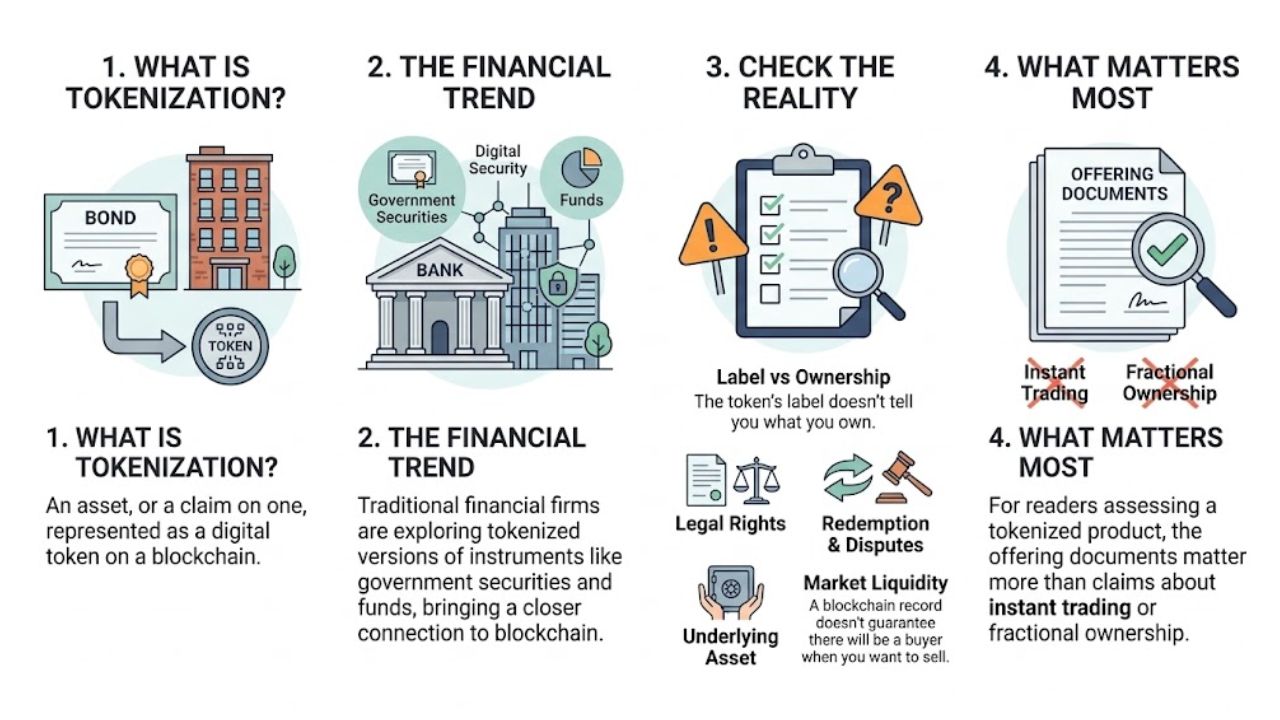
Tokenization represents an asset, or a claim on one, as a digital token on a blockchain. Financial firms are exploring tokenized versions of instruments such as government securities and funds. One of the crypto and blockchain trends in 2026 is this closer connection between blockchain systems and traditional finance.
The token’s label does not tell you what you own. Buyers need to check the legal rights attached to it, who holds the underlying asset, how redemption works, and where disputes would be handled. A blockchain record also does not guarantee that there will be a buyer when the holder wants to sell.
For readers assessing a tokenized product, the offering documents matter more than claims about instant trading or fractional ownership.
3. Banks are Testing Tokenized Deposits
Tokenized bank deposits are digital representations of money held as commercial-bank deposits. They are different from stablecoins, which can have different issuers, legal status, and redemption arrangements.
The BIS’s Project Agorá tested a shared platform combining tokenized commercial-bank deposits with tokenized central-bank reserves. Its prototype involved seven central banks and more than 40 regulated financial institutions. It demonstrated a model for wholesale, multi-currency settlement, but it is not a live global payments network.
This work is about how banks settle with one another, not simply how a consumer holds digital money. Whether it becomes useful at scale depends on shared standards, legal agreements, and broad participation.
4. Crypto ETPs are Easier to Bring to Market
Exchange-traded products (ETPs) allow investors to gain exposure to crypto through brokerage accounts. In 2025, the U.S. Securities and Exchange Commission approved generic listing standards for certain products holding spot commodities, including digital assets. Eligible products can be listed without a separate SEC rule filing for each one.
This may suit investors who do not want to manage private keys or set up a wallet. But an ETP is not the same as owning or using the cryptocurrency directly. It has its own structure and costs, while the underlying asset can remain volatile.
Among the crypto and blockchain trends in 2026, easier access through regulated investment channels is significant—but it should not be mistaken for a safety guarantee or an endorsement of every token.
5. Regulation is Getting More Specific, Not Uniform
The SEC proposed “Regulation Crypto Assets” in August 2026. The proposal concerns certain investment contracts involving crypto assets; it is not final law. In the European Union, the European Commission’s 2026 consultation on the Markets in Crypto-Assets Regulation (MiCA) has closed. The review is part of an assessment of whether the framework remains fit for purpose.
Rules still differ by jurisdiction and by the kind of product or service. A company serving customers in several countries may face different licensing, disclosure, and consumer-protection requirements in each.
“Regulatory clarity” is not a single global development. Businesses and users still need to check the rules that apply where they operate.
6. Layer 2 Networks are Working on Interoperability
Layer 2 networks process transactions alongside a base blockchain, then rely on the main network for some settlement or security functions. They can help with capacity and cost, but users may have to navigate different networks, bridges, and wallets.
Ethereum’s 2026 direction includes a strong base layer and a set of independent Layer 2 networks that can interoperate. The Ethereum Foundation also emphasizes that users should be able to assess each network’s security properties. The label “Layer 2” alone does not tell readers how those guarantees work.
Before moving funds, check the destination network, bridge, and withdrawal process. Better interoperability may make crypto easier to use, but it does not remove the risks of transferring assets between systems.
7. DeFi is Making Restricted Links to Traditional Assets
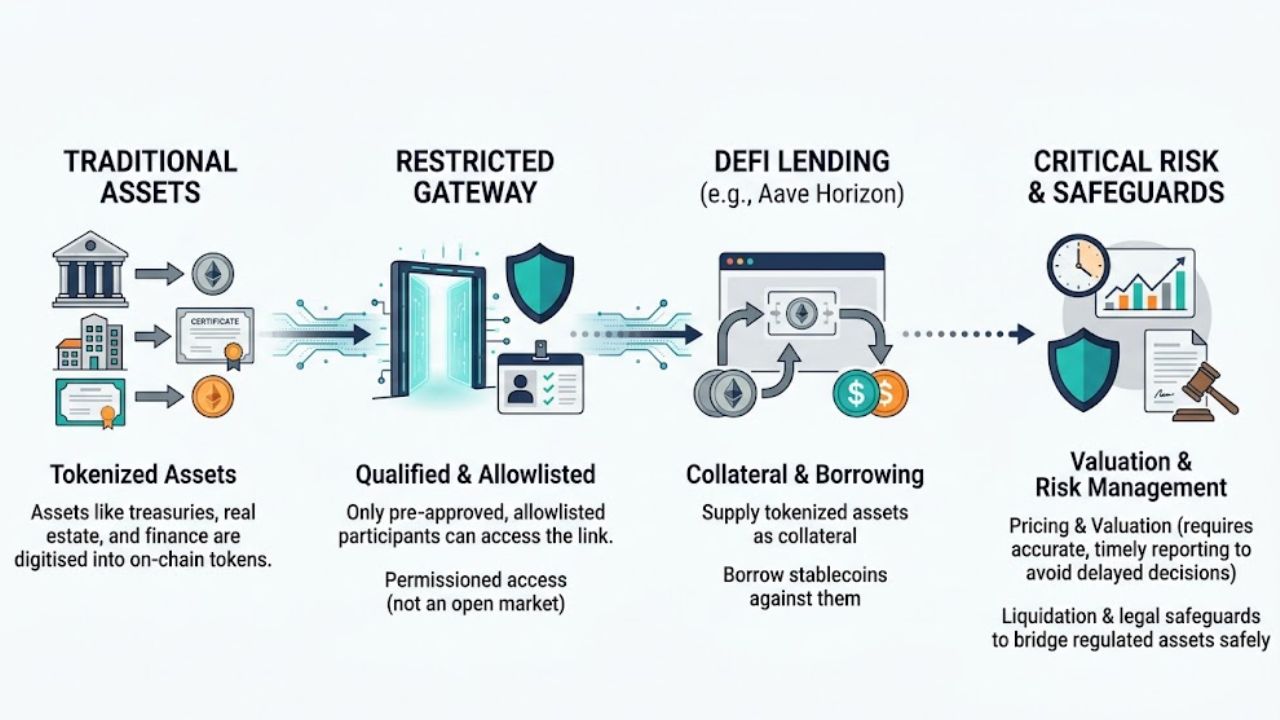
Decentralized finance, or DeFi, is beginning to connect tokenized traditional assets with lending protocols through permissioned arrangements. Aave Horizon is one example: qualified, allowlisted users can supply certain tokenized assets as collateral to borrow stablecoins.
That is a narrower use case than an open market anyone can join. Participants on the collateral side need approval, and the assets rely on reported valuations. A delayed or inaccurate valuation can affect collateral decisions, so pricing and liquidation safeguards matter.
This is one of the more consequential crypto and blockchain trends in 2026 because it tests whether regulated assets can work with DeFi lending without hiding the legal and operational risks.
8. AI Agents are Being Equipped to pay for Online Services
Some developers are testing ways for AI agents to pay for online services automatically. Coinbase’s x402 protocol uses a web payment request flow to enable stablecoin payments for APIs, apps, and AI agents.
A service could request payment before providing a data query. An application could then pay and retry the request. That may suit small automated transactions, but the existence of a protocol does not mean agent-led commerce is widespread.
The practical concern is wallet access. A business testing this approach should set narrow permissions and spending limits so an agent cannot turn a mistaken request into a costly transaction.
9. Privacy Tools are Developing Alongside Compliance Features
Public blockchains can make transactions visible, which helps verification but may expose personal or business activity. Zero-knowledge proofs offer one way to prove a statement without revealing all the information behind it.
Ethereum’s privacy roadmap covers work on privacy tools, identity infrastructure, and compliance-aware systems. These projects remain in development, and their timelines are targets rather than guarantees.
Privacy features do not automatically make a system anonymous or compliant with data-protection rules. Users and businesses need to understand what is hidden, what remains visible, and who can access the information.
10. Security Planning is Becoming Part of Development
A user can lose crypto by exposing a wallet key or approving a transaction without understanding it. Developers also need to plan for longer-term changes in cryptography.
Ethereum’s post-quantum research is one example. Its published guidance says quantum computers do not pose an immediate threat to Ethereum, but cryptographic transitions take years. The project has a multi-year roadmap; its milestones are plans, not guarantees.
There are more immediate efforts as well. In May 2026, an Ethereum working group announced an open standard intended to make transaction approvals clearer and reduce blind signing. That addresses a basic user problem: approving a transaction without being able to tell what it will do.
What Headline Numbers Can Miss
Transaction volume does not prove that people are using a network for everyday payments. A token’s value does not show how easily it can be sold, what legal claim it represents, or how it might behave during market stress.
When evaluating crypto and blockchain trends in 2026, readers should look past a single market-size estimate. Ask what is actually in use, who can access it, and what happens if the service or issuer fails.
Final Thoughts
The most credible developments connect blockchain to a defined task: settling payments, recording asset claims, supporting lending, or paying for digital services. Some are already available in limited forms; others remain prototypes or research.
To assess crypto and blockchain trends in 2026, start with the practical questions: who controls the asset, how can it be redeemed or sold, which rules apply, and what happens if something goes wrong? That is a better guide than a promise that blockchain will make a product faster or safer.
Frequently Asked Questions (FAQs) About Crypto and Blockchain Trends
Are stablecoins the same as bank deposits?
No. Their issuers, legal status, protections, and redemption arrangements may differ. Check the terms and rules in your jurisdiction before using one.
Does tokenization guarantee that an asset can be sold quickly?
No. A token can represent an asset without creating an active market or guaranteed liquidity. Check redemption terms and trading access before buying.
Do crypto users need to move their funds because of quantum computing?
Ethereum’s current guidance says quantum computers do not threaten its cryptography today. Its post-quantum work is long-term planning; it does not call for an immediate user migration.