
Habits reduce stress when they give your mind and body a better way to handle pressure. Stress will not disappear from work, family, money, health, deadlines, relationships, or daily life. But your response can become steadier.
I used to treat stress like something to survive until the weekend. That worked for a while, then it did not. The tension carried into sleep, food choices, focus, mood, and even simple conversations.
The better approach is daily stress maintenance.
Stress reduction habits do not need to be dramatic. A two-minute breathing reset, a walk after work, a clear boundary, a brain dump, or one honest conversation can lower the pressure before it becomes too loud. For the corporate athlete, stress management is performance care. Your focus, patience, creativity, leadership, recovery, and decision-making all depend on how well your nervous system resets.
These lower-stress practices also support the best healthy habits because stress affects sleep, movement, hydration, nutrition, relationships, focus, and mental wellness.
The goal is simple: Stop letting stress run the whole day.
Why Long-Term Stress Reduction Matters?
Long-term stress reduction matters because stress does not stay in one place. It affects how you sleep, think, eat, move, talk, work, and recover. A stressful day can become a stressful week when there is no reset system. Many people think stress management means calming down after everything has already gone wrong. That is only one part of it. The better approach is prevention. You build habits that lower the daily stress load before it becomes overwhelming.
Stress also hides behind productivity. You may still finish tasks, answer emails, attend meetings, care for family, and meet deadlines while your body is quietly carrying tension. The signs may show up as headaches, tight shoulders, poor sleep, impatience, brain fog, cravings, low motivation, or emotional numbness. For desk workers, stress can become physical. Long sitting, shallow breathing, clenched jaw, screen fatigue, and poor posture all add to the load. This is why daily stress relief should include the body, not only the mind.
Long-term stress reduction also helps relationships. When stress stays unmanaged, small problems feel bigger. Messages feel sharper. Conversations become harder. Boundaries get weaker. Patience drops. The point is not to avoid all pressure. Some pressure is normal. The point is to recover often enough that stress does not become your default state.
| Stress Signal | What It May Look Like | Helpful Habit |
| Mental overload | Racing thoughts and poor focus | Brain dump and one priority |
| Physical tension | Tight neck, shoulders, jaw, or back | Movement and stretching |
| Emotional reactivity | Snapping, irritation, impatience | Name stress before reacting |
| Poor sleep | Wired at night, tired in the morning | Evening shutdown ritual |
| Social withdrawal | Avoiding people while feeling alone | Honest check-in |
| Decision fatigue | Small choices feel heavy | Simplify routines |
| Work spillover | Thinking about work all evening | Boundary and closure habit |
Stress becomes easier to manage when you stop waiting for a breaking point.
What Makes a Stress Reduction Habit Actually Work?
A stress reduction habit works when it is small enough to repeat during real life. If the habit only works on a quiet vacation day, it will not help much during a packed workweek. The best stress reduction habits are specific. “Relax more” is too vague. “Take five slow breaths before replying to a tense message” is useful. “Stop being stressed” is not realistic. “Walk for 10 minutes after work” is practical.
A useful habit should also have a cue. Stress habits fail when they depend only on memory. Attach the habit to something you already do: after coffee, after meetings, before lunch, after closing the laptop, before bed, or when you feel your shoulders rise. The habit should work with the body. Stress is not only a thought problem. It is also breathing, muscle tension, heart rate, sleep, hunger, hydration, movement, and sensory overload. That is why walking, stretching, water, sleep, and breathing matter.
A good habit should also respect the real source of stress. Breathing helps you calm down, but it may not solve a workload problem. Journaling helps you see patterns, but it may not fix a boundary issue. Sometimes the habit helps you notice what must change. The strongest lower-stress practices are kind, repeatable, and honest. They do not pretend life is easy. They give you a way to return.
| Stress Habit Rule | What It Means | Practical Example |
| Keep it small | Make it easy to repeat | 2-minute breathing reset |
| Use a cue | Attach it to routine | After each meeting |
| Include the body | Stress lives physically too | Walk, stretch, unclench jaw |
| Be honest | Name the real stressor | “I am overloaded,” not “I am lazy” |
| Reduce friction | Make the habit visible | Breathing card on desk |
| Protect recovery | Stress needs release time | Evening shutdown |
| Adjust the source | Do not only cope | Set boundaries when needed |
A habit works when it lowers pressure without adding more pressure.
7 Habits That Reduce Stress Long Term
These 7 habits reduce stress by targeting the places stress usually builds: thoughts, body tension, time pressure, poor recovery, weak boundaries, isolation, and repeated patterns. You do not need to start all seven at once. Choose the one that matches your biggest stress leak right now. If your mind feels crowded, start with naming stress or a brain dump. If your body feels tense, start with movement. If evenings feel heavy, start with a shutdown ritual. If resentment is building, start with boundaries. If you feel alone, start with connection.
Stress reduction habits work best when they become part of your daily rhythm. They are not emergency tricks only. They are maintenance tools. The goal is not to become calm every minute. That is not real life. The goal is to recover faster, react less harshly, sleep better, think more clearly, and stop carrying every pressure alone.
| Habit | Main Benefit | Best For |
| 1. Name the stress before solving it | Builds clarity | Overthinking and emotional overload |
| 2. Use a daily nervous system reset | Calms the body | Tension and fast reactions |
| 3. Move before stress sits too long | Releases pressure | Desk workers and anxious energy |
| 4. Protect sleep with a shutdown ritual | Improves recovery | Work spillover and bedtime worry |
| 5. Set boundaries before resentment builds | Lowers overload | People-pleasers and busy professionals |
| 6. Keep connection in the stress plan | Adds support | Isolation and silent pressure |
| 7. Review stress patterns weekly | Prevents repeat cycles | Chronic stress and workload issues |
1. Name the Stress Before Solving It
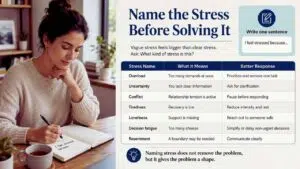
Naming stress is one of the most useful stress reduction habits because vague stress feels bigger than clear stress. When everything feels like “too much,” the brain has no clean next step. Start by asking, “What kind of stress is this?” It may be overload, uncertainty, conflict, tiredness, financial pressure, family pressure, loneliness, decision fatigue, lack of control, or fear of failure. Each one needs a different response.
This habit helps because many people jump straight into fixing before understanding. They open more tabs, send rushed replies, drink more caffeine, or push through. But if the real issue is exhaustion, another task will not fix it. If the real issue is unclear expectations, more effort may not solve it. Naming stress also reduces self-blame. Instead of saying, “I am failing,” you might realize, “I am overloaded because I have three deadlines and no recovery window.” That is a very different story.
Use simple language. You do not need a perfect emotional label. Write one sentence: “I feel stressed because…” Then complete it honestly. This lower-stress practice is especially useful before difficult messages, meetings, decisions, or family conversations.
| Stress Name | What It Means | Better Response |
| Overload | Too many demands at once | Prioritize and remove one task |
| Uncertainty | You lack clear information | Ask for clarification |
| Conflict | Relationship tension is active | Pause before responding |
| Tiredness | Recovery is low | Reduce intensity and rest |
| Loneliness | Support is missing | Reach out to someone safe |
| Decision fatigue | Too many choices | Simplify or delay non-urgent decisions |
| Resentment | A boundary may be needed | Communicate clearly |
Naming stress does not remove the problem, but it gives the problem a shape.
2. Use a Daily Nervous System Reset
A daily nervous system reset is a short practice that tells the body it can come down from high alert. This can be breathing, grounding, stretching, quiet sitting, prayer, meditation, or a slow walk. Stress often keeps the body braced. Shoulders rise. Breathing gets shallow. The jaw tightens. The stomach feels tense. The mind jumps ahead. A reset gives the body a different signal.
One simple reset is longer-exhale breathing. Inhale gently for four seconds. Exhale for six seconds. Repeat for two to five minutes. The long exhale helps many people slow down without needing a complicated technique. Another option is grounding. Notice five things you see, four things you feel, three things you hear, two things you smell, and one thing you taste. This is useful when thoughts feel too loud.
The reset should not become another performance task. You do not need to feel perfectly calm after one round. The wind is practicing the return. Use this habit after meetings, before lunch, after work, before bed, or anytime you notice tension rising.
| Reset Tool | Time Needed | Best Moment |
| Long-exhale breathing | 2-5 minutes | Before replying under stress |
| Grounding exercise | 2 minutes | Anxiety or mental overload |
| Gentle stretching | 5 minutes | Desk tension |
| Quiet sitting | 3-10 minutes | Midday pause |
| Prayer or reflection | Flexible | Emotional steadiness |
| Body scan | 5-10 minutes | Before sleep |
| Slow walk | 5-15 minutes | After work or conflict |
A daily reset teaches the body that stress is not the only available state.
3. Move Before Stress Sits Too Long
Movement is one of the most reliable daily stress relief habits because stress often needs a physical exit. Sitting still with stress for hours can make it feel heavier. This does not mean every stressful day needs a hard workout. In fact, when stress is high and sleep is poor, a brutal workout may add more strain. The better choice may be a walk, light mobility, stretching, cycling, easy strength training, or a short full-body routine.
For desk workers, movement matters even more. Long sitting keeps the body in one shape, and stress can settle into the neck, hips, back, and jaw. A 10-minute walk or 5-minute mobility reset can change the whole tone of the afternoon. Movement also creates a break between stress and reaction. If a message upsets you, stand up before replying. If a task feels overwhelming, walk for two minutes and return. If the workday feels heavy, walk after closing the laptop.
The goal is not to use exercise as punishment. The goal is to release pressure and restore control. This habit connects naturally with movement habits for sedentary lifestyles and full-body workouts busy people can follow.
| Stress Situation | Movement Habit | Why It Helps |
| Afternoon tension | 10-minute walk | Clears mental fog |
| Angry after a message | Stand and breathe | Prevents reactive reply |
| Tight from sitting | Hip and chest stretch | Reduces body tension |
| Restless energy | Light bodyweight circuit | Gives stress an outlet |
| Workday ending | Walk after shutdown | Creates transition |
| Low mood | Outdoor movement | Adds light and activity |
| Recovery day | Easy mobility | Supports calm without overload |
Move before stress becomes stuck in the body.
4. Protect Sleep With a Shutdown Ritual
Sleep is one of the strongest long-term stress buffers, but stress often attacks sleep first. The mind keeps working after the body gets into bed. A shutdown ritual helps close the day before bedtime. It tells your brain what is finished, what can wait, and what comes next tomorrow.
The ritual can be simple. Write tomorrow’s top three tasks. Capture unfinished thoughts. Close work tabs. Put the phone away. Prepare one thing for the morning. Dim the lights. Stretch gently. Breathe for two minutes. This habit works because stress loves open loops. Unfinished tasks, unresolved messages, and vague worries keep returning at night. A shutdown ritual gives them a place to land.
For remote workers, this is especially important. When the home is also the office, work can leak into every room. A shutdown ritual creates a boundary even when the location does not change. This habit also supports evening habits that improve sleep and habits for better focus because tomorrow starts cleaner when tonight ends with structure.
| Shutdown Step | Time Needed | Stress Benefit |
| Write tomorrow’s top 3 | 2 minutes | Reduces morning pressure |
| Brain dump open loops | 3 minutes | Clears mental clutter |
| Close tabs and apps | 1 minute | Ends work visually |
| Set phone boundary | 1 minute | Reduces scrolling |
| Prepare morning item | 2 minutes | Lowers next-day friction |
| Stretch gently | 3-5 minutes | Releases body tension |
| Slow breathing | 2 minutes | Signals calm |
A good shutdown ritual does not solve every problem. It stops every problem from following you into bed.
5. Set Boundaries Before Resentment Builds
Boundaries reduce stress because they prevent silent overload. Many people do not burn out only from hard work. They burn out from unclear limits. A boundary is not rude. It is a clear line that protects time, energy, attention, recovery, and emotional health. Without boundaries, every request feels urgent, every message feels personal, and every “yes” becomes another hidden cost.
Start with the area where resentment is growing. Late-night work messages. Constant favors. Unplanned meetings. Social pressure. Family expectations. Too many commitments. No quiet time. These are signals that a boundary may be needed. A good boundary is clear and respectful. “I cannot take this on this week.” “I reply to non-urgent messages tomorrow.” “I need 30 minutes before discussing this.” “I am offline after dinner.” “I can help for one hour, not the whole day.”
The mistake is waiting until anger explodes. Boundaries work better when communicated early and calmly. This habit is one of the most important lower-stress practices for people-pleasers, managers, caregivers, freelancers, and anyone whose time gets consumed by other people’s urgency.
| Stressful Pattern | Boundary Example |
| Late-night work messages | “I’ll respond during work hours.” |
| Too many favors | “I can’t take this on right now.” |
| Meeting overload | “Can we handle this by message?” |
| Emotional dumping | “I want to support you, but I need a pause.” |
| Family pressure | “I need advance notice for plans.” |
| Social overload | “I can’t join this time, but thank you.” |
| No recovery time | “I’m blocking this evening for rest.” |
Boundaries are stress prevention, not selfishness.
6. Keep Connection in the Stress Plan
Connection is one of the most overlooked stress reduction habits. Stress feels heavier when carried alone. This does not mean talking to everyone about everything. It means having safe people and simple connection habits that keep you from disappearing into pressure.
A connection habit can be small. Send one honest check-in. Call someone during a walk. Tell a trusted friend, “This week has been heavy.” Ask for help before you reach the breaking point. Sit with family without screens. Join a recurring community space. Stress can make people withdraw. Sometimes quiet helps. But isolation for too long can make stress feel bigger. A good support system gives perspective, care, practical help, and emotional relief.
For busy professionals, social wellness often gets pushed aside because work feels more urgent. But connection is not a luxury. It is part of recovery. The key is to choose the right person. Share with someone who can listen safely, not someone who increases the stress. This habit connects naturally with social wellness habits and mental health habits.
| Connection Habit | Time Needed | Why It Helps |
| Honest text | 1 minute | Breaks silence |
| Voice note | 2-5 minutes | Feels more human |
| Walk with someone | 15-30 minutes | Combines movement and support |
| Ask for help | As needed | Reduces overload |
| Weekly call | 10-30 minutes | Maintains support |
| Shared meal | Flexible | Builds belonging |
| Community group | Weekly or monthly | Adds repeated connection |
Stress becomes easier to carry when support is not an afterthought.
7. Review Stress Patterns Weekly

A weekly stress review helps you stop repeating the same stress cycle without noticing it. This habit turns stress into information. Once a week, ask simple questions. What stressed me most? What helped? What made it worse? What did I avoid? Where did I need a boundary? What gave me energy? What drained me? What should I change next week?
This review should not feel like self-criticism. It is not a trial. It is a check-in. The goal is to learn from the week before the same pressure repeats. Many people treat each stressful day as random. But patterns often show up. Maybe Monday mornings are chaotic because planning happens too late. Maybe late caffeine affects sleep. Maybe one recurring meeting drains energy. Maybe skipped lunch makes afternoon stress worse. Maybe social media before bed makes the mind restless.
Once you see the pattern, you can adjust the system. Move a task. Set a boundary. Prepare meals. Add a walking break. Sleep earlier. Ask for help. Reduce unnecessary input. This habit is especially useful for chronic stress because it separates real problems from vague overwhelm.
| Weekly Review Question | What It Reveals |
| What caused the most stress? | Main pressure point |
| What helped me recover? | Useful habit to repeat |
| What made stress worse? | Habit or environment problem |
| Where did I need a boundary? | Overload source |
| What did I avoid? | Hidden stressor |
| What drained my energy? | Schedule or relationship issue |
| What should I simplify next week? | Practical next step |
A weekly review helps stress management become a system, not a guess.
A Simple Daily Stress Relief Routine
A daily stress relief routine should be simple enough to use on normal workdays. It should not depend on perfect silence, extra money, or a wide-open schedule. Start the day with one grounding cue. This could be water before coffee, a short walk, light stretching, or writing one priority. A calmer morning reduces the chance that stress controls the first hour.
During the workday, use small resets. Breathe after meetings. Stand and move every hour. Drink water. Eat a real meal. Close extra tabs. Write down open loops instead of holding them in your head. At the end of work, use a shutdown ritual. Capture unfinished tasks, choose tomorrow’s top priorities, and physically close the workspace if possible.
In the evening, choose recovery over more stimulation. Dim lights, reduce scrolling, stretch, read, journal, talk to someone safe, or practice a short body scan. The goal is not a perfect calm day. The goal is regular pressure release.
| Time of Day | Stress Relief Habit | Time Needed |
| Morning | Water, light, and one priority | 5 minutes |
| Mid-morning | Breathing reset | 2 minutes |
| Lunch | Eat away from screen if possible | 10-20 minutes |
| Afternoon | Walk or stretch | 5-10 minutes |
| After work | Shutdown ritual | 5-10 minutes |
| Evening | Low-stimulation recovery | 15 minutes |
| Before bed | Brain dump or breathing | 5 minutes |
Minimum version:
| Minimum Stress Routine | Action |
| Morning | Name one priority |
| Workday | Take three slow breaths after one meeting |
| Afternoon | Walk for 5 minutes |
| Evening | Write tomorrow’s top 3 |
| Night | Put phone away 15 minutes before sleep |
Small daily stress relief habits work because they are easy to return to.
Beginner Mistakes That Keep Stress High
The first mistake is waiting for stress to become unbearable before doing anything. Stress reduction works better when it is preventive.
The second mistake is relying on one tool for every problem. Breathing helps, but it will not fix an impossible workload. A walk helps, but it may not solve a boundary issue. Journaling helps, but it may not replace a difficult conversation.
Another mistake is confusing distraction with recovery. Scrolling, binge-watching, snacking, shopping, or staying busy may numb stress for a while, but they do not always restore the body and mind.
Many people also ignore the body. Stress is not only in thoughts. It is in sleep, breath, posture, movement, hunger, caffeine, hydration, and muscle tension. If the body is neglected, stress management stays incomplete.
A common mistake is saying yes too quickly. Every yes uses time and energy. If you say yes out of guilt, stress often returns later as resentment.
Another mistake is trying to do every stress habit perfectly. That creates more stress. Choose one habit, repeat it, and let it become normal.
| Mistake | Why It Keeps Stress High | Better Habit |
| Waiting too long | Stress builds silently | Use daily check-ins |
| Using one tool only | Misses the real issue | Match habit to stressor |
| Scrolling as recovery | May add stimulation | Use real breaks |
| Ignoring sleep | Low recovery worsens stress | Protect evening routine |
| Ignoring movement | Stress stays in the body | Walk or stretch |
| Saying yes too fast | Creates overload | Pause before agreeing |
| No weekly review | Patterns repeat | Review stress triggers |
| Avoiding support | Stress feels heavier | Reach out earlier |
Lower stress practices should make life more manageable, not more demanding.
Stress Reduction Habits by Lifestyle Type
Different people need different stress reduction habits. A remote worker may need stronger shutdown rituals. A student may need phone boundaries and study breaks. A founder may need decision limits. A parent may need support and smaller recovery windows. A desk worker may need movement and posture resets. This is why generic stress advice often feels weak. “Relax more” does not help when the real issue is back-to-back meetings, no childcare support, late-night work, skipped meals, chronic pain, or financial pressure.
The best habit should match the stress pattern. If your stress is mental clutter, use a brain dump. If your stress is physical tension, move. If your stress is resentment, set a boundary. If your stress is loneliness, connect. If your stress is poor sleep, protect the evening.
For the Corporate Athlete, stress management should support performance and recovery. A calmer nervous system helps focus, communication, leadership, creativity, and consistency.
| Lifestyle Type | Common Stress Pattern | Best Habit to Start |
| Remote worker | Work never feels finished | Shutdown ritual |
| Desk worker | Body tension and screen fatigue | Movement reset |
| Student | Deadlines and distraction | One priority and focus timer |
| Founder or manager | Decision overload | Weekly stress review |
| Parent | No personal recovery time | Minimum daily reset |
| Writer or creator | Mental clutter | Brain dump |
| Caregiver | Emotional load | Ask for help earlier |
| Frequent traveler | Broken routine | Portable breathing and walking |
| People-pleaser | Resentment and overload | Boundary practice |
Stress management becomes easier when it fits your real life.
How Stress Habits Support the Best Healthy Habits?
Stress habits support the best healthy habits because stress affects the whole system. When stress is high, sleep gets worse, focus drops, food choices become random, movement disappears, hydration is forgotten, and relationships feel harder. Morning habits for better energy help stress by giving the day a steadier start. Evening habits that improve sleep help the body recover from pressure. Movement habits for sedentary lifestyles help release physical tension. Hydration habits and nutrition habits long term help support energy and mood.
Mental health habits are central too. Naming feelings, journaling, practicing grounded gratitude, and checking in with yourself all help stress become clearer. Meditation aids tools can make breathing, grounding, and quiet practice easier. Social wellness habits also matter. Stress gets heavier in isolation. Honest check-ins, low-pressure connection, and asking for help can reduce the sense of carrying everything alone.
Habits for better focus support stress because scattered attention makes work feel larger than it is. A clear priority and protected focus block can reduce daily pressure.
| Stress Habit | Related Healthy Habit Topic |
| Morning priority | Morning habits for better energy |
| Shutdown ritual | Evening habits that improve sleep |
| Stress walk | Movement habits for sedentary lifestyles |
| Water break | Hydration habits |
| Balanced meals | Nutrition habits long term |
| Breathing card | Meditation aids tools |
| Honest check-in | Social wellness habits |
| Brain dump | Mental health habits |
| Focus block | Habits for better focus |
| Recovery review | Recovery day routines |
Stress reduction is not separate from wellness. It helps the whole routine hold together.
When Stress Needs Extra Support?
Daily habits can help with normal stress, but they are not a replacement for professional care when stress becomes intense, persistent, or unsafe. It may be time to seek support if stress affects sleep for weeks, causes panic, leads to hopelessness, changes appetite strongly, damages relationships, affects work or school, or makes daily life feel unmanageable.
It is also important to get help if stress is connected to trauma, abuse, grief, substance use, chronic pain, depression, anxiety, or thoughts of self-harm. In those cases, breathing and journaling may help a little, but they should not be the whole plan. Support can come from a mental health professional, healthcare provider, counselor, therapist, trusted community leader, support group, or crisis service. Getting help is not weakness. It is a responsible step.
If someone feels at risk of self-harm or harming someone else, urgent help is needed. Contact local emergency services, a crisis line, or a trusted person immediately. Stress habits are powerful, but safety and professional support matter more when the situation is serious.
| Sign Extra Support May Help | Why It Matters |
| Stress lasts for weeks or months | May need deeper care |
| Sleep is badly affected | Recovery is breaking down |
| Panic or intense anxiety appears | Professional tools can help |
| Hopelessness appears | Support should not wait |
| Work or relationships suffer | Daily function is affected |
| Substance use increases | Coping may be becoming harmful |
| Trauma symptoms appear | Specialized support may help |
| Self-harm thoughts appear | Urgent help is needed |
Healthy stress management includes knowing when not to handle everything alone.
Final Thoughts
Habits reduce stress when they give pressure a place to go. Name the stress. Reset the body. Move before tension sits too long. Protect sleep. Set boundaries earlier. Stay connected. Review patterns weekly. You do not need a perfect life to lower stress. You need repeatable practices that help you return to yourself.
Start with one habit. If your mind feels crowded, name the stress. If your body feels tense, walk. If evenings feel wired, build a shutdown ritual. If resentment is growing, set a boundary. If you feel alone, reach out. If the same stress keeps repeating, review the pattern.
Stress reduction is not about becoming calm all the time. It is about building a life where stress does not get the final word every day.
That is how daily stress relief becomes realistic. That is how lower-stress practices become part of your routine. And that is why stress reduction habits belong among the best healthy habits for energy, focus, sleep, movement, recovery, relationships, and long-term wellness.
Frequently Asked Questions (FAQs) About Habits Reduce Stress
What are habits that reduce stress?
Habits that reduce stress are small daily routines that help your body and mind recover from pressure. They include naming stress, breathing, movement, sleep routines, boundaries, social connection, and weekly stress reviews.
What is the easiest stress reduction habit to start?
The easiest habit is naming the stress. Ask, “What kind of stress is this?” Then choose one next step. This takes less than a minute and helps stop vague overwhelm.
How can I reduce stress every day?
You can reduce stress daily by using short breathing resets, walking, stretching, drinking water, eating balanced meals, taking screen breaks, setting boundaries, connecting with others, and closing work properly in the evening.
What are good lower-stress practices for work?
Good lower-stress practices for work include one priority before messages, breathing after meetings, movement breaks, phone boundaries, clear task lists, realistic deadlines, and a shutdown ritual at the end of the day.
Can movement reduce stress?
Movement can help many people reduce stress because it releases physical tension and creates a mental reset. Walking, stretching, mobility, cycling, dancing, or light strength training can all help.
How does sleep affect stress?
Poor sleep can make stress harder to manage. Better sleep gives the body and brain more recovery, which can improve mood, focus, patience, and emotional control.