

John Daly’s money story does not match the size of his fame. On one hand, you have a well-known golfer with two major championships, a highly recognizable swing, merchandise and sponsor appeal, and a public image that has outlasted his peak competitive years by decades. On the other hand, public consensus frequently pins his valuation at a modest $2 million. For a sports icon of his size, that number feels low.
Understanding how much is John Daly worth requires looking past a single number. The real story centers on the sheer volume of cash that passed through his hands, combined with a mix of high-stakes gambling, heavy taxes, four divorces, business ventures, and medical costs that constantly reshaped his ledger.
Timing also played an immense role. Daly exploded onto the scene long before professional golf purses reached today’s larger payouts. While he pulled in millions on the PGA Tour and later built continued income on the senior circuit, his sponsor deals and public appeal helped keep money coming in. At the same time, his self-admitted casino habits reached a scale that would damage almost any athlete’s long-term finances.
This unique combination of high earnings and deep spending makes it impossible to define Daly using standard sports clichés. He sits completely outside the typical broke-athlete template, even if he lacks the massive wealth of his long-time peers. By 2026, Daly still appears financially active. He remains a comfortable millionaire, yet his net worth sits as a modest fraction of his lifetime cash flow.
John Daly Net Worth in 2026: The Number Behind the Search
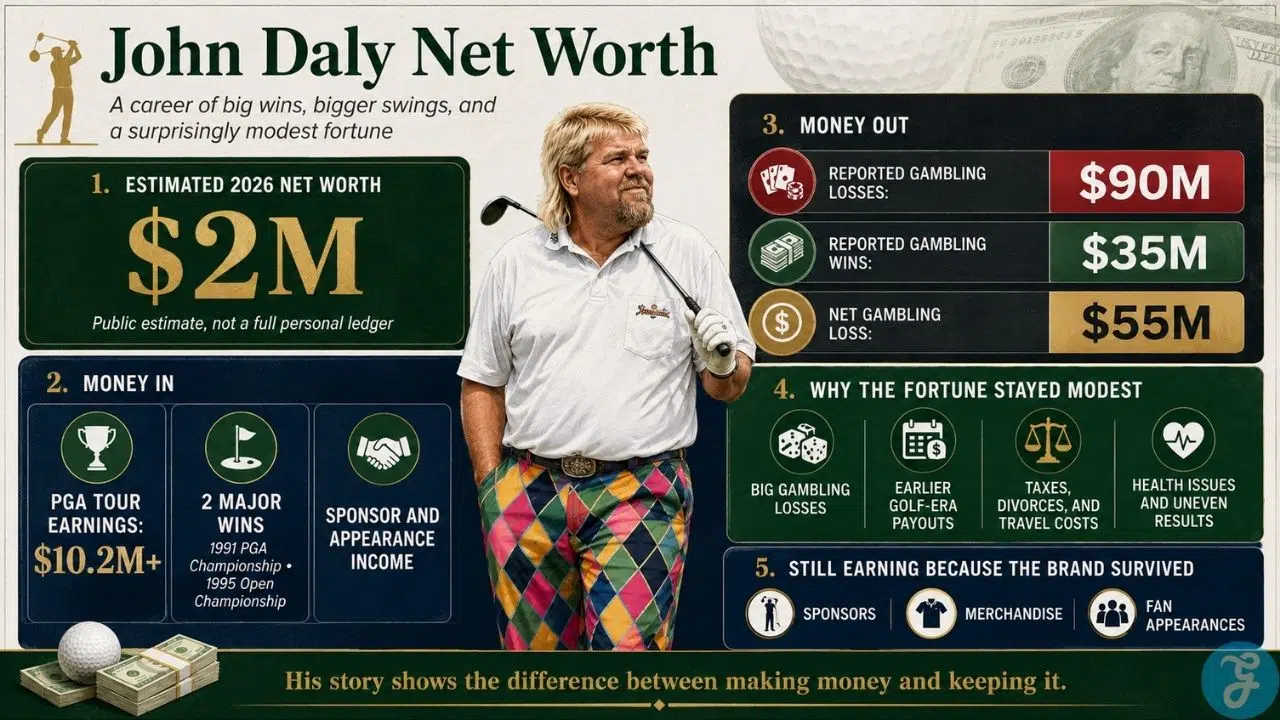
The commonly reported numbers for John Daly sit around $2 million. Public tracking lists can only work from visible income, known career earnings, public business activity, and reported financial history, so the figure works best as a reasonable outside view rather than a full personal ledger.
Even with that caution, the data tells readers something important. Daly appears to remain a millionaire, but not the kind of retired sports millionaire many fans expect after two major titles and decades of fame. His actual money looks smaller than his name.
It’s easy to see why the curiosity surrounding John Daly stays so high. His current net worth looks modest, but his brand still earns. Fans remember the long drives, the loud pants, the cigarettes, the Diet Coke, the Hooters appearances, the Open Championship win, the PGA Championship shocker, and the gambling stories. Daly feels bigger than a $2 million calculation because his public image stayed big.
When people ask how much is John Daly worth, the cleanest answer is that public numbers usually place him around $2 million in 2026. The number makes more sense when his lifetime income, casino losses, taxes, divorces, medical costs, and current sponsor revenue sit together instead of being judged separately.
Why John Daly Net Worth Needs Context
Net worth measures what remains. It does not measure how much someone earned across a career. Daly’s case proves why that difference matters.
A golfer can earn millions and still keep much less than fans assume. Prize checks get cut by taxes, caddie cuts, travel bills, coaching, management, professional expenses, and personal obligations. Sponsor money can also move through business costs, taxes, appearances, agents, and product royalties before it becomes saved cash.
Daly’s reported casino losses added a much bigger leak. They did not nibble at the edges of his fortune. They carved into the core of what could have become long-term investment capital.
A clearer snapshot helps set up the rest of the story.
| Category | Publicly Available Picture |
| Estimated net worth | Around $2 million, based on public tracking data |
| Official PGA Tour earnings | More than $10.2 million in career prize money |
| Major championships | 1991 PGA Championship and 1995 Open Championship |
| Reported gambling losses | $90 million in gross losses, offset by roughly $35 million in wins |
| Reported net gambling deficit | About $55 million between 1992 and 2007 |
| Current profile | Sponsor work, senior golf, merchandise, appearances, and product royalties |
The pattern becomes clear. Daly earned serious money, but his cash flow also carried heavy outflows.
Why His Fortune Feels Smaller Than His Fame
Daly became famous because he did not fit golf’s polished mold. He crushed drives, wore bright clothing, smoked during rounds, drank Diet Coke in public view, and made elite golf look less sealed off from ordinary fans. He brought chaos to a sport that often works hard to hide it.
His public image helped him survive long stretches when his results no longer matched his early promise. Many golfers fade when the wins stop. Daly kept drawing attention because fans followed the person, not only the scorecard.
Fame, however, does not protect money by itself. It creates chances to earn. Wealth grows only when enough of that income survives. Daly’s image helped him sell products, appearances, interviews, nostalgia, and sponsor events. His casino losses and obligations kept cutting into what could have stayed.
Timing also worked against his long-term fortune. Daly’s biggest wins came before golf money reached its current scale. He won the 1991 PGA Championship and the 1995 Open Championship before modern purses, playoff bonuses, and endorsement deals exploded.
He became a star in an older golf economy. His fame felt modern before the sport’s money became modern.
The Early Golf Economy Limited the Upside
Daly’s 1991 PGA Championship win changed his life overnight. He entered as a late alternate and won a major with fearless, aggressive golf. The victory gave him status, sponsor attention, fan loyalty, and one of the best underdog stories in the sport.
The paycheck from that era did not match what modern fans now associate with elite golf. Major wins in the early 1990s carried huge prestige, but the prize money sat far below today’s top payouts. His 1995 Open Championship win at St Andrews gave him a second major and deeper credibility, yet it still came before the sport’s current financial boom.
Those two major championship trophies anchored his entire career, transforming him from a colorful sideshow into a major champion with lasting credibility. They gave his later deals a foundation. He could sell the personality because the golf achievement behind it was real.
But those wins did not hand him the kind of instant fortune that modern sports economics can create. Daly caught global attention before golf’s biggest money wave arrived.
The Verifiable Golf Money: What Daly Earned on the Course
The clearest public number in Daly’s life comes from official tournament money. His PGA Tour career earnings sit a little above $10.2 million. For a player whose breakthrough came more than three decades ago, that remains a strong total.
Daly also kept playing on PGA Tour Champions, where senior-circuit events gave him another check and another way to stay visible. His 2017 Insperity Invitational win added a late-career highlight and reminded fans that he could still compete.
Prize money still tells only part of the story. Golfers do not bank the full number shown on the money list. They pay taxes, caddies, travel bills, coaches, agents, accountants, medical costs, and daily work expenses. A golfer runs a traveling business around his own performance.
Because of that massive business overhead, looking strictly at the reality behind John Daly career earnings is only the starting point for calculating his actual wealth. The gross checks tell only part of what he kept.
Why Tournament Earnings Do Not Tell the Whole Story
Daly’s tournament career had huge peaks but uneven rhythm. He won five PGA Tour events, including two majors, but he did not produce the steady week-after-week dominance that turns some golfers into massive prize-money earners.
Injuries, withdrawals, personal problems, and long stretches without wins made his income less predictable. A player can win big checks and still face thin years. Golf offers no guaranteed salary for most players. The checks follow performance, appearances, sponsor demand, and continued relevance.
Daly’s broader income likely leaned heavily on outside checks. Sponsors, fan events, merchandise, licensing, media work, branded products, and appearances all mattered because his personality sold even when his ranking did not.
Outside checks kept him in the game. It also made the full size of his fortune harder to pin down because private deals rarely reveal every term.
The $90 Million Gambling Rollercoaster
The largest number tied to Daly comes from his own gambling history. Daly said in a widely cited interview that his tax records showed about $90 million in gambling losses over a 15-year period. He also said he won about $35 million during that stretch, leaving a net loss of roughly $55 million between 1992 and 2007.
To really grasp the scale of his lifestyle, you have to look closer at the actual math. He didn’t just take a clean, one-time $90 million hit on a single weekend. He described massive gambling volume, large wins, larger losses, and a net deficit big enough to change a lifetime of wealth.
A $55 million net casino loss can swallow tournament income, sponsor checks, appearance fees, and investment capital. It also steals future growth. Money lost in the 1990s and early 2000s could not compound through property, markets, business ownership, or retirement planning.
Casino losses drain differently from a failed business. A bad company might collapse once. A gambling habit can keep feeding on each new check. Daly could earn, lose, earn again, and still feel like he was chasing old damage.
How Gambling Damaged John Daly’s Long-Term Wealth
Daly’s casino losses help explain why his tracking numbers look so much smaller than his fame. He did not just lose money at the moment of each wager. He lost the decades of growth those dollars could have created.
A player with Daly’s visibility could have built a much larger asset base if more of the money had stayed invested. Sponsor checks could have become property. Appearance fees could have become market assets. Tournament checks could have produced income long after the final putt dropped.
Instead, casino losses pulled huge amounts out of the wealth engine. Daly kept earning because his brand stayed alive, but his ability to earn kept meeting damage from the past.
By all ordinary standards, John Daly is safely a millionaire, even if that $2 million valuation looks modest next to golf’s biggest names. The more revealing point is that he appears to have moved through far more money than he kept.
John Daly Asset Portfolio: What Can Be Seen Publicly
A complete list of John Daly’s assets does not exist in public view. The discussion centers on the items and deals that can be verified.
Golf checks: Daly earned official PGA Tour money, added PGA Tour Champions income, and stayed involved in golf events that kept him in front of fans.
Sponsorships and brand deals: Daly has been publicly connected with Hooters, Good Boy Vodka, John Daly Cocktails, John Daly Pizza, Loudmouth, Sunfish, and other golf or lifestyle brands. These deals show that companies still see value in his name.
Merchandise and licensing: Daly’s look sells because people understand it immediately. Bright clothing, long drives, fan-friendly behavior, and a rough-edged golf image all support apparel, autographs, accessories, drinks, and branded products.
Appearances and fan events: Daly can pull attention even when he is not near the top of a leaderboard. His presence works as a draw because fans still want the story, the photo, the autograph, and the personality.
Media and entertainment: Music, interviews, podcasts, golf videos, social media, and entertainment appearances keep the Daly name circulating.
These deals do not create an exact asset value, but they show why Daly still earns. His brand remains useful because it still feels specific.
The Asset Picture Still Looks Active
Daly’s career has never depended only on tournament results. His personality became its own product. Sponsors can build around the image because the image does not need much explanation.
A Daly appearance brings a different kind of golf audience. It attracts fans who may not care about swing mechanics or FedEx Cup points but still care about the man who made golf feel loud, flawed, and accessible.
This continuous, active commercial footprint is one reason his brand still earns. A modest number does not mean he has no ability to make money. It means his long financial history reduced how much of those checks turned into saved capital.
Why Brands Still Work With John Daly
Brands still work with Daly because his identity remains clear. He is not a generic retired athlete trying to stay visible. He remains instantly recognizable, and fans know what kind of energy he brings.
Some sponsors would never touch that image. Daly carries risk for brands that want clean lines and controlled messaging. But companies tied to casual golf culture, fan events, sports bars, drinks, apparel, and personality-driven products can use the very traits that make him different.
The Hooters partnership is the obvious example. The brand does not need Daly to win tournaments. It needs him to draw attention, connect with fans, and fit the casual sports culture that surrounds the brand. Daly does that naturally.
The same logic applies to other lifestyle and golf-related products. Daly’s appeal comes from recognition and consistency. Fans understand the persona because it has not changed much.
Commercial Value Is Not the Same as Huge Wealth
Daly’s sponsor appeal still matters. It likely helps him keep earning and keeps his name in circulation. But sponsor visibility and net worth do not always move together.
Some deals pay flat fees. Some include royalties. Some require appearances. Some involve product promotion, licensing, or revenue sharing. The public usually sees the logo, not the contract.
Daly is still useful to the right sponsors. His appeal explains why he keeps earning. His losses and obligations help explain why the public numbers still look modest.
Trophies Opened Doors, But They Did Not Guard the Money
Daly’s major championships still give his brand real weight. His 1991 PGA Championship win at Crooked Stick remains one of golf’s great surprise victories. His 1995 Open Championship win at St Andrews proved he was not just a one-week story.
Those wins changed his life because they attached real achievement to his public image. Daly was not just a colorful golfer. He won two of the biggest tournaments in the sport.
The trophies created a platform for decades of sponsor work. They gave sponsors and fans a reason to take the personality seriously. A loud golfer without major titles would not have carried the same long-term value.
But trophies do not manage money. They open doors, and then life decides what happens next. Daly walked through doors into endorsement opportunities, casino rooms, travel schedules, divorces, medical costs, and business deals. The wins built the stage. His choices and costs shaped the balance sheet.
Golf Skill and Money Management Are Different Skills
Daly’s career shows how different earning money and keeping money can be. He had rare power, competitive courage, public charm, and a memorable image. Those traits helped him earn.
Keeping the money required another set of habits: patience, planning, risk control, tax discipline, investment structure, and the ability to walk away from spending. Daly’s story shows what happens when the ability to earn outruns control.
This is not only an athlete problem. Many people raise their income and raise their risk at the same time. Daly’s version simply played out with larger numbers, brighter lights, and more public attention.
The Quiet Costs: Taxes, Divorces, Travel, and Health
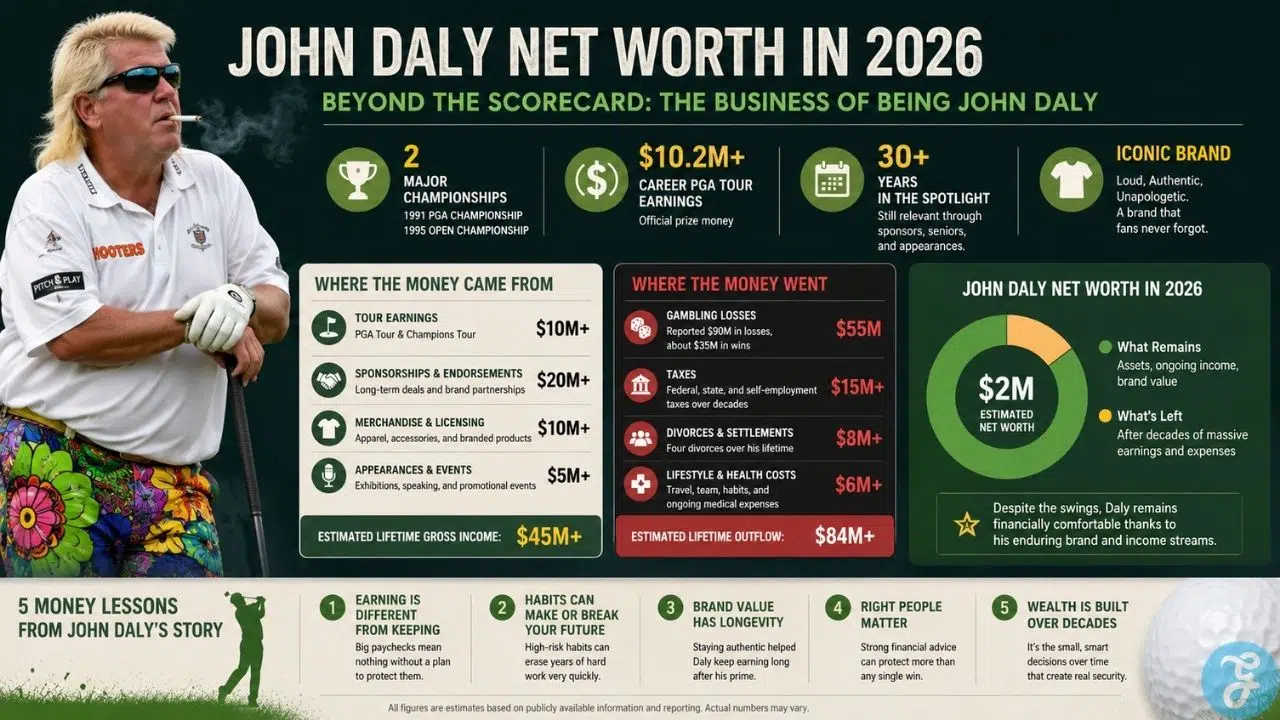
Gambling draws the largest headline, but other costs also shaped Daly’s life. Taxes cut into prize money, endorsement checks, appearance fees, and business income before any of it can become saved cash.
Divorces also affected the picture. Daly has been married several times, and his personal life often drew public attention alongside his money problems. Legal costs, settlements, asset division, and continuing obligations can hit any high-earning person hard.
Golf itself carries heavy overhead. Travel, hotels, caddies, coaches, agents, accountants, training, equipment, and medical support all cost money. Daly’s career stretched across decades, so those costs traveled with him for a long time.
Health also entered the story. Daly has spoken publicly about serious medical problems, including cancer treatment. Health challenges can limit travel, tournament starts, promotional work, and steady income, especially for a golfer who works as his own business.
Why These Costs Matter
Fans see the tournament checks. They rarely see the money leave. A professional golfer’s income passes through taxes, work costs, support teams, family obligations, and personal spending before it becomes saved capital.
Strong, steady earners can absorb those costs and still build large fortunes. Daly’s income came with higher volatility and huge reported casino losses, so normal costs became more damaging.
His balance sheet wasn’t hurt by a single isolated mistake. Instead, a series of regular expenses and losses pulled money away over decades. Even a famous athlete can struggle to hold onto capital when too much cash keeps moving out.
Is John Daly a Millionaire in 2026?
So, is John Daly a millionaire? Based on public estimates, yes. A roughly $2 million net worth places him in millionaire territory.
The answer still needs context. Two million dollars is strong by ordinary standards, but it sits far below the money held by golf’s richest figures. It also feels modest beside Daly’s fame, history, and visibility.
The word millionaire can hide how money is actually structured. A person can hold assets in cash, land, private contracts, business stakes, licensing income, or future checks. Each version creates a different everyday reality.
Daly’s case fits that complexity. He appears to have real value, but not the kind of massive fortune fans often imagine when they think of a two-time major champion with decades of fame.
Why the Answer Still Surprises People
Daly feels richer than the tracking data suggests because he remains visible. He appears in golf content. Sponsors still use his name. Fans still recognize him instantly. His personality still travels farther than many players’ trophy records.
Public attention, however, does not equal saved cash. Daly’s reported casino losses, career timing, taxes, divorces, health problems, and uneven playing checks explain why the numbers land where they do.
His millionaire status feels strange because both things are true. He remains financially relevant, and he still appears far less wealthy than his legend suggests.
John Daly Financial Status: Active and Marketable
Daly does not fit the quiet retired-athlete mold, living instead as a lesson in fame, casino risks, and pure commercial survival. Precision remains difficult because Daly’s private finances stay private. Public information shows visible earnings, reported losses, sponsor activity, and career money. It does not show every contract, obligation, asset, or debt.
The best reading is that Daly remains a commercially active millionaire with a public net worth estimate that looks modest compared with his fame. His brand still earns. His past losses still define much of the conversation around him. His current position looks stable from the outside, but it does not look simple.
Daly is not a normal retired golfer. He is a long-running case study in fame, risk, spending, resilience, and brand survival.
Cash Flow and Wealth Are Not the Same
Daly can still earn through appearances, sponsorships, products, and golf-related work. Ongoing income does not automatically create a large net worth. Cash flow arrives. Wealth stays.
This difference explains much of Daly’s story. His name can still produce income, but decades of strain affect how much remains.
For readers, the lesson matters more than the exact calculation. A person can stay active, recognizable, and paid while holding less accumulated money than outsiders expect.
What Regular Readers Can Learn From Daly’s Money Story
Daly’s numbers are larger than ordinary life, but the core lesson is simple. Income and wealth are different.
A person can earn well and still fail to build lasting security if spending, debt, taxes, gambling, legal costs, health problems, or bad habits absorb the surplus. Daly’s story uses athlete-level money, but the pattern appears in regular households too.
His life is more than a tabloid headline; it shows how earning power without asset protection creates an endless cycle of damage control.
The compounding lesson cuts deepest. Money lost in the 1990s and early 2000s did not only disappear once. It also lost decades of possible growth. A smaller sum invested and left alone can become much larger over time. A larger sum lost repeatedly never gets that chance.
Daly avoided the worst possible ending partly because his name kept commercial value. Most people do not have that recovery channel. They cannot replace lost savings with sponsor appearances, branded products, or fan events.
The Practical Warning Behind the Famous Name
The real lesson here isn’t about wagging a finger at his personal vices. It’s about recognizing how a high-volume income stream can mask a fundamentally weak foundation for decades.
As long as money keeps coming in, old losses may seem manageable. The problem grows when income slows, health changes, opportunities narrow, or obligations remain. At that point, the difference between earnings and saved money becomes obvious.
Daly’s numbers may surprise fans, but it fits a wider truth. Large income does not protect anyone unless enough of it stays protected from repeated losses.
The Honest Read on Daly’s Money
John Daly net worth appears to sit around $2 million, based on common public estimates. The figure gives a reasonable outside view of a golfer whose life included major earnings, major losses, and unusual staying power.
Daly won two majors, earned more than $10 million in official PGA Tour money, built a sponsor-friendly identity, and stayed visible through golf culture, merchandise, appearances, drinks, media, and fan events. He also reported casino losses that changed the long-term math.
Daly didn’t fail or go broke in the traditional sense. He’s still globally famous, comfortably sitting in millionaire territory, and pulling in commercial income. His career shows the hard difference between making money and keeping it.
Readers trying to understand the numbers should focus on the shape of the story. The $2 million calculation gives one point of reference. The reported $55 million net casino loss explains why the saved money looks smaller than the fame. The sponsor activity shows why Daly keeps earning even after his tournament peak.
Daly is still worth real money, but his legacy does not live in one static number. It lives in a career where a rare golfer earned a lot, lost a lot, stayed recognizable, and kept turning the John Daly story into income long after most players would have faded from public view.