
A niche audience does not need more random links. It needs someone who can sort the noise, remove the weak stuff, explain what matters, and connect scattered ideas into something useful.
That is the real job behind content curation strategies. You are not just collecting articles, tweets, videos, reports, or podcast clips. You are building trust by showing your audience what deserves attention and why.
Good curation also fits Google’s people-first content direction: content should help real users, not exist only to chase rankings. Google’s Search guidance emphasizes helpful, reliable, people-first content, while Content Marketing Institute describes curation as selecting, organizing, adding commentary, and presenting relevant information for an audience.
Our Selection Criteria
We selected these strategies based on what actually helps niche publishers, bloggers, newsletter creators, community builders, and small content teams.
| Criteria | What We Looked For |
|---|---|
| Audience usefulness | Does the strategy save readers time or improve their understanding? |
| Niche fit | Can it work for a narrow industry, hobby, profession, or community? |
| Editorial value | Does it add context instead of simply reposting links? |
| Repeatability | Can a small team use it weekly or monthly without burning out? |
| SEO value | Can it support topical authority, internal linking, and long-term discovery? |
| Trust building | Does it help the audience see the curator as selective, informed, and fair? |
Who This Is For
These content curation strategies are useful for niche site owners, newsletter writers, B2B marketers, SaaS blogs, affiliate publishers, educators, community managers, and creators who want to become a reliable filter in a specific space.
They are especially helpful if your niche moves quickly, your audience is busy, or the best information is scattered across reports, social posts, forums, podcasts, industry blogs, and research updates.
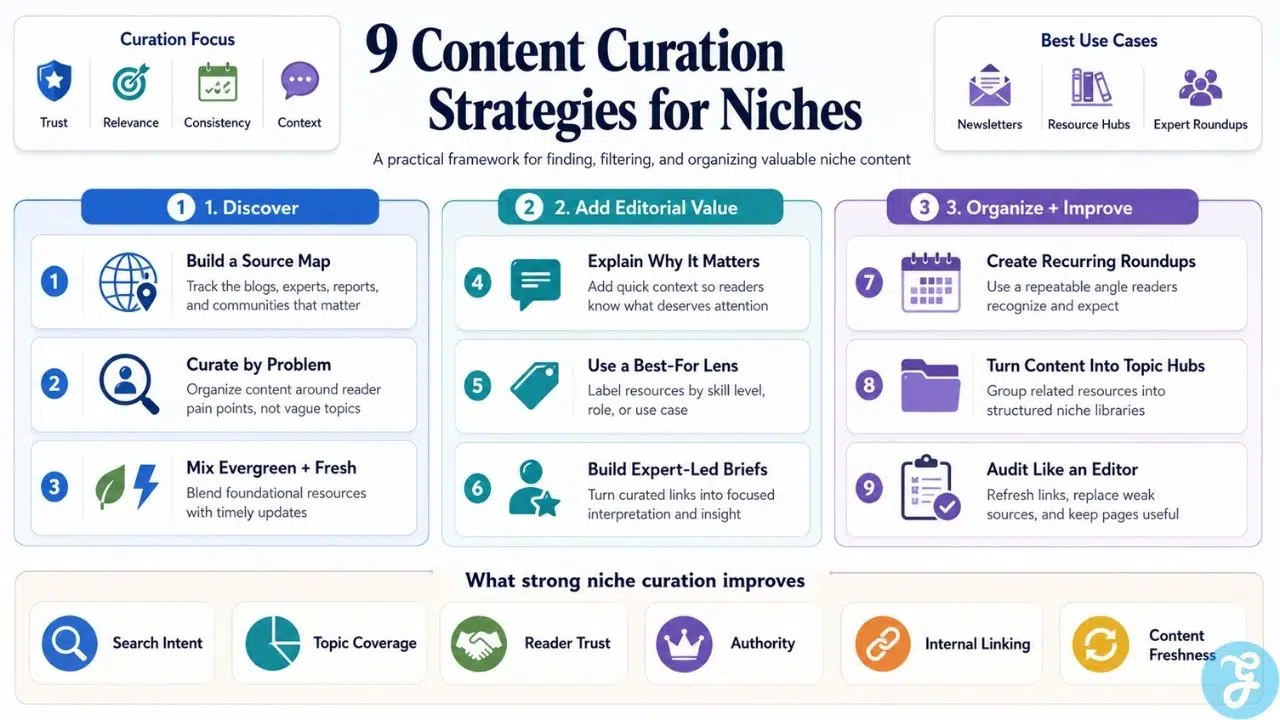
9 Content Curation Strategies for Niche Audiences
Before choosing a tactic, remember the rule: curation without judgment is just aggregation. Your audience should leave with a clearer view than they had before.
1. Build a Source Map Before You Curate Anything
A strong curator strategy starts with knowing where your niche’s best information actually comes from. Create a source map that includes industry blogs, newsletters, research bodies, expert social accounts, forums, YouTube channels, podcasts, reports, communities, and competitor content.
This gives your curation process structure. Instead of desperately searching every week, you know where to look and which sources deserve more trust.
Best Feature/For:
- Best for building a reliable niche content curation system
- Great for newsletters, industry blogs, and authority sites
Why We Chose It:
- Prevents random link collecting
- Helps separate primary sources from recycled commentary
- Makes weekly or monthly curation easier to repeat
- Improves source quality over time
Things to consider:
- Review your source list regularly
- Do not rely only on the loudest voices in your niche
2. Use the “Explain Why It Matters” Filter
The weakest curated posts say, “Here are five links.” The strongest ones explain why each link matters to the reader right now.
For every item you include, add one or two lines of editorial context. Explain who should read it, what changed, what is missing, what you agree with, or why the source is worth attention. That small layer of judgment is what turns a content roundup into useful curation.
Best Feature/For:
- Best for adding editorial value to curated content
- Great for expert blogs, LinkedIn newsletters, and niche communities
Why We Chose It:
- Makes curated content feel original and useful
- Helps readers understand the relevance quickly
- Builds trust in your taste and judgment
- Reduces the risk of shallow aggregation
Things to consider:
- Avoid summarizing too much from the original source
- Link clearly and give proper credit
3. Create Recurring Content Roundups With a Clear Angle
Content roundup tactics work better when they have a repeatable angle. Instead of publishing a vague “weekly roundup,” make the promise specific: “This Week in AI Policy,” “Best Indie Game Dev Reads,” “Climate Tech Funding Notes,” or “5 Ecommerce Conversion Ideas Worth Testing.”
A strong roundup should feel like a recurring editorial product. Readers should know what they will get, when they will get it, and why it is worth opening.
Best Feature/For:
- Best for newsletters, blogs, and social media series
- Great for building audience habits
Why We Chose It:
- Easy to repeat weekly, biweekly, or monthly
- Helps readers associate your brand with a specific niche
- Supports internal linking to older roundups and related guides
- Works well for fast-moving industries
Things to consider:
- Keep the format tight
- Do not include weak links just to hit a fixed number
4. Curate by Problem, Not Just by Topic
Most niche audiences do not think in neat content categories. They think in problems: “How do I lower churn?”, “Which tool should I use?”, “What changed this month?”, “What should I avoid?”
So instead of curating around broad topics, organize curated resources around specific pain points. A fitness site might curate “best recovery advice for runners over 40.” A SaaS blog might curate “resources for fixing onboarding drop-off.” A finance newsletter might curate “plain-English explanations of rate changes.”
Best Feature/For:
- Best for audience-first niche content curation
- Great for practical guides, resource hubs, and email series
Why We Chose It:
- Matches how real readers search and decide
- Makes curated content more actionable
- Helps turn scattered resources into a useful pathway
- Supports stronger topical authority
Things to consider:
- Do not make the problem too broad
- Add your own short takeaway for each resource
5. Mix Evergreen Resources With Fresh Updates
A niche curation page can become outdated quickly if it only chases new links. It can also become stale if it only lists old evergreen resources.
A better content mix combines stable foundational resources with recent updates. For example, a cybersecurity curator might include a beginner-friendly guide, a current vulnerability report, a new tool update, and one expert opinion. This gives readers both context and freshness.
Best Feature/For:
- Best for balancing long-term usefulness and current relevance
- Great for resource pages, newsletters, and niche guides
Why We Chose It:
- Gives beginners and advanced readers something useful
- Prevents roundups from becoming disposable
- Helps update old curated pages without rebuilding them from scratch
- Makes content feel both timely and durable
Things to consider:
- Mark older resources clearly when needed
- Replace outdated links instead of letting them rot
6. Add a “Best For” Lens to Every Curated Item
Not every good resource is good for every reader. A detailed research paper may be useful for analysts but painful for beginners. A quick video may help newcomers but not professionals.
Adding a “best for” lens makes your curation more helpful. Label items by reader type, stage, budget, skill level, use case, or urgency. This is one of the simplest ways to make curated content feel tailored rather than dumped into a list.
Best Feature/For:
- Best for mixed-skill niche audiences
- Great for tool lists, learning hubs, and expert roundups
Why We Chose It:
- Helps readers choose faster
- Reduces overwhelm
- Makes your recommendations more precise
- Improves the user experience of long curated lists
Things to consider:
- Keep labels honest and specific
- Avoid pretending every resource is perfect for everyone
7. Build Expert-Led Curated Briefs
A curated brief is more focused than a roundup. It collects a small number of high-value resources around one issue, then adds your expert interpretation.
For example, instead of “10 marketing articles this week,” a brief might cover “What the latest email deliverability changes mean for small ecommerce brands.” The curated links support your explanation, but your analysis carries the piece.
Best Feature/For:
- Best for authority building
- Great for B2B niches, industry newsletters, and professional audiences
Why We Chose It:
- Shows expertise instead of just taste
- Helps explain complex developments
- Encourages higher-quality engagement
- Turns curation into thought leadership
Things to consider:
- Requires more judgment than a basic roundup
- Works best when the curator understands the niche deeply
8. Turn Curated Content Into Topic Hubs
If you curate often, do not let every piece disappear into the archive. Group related curated resources into topic hubs.
A topic hub might collect beginner guides, expert interviews, statistics, tools, examples, mistakes, trends, and case studies around one niche subject. This helps readers explore a subject in one place and gives your site a stronger internal structure. Google’s Search Essentials also recommends making links crawlable so search engines can discover pages through your site’s links, which makes organized internal linking useful for both users and search visibility.
Best Feature/For:
- Best for long-term SEO and topical authority
- Great for publishers, education sites, and niche blogs
Why We Chose It:
- Turns scattered curated posts into a useful content library
- Supports internal linking
- Helps readers move from basic to advanced resources
- Makes older curated content easier to rediscover
Things to consider:
- Update hubs regularly
- Add original summaries and structure, not just outbound links
9. Audit Your Curated Content Like an Editor
Curation is not a one-time task. Old roundups, resource pages, and niche guides can become outdated, biased, broken, or bloated.
Set a recurring audit schedule. Remove dead links, replace outdated sources, check whether claims still hold up, improve summaries, and add better resources when the niche changes. This keeps your content useful instead of letting it become a graveyard of once-good links.
Best Feature/For:
- Best for maintaining trust over time
- Great for evergreen curated pages and resource libraries
Why We Chose It:
- Protects reader trust
- Improves content freshness
- Helps identify weak or outdated sources
- Keeps curated hubs from becoming messy
Things to consider:
- Track update dates
- Remove weak links even if they once performed well
A Quick Overview
These content curation strategies work best when you match them to your publishing rhythm, audience maturity, and niche complexity. Some are better for weekly visibility, while others help build long-term topical authority and trust.
| Strategy | Best Use | Main Benefit | Best Fit |
|---|---|---|---|
| Source map | Building a curation system | Better discovery and consistency | Newsletters, blogs |
| “Why it matters” filter | Adding context | More editorial value | LinkedIn, blogs, email |
| Recurring roundups | Building habits | Repeatable publishing format | Weekly newsletters |
| Problem-based curation | Helping specific readers | Better relevance | Niche guides |
| Evergreen + fresh mix | Balancing old and new | Durable usefulness | Resource pages |
| “Best for” lens | Segmenting recommendations | Faster reader decisions | Tool lists, learning hubs |
| Expert-led briefs | Explaining complex issues | Stronger authority | B2B niches |
| Topic hubs | Organizing resources | Better internal structure | SEO content sites |
| Editorial audits | Maintaining quality | Long-term trust | Evergreen libraries |
Our Top 3 Picks and Why
1. Problem-Based Curation
This is the most useful strategy for niche audiences because it starts with what readers need, not what the curator found. It works well for SEO, email, social posts, and resource hubs.
2. Expert-Led Curated Briefs
This strategy builds authority faster because it adds interpretation. You are not just pointing to sources. You are helping the reader understand what those sources mean.
3. Topic Hubs
Topic hubs turn curation into a long-term asset. They help readers explore a niche deeply and make your older curated work easier to find.
How to Choose the Right Content Curation Strategy
Choose your strategy based on your audience’s problem and your publishing capacity. A solo creator may start with one weekly roundup and one source map. A niche publisher may build topic hubs and quarterly audits. A B2B team may get more value from expert-led briefs than daily link sharing.
A simple selection framework:
- Pick recurring roundups if your niche changes weekly.
- Pick problem-based curation if your audience needs practical help.
- Pick expert-led briefs if trust and authority matter most.
- Pick topic hubs if you want long-term SEO value.
- Pick editorial audits if you already have old curated content.
Final Checklist Before Publishing Curated Content
Before you publish, ask:
- Does this help a specific niche audience, or is it too general?
- Did I add context, judgment, or explanation?
- Are the sources credible and properly credited?
- Did I organize the content around a reader problem?
- Is there a reason this curated piece should exist on my site?
Good Curation Makes the Reader Feel Less Lost
The best content curation strategies do not flood people with more tabs. They reduce the number of tabs someone needs to open.
For niche audiences, that is powerful. A good curator saves time, filters weak sources, explains context, and helps readers make better decisions. That is why niche content curation works best when it feels like editorial service, not recycled content.
Your job is not to collect everything. Your job is to make the important things easier to see.
Frequently Asked Questions (FAQs) about Content Curation Strategy
What are content curation strategies?
Content curation strategies are repeatable methods for finding, selecting, organizing, and explaining useful content from other sources for a specific audience. Good curation adds context instead of simply reposting links.
What is niche content curation?
Niche content curation focuses on a narrow audience, industry, problem, or community. It works well because readers often need a trusted filter for specialized information.
What makes a good curator strategy?
A good curator strategy includes reliable sources, clear selection criteria, useful commentary, proper attribution, regular updates, and a defined audience need.
Are content roundup tactics still useful?
Yes, but only when the roundup has a clear purpose. A strong roundup should save readers time, highlight useful resources, and explain why each item matters.
Can curated content help SEO?
Curated content can support SEO when it is original in structure, helpful to readers, properly attributed, and connected to a broader topical strategy. Thin lists of links with little added value are much less useful.