
Math anxiety does not begin when a student fails an exam. It usually starts much earlier, when one missed concept quietly turns into five, then ten, then a full-blown fear of numbers. That is why AI Math Tutors are gaining serious attention in the United States: they promise something traditional tutoring often struggles to provide at scale – patient, step-by-step support at the exact moment a student gets stuck.
Our Selection Criteria
This list started with the country decision, not the company list. I first looked at where AI math tutoring startups and SME-style EdTech companies are most concentrated, then checked whether those companies were active, verifiable, and directly relevant to math learning rather than generic homework help.
Why We Chose the United States?
The U.S. stood out because it has the highest number of companies in the K-12 AI Math Tutor category and a stronger spread of active startups, private EdTech firms, AI-native tutor apps, and math-focused learning platforms. The U.K. and Germany also have meaningful activity, but their company depth is smaller in this exact niche.
Here is the country comparison used before selecting the final market:
| Country Considered | Strength in AI Math Tutoring | Startup/SME Density | Final Assessment |
|---|---|---|---|
| United States | Strongest concentration of AI math tutor startups and private EdTech companies | Highest listed company count in K-12 AI Math Tutor category | Selected |
| United Kingdom | Strong school-focused AI maths tutoring activity, especially for curriculum support | Smaller but credible niche ecosystem | Not selected |
| Germany | Growing adaptive learning and AI education activity | Smaller visible company base in this exact niche | Not selected |
After choosing the country, each company was filtered through the following criteria:
- Headquartered, incorporated, or operationally rooted in the United States.
- Active SME, startup, or private/mid-sized EdTech company.
- Clear focus on AI math tutoring, adaptive math support, AI-guided problem solving, or step-by-step math coaching.
- Publicly visible product, website, contact path, app listing, or credible company profile.
- Relevance to students, parents, schools, colleges, teachers, or tutoring providers.
- Excluded Big Tech-owned products, broad AI chatbots, generic tutoring marketplaces, and tools where math was only a weak side feature.
10 U.S. EdTech SMEs Specializing in AI Math Tutors for Smarter Learning Support
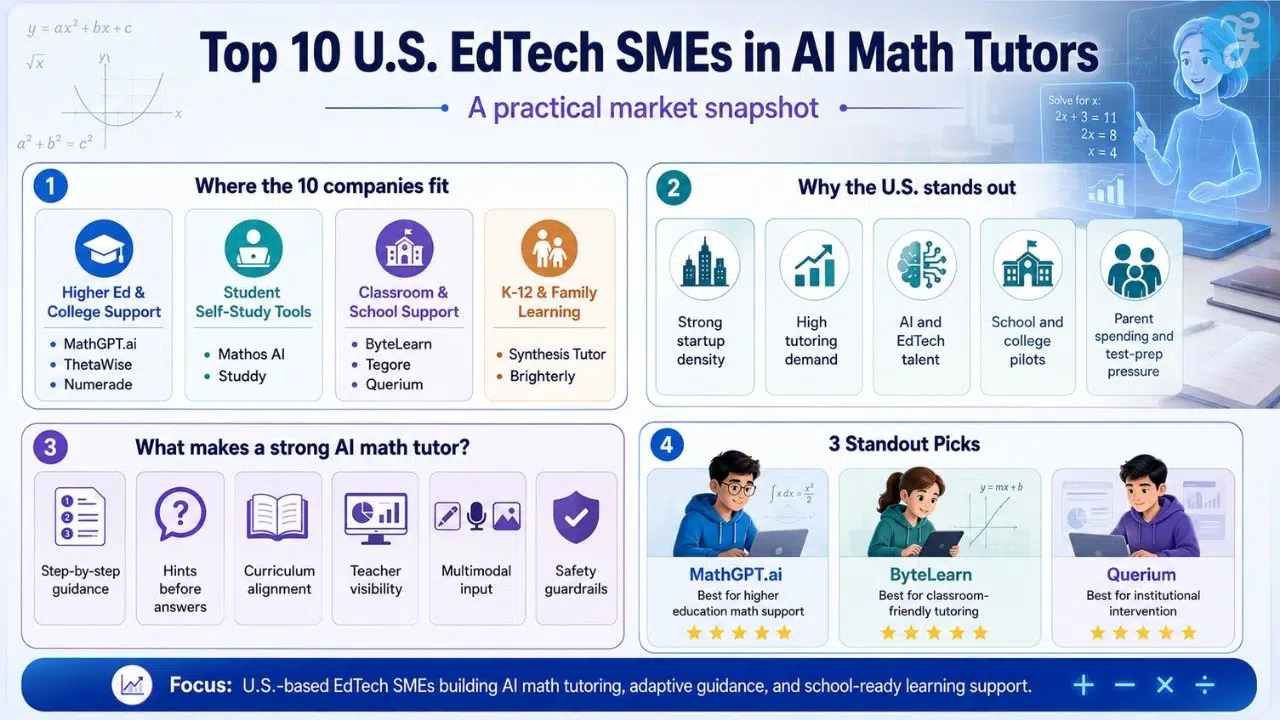
The U.S. AI math tutoring market is not built around one single model. Some companies focus on Socratic tutoring, some on photo-based math help, some on classroom support, and others on adaptive elementary math or higher education assignments. That variety makes the market useful, but it also makes careful comparison necessary.
1. MathGPT.ai
Headquarters: Palo Alto, California, United States
Website: https://www.mathgpt.ai
Email: info@mathgpt.ai
MathGPT.ai is an AI-first math tutoring and assignment platform designed mainly for higher education classrooms. Its strongest angle is “responsible” tutoring: instead of simply giving students answers, it uses Socratic guidance, assignment support, and instructor-led controls to keep learning and academic integrity in the same conversation. The platform also works with textbooks and LMS environments, which makes it more classroom-friendly than many consumer math solvers. For colleges trying to support students without encouraging shortcut behavior, MathGPT.ai is one of the clearest U.S. fits.
Best Feature/For:
- Best for higher education math instructors who want AI tutoring with academic guardrails.
- Strong for course-based math support, LMS use, and textbook-aligned assignments.
Why We Chose It:
- Focuses specifically on math rather than general homework help.
- Uses Socratic guidance to reduce answer-copying behavior.
- Built for instructors as well as students.
- Clear U.S. location and public contact details.
Things to consider:
- It is more useful for structured courses than casual one-off homework help.
- Institutions should test how well it fits their existing LMS and assessment rules.
2. Mathos AI
Headquarters: Santa Clara, California, United States
Website: https://www.mathgptpro.com
Email: mathgpt.info@gmail.com
Mathos AI, also known as MathGPTPro, is an AI math solver and tutor built for students who need fast explanations across algebra, calculus, physics, engineering, and related STEM problems. It supports photo, voice, text, and PDF input, which makes it useful for students dealing with worksheets, handwritten notes, or exam preparation. Its tutoring value depends on how students use it: as a guided explanation tool, it can be helpful; as a final-answer machine, it can become a crutch. Still, its math-first positioning and broad input options make it a strong U.S. AI math tutor startup.
Best Feature/For:
- Best for students who need photo, text, voice, or PDF-based math help.
- Useful for algebra, calculus, physics, engineering, and homework walkthroughs.
Why We Chose It:
- Strong math-first product identity.
- Supports multiple input formats that match real student behavior.
- Public app listing and company identity are visible.
- Suitable for self-paced learners who need 24/7 help.
Things to consider:
- Students need discipline to study the steps, not just copy the solution.
- Accuracy should still be checked for high-stakes or advanced problems.
3. ThetaWise
Headquarters: Santa Clara, California, United States
Website: https://thetawise.ai
Email: Not publicly listed
ThetaWise is an AI math tutor focused on helping students learn complex math faster through step-by-step reasoning, hints, corrections, tutor mode, videos, quizzes, and visual explanations. Its appeal is strongest among students who want more than a calculator but less friction than scheduling a human tutor. The platform positions itself around real learning, not just instant answers, and that distinction matters in a crowded AI solver market. For high school and college students wrestling with advanced math topics, ThetaWise has one of the clearer tutoring-focused offerings.
Best Feature/For:
- Best for students who want guided explanations, tutor mode, and visual math support.
- Strong for upper-level math learners who need follow-up questions and corrections.
Why We Chose It:
- Dedicated AI math tutor positioning.
- Covers step-by-step help, hints, quizzes, and explainer videos.
- Small private company profile fits the SME/startup filter.
- Built around learning support rather than only answer retrieval.
Things to consider:
- Public email information is limited.
- Learners should compare its explanations against class methods when preparing for exams.
4. Studdy
Headquarters: San Francisco, California, United States
Website: https://www.studdy.ai
Email: team@studdy.ai
Studdy is a Y Combinator-backed startup that describes itself as “an AI math tutor for every student.” Its Studdy Buddy product uses AI, speech, text, and image recognition to help students get support from schoolwork and learning materials. The company is still small, but that is part of why it belongs here: it represents the newer generation of AI-native tutoring companies built after large language models changed what homework help could look like. Its value is strongest for students who want quick, conversational help without navigating a heavy classroom platform.
Best Feature/For:
- Best for students who want a lightweight AI math tutor from a small AI-native startup.
- Useful for image-based homework support and quick learning help.
Why We Chose It:
- Directly positioned as an AI math tutor.
- Backed by Y Combinator and clearly U.S.-based.
- Small team fits the startup profile.
- Uses multimodal input, which is important for real math homework.
Things to consider:
- As an early-stage startup, the product may evolve quickly.
- Schools should test reliability, privacy, and age-appropriate use before recommending it widely.
5. ByteLearn
Headquarters: Lewes, Delaware, United States
Website: https://www.bytelearn.com
Email: support@bytelearn.ai
ByteLearn is an AI math tutoring platform for students and a teaching assistant for educators. Its AI tutor, Byte, guides students through math practice step by step and helps teachers personalize assignments, identify knowledge gaps, and support more students without manually tutoring everyone. The company is especially relevant for middle school and high school math, including Algebra, Geometry, Pre-Calculus, Calculus, SAT, and ACT support. ByteLearn stands out because it tries to serve both sides of the classroom: the student who is stuck and the teacher who has too many students to help individually.
Best Feature/For:
- Best for teachers and students who need AI-guided step-by-step math practice.
- Strong for middle school, high school, and test-prep math support.
Why We Chose It:
- Built specifically around AI math tutoring.
- Combines student tutoring with teacher-facing tools.
- Focuses on step-by-step coaching rather than direct answer dumping.
- Verified as a U.S.-based seed-stage company through company databases.
Things to consider:
- The company also has India-linked corporate records, so buyers should confirm contracting details.
- Teachers should review how well its hints match their classroom methods.
6. Synthesis Tutor
Headquarters: Los Angeles, California, United States
Website: https://www.synthesis.com/tutor
Email: legal@synthesis.is
Synthesis Tutor is an adaptive math learning tool for children, built from the education ideas associated with the SpaceX school environment. It focuses mainly on elementary math and uses an intelligent, responsive digital tutor to guide children through concepts with interaction, feedback, and a more playful learning design. The product is not a generic AI chatbot bolted onto worksheets; it is closer to a purpose-built math experience for younger learners. For parents who want an AI-supported math tutor that feels less like homework punishment, Synthesis is a strong option.
Best Feature/For:
- Best for elementary learners who need adaptive, engaging math support.
- Useful for families seeking a math tutor-style app for ages roughly 5-11.
Why We Chose It:
- Clear U.S. private company profile.
- Strong math-focused product with adaptive tutoring claims.
- Designed around young learners rather than general study help.
- Offers a more interactive experience than standard solver apps.
Things to consider:
- It is not aimed at high school algebra, calculus, or college math.
- Parents should still monitor screen time and learning quality.
7. Numerade
Headquarters: Pasadena, California, United States
Website: https://www.numerade.com
Email: support@numerade.com
Numerade is a STEM learning platform with Ace, its AI tutor for step-by-step help, study support, notes, quizzes, worksheets, and exam preparation. It is broader than math alone, but math and STEM problem support are central to its product identity. Numerade’s biggest advantage is that its AI tutor sits alongside a large library of educator-created video explanations, which gives students more ways to understand a problem. That mix of AI, video, and human educator content makes it different from pure chatbot tools.
Best Feature/For:
- Best for students who want AI tutoring plus video-based STEM explanations.
- Useful for math, physics, chemistry, textbook problems, and exam prep.
Why We Chose It:
- U.S.-based private EdTech company.
- Ace AI Tutor is clearly part of its product offering.
- Strong STEM learning positioning with math-heavy use cases.
- Combines AI help with educator-created explanations.
Things to consider:
- It is not math-only, so buyers should judge it by the specific math topics they need.
- Subscription and cancellation terms should be checked carefully before use.
8. Brighterly
Headquarters: Las Vegas, Nevada, United States
Website: https://brighterly.com
Email: info@brighterly.com
Brighterly is an online math and reading platform for K-12 students, combining 1:1 tutoring with personalized learning and AI-powered practice tools. It is not a pure AI-only tutor, which is actually part of its appeal: the company positions AI as support around human teaching rather than a total replacement. That makes it relevant for families who want personalization, structured practice, and tutor involvement in one learning flow. Brighterly fits the AI Math Tutors market because it shows where the category may be headed: AI as a learning assistant, not a lonely robot teacher.
Best Feature/For:
- Best for parents who want human tutoring supported by AI-powered practice.
- Strong for younger and K-12 students who need structured math help.
Why We Chose It:
- U.S.-focused math tutoring platform with AI-powered learning support.
- Clear contact information and public company presence.
- Combines personalized learning with human tutor oversight.
- Useful for families uncomfortable with fully automated tutoring.
Things to consider:
- It is not a pure standalone AI tutor.
- Families should compare tutor quality, lesson frequency, and platform cost before enrolling.
9. Tegore
Headquarters: San Francisco, California, United States
Website: https://tegore.ai
Email: founders@tegore.ai
Tegore is a very early-stage Y Combinator startup building an interactive AI-powered math tutor for K-12 learners. It focuses on curriculum-aligned lessons, voice, interactive visuals, and dialectic teaching that checks whether students actually understand the concept. Tegore is still young, but it belongs on this list because it is directly attacking the core AI math tutoring problem: how to teach, not merely solve. Its classroom pilots and teacher-facing direction make it worth watching.
Best Feature/For:
- Best for early adopters interested in curriculum-aligned AI math lessons.
- Strong for schools and teachers exploring interactive AI tutoring pilots.
Why We Chose It:
- Directly positioned as an AI-powered math tutor.
- Y Combinator-backed and based in San Francisco.
- Uses voice, visuals, and concept checks instead of plain answer generation.
- Focuses on school curriculum alignment.
Things to consider:
- It is still early-stage and may not be ready for broad district rollout.
- Schools should ask for pilot data, privacy details, and teacher controls.
10. Querium
Headquarters: Austin, Texas, United States
Website: https://www.querium.com
Email: support@querium.com
Querium is a mature Austin-based EdTech company behind StepWise, an AI-based virtual tutor for math and STEM learning. Its StepWise AI is designed to mimic the support of a strong teacher by guiding students through problems step by step, identifying mistakes, and building personalized learning paths. Unlike many newer generative AI tools, Querium has a longer history in intelligent tutoring and math intervention, including education research and grant-linked development. That makes it one of the more proven AI math tutoring SMEs on this list.
Best Feature/For:
- Best for schools, colleges, and publishers seeking AI-based step-by-step math tutoring.
- Strong for Algebra, STEM readiness, and structured intervention programs.
Why We Chose It:
- Longstanding AI math tutoring focus through StepWise.
- U.S.-based SME with Austin roots.
- Strong education research and SBIR-style development background.
- Built for institutional use, not just individual homework solving.
Things to consider:
- Its product style may feel less flashy than newer consumer AI tutors.
- Buyers should confirm current deployment options and integration requirements.
An Overview Of U.S. AI Math Tutors and Where They Fit
The U.S. market is useful because it covers the full spectrum: K-12 practice, college assignments, AI solvers, Socratic tutors, school dashboards, parent-facing platforms, and institutional math intervention. That does not mean every tool is equally strong. It means buyers need to match the tool to the learning problem.
Overview Comparison Table
The comparison below separates the companies by their strongest use case so readers can scan the market without treating every AI tutor as the same product.
| Company | Best Fit | Core Strength | Strongest Buyer/User |
| MathGPT.ai | Higher education math courses | Responsible AI tutoring and assignment support | Colleges, instructors, departments |
| Mathos AI | Fast multimodal math help | Photo, voice, text, and PDF math solving | Students and self-learners |
| ThetaWise | Advanced student math support | Tutor mode, videos, quizzes, and step guidance | High school and college students |
| Studdy | Lightweight AI math tutoring | Image-based homework help and AI learning buddy | Students and early adopters |
| ByteLearn | Classroom and student math practice | AI tutor plus teacher assistant tools | Teachers, students, schools |
| Synthesis Tutor | Elementary math learning | Adaptive digital tutor for younger children | Parents and homeschool families |
| Numerade | STEM study help | Ace AI Tutor plus educator video explanations | Students, schools, STEM learners |
| Brighterly | Human tutoring plus AI practice | 1:1 tutoring with AI-supported practice | Parents and K-12 learners |
| Tegore | Curriculum-aligned AI lessons | Voice, visuals, and interactive concept checks | Schools and pilot classrooms |
| Querium | Institutional AI math intervention | StepWise AI virtual tutor and diagnostics | Schools, colleges, publishers |
Our Top 3 Picks and Why?
The strongest pick depends on who is buying. A parent, a college instructor, and a school district do not need the same AI math tutor, even if the sales language sounds similar.
| Rank | Pick | Why It Stands Out |
| 1 | MathGPT.ai | Best for responsible, instructor-led AI math tutoring in higher education settings. |
| 2 | ByteLearn | Best classroom-friendly AI math tutor because it supports both students and teachers. |
| 3 | Querium | Best proven institutional option because StepWise has a longer intelligent tutoring history. |
Why are AI Math Tutors Booming in the United States
AI Math Tutors are booming in the United States because the pain point is brutally obvious. Math scores, tutoring costs, teacher workload, homework stress, and learning gaps have all created demand for support that is available outside normal classroom hours. The appeal is simple: a student gets stuck at 9:47 p.m., and the AI tutor does not need scheduling, overtime pay, or a parent who remembers algebra.
What’s their secret sauce?
The strongest U.S. companies are not just building prettier calculators. Their secret sauce is a mix of adaptive learning, Socratic prompting, instant feedback, multimodal input, teacher dashboards, and content alignment. The best tools understand that math tutoring is not only about solving the problem; it is about identifying where the student’s thinking broke.
The U.S. also has the right business environment for this category. It has venture capital, school procurement channels, higher education pilots, AI talent, strong parent spending on tutoring, and enough test-prep pressure to make math support feel urgent. That combination gives startups room to test consumer apps, classroom tools, and institutional products at the same time.
The Real Test Is Whether Students Learn More, Not Faster
My honest view is that AI math tutoring has a real future, but the hype is ahead of the evidence. A tool can explain a solution beautifully and still fail as a tutor if the student becomes passive. The uncomfortable truth is that some AI math tools make cheating easier, even when their marketing says they support learning.
The winners will be the companies that design friction into the learning process: hints before answers, concept checks before completion, teacher visibility before blind automation, and correction that targets the exact misconception. That is harder than building a math solver, but it is also where the real value lives.
The future of AI Math Tutors in the United States will likely split into three layers. Consumer tools will help students get unstuck. Classroom tools will help teachers personalize support. Institutional tools will help schools and colleges scale intervention. The companies that survive will not be the ones shouting “AI tutor” the loudest; they will be the ones that prove students actually understand more after using them.
Frequently Asked Questions (FAQs) About AI Math Tutors
What are AI Math Tutors?
AI Math Tutors are digital tools that use artificial intelligence to help students understand math problems, concepts, and steps. The better ones guide students through reasoning instead of only giving final answers.
Why was the United States selected for this list?
The United States was selected because it has the strongest visible company density in the AI math tutoring category. It also has a wide mix of startups, private EdTech companies, school tools, higher education platforms, and consumer AI tutor apps.
Are AI Math Tutors better than human tutors?
Not always. AI tutors are cheaper, faster, and available anytime, but human tutors still offer emotional judgment, motivation, and deeper diagnosis. The strongest model may be AI support combined with human teaching.
Can AI Math Tutors help students cheat?
Yes, if the tool simply gives answers and the student copies them. Responsible AI math tutors reduce that risk by using hints, Socratic questions, step checks, and teacher controls.
What should parents or schools check before choosing one?
They should check accuracy, privacy, age suitability, teaching style, pricing, curriculum alignment, and whether the tool explains steps clearly. Schools should also check data policies and classroom controls before adoption.