Most climate action steps fail before people even start because the advice sounds either too tiny or too impossible. One side tells you to change your toothbrush and feel proud. The other side tells you the whole system is broken, so nothing you do matters. Both messages leave people stuck. One makes climate action feel shallow. The other makes it feel hopeless.
The truth sits in the uncomfortable middle. Individual climate action cannot solve the climate crisis alone. But individual choices still matter when they reduce repeated emissions, shift demand, influence families and communities, pressure companies, and support better policy. The goal is not to become the most perfect eco person in your neighborhood. Nobody needs that much pressure. The goal is to put your effort where it actually compounds.
That means focusing on the big areas: transportation, home energy, food, waste, money, voting, work, and conversations. These are the places where personal climate steps can move beyond symbolism and become part of real-world change.
This list covers 31 climate action steps individuals can take, from quick habits to bigger life decisions. Start with what fits your life now. Then build from there.
Where Individual Climate Action Has the Most Impact
The most useful climate action steps are not always the ones that look the most “eco.” They are the ones that reduce repeated emissions, influence bigger systems, or change habits that happen every week.
That is why this guide focuses on the areas where individual choices can realistically compound: how we travel, how we use energy at home, what we eat, what we waste, where our money goes, how we vote, and how we talk about climate with the people around us.
A reusable bag is fine. Recycling is useful. Buying greener products can help when you actually need something. But the bigger climate wins usually come from reducing car trips, cutting food waste, improving home energy use, eating more plant-forward meals, supporting cleaner businesses, moving money away from fossil-heavy systems, and pushing local leaders for better infrastructure.
This article is not asking you to do all 31 things at once. It is meant to help you choose the climate action steps that fit your life now, then build toward bigger changes over time.
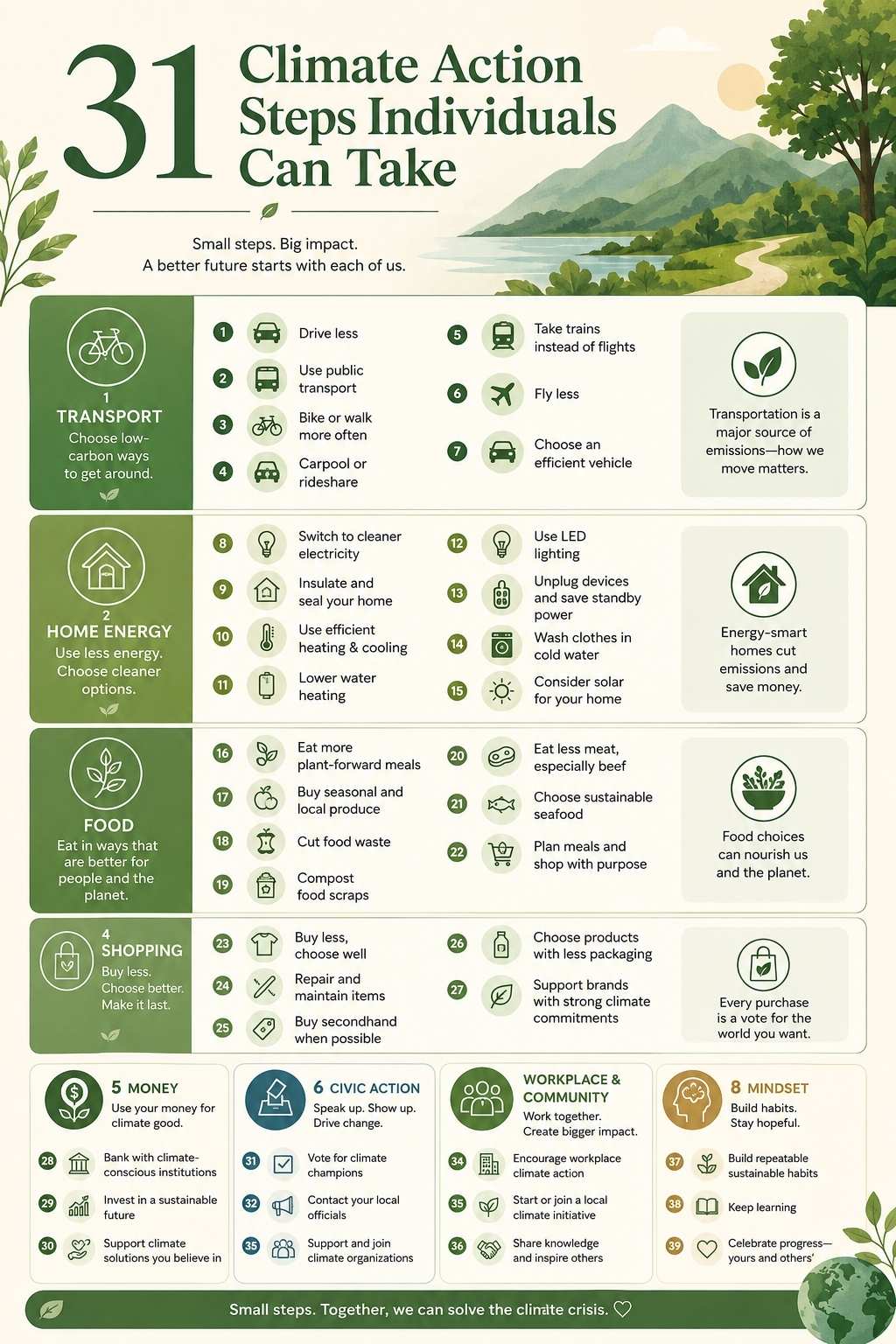
31 Climate Action Steps Individuals Can Take
Climate action works best when it becomes practical. You do not need to start with the hardest thing. Start with the step that fits your life and has enough impact to be worth repeating.
1. Drive Less Where You Realistically Can
Driving less remains one of the clearest individual climate action steps because gasoline and diesel trips create direct emissions. The point is not to shame people who live in car-dependent places. Many people do not have safe sidewalks, reliable buses, or nearby services.
The practical move is to find the trips you can actually reduce. Maybe that is one commute day, one school pickup rotation, one short errand, or one weekly drive replaced by walking, biking, public transport, or carpooling.
A single avoided drive is small. A repeatedly avoided drive becomes a real pattern.
Start here: Pick one regular trip each week and replace it with a lower-emission option.
2. Walk, Bike, or Use Public Transport for Short Trips
Short car trips are often the easiest to replace because they use fuel inefficiently and add local pollution. Walking, biking, buses, and trains can cut emissions while also improving health, reducing traffic, and saving money.
This step works best when you start with convenience. Do not begin with the hardest route in your life. Start with the nearby shop, school run, gym trip, office commute, or local appointment that already feels possible.
Good fit for: People living near shops, schools, workplaces, transit routes, or bike-friendly streets.
3. Combine Errands Instead of Making Separate Car Trips
If you cannot drive less every day, drive smarter.
Combining errands is simple, but it works because it reduces repeated short trips. Instead of driving to the grocery store on Monday, pharmacy on Tuesday, post office on Wednesday, and another shop on Thursday, group them into one route. It also saves time, which is what people actually feel.
Practical step: Keep a running errands list and choose one combined route instead of multiple spontaneous trips.
4. Choose an EV, Hybrid, E-Bike, or Smaller Car When You Replace a Vehicle
You do not need to replace a working car tomorrow to prove you care about the climate. In many cases, the better move is to plan your next replacement carefully.
When your vehicle is truly due for replacement, consider an EV, plug-in hybrid, regular hybrid, e-bike, cargo bike, or smaller, efficient car. The best option depends on your budget, charging access, driving distance, local grid, and household needs.
The key idea is replacement timing. A rushed car decision can lock in emissions for years.
Before you buy: Ask whether you need a full-size car, a second car, or a lower-cost alternative like an e-bike.
5. Fly Less When a Trip Is Optional
For frequent flyers, reducing air travel can be one of the highest-impact personal climate steps.
Not every flight is avoidable. Families are spread across countries. Work happens. Emergencies happen. But some flights are optional, replaceable, or combinable. Those are the ones to question first.
Can you take a train? Combine two work trips? Attend remotely? Take one longer trip instead of three short ones? Choose a closer destination?
High-impact move: Replace one avoidable flight this year with a lower-emission option.
6. Seal Air Leaks at Home
A drafty home wastes energy quietly. Heated or cooled air escapes, and your HVAC system works harder to keep the same temperature.
Air sealing can include weatherstripping doors, sealing gaps around windows, adding door sweeps, sealing attic hatches, and fixing obvious leaks around pipes or vents. It is not glamorous, but it is practical.
This is one of the best first-home eco actions because it can improve comfort and reduce energy waste at the same time.
Start here: Check doors, windows, attic access, and basement gaps.
7. Improve Insulation Where It Matters Most
Insulation helps your home hold temperature longer. That means less heating in winter and less cooling in summer.
The best place to start depends on the home, but attics, roofs, crawl spaces, basements, and exterior walls often matter. For renters, heavy curtains, draft blockers, and landlord requests may be more realistic than major insulation work.
Good fit for: Older homes, high energy bills, cold rooms, hot rooms, and homes with uneven temperatures.
8. Use a Smart Thermostat Properly
A smart thermostat only helps if you actually use it well. The main idea is simple: do not heat or cool an empty home as if everyone is sitting there. Set schedules, use away modes, and avoid extreme temperature swings that make systems work harder.
This is a small action with repeated payoff, especially in homes with regular heating or cooling demand.
Practical move: Set a realistic schedule for sleeping, working, and away hours.
9. Switch High-Use Bulbs to LEDs
LEDs are not the biggest climate action on this list, but they are easy, affordable, and widely available.
Start with the lights that run the longest: kitchen lights, living room lamps, porch lights, hallway lights, bathroom lights, and workspace lighting. Replacing rarely used bulbs can wait.
Simple rule: Replace high-use bulbs first, not every bulb at once.
10. Choose Efficient Appliances When Old Ones Need Replacing
Appliances last for years, so replacement decisions matter. When a refrigerator, washer, dryer, dishwasher, air conditioner, or water heater reaches the end of its life, compare energy use before buying. An efficient appliance can reduce household emissions without asking you to change your daily routine.
Do not replace everything early just because a newer model looks greener. Timing matters.
Best moment: When an appliance is failing, inefficient, oversized, or expensive to run.
11. Electrify Heating and Cooling With Heat Pumps
Heating and cooling are major home emissions areas, especially in homes that burn gas, oil, or propane.
Heat pumps can heat and cool using electricity, often much more efficiently than traditional systems. They are not a casual impulse purchase, but they are worth researching before your furnace, boiler, or air conditioner fails.
The worst time to learn about heat pumps is during an emergency breakdown.
Planning step: Get quotes and understand rebates before your current system reaches end of life.
12. Switch to Cleaner Electricity
Cleaner electricity makes many other climate steps stronger. If your home, car, cooking, and heating rely more on electricity, the source of that electricity matters.
Options may include rooftop solar, community solar, green power programs, renewable electricity plans, or a utility grid that is already getting cleaner. Not every option is available everywhere, but it is worth checking.
Good first step: Look at your utility’s renewable electricity options or community solar availability.
13. Reduce Hot Water Waste
Hot water uses energy. Every long hot shower, hot laundry cycle, and running tap adds up.
The practical fixes are simple: wash clothes in cold water when appropriate, fix leaks, use low-flow showerheads, run full dishwasher loads, and avoid letting hot taps run unnecessarily.
Low-effort win: Switch regular laundry to cold water unless hot water is truly needed.
14. Eat More Plant-Forward Meals
Food is personal, cultural, emotional, and often political. So let’s keep this realistic.
You do not need to become perfectly vegan overnight to lower your food footprint. Eating more plant-forward meals means making beans, lentils, chickpeas, tofu, vegetables, grains, nuts, and lower-impact proteins a larger part of your routine.
The climate benefit comes from the pattern, not one perfect dinner.
Start here: Replace two meat-heavy meals per week with plant-forward meals you already like.
15. Reduce Beef and Lamb First
If you want the biggest food-related climate ROI, start with beef and lamb.
Not all meats have the same footprint. In general, ruminant meats tend to have much higher emissions than plant-based foods and many other protein choices. That means reducing beef and lamb can matter more than stressing over every tiny grocery detail.
Simple swap: Try lentil chili, bean tacos, mushroom pasta, tofu stir-fry, chickpea curry, or veggie burgers instead of beef-heavy meals.
16. Cut Food Waste
Food waste is climate waste. When food gets thrown away, the emissions from growing, processing, packaging, transporting, storing, and cooking it are wasted too. If it rots in a landfill, it can also produce methane.
The solution is not a perfect fridge. It is a better system.
Try this: Create an “eat first” shelf, freeze leftovers early, plan flexible meals, and stop buying aspirational vegetables you know you will ignore.
Preventing food waste comes first. Composting comes after.
Composting helps keep organic waste out of landfills and can return nutrients to the soil. If you have a backyard, local pickup, apartment composting, or community drop-off, use it for unavoidable scraps like peels, coffee grounds, eggshells, and spoiled bits you could not prevent.
Important note: Composting is helpful, but it is not permission to waste edible food.
18. Buy Only What You Will Actually Use
This sounds obvious until you look inside a closet, pantry, garage, or online order history.
A big part of climate action is simply buying less unnecessary stuff. Every product carries materials, manufacturing, packaging, shipping, storage, and disposal. Even “eco-friendly” products have footprints.
Before buying, ask: Will I use this often? Do I already own something that works? Can I borrow, rent, repair, or buy secondhand?
Best question: “Do I need this, or do I just like the idea of owning it?”
19. Repair, Reuse, and Borrow More Often
Repair culture is climate action with a practical soul.
Repairing clothes, shoes, appliances, bikes, furniture, electronics, and household goods keeps materials in use longer. Borrowing tools, party supplies, camping gear, or specialty equipment also prevents one-time purchases that sit unused for years.
Good starting point: Repair one thing you already own before buying its replacement.
20. Choose Durable Goods Over Trendy Green Products
Sustainable shopping can still become overconsumption if it turns into constant buying.
A durable product you use for years is usually better than a trendy “green” product you replace quickly. Quality, repairability, and long-term usefulness matter.
This is especially true for clothing, shoes, furniture, kitchenware, electronics, and home goods.
Buying rule: Choose fewer, better, longer-lasting items when you truly need something.
21. Check Whether Your Bank Funds Fossil Fuels
Money has climate power.
Many people think of individual climate action only as daily habits, but banks and financial institutions help decide what gets built. If your bank heavily finances fossil fuel expansion, your money may be connected to systems you would not personally support.
You do not have to become a finance expert. Start by checking credible fossil finance reports, your bank’s climate policies, and whether better banking options are available.
Practical step: Compare your bank with climate-conscious banking alternatives before opening or keeping major accounts.
22. Review Retirement and Investment Funds
Retirement accounts and investment funds can carry hidden fossil fuel exposure.
If you have a pension, workplace retirement plan, mutual fund, index fund, or brokerage account, check what it holds. Some funds market themselves as sustainable but still include companies or sectors you may want to avoid.
This is not about chasing perfect purity. It is about knowing where your money sits and asking better questions.
Start here: Look up your largest funds and check their holdings, fees, and climate policies.
23. Support Businesses That Take Climate Seriously
Voting with your wallet is not enough on its own, but it is not meaningless either.
When people support companies that reduce emissions, use cleaner energy, avoid wasteful packaging, design durable products, and disclose real progress, they send a market signal. The reverse is also true. Companies notice when customers stop rewarding wasteful behavior.
Use this wisely: Reward better companies when you already need to buy something. Do not buy more just to feel sustainable.
24. Vote in Every Climate-Relevant Election
Climate policy is where individual action scales.
National elections matter, but local elections often shape transportation, zoning, building codes, energy programs, waste systems, tree cover, flood planning, and public transit. Those decisions directly affect how easy or hard low-carbon living becomes.
If you only vote in major national elections, you are missing many climate decisions.
Personal climate step: Track local elections, candidate positions, and ballot measures related to energy, transport, housing, waste, and land use.
25. Contact Local Officials About Specific Climate Issues
A vague message saying “please care about the climate” is better than silence, but a specific ask is stronger.
Ask for safer bike lanes. Better bus frequency. Building efficiency programs. Tree protection. Community solar. Flood resilience. Composting. Heat pump incentives. Clean school buses. Local officials hear from loud opponents all the time. They also need to hear from residents who want climate action.
Make it easy: Send one short message about one specific issue.
26. Support Clean Transport and Safer Streets
Individual transportation choices are limited by infrastructure. That is why supporting better infrastructure is a climate action.
Safe sidewalks, bike lanes, bus lanes, train service, shaded walking routes, traffic calming, and e-bike access can help many people drive less. These changes also improve safety, health, and local air quality.
Good local action: Support one project that makes walking, biking, or public transport easier in your area.
27. Join or Support a Local Climate Group
Climate action is easier when you stop acting alone.
Local climate groups often work on clean energy, transit, school policies, food systems, tree planting, flood resilience, waste reduction, and local legislation. You can volunteer, donate, show up at meetings, help with communications, or simply amplify their work.
Low-pressure entry: Attend one meeting or subscribe to one local group’s updates.
28. Push Your Workplace to Reduce Emissions
Workplaces buy energy, manage buildings, book travel, choose suppliers, run events, invest retirement funds, and influence employees.
That means workplace climate action can go beyond your personal footprint. You can ask about renewable electricity, business travel policies, remote-work options, building efficiency, supplier choices, retirement fund options, waste systems, and internal climate goals.
Useful question: “What is one emissions-reducing decision our workplace could make this year?”
29. Use Your Skills in Climate-Relevant Ways
Not everyone needs to become a climate scientist.
Writers, designers, accountants, engineers, teachers, marketers, lawyers, developers, builders, HR teams, project managers, chefs, planners, and entrepreneurs can all use their skills in climate-relevant ways.
You might shift jobs, support a climate-focused project, help a local group, improve your company’s operations, or create content that helps people act.
Career step: Identify one skill you already have that could support climate work.
30. Talk to Family About Realistic Climate Steps
Climate conversations matter because habits spread through families and communities.
Do not start by lecturing. Start with shared concerns: bills, health, air quality, food waste, children, extreme weather, local flooding, heat, or transport costs. Then suggest one practical step that fits the household.
The best climate conversation is not “you are doing everything wrong.” It is “what can we change together that makes life better?”
Good starter: Talk about one shared action, such as reducing food waste, lowering energy bills, or planning fewer car trips.
31. Choose Repeatable Action Over Perfect Action
Perfection is one of the biggest traps in individual climate action. People try to do everything, fail, feel guilty, and quit. That helps nobody. A repeatable action that cuts emissions every week is better than a dramatic action you abandon after two days.
Choose your next step based on your life, not someone else’s Instagram version of sustainability.
Final rule: Do the highest-impact thing you can repeat.

Quick Overview: 31 Climate Action Steps Individuals Can Take
| Category | Climate Action Step | Impact Type |
| Transport | Drive less where possible | Direct emissions reduction |
| Transport | Walk, bike, or use public transport | Direct emissions reduction |
| Transport | Combine errands and reduce short trips | Habit change |
| Transport | Choose an EV, hybrid, e-bike, or smaller car when replacing | Long-term emissions reduction |
| Transport | Fly less and travel smarter | High-impact lifestyle shift |
| Home | Seal air leaks and improve insulation | Energy efficiency |
| Home | Use a smart thermostat properly | Energy efficiency |
| Home | Switch to LEDs | Low-cost efficiency |
| Home | Choose efficient appliances when replacing | Long-term efficiency |
| Home | Electrify heating and cooling with heat pumps | Major home upgrade |
| Home | Switch to cleaner electricity | Clean energy |
| Home | Reduce hot water waste | Energy and water savings |
| Food | Eat more plant-forward meals | Food footprint reduction |
| Food | Reduce beef and lamb first | High-impact diet shift |
| Food | Cut food waste | Waste and methane reduction |
| Food | Compost the unavoidable scraps | Waste reduction |
| Food | Buy only what you will actually eat | Consumption discipline |
| Shopping | Buy less new stuff | Consumption reduction |
| Shopping | Repair, reuse, and borrow | Product life extension |
| Shopping | Choose durable goods over trendy green products | Smarter purchasing |
| Money | Check your bank’s fossil fuel exposure | Financial climate pressure |
| Money | Review retirement and investment funds | Long-term financial alignment |
| Money | Support climate-conscious businesses | Market signal |
| Civic | Vote in every relevant election | Policy leverage |
| Civic | Contact local officials about climate issues | Local pressure |
| Civic | Support clean transport and safe streets | Infrastructure change |
| Civic | Join or support a local climate group | Community action |
| Work | Push your workplace to reduce emissions | Institutional influence |
| Work | Use your skills in climate-relevant ways | Career leverage |
| Social | Talk to family about realistic climate steps | Social influence |
| Mindset | Pick repeatable actions, not perfection | Long-term consistency |
Best Climate Action Steps by Lifestyle
| If You Are… | Start With This |
| A daily driver | Reduce one recurring car trip |
| A frequent flyer | Replace or combine one avoidable flight |
| A renter | LEDs, clean electricity options, food waste, and hot water savings |
| A homeowner | Air sealing, insulation, heat pump planning, and clean electricity |
| A parent | Food waste, school transport, and local climate-safe policies |
| A student | Transit, plant-forward meals, climate conversations, local organizing |
| A high earner | Flights, cars, investments, home energy, donations |
| A low-budget household | Food waste, energy waste, repair, and efficient habits |
| A business owner | Energy, suppliers, delivery, and workplace policies |
| A job seeker | Climate-relevant roles, skills, employers, projects |
What Climate Actions Are Overrated?
Some eco actions are not bad, but they are often overpraised.
Reusable bags are useful, but they do not compare with transport, food, home energy, or voting. Recycling matters, but reducing waste matters more. Buying eco products can help, but buying less is often better. Carbon offsets can be complicated and should not become permission to keep high-emission habits unchanged.
The question should always be: Does this action reduce repeated emissions, shift money, influence systems, or make climate-friendly choices easier for others?
If yes, it is probably worth doing.
How to Build a Personal Climate Action Plan
You do not need all 31 steps at once. Use this simple order:
- Pick your biggest emissions area: transport, home, food, flights, money, or consumption.
- Choose one action you can repeat.
- Add one medium-term upgrade, such as insulation, clean electricity, or a better commute.
- Add one social or civic action, such as voting, contacting officials, or talking with family.
- Review every few months and choose the next step.
Climate action works better as a system than as a random list of good intentions.
The Bigger Picture
Individual climate action should never become a way to blame ordinary people for a crisis built by fossil fuel systems, weak policy, and overconsumption-heavy economies.
But it should also not become an excuse to do nothing.
The most useful climate action steps are the ones that connect personal choices with system pressure. Drive less if you can, and support better transit. Eat more plant-forward meals, and support food systems that reduce waste. Move your money, and ask institutions to stop funding fossil expansion. Use less energy at home, and support clean power policies. Talk to your family, and vote for leaders who treat the climate seriously.
That is how personal climate steps become more than private virtue. They become part of public change.
Frequently Asked Questions About Climate Action Steps for Individuals
1. What are the most effective climate action steps individuals can take?
The most effective climate action steps usually involve transportation, home energy, food, waste, money, and civic pressure. Driving less, flying less, improving home efficiency, switching to cleaner electricity, eating more plant-forward meals, cutting food waste, moving money away from fossil fuels, and voting for climate policy are all high-impact areas.
2. Can individual climate action really make a difference?
Yes, but not by itself. Individual climate action matters when it reduces repeated emissions, shifts demand, influences family and community habits, and supports policy change. The biggest climate progress still requires systems, infrastructure, regulation, and corporate accountability.
3. What climate action should I start with if I feel overwhelmed?
Start with one repeatable action in your biggest emissions area. If you drive daily, reduce one car trip. If you waste food, build an “eat first” shelf. If your home wastes energy, seal drafts. If you are a frequent flyer, replace one flight. Start where your effort has a real impact.
4. Are eco actions like recycling and reusable bags enough?
No. Recycling and reusable bags can help, but they are not enough on their own. Higher-impact personal climate steps usually involve transport, home energy, food choices, food waste, purchasing less, financial choices, and political action.
5. How can I take climate action if I do not have much money?
Focus on steps that save money or require little spending: reduce food waste, drive less when possible, use less hot water, switch high-use bulbs to LEDs, repair items, buy less, use public transport where available, compost through community programs, and vote for better local climate policies.
6. What is the biggest mistake people make with climate action?
The biggest mistake is chasing perfection instead of consistency. People try to change everything at once, feel guilty when they cannot, and stop. It is better to choose a few high-impact actions you can repeat and then build from there.