Most home recovery products promise the same fantasy: train hard, use one gadget for ten minutes, wake up feeling brand new. That sounds lovely. It is also not how bodies work. Recovery is still built on boring fundamentals: sleep, hydration, enough food, smart training, rest days, mobility, and knowing when pain is no longer “just soreness.” No massage gun, compression boot, heated wrap, or foam roller can outsmart terrible sleep and overtraining.
But the right recovery gear can help. A good product can make sore muscles feel easier to manage, help you warm up stiff areas, support mobility work, or make post-workout recovery more consistent at home. The problem is that the recovery market is packed with expensive gadgets, copycat devices, and bold claims that make everything sound essential. It is not.
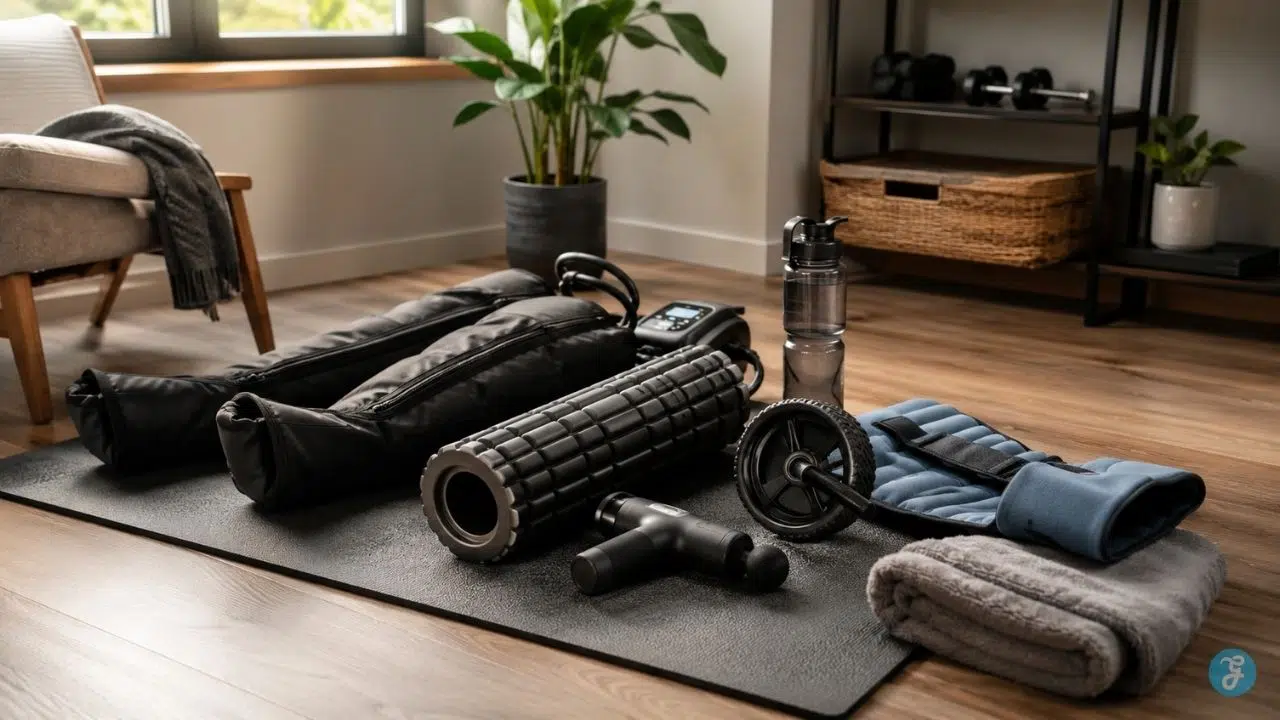
This list focuses on 7 home recovery products that are actually worth considering because they solve different problems: percussion massage, leg compression, heat and vibration, hot-cold therapy, foam rolling, vibrating rolling, and targeted back release.
What Makes Home Recovery Products Worth It?
A recovery product is worth it only if it fits your body, routine, and actual problem.
A massage gun may be useful if you regularly deal with tight quads, calves, traps, or glutes. Compression boots may make sense if your legs feel heavy after long runs, cycling, lifting, travel, or standing all day. A heat wrap may help if your lower back gets stiff after desk work. A foam roller is still one of the simplest tools for basic muscle release. A hot-cold device may be useful for people who want targeted temperature therapy without constantly refreezing ice packs.
The best recovery products usually meet at least one of these standards:
- They are easy enough to use consistently.
- They solve a specific recovery problem.
- They do not require a complicated setup.
- They have clear settings and safety guidance.
- They fit your budget and recovery routine.
- They support movement and comfort without pretending to replace medical care.
Use these products for soreness, stiffness, warmups, cooldowns, and general recovery routines. For sharp pain, swelling, injury, numbness, worsening symptoms, or pain that does not improve, see a qualified health professional.
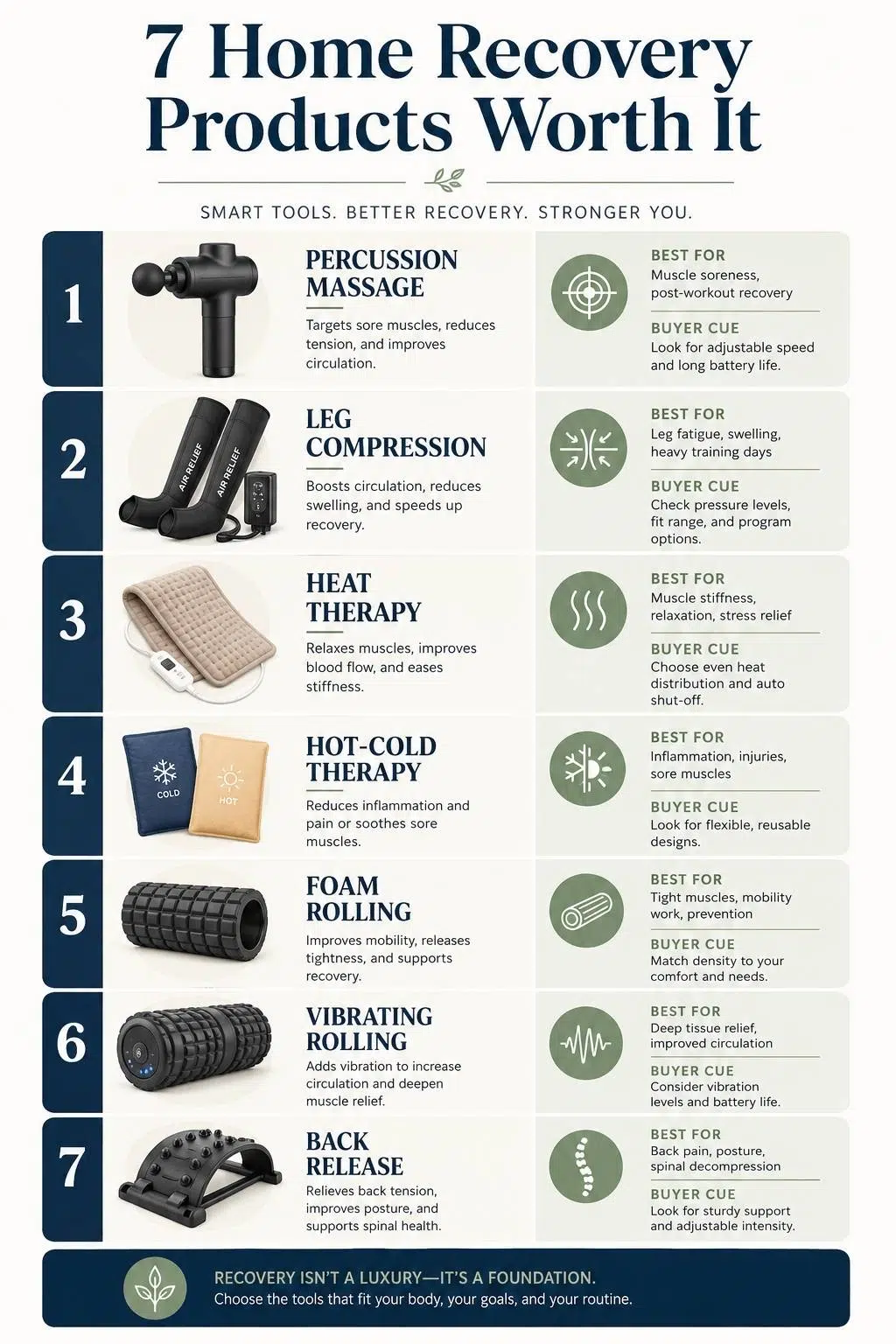
7 Home Recovery Products Worth It
The products below are not all for the same user. Some are premium recovery devices for athletes. Some are simple tools for everyday stiffness. The point is to choose the product that matches your recovery need, not the one with the flashiest marketing video.
1. Hyperice Hypervolt 3 Pro
Hyperice Hypervolt 3 Pro is one of the strongest massage gun picks for people who want serious percussive recovery without buying the most complicated device on the market.
It is designed for deep-tissue massage, app-connected routines, and controlled intensity. Hyperice highlights Bluetooth connection to the Hyperice App, QuietGlide technology, a long battery life, and a premium travel case. That makes it useful for people who train often and want guided recovery rather than randomly hammering sore muscles for two minutes and hoping for the best.
The real value is control. A good massage gun should not just be powerful. It should be adjustable enough for different muscle groups, soreness levels, and users. The Hypervolt 3 Pro is better suited to people who will actually use multiple speeds and guided routines.
It is not the best choice for someone who only wants occasional gentle relief. For casual users, a less expensive massage gun may be enough.
A strong match for: Athletes, gym users, runners, cyclists, and people who want a powerful app-connected massage gun.
Best feature: QuietGlide technology and Bluetooth support for guided recovery routines.
Worth considering: Massage guns should not be used directly on bones, joints, injuries, bruises, swollen areas, or areas with numbness.
2. Hyperice Normatec 3 Legs
Hyperice Normatec 3 Legs is one of the most recognizable home recovery products for people who want compression therapy for tired legs.
These boots use dynamic air compression to squeeze and release the legs in a patterned way. The goal is to help legs feel fresher after hard workouts, long runs, cycling sessions, heavy training weeks, travel, or long days on your feet.
This is not a small purchase. It is a serious recovery device, and it takes more space than a massage gun or roller. But for people who repeatedly deal with heavy, tired legs, compression boots can become one of the most-used recovery tools at home.
Normatec 3 Legs makes the most sense if lower-body recovery is your real issue. If your soreness is mostly shoulders, hips, back, or neck, spend your money elsewhere.
Ideal for: Runners, cyclists, lifters, team-sport athletes, and people whose legs often feel heavy after training.
Top advantage: Full-leg dynamic compression with a more complete recovery feel than smaller tools.
Before buying: Check sizing carefully and avoid compression devices if you have medical conditions where compression is not advised unless a clinician clears it.
3. Hyperice Venom 2 Back
Hyperice Venom 2 Back is a wearable heat and vibration wrap designed for people whose back feels stiff, tight, or overworked.
This is one of the more practical recovery devices for desk workers and active people because lower-back tension is common. Instead of lying on a roller or trying to reach your back with a massage gun, you strap the wrap around your lower back and let the heat and vibration do the work.
Its main appeal is convenience. Heat can help relax stiff muscles before movement, while vibration adds a massage-like feel. It is especially useful before stretching, after long sitting, or during a low-key recovery routine.
It is not a cure for back pain, and it should not be used to mask serious symptoms. But as a home recovery tool for general stiffness and tension, it is much easier to use consistently than many bulkier devices.
Works well for: Desk workers, lifters, runners, and anyone who often feels lower-back tightness.
Best feature: Wearable heat plus vibration in one back-focused device.
Practical note: Start with lower heat settings and avoid using heat on acute swelling or new injuries unless advised by a professional.
4. Therabody RecoveryTherm Cube
Therabody RecoveryTherm Cube is a compact hot-cold recovery device for people who want targeted temperature therapy without dealing with melting ice packs or reheating pads.
It offers cold, heat, and contrast therapy in a small wearable format. That makes it more convenient for knees, elbows, shoulders, ankles, or specific sore spots than a traditional heating pad or bag of ice. The big selling point is control: you can choose cold, heat, or alternating contrast therapy depending on what your body needs and what the device instructions allow.
This is best for people who often use both ice and heat and want a cleaner, more portable setup. It is less necessary for someone who only occasionally needs a basic ice pack.
Temperature therapy should be used carefully. Cold can be useful for swelling and acute irritation. Heat may feel better for stiffness and tight muscles. But not every ache needs the same treatment.
A good choice for: People who regularly use heat, cold, or contrast therapy for targeted recovery.
Best feature: Compact heat, cold, and contrast therapy in one device.
One thing to note: It is a convenience upgrade, not a must-have. Basic ice packs and heating pads still work for many people.
5. Therabody WaveRoller
Therabody WaveRoller is for people who already like foam rolling but want more intensity and vibration options.
It combines a high-density foam roller with vibration, making it more advanced than a standard roller. This can be useful for large muscle groups like quads, hamstrings, calves, glutes, lats, and upper back areas, where vibration may make rolling feel more effective or easier to tolerate.
The WaveRoller makes the most sense for people who actually foam roll regularly. If you hate foam rolling, adding vibration may not magically change your personality. But if rolling is already part of your warmup or cooldown, this is a strong upgrade.
It is also more expensive than a basic roller and needs charging, so beginners may want to start with a simpler product first.
Best suited to: People who already use foam rolling and want a stronger, more premium version.
Key benefit: Traditional foam rolling plus vibration for larger muscle groups.
Worth knowing: Avoid rolling directly over joints, the spine, bruised areas, or acute injuries.
6. TriggerPoint GRID 1.0 Foam Roller
TriggerPoint GRID 1.0 is the product on this list that proves recovery gear does not need to be expensive to be useful.
It is a durable textured foam roller with a hollow core and EVA foam surface. The GRID pattern is designed to create different pressure zones, giving more texture than a smooth basic roller. It is simple, portable enough for most homes, easy to clean, and does not need charging, an app, or a warranty debate every time you want to loosen tight calves.
This is one of the best starting points for people building a home recovery setup. You can use it before workouts, after workouts, or during mobility sessions. It also pairs well with stretching, strength work, and simple movement breaks.
The main caution is pressure. Beginners often roll too hard, too fast, and too long. Start gently.
Perfect if you want: A reliable, affordable recovery tool that does not need batteries.
Best feature: Durable textured design for everyday foam rolling.
Before you buy: If you are very sensitive to pressure, start with a softer roller before choosing a firm textured one.
7. Chirp Wheel+ 4-Pack
Chirp Wheel+ 4-Pack is a targeted back and neck rolling system for people who want something more specific than a standard foam roller.
The set includes different wheel sizes designed for different areas and pressure levels. The larger wheel gives a broader back stretch, while smaller wheels target tighter spots around the upper back, neck, and deeper muscle tension. Chirp’s spinal canal design is meant to reduce direct pressure on the spine while allowing pressure on the surrounding muscles.
This product is useful for people who sit a lot, feel upper-back tightness, or want a more controlled back rolling tool. It is not for aggressive cracking or forcing movement. Used gently, it can become a simple daily reset.
If you have a history of spine injury, disc issues, nerve symptoms, osteoporosis, or unexplained back pain, do not experiment aggressively with back tools. Get professional guidance first.
Recommended for: People with general back and neck tightness from sitting, training, or posture habits.
Best feature: Multiple wheel sizes for different pressure levels and back areas.
Final buying note: Start with the gentlest wheel and use a wall-supported version before full bodyweight rolling.
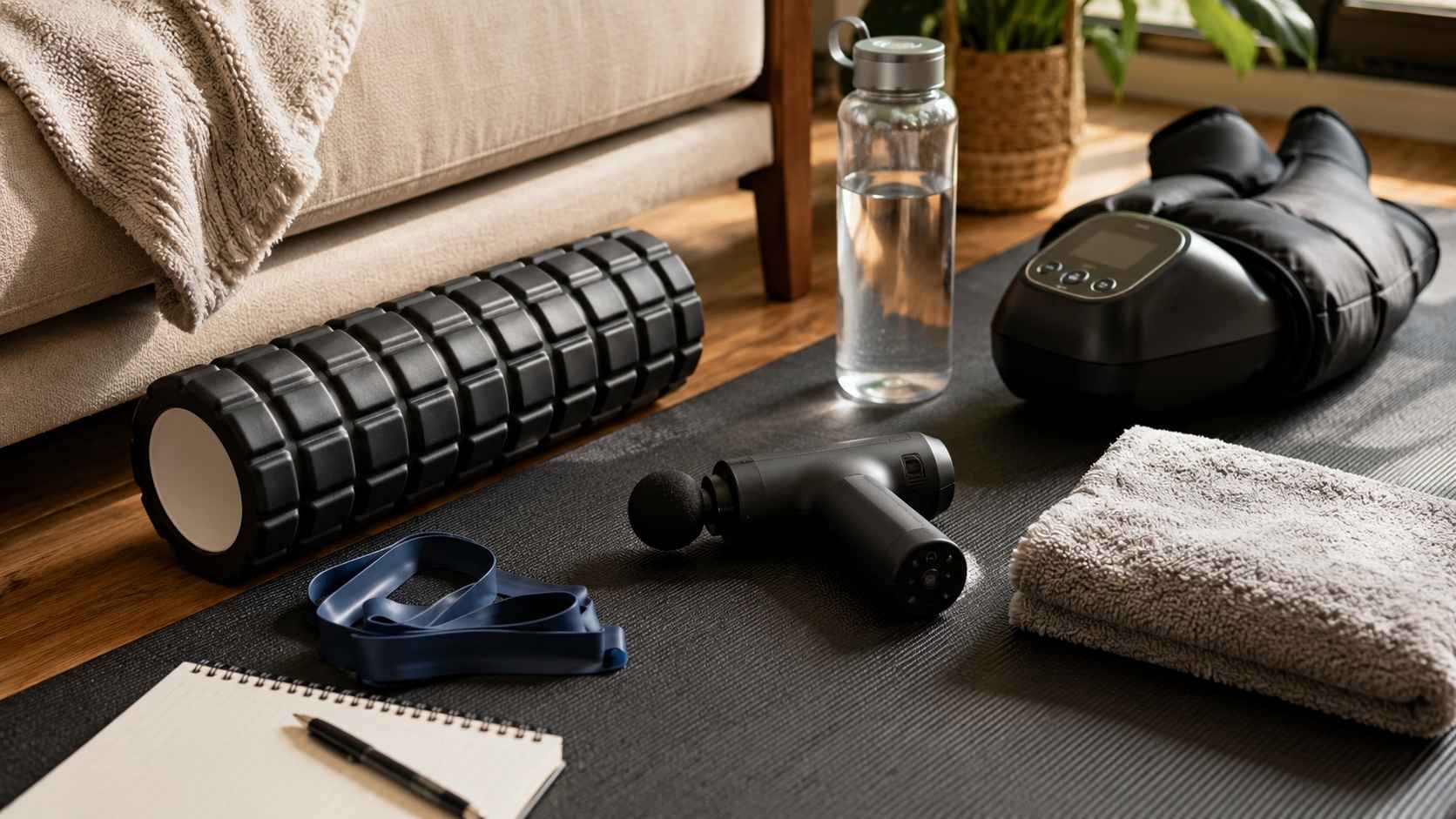
Quick Comparison: 7 Home Recovery Products Worth It
| Product | Best For | Product Type | Main Strength |
| Hyperice Hypervolt 3 Pro | Serious massage gun users | Percussion massage gun | Powerful app-connected massage gun with QuietGlide technology |
| Hyperice Normatec 3 Legs | Heavy legs and serious lower-body recovery | Compression boots | Dynamic air compression for legs |
| Hyperice Venom 2 Back | Lower-back stiffness and tension | Heated vibration wrap | Heat plus vibration in a wearable back wrap |
| Therabody RecoveryTherm Cube | Targeted hot and cold recovery | Hot-cold contrast device | Compact heat, cold, and contrast therapy |
| Therabody WaveRoller | Large muscle rolling with vibration | Vibrating foam roller | Foam rolling plus vibration settings |
| TriggerPoint GRID 1.0 Foam Roller | Affordable daily mobility work | Foam roller | Durable, simple, no charging needed |
| Chirp Wheel+ 4-Pack | Back and neck rolling | Back/neck recovery wheels | Different wheel sizes for targeted spinal-area muscle release |
What to Check Before Buying Recovery Gear
Before buying recovery gear, ask these questions:
- What problem am I trying to solve?
- Is this for soreness, stiffness, warmup, cooldown, or injury support?
- Will I actually use it weekly?
- Does it need charging?
- Is it easy to clean?
- Does it fit my body size and comfort level?
- Does it come with clear safety instructions?
- Is there a cheaper tool that solves the same problem?
- Do I have any medical condition that makes compression, heat, cold, or vibration risky?
The most expensive recovery device is not automatically the best. A $40 foam roller used three times a week is more valuable than a $900 device that becomes furniture.
Common Mistakes People Make With Muscle Recovery Products
- Buying recovery devices before fixing basic recovery habits. If you sleep five hours, skip rest days, and under-eat after training, a massage gun will not save you.
- Using too much pressure. More pain does not mean more recovery. It often means you are irritating tissue.
- Using heat, cold, compression, or vibration on the wrong problem. New injuries, swelling, nerve symptoms, and sharp pain need caution.
- Treating devices like medical treatment. Recovery tools can support comfort and mobility, but they are not a substitute for professional care.
- Buying duplicate tools. You probably do not need three massage guns, two compression systems, and five rollers unless you run a recovery studio.
A Simple Home Recovery Routine
A good recovery routine does not need to be complicated.
Try this after a hard workout:
- Walk or move lightly for a cooldown.
- Hydrate and eat a proper meal.
- Use a foam roller or vibrating roller for tight muscle groups.
- Use a massage gun briefly on large muscles, not joints.
- Use compression boots if your legs feel heavy.
- Use heat for general stiffness or cold for acute irritation when appropriate.
- Sleep properly.
The product should support the routine, not replace the routine.
Wrapping Up
The best home recovery products are the ones you will use safely and consistently.
Hyperice Hypervolt 3 Pro is a strong massage gun for serious users. Normatec 3 Legs is worth considering for lower-body recovery. Venom 2 Back is practical for heat and vibration around the back stiffness. Therabody RecoveryTherm Cube is useful for targeted hot-cold therapy. WaveRoller is a premium upgrade for people who already foam roll. TriggerPoint GRID 1.0 is the best simple starting point. Chirp Wheel+ 4-Pack is useful for controlled back and neck rolling.
Recovery gear can help sore muscles feel more manageable, but it should not become a shortcut for rest, sleep, smart training, and medical care when needed. Buy the tool that solves your real recovery problem. Ignore the rest.
Frequently Asked Questions About Home Recovery Products
1. What are home recovery products?
Home recovery products are tools and devices designed to support post-workout recovery, mobility, soreness relief, and muscle relaxation at home. They include foam rollers, massage guns, compression boots, heat wraps, hot-cold devices, vibrating rollers, and back release tools.
2. Are massage guns worth it for muscle recovery?
Massage guns can be worth it if you regularly deal with tight or sore muscles and use them safely. They are best for large muscle groups, short sessions, and warmup or cooldown support. They should not be used on bones, joints, acute injuries, swelling, or unexplained pain.
3. Are compression boots worth buying?
Compression boots may be worth it for runners, cyclists, lifters, athletes, and people whose legs often feel heavy after training or long days. They are expensive, so they make the most sense for frequent users, not casual exercisers who only need occasional recovery support.
4. What is the best affordable home recovery product?
A good foam roller, such as the TriggerPoint GRID 1.0, is one of the best affordable recovery products. It does not need charging, supports mobility work, and can help with tight muscles when used gently and consistently.
5. Should I use heat or cold for muscle recovery?
Cold is often used for new irritation, swelling, or acute soreness, while heat may feel better for stiffness and tight muscles. The right choice depends on the issue. Avoid extreme temperatures, protect your skin, and ask a professional if pain is serious or persistent.
6. Can recovery gear replace physical therapy?
No. Recovery gear can support comfort, mobility, and soreness management, but it cannot replace physical therapy or medical care. If you have sharp pain, injury, swelling, numbness, weakness, or pain that keeps returning, see a qualified professional.