

Most climate investment decisions sound simple until you actually look at your money. You want your portfolio to match your values. Fair enough. Then you open a fund page and see words like ESG, sustainable, impact, transition, low carbon, Paris-aligned, climate aware, green bond, fossil-free, stewardship, and responsible investing.
Suddenly, “I want my money to do less harm” turns into a small research project with fees, risk ratings, fund holdings, and suspicious marketing language. That is where climate-conscious investors get stuck.
Some funds sound green but still hold fossil fuel companies. Some clean-energy stocks are exciting but volatile. Some ESG funds focus more on governance than climate. Some banks market sustainability while financing fossil fuel expansion. Some retirement plans offer limited choices. And some investors make the classic mistake of turning a long-term portfolio into a personal values panic. The better approach is calmer.
Climate-conscious investing should not mean chasing every hot green stock or assuming every ESG label is clean. It means making clear decisions about risk, diversification, fees, fossil fuel exposure, climate themes, financial goals, and real-world impact.
This guide covers 8 investment decisions climate-conscious people should think through before building or adjusting a sustainable portfolio.
What Climate-Conscious Investing Really Means
Climate-conscious investing is not one single strategy. For one person, it may mean avoiding fossil fuel producers. For another, it may mean investing in clean energy, grid infrastructure, climate adaptation, green bonds, or companies with credible transition plans. For someone else, it may mean using ESG funds inside a retirement account because that is the only practical option available.
The important part is knowing the difference between values, risk, and impact. A fund can match your values without directly funding new climate solutions. A clean-energy stock can support a climate theme but still be risky. A broad ESG fund can improve diversification but may not be fossil-free. A green bond can finance environmental projects, but still needs a credit-quality review. A bank can advertise sustainability while lending heavily to oil and gas companies.
So the first job is not to find the “perfect” investment. The first job is to understand what kind of climate investor you want to be.
Do you want to avoid certain industries? Do you want to support climate solutions? Do you want a lower-carbon version of a diversified portfolio? Do you want measurable impact? Do you want to use shareholder voting? Do you want your cash, bank, retirement plan, and investments to point in the same direction? Those are different goals. They need different decisions.
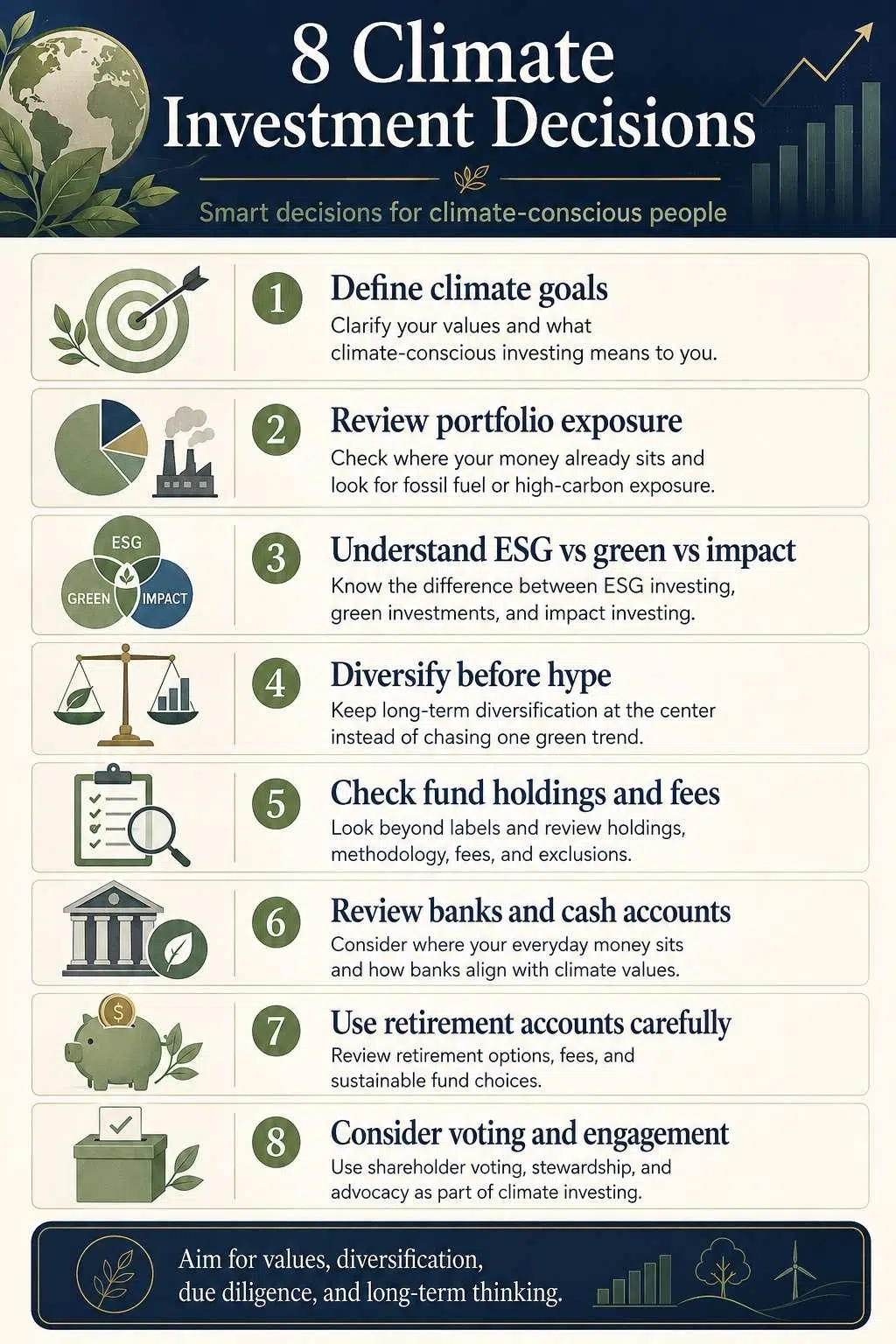
8 Climate Investment Decisions for Climate-Conscious People
These decisions are not personal financial advice. They are a practical framework to help you ask better questions before investing. For decisions involving your personal risk tolerance, taxes, retirement, or major portfolio changes, speak with a qualified financial professional.
1. Decide What “Climate-Conscious” Means for Your Money
The first decision is not which fund to buy. It is what you mean by climate-conscious investing.
Some investors care most about avoiding fossil fuels. Some want exposure to clean energy. Some want broad ESG investing. Some want companies with better emissions management. Some want direct impact through green bonds, community finance, or climate-focused private investments. Some simply want their portfolio to stop feeling completely disconnected from their values. You need to define your goal before comparing options.
Otherwise, you may choose a fund that sounds sustainable but does not match your values. For example, a broad ESG fund may include large technology, healthcare, and financial companies with strong governance scores, but it may not be a pure climate fund. A clean-energy ETF may align more closely with climate themes but may carry higher sector concentration risk. A fossil-free fund may avoid oil and gas producers but still hold companies with large supply-chain emissions.
None of these is automatically wrong. They are just different.
Best move: Write one sentence that explains your climate investing goal.
Example: “I want a diversified portfolio with reduced fossil fuel exposure and some exposure to climate solutions, without taking extreme single-sector risk.”
Watch out for: Choosing investments based only on names like green, ESG, sustainable, clean, responsible, or climate aware.
2. Review Your Current Portfolio Before Buying Anything New
Many people jump straight into green investments without checking what they already own. That is a mistake.
Your current portfolio may already include broad index funds, retirement funds, target-date funds, employer stock, bank products, bonds, or ETFs. Some of those holdings may include fossil fuel companies, utilities, airlines, mining firms, banks, industrial companies, or high-emissions sectors. Some may also include clean-energy or transition-related companies without you realizing it.
A climate-conscious investor should start with a portfolio check. Look at your largest holdings first. Do not get distracted by a tiny fund that makes up 1% of your money while ignoring the retirement fund that holds most of your assets. The biggest positions usually matter most.
This does not mean you must sell everything that is not perfect. It means you should know what you own before making changes.
A smart first step: Check the top holdings and sector exposure of your largest funds.
Best for: Investors with retirement accounts, brokerage accounts, robo-advisors, or target-date funds.
Worth considering: Taxes can matter if you sell investments in a taxable account. Do not make big changes without understanding tax consequences.
3. Learn the Difference Between ESG Investing, Green Investments, and Impact Investing
The words sound similar, but they are not the same.
ESG investing: It usually considers environmental, social, and governance factors as part of investment analysis. A fund may look at climate risk, labor practices, board structure, executive pay, diversity, corruption risk, shareholder rights, or other factors. ESG does not always mean fossil-free.
Green investments: Focus more directly on environmental themes such as renewable energy, energy efficiency, grid upgrades, batteries, electric vehicles, water, waste, sustainable agriculture, or climate infrastructure.
Impact investing: Aims to generate measurable social or environmental outcomes alongside financial return. This may include green bonds, community investing, climate adaptation finance, or funds with specific impact reporting.
The confusion matters because many disappointed investors thought they were buying one thing and got another.
If your goal is climate alignment, do not assume a broad ESG fund is enough. If your goal is diversification, do not assume a narrow clean-energy fund is enough. If your goal is measurable, real-world outcomes, do not assume a public equity ESG fund can prove direct impact.
Best move: Match the investment type to the job you want it to do.
Good question to ask: Is this fund avoiding harm, managing ESG risk, investing in climate solutions, or claiming measurable impact?
Common trap: Treating every ESG fund as if it were a climate fund.
4. Choose Diversification Before Climate Hype
Climate investing should still be investing. That means diversification matters. Fees matter. Risk matters. Time horizon matters. Valuation matters. Your emergency fund, debt, income stability, and retirement needs still matter.
Some climate-conscious investors get pulled into narrow green themes because they feel urgent and morally clear. Solar, wind, batteries, hydrogen, EVs, carbon capture, grid technology, and climate tech can all be important. But important industries do not automatically create smooth investment returns.
A sector can be necessary for the future and still have volatile stocks. A company can support decarbonization and still be overvalued. A clean-energy fund can rise sharply one year and underperform the next. Climate themes can be affected by interest rates, supply chains, subsidies, elections, trade policy, commodity prices, and competition.
That is why many investors use a core-and-satellite approach. The core stays diversified. The satellite portion tilts toward climate themes, fossil-free funds, green bonds, or specific sustainable investments.
Best move: Build the portfolio around diversification first, then add climate tilts carefully.
Strong fit for: Long-term investors who want climate alignment without turning the whole portfolio into a bet on one sector.
Watch out for: Putting too much money into a single green trend because it feels like the future.
5. Check Fund Holdings, Fees, and Methodology Before Trusting the Label
A fund name is marketing. Holdings are reality.
Before choosing an ESG or climate fund, look at what it actually owns. Check the top holdings, sector weights, fossil fuel exposure, carbon metrics if available, voting record, engagement policy, expense ratio, turnover, benchmark, and whether the fund uses exclusions, ESG integration, best-in-class selection, thematic investing, or impact reporting.
Fees also matter. A sustainable portfolio can still be weakened by high costs. If two funds offer similar exposure but one charges much more, the higher-cost fund needs to justify itself with a genuinely better strategy, not prettier branding.
Methodology matters too. One ESG fund may exclude fossil fuels. Another may hold oil and gas companies if they score well relative to peers. Another may focus on companies with lower emissions intensity. Another may invest in companies helping the transition, even if they are not “green” today.
This is where greenwashing risk shows up. Not every imperfect ESG fund is greenwashing. But vague claims, unclear methodology, surprising holdings, weak reporting, and high fees should make you pause.
Best move: Read the fund summary, holdings, fees, ESG methodology, and shareholder voting policy before investing.
Good question to ask: Would I still choose this fund if the word “sustainable” were removed from the name?
Red flag: A fund claims climate leadership but gives little detail about holdings, exclusions, engagement, or impact measurement.
6. Review Your Bank, Cash, and Short-Term Money
Climate investing is not only about stocks and funds. Your bank matters too.
Banks use deposits, lending, underwriting, and capital-market relationships to support the real economy. Some banks have large fossil fuel financing relationships. Others focus more on community finance, clean energy, responsible lending, or lower fossil fuel exposure.
This does not mean everyone can or should switch banks overnight. Banking choices depend on fees, access, location, deposit insurance, customer service, business needs, interest rates, and safety. But climate-conscious people should at least know where their cash sits.
Cash accounts are often ignored because they do not feel like “investments.” But for many people, checking accounts, savings accounts, emergency funds, and business accounts are a meaningful part of their financial life.
Best move: Research your bank’s fossil fuel financing, climate policy, and alternatives before opening or keeping major accounts.
Good fit for: People who want their everyday money to align better with their climate values.
Practical note: Do not sacrifice basic financial safety, deposit protection, or access just for a climate label. Check the basics first.
7. Make the Most of Retirement Accounts Without Overcomplicating Them
For many people, retirement accounts are the biggest investment pool they have. That makes retirement choices important. It also makes them tricky.
Employer plans may offer limited fund options. Some plans include ESG funds, climate-aware funds, target-date funds, brokerage windows, or self-directed choices. Others offer none of that. If your options are limited, you may still be able to choose lower-cost diversified funds and then handle climate tilts in another account.
Do not ignore fees and diversification just because a retirement fund has an ESG label. Retirement money needs to support your future. Climate-conscious investing should work with that goal, not against it.
If your plan does not offer sustainable options, you can ask HR or the plan administrator whether ESG or climate-aware choices can be added. One employee’s asking may not change everything. Multiple employees asking over time can create pressure.
Best move: Review your retirement plan options, fees, holdings, and any ESG or climate-aware funds available.
Useful question: Does this plan offer a diversified, sustainable portfolio option, or only narrow thematic funds?
Watch out for: Moving retirement money into a trendy climate fund without understanding risk, fees, or suitability.
Climate-conscious investing is not only about what you avoid. It is also about how investor power gets used.
Large asset managers, pension funds, and individual shareholders can influence companies through proxy voting, shareholder resolutions, engagement, and public pressure. Some funds actively engage with companies on climate disclosure, emissions targets, transition plans, board accountability, and capital allocation. Others are more passive.
If you own individual stocks, you may have voting rights. If you own funds, your fund manager usually votes on your behalf. That is why it matters to check a fund manager’s voting record and stewardship policy, not just the fund label.
This is especially important for investors who do not believe divestment alone is enough. Some prefer engagement. Others prefer exclusion. Some use both. The right approach depends on your values and strategy.
Best move: Check how your fund manager votes and engages on climate-related issues.
Good fit for: Investors who want their money to support system pressure, not only personal portfolio alignment.
Practical note: If your retirement plan or fund manager consistently votes against climate accountability, that may become part of your decision-making.

Quick Overview: 8 Climate Investment Decisions
| Decision | What It Helps You Do | Why It Matters |
| Define your climate investing goal | Clarify values and priorities | Prevents random fund picking |
| Review your current portfolio | Find fossil fuel and high-carbon exposure | Shows where your money already sits |
| Understand ESG vs green vs impact investing | Avoid label confusion | Reduces greenwashing risk |
| Choose diversification before hype | Protect long-term portfolio health | Avoids overconcentration in trendy sectors |
| Check fund holdings, fees, and methodology | Improve due diligence | Separates real strategy from marketing |
| Review your bank and cash accounts | Align everyday money | Banks influence fossil fuel financing |
| Use retirement accounts carefully | Work within available choices | Retirement money is often the biggest pool |
| Consider voting, engagement, and advocacy | Add system pressure | Investing influence is not only buying and selling |
Best Climate Investment Decisions by Investor Type
| Investor Type | Best Starting Decision |
| Beginner investor | Define your climate goal and learn ESG basics |
| Retirement saver | Review plan options, fees, and holdings |
| Index-fund investor | Compare fossil-free, ESG, and low-carbon index options |
| High-income investor | Review tax consequences before portfolio changes |
| Values-first investor | Check exclusions, holdings, and bank relationships |
| Risk-sensitive investor | Prioritize diversification over narrow climate themes |
| Impact-focused investor | Look into green bonds, community investing, and impact reporting |
| Active shareholder | Review proxy voting and stewardship policies |
What Climate-Conscious Investors Should Avoid
Avoid any investment that sounds too clean, too easy, or too guaranteed.
Be careful with funds that use vague sustainability language but provide little detail. Be careful with single-stock climate bets that depend on hype rather than fundamentals. Be careful with private deals you do not understand. Be careful with carbon-credit schemes promising simple climate impact. Be careful with influencers selling “green wealth” without discussing risk.
Also, avoid judging an investment only by whether it feels morally satisfying. A good climate investment decision should consider values, evidence, financial suitability, fees, risk, liquidity, tax consequences, and time horizon.
Climate investing should not become emotional impulse buying in a green wrapper.
How to Build a Sustainable Portfolio Without Getting Overwhelmed
Start small and work in order.
- Write your climate investing goal.
- Review your largest current holdings.
- Check your bank and cash accounts.
- Compare ESG, fossil-free, green, and impact options.
- Look at fees and diversification.
- Decide what belongs in your core portfolio.
- Add climate-focused tilts only where they fit.
- Review once or twice a year.
You do not need to rebuild your whole financial life in one weekend. A sustainable portfolio is still a portfolio. It should be managed calmly.
Wrapping Up
The smartest climate investment decisions are not the loudest ones.
Start by defining what climate-conscious investing means to you. Review what you already own. Learn the difference between ESG investing, green investments, and impact investing. Keep diversification at the center. Check fund holdings, fees, and methodology. Review your bank and cash accounts. Use retirement options carefully. Look at shareholder voting and engagement, not just fund names.
A sustainable portfolio should not be built on guilt, hype, or perfect purity.
It should be built on clear values, careful due diligence, realistic risk management, and enough discipline to keep investing like an adult even when the marketing gets emotional.
Frequently Asked Questions About Climate Investment Decisions
1. What are climate investment decisions?
Climate investment decisions are financial choices that consider climate risk, fossil fuel exposure, green investments, ESG factors, and long-term sustainability. They may include choosing funds, reviewing banks, adjusting retirement accounts, checking holdings, and deciding how much climate-focused exposure belongs in a portfolio.
2. Is ESG investing the same as climate investing?
No. ESG investing looks at environmental, social, and governance factors, while climate investing focuses more specifically on climate-related risks and solutions. Some ESG funds are climate-conscious, but not all ESG funds are fossil-free or focused on decarbonization.
3. Are green investments risky?
Green investments can carry risk like any other investment. Some diversified sustainable funds may spread risk broadly, while narrow clean-energy or climate-tech investments can be volatile. Investors should review fees, holdings, diversification, time horizon, and suitability before investing.
4. How do I know if a fund is really sustainable?
Check the fund’s holdings, strategy, exclusions, ESG methodology, fees, benchmark, voting record, and impact reporting. Do not rely only on the fund name. A fund that says “sustainable” should clearly explain how it invests and what it avoids or prioritizes.
5. Should climate-conscious investors avoid all fossil fuel companies?
That depends on the investor’s values and strategy. Some investors prefer fossil-free portfolios. Others hold companies and support engagement or transition strategies. Some use a mix. The important part is making the decision intentionally rather than assuming every ESG fund handles fossil exposure the same way.
6. Can climate investing replace personal climate action?
No. Climate investing is one part of personal climate action, not a replacement for voting, transportation choices, home energy changes, food choices, local action, and workplace pressure. Money matters, but it works best when combined with broader climate-conscious decisions.