
Search “ark augmented reality” and you’ll get a SERP that can’t quite agree on what it’s talking about. Some results describe a Microsoft Research AI framework. Others describe a kiosk prototype from Portugal. One is a podcast from Cathie Wood’s investment firm. Several use the term as a loose synonym for advanced AR without tying it to any specific system at all.
That confusion isn’t the reader’s fault. “ARK” means genuinely different things depending on who’s using it—and no current source in the top results takes the time to separate them before diving into technical content. This article fixes that.
What follows is a complete 2026 guide to ark augmented reality: which ARK you’re most likely searching for, what the Microsoft Research framework actually does and how it works, where it fits in today’s hardware landscape, what industries are closest to deploying it, and an honest assessment of how far the technology has come since the original 2023 paper. If you’ve been landing on generic AR explainers that recycle the same three facts, this is the guide they should have been.
Quick answer: The most technically significant “ARK augmented reality” is the Augmented Reality with Knowledge Inference Interaction framework, published by Microsoft Research in May 2023. It extends conventional AR by embedding knowledge memory from foundation models like GPT-4 and DALL·E, enabling AI systems to generate and understand scenes in environments they’ve never encountered before. As of 2026, it remains a research framework rather than a commercially available product — but the ecosystem needed to deploy it has substantially matured.
The Four ARKs You Might Be Searching For
Before going deep on the Microsoft Research system, it’s worth naming the disambiguation problem clearly. “Ark augmented reality” is not a single entity.
The four distinct things people find under this search:
ArK (Microsoft Research, 2023) is the most technically substantive entry, a research paper and AI framework titled “Augmented Reality with Knowledge Interactive Emergent Ability,” authored by Qiuyuan Huang and colleagues. It is the primary subject of this guide.
ARK Kiosk (Computer Graphics Centre, Portugal) is a separate hardware prototype, also abbreviated ARK, standing for Augmented Reality Kiosk. It’s a screenless, hand-tracking AR system designed to deliver accessible AR experiences without expensive headsets. Unrelated to the Microsoft framework.
ARK Invest is Cathie Wood’s thematic investment management firm. It covers augmented reality as part of its “Next Generation Internet” investment thesis and has published a podcast on the AR/VR hardware space. A completely different ARK, relevant to investors, not developers.
Apple ARKit is Apple’s AR development framework, often phonetically confused with “ArK” in search queries and occasionally referenced in the same breath as the Microsoft system in poorly researched articles.
The table below shows what each one is, so you can route yourself quickly:
| Entity | What it is | Who it’s for |
|---|---|---|
| ArK (Microsoft Research) | AI framework for knowledge-driven scene generation in AR | AI researchers, developers |
| ARK Kiosk (Portugal) | Screenless AR hardware prototype | Hardware engineers, accessibility researchers |
| ARK Invest | Thematic investment firm covering AR/VR/XR | Investors, finance analysts |
| Apple ARKit | Apple’s AR development SDK | iOS and visionOS developers |
From here on, “ark augmented reality” refers to the Microsoft Research framework unless stated otherwise.
What ARK Augmented Reality Actually Is: The Microsoft Research Framework
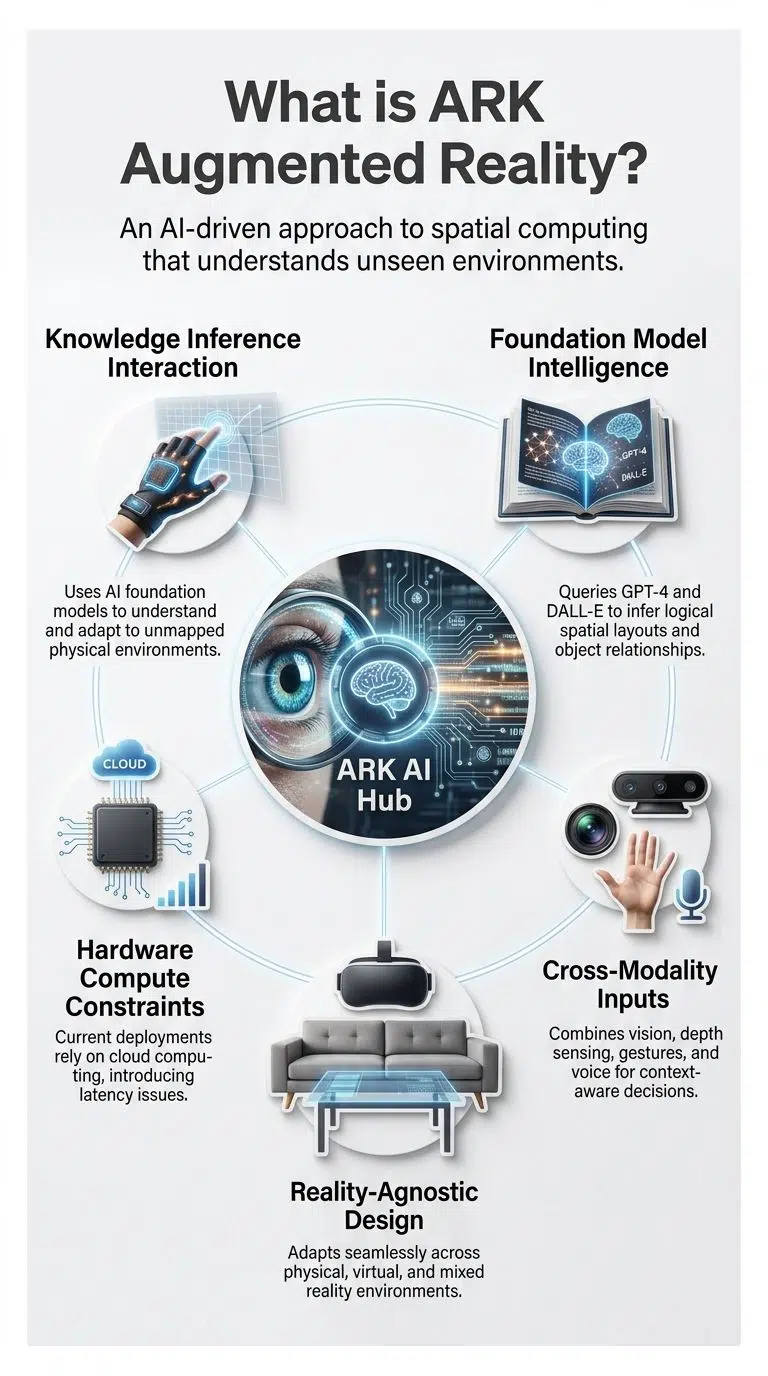
ARK augmented reality, as defined in the 2023 Microsoft Research paper, is an approach to making AR systems genuinely intelligent rather than just visually overlaying digital content on the real world.
The full name — Augmented Reality with Knowledge Inference Interaction — tells you the core idea. Standard AR overlays a 3D object onto a camera view. ARK augmented reality goes further: it uses knowledge stored in foundation models to understand what the system is looking at, reason about it, and generate contextually appropriate content in environments it has never seen before.
The original paper puts it this way: the system “leverages knowledge-memory to generate scenes in unseen physical world and virtual reality environments. ” That phrase — “unseen environments” — is the key differentiator. Most AR deployments require the developer to map every environment in advance. ARK augmented reality is designed to work without that pre-mapping.
How it handles novelty is the breakthrough. When an ARK-powered system encounters a room it hasn’t been trained on, it draws from the knowledge memory of large foundation models, GPT-4 for language and reasoning and DALL-E for visual generation, to infer what the space likely contains, how objects relate spatially, and what virtual content would be meaningful there. It’s less like a camera filter and more like an AI agent that reads the room.
How ARK Augmented Reality Works Under the Hood
The framework sits on three technical pillars, and understanding each one makes the system’s potential and its current limitations much clearer.
Foundation model knowledge. ARK augmented reality is not a standalone system. It is a mechanism that draws knowledge from general-purpose foundation models. Think of GPT-4 and DALL·E as external knowledge libraries the system can query. “What objects typically belong in a room like this? How does a surgery suite usually look? What furniture arrangement is most common in a café? “The AR system inherits the broad world knowledge these models were trained on and applies it to whatever camera feed it’s processing.
Cross-modality input. ARK uses what the paper calls “micro-actions of cross-“modality”—combining visual data, depth sensing, language cues, and gesture inputs to build a richer understanding of the scene than any single sensor could provide. A depth map tells the system where surfaces are. Language cues tell it what the user is asking for. Vision tells it what’s already there. The combination lets the system make intelligent decisions about what to generate and where to place it.
Reality-agnostic orientation. One of the most distinctive features of ark augmented reality is what the paper calls the “macro-behavior of reality-agnostic” design. The system doesn’t need to know whether it’s operating in a fully physical environment, a fully virtual one, or a mixed space. It adapts its behavior across all three. This flexibility is what makes ARK augmented reality relevant beyond traditional AR into mixed reality and metaverse applications.
The result — when it works well — is an AR environment that feels genuinely contextual rather than pasted on. Virtual furniture that respects real room lighting. Training overlays that adjust to an actual surgical suite rather than a pre-built simulation. Gaming environments that read a player’s physical space and build the experience around it.
ARK Augmented Reality in 2026: Where It Fits in Today’s Hardware Landscape
The 2023 paper landed in a different hardware moment than we’re in now. Apple Vision Pro wasn’t released until early 2024. Meta Quest 3 had only just launched. The Android XR alliance between Google and Samsung didn’t exist. In 2026, the picture has shifted considerably.
ARK augmented reality is designed for precisely the kind of spatial computing hardware that is now commercially available. The Apple Vision Pro’s spatial audio, eye tracking, and advanced scene understanding capabilities are exactly the input modalities that ArK’s cross-modality framework is built to leverage. Meta Quest 3’s mixed reality passthrough, which lets users see their real room while digital objects inhabit it is the environment ARK augmented reality was architected for.
The gaming trends reshaping spatial experiences in 2026 confirm how central this shift has become. The competitive dynamic between Apple’s XR ecosystem and the Android XR alliance has pushed headset prices down while driving capability up. Spatial strategy games where digital elements inhabit real physical rooms—dragons flying around a user’s actual living room lamp, detective games where clues appear on real walls—are becoming viable consumer products. ARK augmented reality is the AI layer that could make those experiences genuinely dynamic rather than scripted.
The honest limitation is hardware compute. Running foundation model inference in real-time, on-device, for AR applications is still expensive. Most 2026 deployments that approximate ARK augmented reality behavior rely on cloud inference with local rendering, which introduces latency. Until on-device model performance catches up with the ambitions of the ArK framework, full real-time ARK augmented reality will remain constrained to controlled environments with reliable connectivity.
What ARK Augmented Reality Can Actually Do: Real Applications by Industry
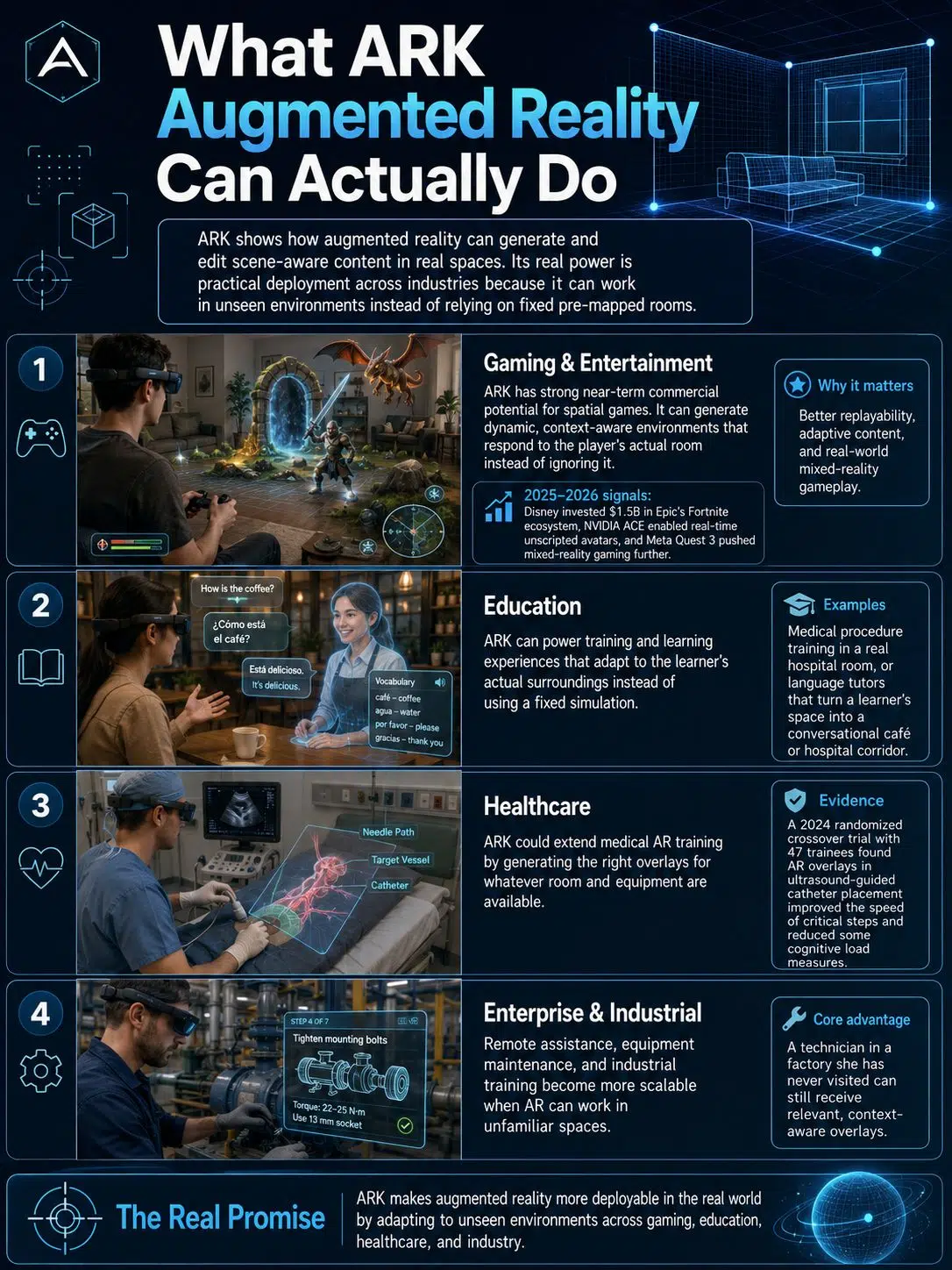
The paper demonstrates ARK augmented reality primarily through scene generation and editing tasks. But the downstream applications across industries are where the real-world argument gets made.
Gaming and entertainment
This is where ARK augmented reality has the clearest near-term commercial fit. The ability to generate dynamic, contextually aware game environments without pre-mapping every possible room is exactly what the next generation of spatial games needs. AI-generated game worlds are already transforming how studios think about replayability and dynamic content. ARK augmented reality adds the physical layer, letting those generative environments respond to and inhabit the player’s actual space.
How the metaverse gaming ecosystem evolved in 2025 and 2026 illustrates the commercial infrastructure already forming around this kind of experience. Disney’s $1.5 billion investment in Epic’s Fortnite ecosystem, NVIDIA’s ACE avatars capable of real-time unscripted conversation, and the Meta Quest 3’s mixed reality gaming category all point toward the same future ARK augmented reality is designed to enable: environments that understand and adapt to physical space rather than ignoring it.
Education
The training and learning applications are among the most compelling. A medical trainee practicing a procedure in an actual hospital room — not a simulation built around a fixed layout — benefits enormously from an AI system that can adapt overlays to the real equipment present. Language learning is another strong fit. AI language tutors already delivering immersive conversational practice through avatar-based conversation tools demonstrate the market appetite for spatially aware, context-sensitive learning. The logical next step is those tutors understanding and inhabiting a learner’s real environment—a café scene for conversational French, a hospital corridor for medical English—generated dynamically from the learner’s actual surroundings.
Healthcare
A 2024 randomized crossover trial with 47 trainees showed that AR overlays in ultrasound-guided catheter placement improved the speed of critical steps and reduced some cognitive load measures compared to standard viewing. ARK augmented reality extends this: rather than requiring a fixed pre-mapped procedure room, an ARK-powered surgical training system could adapt to whatever room is available, generating appropriate overlays based on what it sees.
Enterprise and industrial
Remote assistance, equipment maintenance, and industrial training are all areas where AR’s value proposition is strong but deployment is limited by environment diversity. ARK augmented reality’s core promise — working in unseen environments — directly addresses the deployment constraint. A technician using ARK-powered AR glasses in a factory she’s never visited still gets relevant, contextually appropriate overlays.
ARK Augmented Reality Compared to Competing Spatial AI Approaches
ARK augmented reality is not the only approach to knowledge-driven spatial computing in 2026. Understanding where it sits relative to its peers sharpens what’s genuinely novel about it.
Apple RealityKit and Vision Pro scene understanding use LiDAR, depth sensing, and on-device ML to understand surfaces, objects, and spatial relationships. Apple’s approach is impressively capable and tightly integrated with its hardware ecosystem. The difference from ARK augmented reality is that Apple’s system infers scene structure—it doesn’t generate novel content or draw from external foundation model knowledge to reason about unseen environments.
Google ARCore ML Kit enables object detection, image labeling, and pose estimation in Android AR applications. Like Apple’s approach, it’s primarily perceptual: understanding what’s there, not generating what could be there or reasoning about it from a knowledge base.
Meta’s Segment Anything in 3D (SAM3D) is perhaps the closest competitor in philosophy—it segments real-world objects in 3D point clouds, enabling AR systems to interact with arbitrary physical objects rather than only pre-defined ones. SAM3D solves the “unknown object” problem in physical space; ARK augmented reality solves the “unknown environment” problem through knowledge inference rather than purely through segmentation.
The distinction matters for developers choosing an approach: ARK augmented reality is strongest when the challenge is generating contextually appropriate content in novel environments. Competing frameworks are stronger when the challenge is precise physical object interaction with existing hardware ecosystems.
The Developer Path: What It Takes to Build With ARK Augmented Reality
ARK augmented reality, as a research framework, doesn’t install from a package manager. There’s no npm install ark-augmented-reality OR Unity plugin page. Developers working toward ARK-style capabilities are assembling the system from components.
The practical stack typically involves a spatial computing device (Vision Pro, Quest 3, or a development-grade Android XR headset), a foundational AR development environment, and API connections to the large language models and image generation models that provide the knowledge layer.
The game engines and spatial computing frameworks developers are building on are the entry point for most teams. Unreal Engine 5 with its Nanite geometry system handles the rendering side. Unity AR Foundation provides cross-platform AR primitives. Microsoft’s own HoloLens SDK includes spatial mapping capabilities that align closely with what ARK augmented reality requires.
The knowledge inference layer connects to OpenAI, Anthropic, or Google’s multimodal model APIs, which as of 2026 are significantly more capable than the GPT-4 and DALL·E versions cited in the original paper. The challenge is latency: a system that needs to call a cloud API to understand a new room cannot yet do so fast enough for real-time immersive AR. Teams working closest to ARK augmented reality deployment are using local model distillation — smaller, faster versions of foundation models fine-tuned for spatial reasoning — to reduce the inference loop.
The Honest Production Readiness Gap
Three years after the original paper, the honest answer to “Is ARK augmented reality production-ready?” is partially, and it depends on what you mean by “production.”
Research demonstrations of ARK augmented reality show genuine scene generation quality improvements over baseline AR systems. The paper’s own benchmarks show meaningful gains on scene generation and editing tasks. The underlying foundation models have improved dramatically since 2023. The hardware has caught up in ways the paper couldn’t anticipate.
What hasn’t changed is the deployment economics. Running real-time foundation model inference for AR is expensive. Latency remains a problem in cloud-inference architectures. On-device model performance at the scale needed for real-time scene understanding is still a roadblock for consumer applications. These aren’t unsolvable problems—they’re engineering challenges that the industry is actively working through—but they explain why ARK augmented reality remains a framework rather than a product in 2026.
This is the same structural challenge facing many AI systems built on foundation models. As our analysis of why AI tools built on foundation models still struggle to prove enterprise ROI shows, the gap between a compelling demo and a commercially deployable product is often wider than it appears. The cost of running foundation model inference at scale, the challenge of proving measurable ROI to enterprise buyers, and the infrastructure requirements of real-time AI—these aren’t ARK augmented reality problems specifically. They’re the shared commercial frontier for this generation of AI.
The teams most likely to successfully deploy ARK-style capabilities in the near term are those with controlled environments (training centers, enterprise facilities, and medical simulation labs) where the deployment conditions can be managed, connectivity is reliable, and the ROI case is concrete.
Frequently Asked Questions (FAQs) on ARK Augmented Reality
What exactly is ARK augmented reality?
ARK augmented reality refers to the Augmented Reality with Knowledge Inference Interaction framework published by Microsoft Research in May 2023. It extends conventional AR by embedding knowledge memory from large foundation models—like GPT-4 and DALL·E—allowing AR systems to generate and understand scenes in environments they have never encountered before, without requiring pre-mapping.
Is ARK augmented reality a product I can download?
No. ARK augmented reality is a research framework published in an academic paper, available on arxiv.org and the Microsoft Research publication page. It is not a downloadable software product, commercial SDK, or consumer application as of mid-2026. Developers can approximate its capabilities by combining existing AR development frameworks with foundation model APIs, but there is no official ARK augmented reality product release.
How is ARK augmented reality different from standard AR?
Standard AR overlays pre-designed digital content onto a camera view, typically in pre-mapped environments. ARK augmented reality adds knowledge inference—the system reasons about unfamiliar environments by drawing on the world knowledge embedded in foundation models, then generates contextually appropriate content rather than placing pre-built assets. The difference is between “displaying a pre-made chair” and “generating the right furniture for this room based on what the AI knows about room contexts.”
What hardware does ARK augmented reality run on?
The 2023 paper demonstrates ARK augmented reality conceptually rather than on specific hardware. The most capable 2026 hardware for deploying ARK-style systems includes Apple Vision Pro (visionOS), Meta Quest 3 (mixed reality passthrough), and high-end Android XR devices. Microsoft’s own HoloLens remains relevant for enterprise and research applications. Full real-time ARK augmented reality performance on consumer hardware is still constrained by on-device compute limitations.
Is ARK augmented reality the same as Apple ARKit?
No. ARKit is Apple’s augmented reality development framework for iOS and visionOS applications — it enables object detection, surface mapping, image anchoring, and spatial audio in Apple device AR apps. ARK augmented reality (the Microsoft Research framework) is a separate AI system designed around knowledge-driven scene generation and understanding. They operate on different architectural principles and have no direct relationship.
What industries are closest to deploying ARK augmented reality today?
Medical training and simulation, enterprise maintenance and remote assistance, and high-end spatial gaming are the industries with the strongest near-term alignment. These applications combine concrete ROI, controlled deployment environments, and use cases where ARK augmented reality’s key advantage—working in novel, unmapped environments—directly solves a real deployment problem.
Final Words: Where ARK Augmented Reality Goes From Here
ARK augmented reality sits at a specific and interesting point in the technology lifecycle. The research case has been made. The hardware has largely caught up. The foundation models have improved substantially beyond what the 2023 paper used. What remains is the engineering work of closing the deployment gap—reducing inference latency, improving on-device model performance, and proving ROI in production environments.
The most likely near-term evolution of ARK augmented reality is not a single flagship product from Microsoft but a gradual diffusion of its core ideas into commercial AR frameworks. Apple, Meta, and Google are all working on knowledge-driven spatial AI in their own ways. The concepts the ArK paper articulated—cross-modality scene understanding, knowledge inference from foundation models, and reality-agnostic behavior—are already visible in the direction each of these platforms is moving, even if they don’t use the ArK name.
For developers, the practical opportunity right now is assembling ARK augmented reality-style systems from available components—Vision Pro hardware, Unreal or Unity spatial frameworks, and multimodal foundation model APIs—in environments where the deployment constraints are manageable. The teams doing that work today will be best positioned when the infrastructure catches up to the ambition.
For everyone else: ark augmented reality is one of the more honest names in recent AI research. It describes exactly what it is — augmented reality that knows things. The knowing part is what makes it genuinely new.