Sustainable insulation materials sound like an easy win until you start comparing the options. One product claims to be natural. Another says it has recycled content. A third promises high R-value per inch. A fourth looks green on the label but comes with questions about chemical binders, moisture risk, fire treatment, or embodied carbon. And if you are a homeowner, builder, architect, or renovator trying to make a responsible choice, the whole thing can get frustrating fast.
The truth is that insulation is one of the most important choices in a green building project, but it is also one of the easiest to oversimplify.
Good insulation can reduce heating and cooling demand for years. Poorly chosen or poorly installed insulation can trap moisture, lose performance, create indoor air concerns, or cost more than it saves. And the most “sustainable” option on paper may not be the best option for every wall, roof, floor, climate, or budget. That is why sustainable insulation is not just about choosing the most natural-looking material.
It is about balancing thermal performance, embodied carbon, recycled or renewable content, durability, moisture behavior, fire safety, indoor air quality, local availability, installation quality, and end-of-life impact.
This guide explains the main eco insulation choices in plain language so you can understand what each material does well, where it falls short, and how to choose green insulation options that actually make sense.
What Are Sustainable Insulation Materials?
Sustainable insulation materials are insulation products designed to reduce a building’s environmental impact while still delivering strong thermal performance. That can mean different things depending on the product.
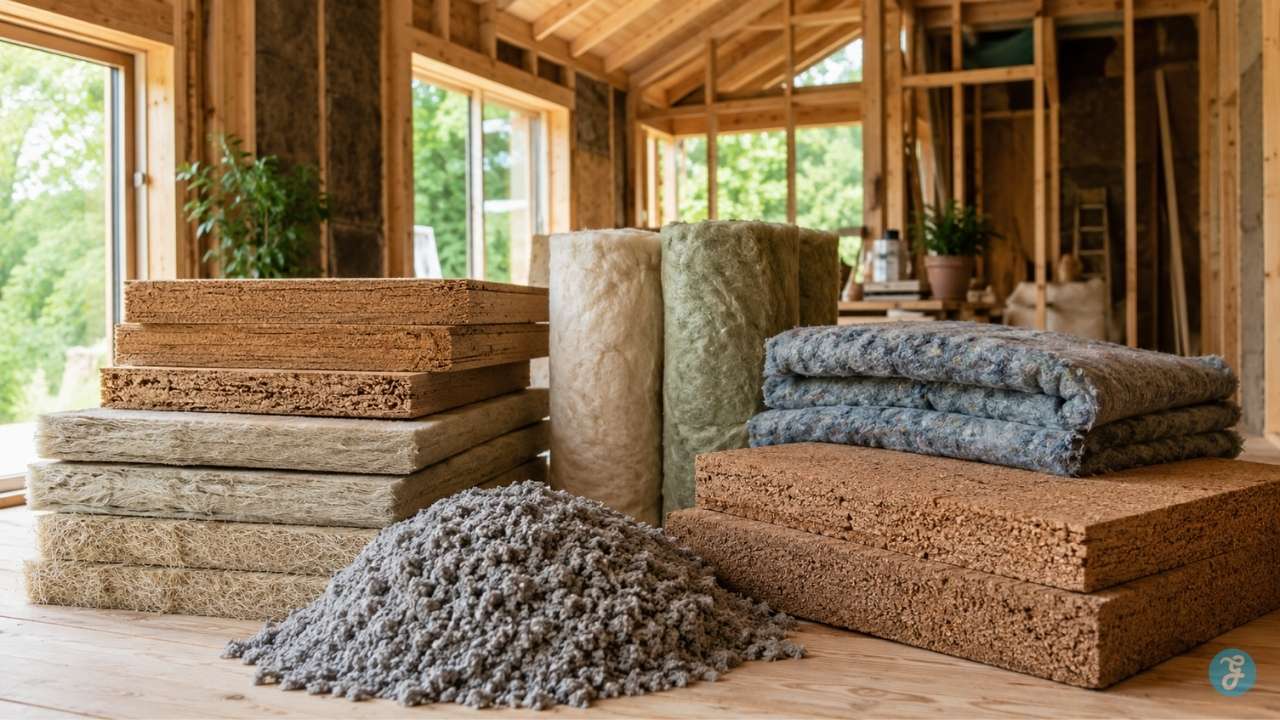
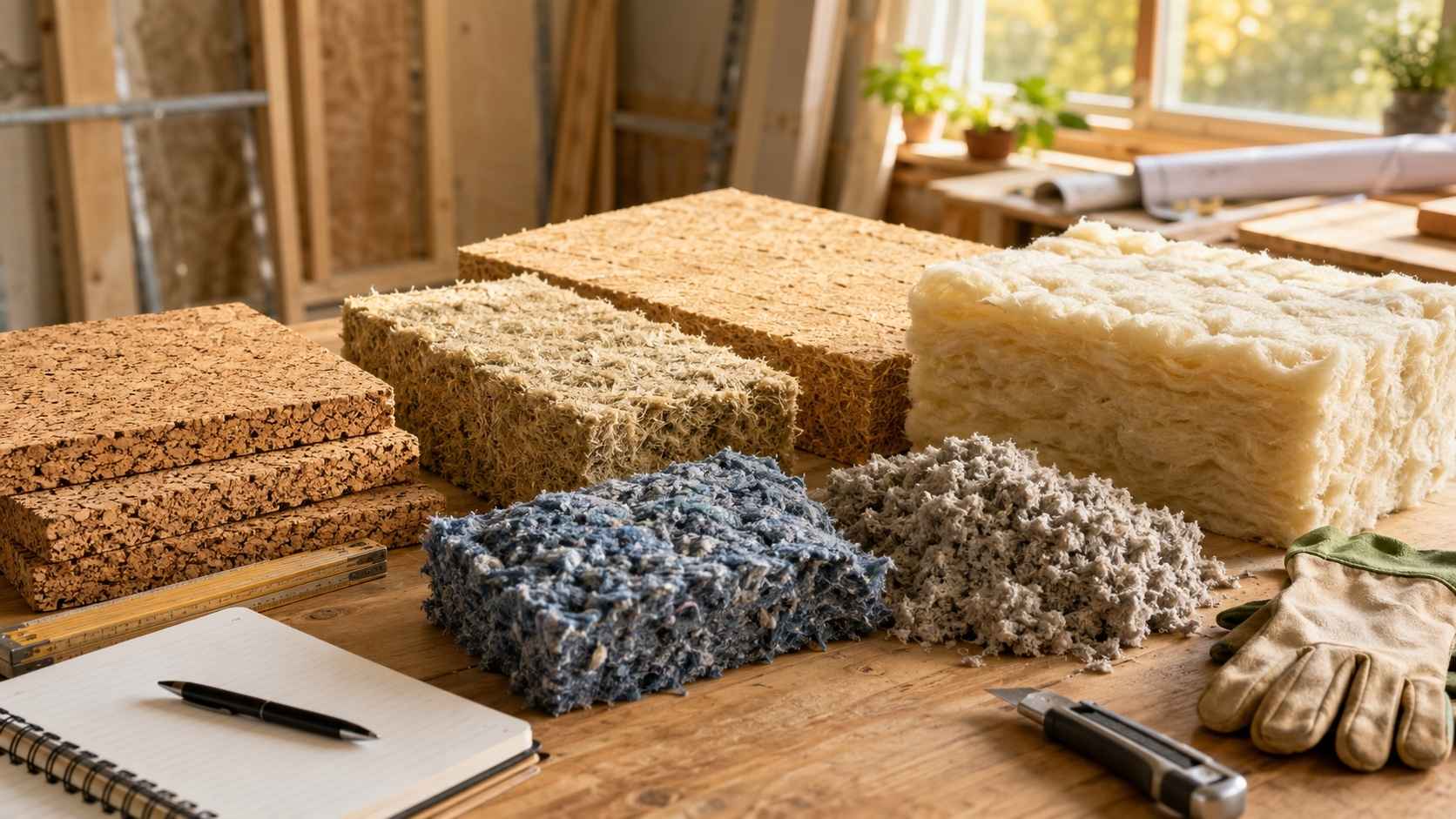
Some sustainable insulation materials are made from recycled content, such as cellulose or recycled denim. Some are made from renewable plant or animal fibers, such as hemp, wood fiber, cork, straw, or sheep’s wool. Some are conventional insulation materials with improved manufacturing, better recycled content, lower emissions, or lower global warming potential.
A sustainable insulation product may score well because it:
- Reduces heating and cooling energy use
- Uses recycled materials
- Uses renewable raw materials
- Has low embodied carbon
- Stores biogenic carbon
- Avoids high-impact blowing agents
- Has low VOC emissions
- Supports healthy indoor air
- Performs well for decades
- Can be reused, recycled, or safely disposed of
- Requires less energy to manufacture
- Helps control moisture safely
- Is locally available
The key phrase is “performs well.”
A green insulation material that fails early, gets wet, grows mold, settles badly, or is installed incorrectly is not a sustainable choice in practice.
Why Insulation Matters in Sustainable Building
Insulation matters because buildings use a large amount of energy to stay comfortable.
Heating and cooling demand can be heavily influenced by the building envelope: walls, roofs, floors, windows, doors, air sealing, and thermal bridges. Insulation helps slow heat movement, which means homes can stay warmer in winter and cooler in summer with less mechanical energy.
But insulation has two carbon stories:
- There is operational carbon. This comes from the energy used to heat and cool the building over time.
- There is embodied carbon. This comes from extracting raw materials, manufacturing the product, transporting it, installing it, maintaining it, and eventually disposing of it.
The best insulation decision considers both.
A material with very low embodied carbon but poor installed performance may not save enough energy. A high-performance foam may reduce energy use but may come with higher embodied carbon or chemical concerns, depending on the product and blowing agent.
Sustainable insulation is not about chasing one perfect material. It is about choosing the right material for the right assembly.
What Makes Insulation “Eco-Friendly”?
Eco insulation should be judged by more than one label. A product may be called green because it is natural. But natural does not automatically mean best. Another product may be synthetic but durable, high-performing, and useful in a specific moisture-prone application. A recycled product may be lower impact, but still needs fire treatment or careful moisture control.
Use the following criteria before choosing.
1. Thermal Performance
Thermal performance is usually measured by R-value. A higher R-value means greater resistance to heat flow. But R-value is not the whole story.
Installed performance also depends on:
- Air sealing
- Moisture exposure
- Gaps and compression
- Thermal bridging
- Density
- Settling
- Installation quality
- Climate
- Assembly design
A high R-value product installed poorly can underperform. A lower R-value product installed carefully in the right assembly may perform reliably.
2. Embodied Carbon
Embodied carbon matters because insulation is installed upfront, while energy savings happen over time.
Some insulation materials have lower embodied carbon because they use recycled fibers, plant-based feedstocks, or less energy-intensive manufacturing. Some natural insulation materials may also store carbon absorbed during plant growth.
Foam plastics can offer high R-value per inch, but some types historically carried concerns around high-impact blowing agents. Low-GWP alternatives have improved that picture, but product-specific data still matters.
3. Recycled or Renewable Content
Many eco-insulation products use recycled or renewable materials.
Examples include:
- Recycled paper in cellulose
- Recycled cotton or denim
- Recycled glass in fiberglass
- Recycled slag or stone in mineral wool
- Renewable hemp fiber
- Wood fiber from forestry byproducts
- Cork from cork oak bark
- Straw from agricultural residue
- Sheep’s wool from animal fiber
Recycled content can reduce waste and raw material demand. Renewable content can reduce dependence on petrochemical materials. But sourcing, manufacturing, transport, and durability still matter.
4. Indoor Air Quality
A good insulation choice should not create unnecessary indoor air concerns.
Look for products with:
- Low VOC emissions
- Formaldehyde-free or low-emission binders where relevant
- Clear safety data
- Proper installation guidance
- Moisture-safe assembly design
- No hidden pest or mold risk
Natural insulation can feel healthier, but it may still need borate, fire retardant, pest treatment, or binder. Synthetic insulation can be safe when installed correctly, but products vary.
Do not rely only on marketing claims.
5. Moisture Behavior
Moisture is where many insulation decisions go wrong.
Some materials can safely buffer small amounts of moisture and dry out when assemblies are designed properly. Others lose performance or become risky when wet. Some rigid boards resist moisture well but may trap vapor if used in the wrong place.
Before choosing insulation, consider:
- Climate zone
- Wall or roof assembly
- Vapor control layer
- Drainage plane
- Air sealing
- Drying potential
- Flood or leak risk
- Basement or crawlspace conditions
- Exterior vs interior placement
Sustainable insulation should support a durable building envelope. A material that cannot handle the moisture conditions of the assembly is not sustainable for that project.
6. Fire Safety
All insulation must meet fire safety requirements. Natural insulation materials often need fire-retardant treatments. Cellulose, wool, cotton, hemp, and other fibers may be treated to resist flame, pests, or mold. Mineral wool is naturally fire-resistant. Foam plastics usually require code-compliant thermal barriers or protective assemblies.
Always check local code requirements and product certifications. Fire performance is not optional.
7. End-of-Life Impact
Some insulation can be reused, recycled, composted, or disposed of with a lower impact. Some products are harder to recycle or may end up in a landfill.
End-of-life matters, but durability usually matters more. An insulation product that lasts the life of the building can be a better choice than a theoretically recyclable product that fails early.
Best Sustainable Insulation Materials Explained
There is no single best insulation material for every project. Each option has strengths, weaknesses, and best-use cases.
1. Cellulose Insulation
Cellulose is one of the most common sustainable insulation materials. It is usually made from recycled paper fiber, often from newspapers or other post-consumer paper products, and treated for fire and pest resistance.
It is typically installed as loose-fill or dense-pack insulation.
Cellulose is popular because it uses recycled content, performs well in wall and attic cavities, and can fill irregular spaces better than many batt products.
Why It Works Well
Cellulose can be a strong eco-insulation choice because it reuses paper waste and usually has a lower-impact material profile than many conventional options. Dense-pack cellulose can also reduce air movement inside cavities when installed properly, although it should not be treated as a replacement for dedicated air sealing.
It is especially useful for:
- Attics
- Existing wall cavities
- Wood-framed walls
- Retrofit projects
- Irregular cavities
- Sound control
Things to Consider
Cellulose must be kept dry. Like many fiber-based insulation materials, moisture can reduce performance and create durability concerns if the building assembly is not designed well.
It also needs skilled installation. Loose-fill material can settle if installed incorrectly, while dense-pack cellulose needs proper density to avoid voids.
Best for: Attics, retrofits, dense-pack wall cavities, and homeowners looking for a recycled-content insulation option.
2. Wood Fiber Insulation
Wood fiber insulation is made from wood chips, sawmill residues, or forestry byproducts. It is available as batts, boards, or loose-fill products, depending on the market.
It is widely used in parts of Europe and has been gaining more attention in North America and other green building markets.
Why It Works Well
Wood fiber is valued for its renewable content, thermal performance, acoustic performance, and ability to help manage moisture in vapor-open assemblies.
Rigid wood fiber boards are often used on the exterior of walls and roofs to reduce thermal bridging while allowing assemblies to dry.
Wood fiber can be useful for:
- Exterior continuous insulation
- Roof assemblies
- Wall assemblies
- Timber construction
- Low-carbon building projects
- Vapor-open envelope design
Things to Consider
Wood fiber insulation is not always widely available. It can also cost more than conventional insulation in some markets.
It must be protected from bulk water and installed as part of a moisture-safe assembly. Fire performance and code approvals should be checked for the specific product.
Best for: High-performance walls and roofs where renewable content, vapor openness, and low-carbon design are priorities.
3. Hemp Insulation
Hemp insulation is made from hemp plant fibers. It may be sold as batts, rolls, boards, or hemp-lime products such as hempcrete.
Hemp grows quickly and can be cultivated with relatively low input compared with some other crops, which makes it attractive in sustainable building conversations.
Why It Works Well
Hemp insulation is renewable, plant-based, and often pleasant to handle compared with itchy fiber products. It can provide thermal and acoustic benefits and may work well in vapor-open wall systems.
Hemp-lime materials can also provide thermal mass and moisture-buffering benefits, although hempcrete is not the same as standard batt insulation.
Hemp can be useful for:
- Timber-framed homes
- Interior walls
- Roofs
- Natural building projects
- Breathable wall assemblies
- Sound control
Things to Consider
Availability can be limited depending on the region. Cost may be higher than conventional materials. Hemp products may also use binders or treatments, so the specific product data matters. Like other natural insulation materials, hemp should be protected from persistent moisture.
Best for: Natural building projects, low-carbon homes, and assemblies designed for vapor openness and moisture control.
4. Sheep’s Wool Insulation
Sheep’s wool is a natural insulation made from wool fibers. It is often sold as batts, rolls, or loose-fill products.
It is appealing because it is renewable, soft to handle, and can buffer moisture without feeling wet under certain conditions.
Why It Works Well
Sheep’s wool can absorb and release moisture, which may help in certain building assemblies when drying is properly managed. It is also comfortable to install and can provide good acoustic performance. It may appeal to homeowners who want a natural insulation option with low handling irritation.
Sheep’s wool can be useful for:
- Roofs
- Walls
- Floors
- Interior partitions
- Sound control
- Natural building projects
Things to Consider
Wool insulation is usually more expensive than mainstream options. It often needs treatment for moth resistance and fire performance. Sourcing and animal welfare may also matter to some buyers.
It should not be treated as a magic moisture solution. The whole wall or roof assembly still needs to be designed correctly.
Best for: Natural insulation projects where comfort, acoustic performance, and renewable sourcing matter.
5. Cork Insulation
Cork insulation comes from the bark of cork oak trees. Expanded cork boards are made by heating cork granules, allowing natural resins to bind the material.
Cork is renewable when harvested responsibly because the tree can continue growing after bark removal.
Why It Works Well
Cork is durable, moisture-resistant compared with many fiber insulation products, and useful as a rigid board insulation material. It can also offer acoustic benefits and good dimensional stability.
Cork can be used for:
- Exterior wall insulation
- Interior insulation
- Floor insulation
- Roof insulation
- Acoustic panels
- Thermal break applications
Things to Consider
Cork can be expensive and regionally limited. Sustainability depends on responsible harvesting and supply chain practices.
It also may not always outperform other wood-based insulation options enough to justify the cost, depending on the project.
Best for: Projects needing rigid natural insulation, acoustic performance, and moisture-tolerant material behavior.
6. Recycled Cotton or Denim Insulation
Recycled cotton insulation, often called denim insulation, is made from recycled cotton textiles. It is usually sold as batts or rolls and is often marketed as a safer-to-handle alternative to fiberglass.
Why It Works Well
Recycled cotton gives textile waste a second life. It is soft, less irritating to handle, and can provide good sound absorption. It can be attractive for interior walls, residential projects, and homeowners who want a recycled-content material.
It can be useful for:
- Interior partitions
- Walls
- Ceilings
- Sound control
- DIY-friendly projects
- Residential retrofits
Things to Consider
Recycled cotton insulation can be more expensive than fiberglass or cellulose. It may be harder to cut neatly and can be less widely available. It must be treated for fire resistance and should be protected from moisture.
Best for: Homeowners who want recycled-content batt insulation with comfortable handling and good acoustic performance.
7. Straw Bale and Straw-Based Insulation
Straw bale construction uses compacted straw bales as thick insulating wall elements. Straw panels and compressed agricultural fiber boards are also used in some markets.
Straw is an agricultural byproduct, which makes it attractive from a resource-efficiency perspective.
Why It Works Well
Straw can provide thick, highly insulating walls with low embodied carbon when sourced locally and built properly. It can also store biogenic carbon and support natural building approaches.
Straw-based systems can be useful for:
- New construction
- Natural homes
- Thick wall assemblies
- Rural or local-material projects
- Low-carbon building
- Passive and high-performance homes
Things to Consider
Straw bale is not a casual replacement for standard cavity insulation. It requires proper design, moisture control, detailing, plastering, pest prevention, and code compliance. It is usually more practical for new construction than simple retrofits.
Best for: New builds where the design team understands natural construction and moisture-safe detailing.
8. Mineral Wool With Recycled Content
Mineral wool, also known as rock wool or stone wool, is made from molten rock, slag, or recycled mineral content spun into fibers.
It is not a natural plant-based insulation, but it can be a useful green insulation option in certain projects because it is durable, fire-resistant, moisture-tolerant, and often contains recycled content.
Why It Works Well
Mineral wool has strong fire resistance, good sound absorption, and good dimensional stability. It does not absorb water the way some fiber products do, although water management is still important.
It can be useful for:
- Exterior walls
- Rain-screen assemblies
- Fire-rated assemblies
- Basements, depending on design
- Sound control
- Multifamily buildings
- Commercial projects
- Continuous insulation
Things to Consider
Mineral wool is energy-intensive to manufacture compared with many plant-based materials. It can also be heavier and may require protective gear during installation.
It may not be the lowest embodied-carbon option, but its durability and fire performance can make it a practical choice.
Best for: Projects needing fire resistance, acoustic control, moisture tolerance, and reliable exterior insulation performance.
9. Fiberglass With High Recycled Content
Fiberglass is one of the most common insulation materials. It is made from glass fibers and may include recycled glass content.
It is not usually the first material people think of when discussing eco insulation, but newer low-emission binder options and recycled-content products can make it part of a balanced comparison.
Why It Works Well
Fiberglass is widely available, familiar to installers, lightweight, and usually affordable. It can perform well when installed carefully with proper air sealing.
It can be useful for:
- Attics
- Wall cavities
- Floors
- Ceilings
- Budget-conscious projects
- Standard residential construction
Things to Consider
Fiberglass performance can drop when batts are compressed, poorly cut, or installed with gaps. It is also less pleasant to handle than cotton, wool, or wood fiber products.
From a sustainability point of view, recycled content, binder chemistry, product certification, and installation quality matter.
Best for: Budget-sensitive projects where careful installation and lower-emission product selection are priorities.
10. Low-GWP Foam Insulation
Foam insulation includes materials such as polyisocyanurate, expanded polystyrene, extruded polystyrene, and spray polyurethane foam.
Foams are synthetic and petrochemical-based, so they are not natural insulation materials. However, they can still play a role in some energy-efficient buildings when used carefully, especially where high R-value per inch or moisture resistance is needed.
Why It Works Well
Foam insulation can provide a high R-value in a limited space. Some types resist moisture well and can help with continuous insulation or below-grade applications.
Foam can be useful for:
- Exterior continuous insulation
- Roof insulation
- Below-grade insulation
- Tight spaces
- Thermal bridge reduction
- High-R-value assemblies
- Air sealing, in the case of spray foam
Things to Consider
Foams can have higher embodied carbon than many fiber-based insulation options. Some foam products have historically used high-impact blowing agents, though lower-GWP options are now increasingly important.
Spray foam also requires careful installation, ventilation, and quality control. Poor installation can create odors, indoor air concerns, or performance issues.
For greener projects, use foam only where its performance advantage is genuinely needed, and check for low-GWP blowing agents and product-specific environmental data.
Best for: Moisture-prone or space-limited applications where natural insulation may not be practical.
Quick Comparison of Sustainable Insulation Materials
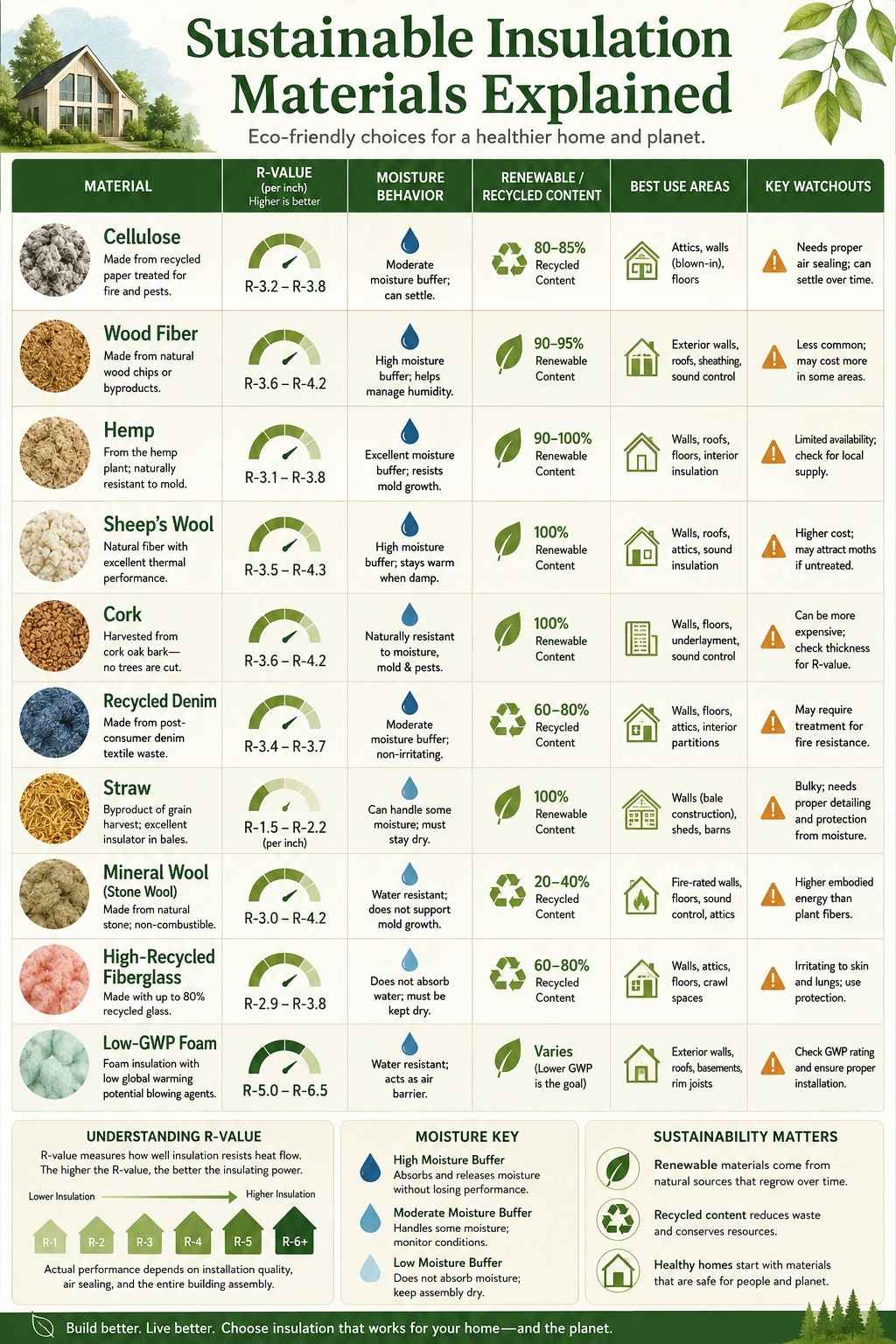
| Material | Main Sustainability Strength | Best Use | Main Watchout |
| Cellulose | High recycled paper content | Attics, dense-pack walls, retrofits | Moisture and settling if poorly installed |
| Wood fiber | Renewable, vapor-open, low-carbon potential | Exterior walls, roofs, and high-performance homes | Cost and availability |
| Hemp | Renewable plant fiber | Natural walls, roofs, and acoustic control | Availability and moisture detailing |
| Sheep’s wool | Renewable animal fiber, comfortable handling | Walls, roofs, and interior sound control | Cost and treatment requirements |
| Cork | Renewable bark, durable, rigid board | Exterior/interior boards, floors, acoustics | Cost and responsible sourcing |
| Recycled denim | Reuses textile waste, comfortable handling | Walls, ceilings, sound control | Higher cost and cutting difficulty |
| Straw | Agricultural byproduct, low-carbon potential | New natural buildings | Needs expert detailing and code compliance |
| Mineral wool | Fire resistance, durability, and recycled content potential | Exterior walls, fire-rated assemblies | Energy-intensive manufacturing |
| High-recycled fiberglass | Affordable, widely available | Attics, walls, floors | Installation gaps reduce performance |
| Low-GWP foam | High R-value per inch, moisture resistance | Tight spaces, exterior boards, and below-grade | Embodied carbon and installation quality |
Common Mistakes When Choosing Eco Insulation
1. Choosing Only by R-Value
R-value matters, but it does not tell the whole story. Moisture, air sealing, installation quality, embodied carbon, and durability also matter.
2. Assuming Natural Always Means Better
Natural insulation can be excellent, but it still needs fire safety, pest resistance, moisture control, and code compliance.
3. Ignoring Moisture Risk
This is one of the biggest mistakes. A green insulation material placed in the wrong moisture conditions can fail.
4. Forgetting Air Sealing
Insulation without air sealing often disappoints. Seal leaks before expecting insulation to perform fully.
5. Overlooking Installer Experience
Some sustainable insulation materials require specific installation skills. Do not assume every contractor knows every product.
6. Using Foam Everywhere
Foam can be useful, but it should not be the automatic answer. In many applications, lower-carbon fiber-based materials may work well.
7. Ignoring Local Availability
A material shipped long distances may lose some environmental advantage. Local supply and installer familiarity matter.
8. Not Checking Fire and Building Codes
Every insulation material must meet safety and code requirements. Always verify before installation.
Best Uses by Project Type
For Attic Retrofits
Cellulose is often one of the strongest eco insulation options because it can be blown over attic floors and fill gaps well. Fiberglass and mineral wool can also work when installed properly.
Best options to compare:
- Cellulose
- Loose-fill fiberglass
- Mineral wool
- Sheep’s wool, where available
For Existing Wall Retrofits
Dense-pack cellulose is commonly used because it can be installed into closed cavities. Mineral wool or fiberglass may work in open-wall renovations.
Best options to compare:
- Dense-pack cellulose
- Wood fiber, where available
- Mineral wool
- Fiberglass
- Hemp or wool in open cavities
For New Low-Carbon Homes
New construction gives more flexibility. You can design the wall, roof, air barrier, vapor control, and exterior insulation together.
Best options to compare:
- Wood fiber
- Cellulose
- Hemp
- Straw-based systems
- Mineral wool
- Cork
- Low-GWP foam only where needed
For Exterior Wall Insulation
Exterior insulation needs durability and weather-aware detailing.
Best options to compare:
- Wood fiber boards
- Mineral wool boards
- Cork boards
- Low-GWP rigid foam
For Sound Control
Many sustainable insulation materials also help reduce sound transfer.
Best options to compare:
- Mineral wool
- Cellulose
- Recycled denim
- Sheep’s wool
- Wood fiber
For Moisture-Prone Areas
Be careful with natural fibers in areas with high moisture risk.
Best options to compare:
- Mineral wool
- Certain rigid foams
- Cork in appropriate assemblies
- Other moisture-tolerant systems recommended by a building professional
Are Natural Insulation Materials Worth It?
Natural insulation materials can be worth it when they match the building assembly, climate, budget, and performance goal. They can offer renewable content, lower embodied carbon potential, pleasant handling, acoustic benefits, and strong appeal for low-toxin or low-carbon homes.
But they are not automatically the best choice for every project. A natural insulation product may cost more, require a specialized installer, need careful moisture detailing, or have limited availability. Some products also need chemical treatment for fire, pests, or durability.
Are Foam Insulation Materials Sustainable?
Foam insulation is complicated. Foam products are not natural insulation materials, and many have higher embodied carbon than plant- or recycled-fiber options. Some foam products have also raised environmental concerns because of the blowing agents used in manufacturing.
At the same time, foam can solve real building problems. It offers high R-value per inch, moisture resistance, and continuous insulation options that can be difficult to achieve with some natural materials. A balanced approach is to use foam selectively.
Consider foam when:
- Space is limited
- Moisture exposure is high
- Below-grade insulation is needed
- Continuous insulation is required
- Natural materials are not practical
- The product uses low-GWP blowing agents
- Product-specific environmental data is available
Avoid using foam by default when lower-impact materials can do the job well.
The Bottom Line on Sustainable Insulation Materials
Sustainable insulation materials are not about choosing the trendiest green product. They are about making a building more comfortable, efficient, durable, healthy, and lower impact over time.
For many homes, cellulose, wood fiber, hemp, sheep’s wool, cork, recycled denim, straw, mineral wool, and carefully selected low-GWP foam all deserve consideration. Each has a place. Each has trade-offs.
The best choice depends on the building. If you want the simplest rule, use this:
Choose insulation that performs well, lasts long, manages moisture safely, lowers environmental impact, supports healthy indoor air, and can be installed correctly by people who understand the material.
That is what makes insulation truly sustainable. Not just the label. The result.
Frequently Asked Questions About Sustainable Insulation Materials
1. What are sustainable insulation materials?
Sustainable insulation materials are products designed to reduce environmental impact while improving building energy efficiency. They may use recycled content, renewable fibers, low embodied carbon materials, low-emission binders, or lower-impact manufacturing methods.
2. What is the best eco-insulation for homes?
There is no single best eco insulation for every home. Cellulose is often strong for attics and retrofits, wood fiber is useful for high-performance walls and roofs, mineral wool works well where fire resistance matters, and natural insulation options like hemp, wool, cork, and straw can be excellent in the right assemblies.
3. Is natural insulation better than fiberglass?
Natural insulation can offer renewable content, lower irritation, and lower embodied carbon potential, but it is not automatically better in every situation. Fiberglass can be affordable and effective when installed correctly, especially if it has recycled content and low-emission binders. The better choice depends on location, budget, moisture risk, and installation quality.
4. What are the most common green insulation options?
Common green insulation options include cellulose, wood fiber, hemp, sheep’s wool, cork, recycled denim, straw-based insulation, mineral wool with recycled content, high-recycled fiberglass, and low-GWP foam used selectively.
5. Is cellulose insulation sustainable?
Cellulose is widely considered one of the more sustainable insulation materials because it is usually made from recycled paper and works well in attics and dense-pack wall cavities. It still needs proper installation, fire treatment, and moisture-safe building design.
6. How do I choose sustainable insulation for my home?
Start with the area you need to insulate, the required R-value, your climate, moisture risk, budget, and installation method. Then compare materials by thermal performance, embodied carbon, recycled or renewable content, indoor air quality, fire safety, durability, and local availability.