Habits for better focus matter because attention is no longer protected by default. Most workdays are built around tabs, pings, meetings, messages, deadlines, and quick reactions. I used to blame myself when focus broke. Then I noticed the pattern. My attention was not weak. My environment was noisy. My task list was too crowded. My phone was too close. My breaks were poor. My energy was not planned.
Focus building became easier when I stopped chasing motivation and started building structure. Better focus does not mean working like a machine. It means knowing what matters, reducing unnecessary switching, taking smart breaks, and giving the brain cleaner conditions. For the corporate athlete, focus is performance. If your work depends on writing, editing, planning, managing, studying, designing, selling, or creating, your attention is one of your most valuable assets.
These attention habits also support the best healthy habits because focus improves when sleep, movement, hydration, nutrition, recovery, stress control, and mental wellness work together.
The goal is simple: Make concentration easier to return to.
Why Focus Breaks So Easily?
Focus breaks easily because modern work constantly asks the brain to switch direction. A message arrives. A tab opens. A meeting starts. A notification flashes. A thought appears. A task feels hard, so the hand reaches for the phone. Before you know it, the original task has lost its shape. Most people think focus is only about discipline. Discipline helps, but it is not enough when the environment is designed for interruption. If your phone sits beside your keyboard, your inbox stays open, and every task has equal urgency, your brain has to fight all day.
Task switching is one of the biggest focus killers. Even when the switch feels small, the mind needs time to return. This is why checking one message during deep work can cost more than the 20 seconds it takes to reply. The real cost is the attention reset. Focus also breaks when energy is unmanaged. Poor sleep, skipped meals, low water intake, long sitting, stress, and no movement can all make concentration harder. Sometimes the problem is not laziness. Sometimes the brain is tired, under-fueled, or overstimulated.
Another issue is unclear priority. When everything matters, nothing gets full attention. A crowded task list creates mental noise before the work even begins. Better focus starts by reducing friction around attention.
| Focus Problem | What It Looks Like | Habit That Helps |
| Too many open tasks | Constant mental switching | Choose one priority |
| Phone nearby | Quick checking and scrolling | Create phone distance |
| Open inbox | Reactive work | Schedule message windows |
| Poor sleep | Foggy thinking | Improve evening routine |
| Long sitting | Restless body and dull energy | Movement breaks |
| No clear break | Burnout and drifting | Use planned recovery breaks |
| Messy workspace | Visual distraction | Build a focus-friendly setup |
Focus is easier when your day stops attacking your attention from every direction.
What Makes an Attention Habit Actually Work?
An attention habit works when it reduces the number of decisions your brain has to make. Focus fails when every work block starts with questions: What should I do? Where is the file? Should I check messages first? How long should I work? What if something urgent appears? A useful focus habit answers those questions before the session begins.
The best attention habits are simple, visible, and repeatable. “Focus more” is not a habit. “Work on one task for 30 minutes with phone away” is a habit. “Stop getting distracted” is not a system. “Close all tabs except the task tab” is a system. A good focus habit also needs a clear start and stop. The brain likes containers. A 25-minute block, 45-minute block, or 90-minute deep work window feels easier than “work until finished.” A timer creates structure without needing constant self-monitoring.
The habit should also match your energy. Hard thinking is usually easier when energy is higher. Admin work can fit lower-energy hours. If you plan deep work during your worst time of day, focus will feel harder than necessary. Breaks matter too. Better concentration practices are not only about working harder. They also include stepping away, moving, drinking water, breathing, and returning.
| Attention Habit Rule | What It Means | Practical Example |
| Make the task clear | Know exactly what you will do | “Draft intro,” not “work on article” |
| Remove one distraction | Reduce friction before starting | Phone across the room |
| Use a time container | Give focus a boundary | 45-minute work block |
| Match energy to task | Use high energy for hard work | Deep work in the morning |
| Close open loops | Capture stray thoughts | Brain dump list |
| Plan breaks | Prevent mental drift | 5-minute walk after focus block |
| Repeat the cue | Build rhythm | Same desk setup, same timer |
A strong attention habit makes focus easier before willpower is needed.
11 Habits for Better Focus
These habits for better focus are designed for real workdays. They do not require a silent retreat, perfect schedule, or expensive productivity system. You do not need to start all 11 today. Choose the habit that solves your biggest focus leak. If your day starts messy, choose one priority. If your phone steals attention, create distance. If you keep switching tasks, protect a deep work block. If your mind feels crowded, use a brain dump. If your energy drops, use movement, water, food, and better breaks.
Focus building works best when habits stack together. A clear task helps. A clean workspace helps. A timer helps. A phone boundary helps. A planned break helps. Better sleep and hydration help too. The goal is not to become perfectly focused all day. That is unrealistic. The goal is to build stronger returns. You drift, notice, reset, and come back.
| Habit | Main Benefit | Best For |
| 1. Choose one priority before opening messages | Reduces reactive work | Busy mornings |
| 2. Protect one deep work block | Builds real concentration | Writers, creators, professionals |
| 3. Use a single-task rule | Reduces task switching | Multitaskers |
| 4. Create phone distance | Cuts easy distraction | Scroll-heavy days |
| 5. Close extra tabs before work | Reduces visual noise | Browser-heavy work |
| 6. Use a focus timer | Adds structure | Beginners and remote workers |
| 7. Take movement-based breaks | Restores energy | Desk workers |
| 8. Build a water and snack focus cue | Supports steady energy | Afternoon slump |
| 9. Use a brain dump for open loops | Clears mental clutter | Overthinkers |
| 10. Design a focus-friendly workspace | Lowers distraction | Home and office workers |
| 11. End work with a shutdown ritual | Protects tomorrow’s focus | Busy professionals |
1. Choose One Priority Before Opening Messages
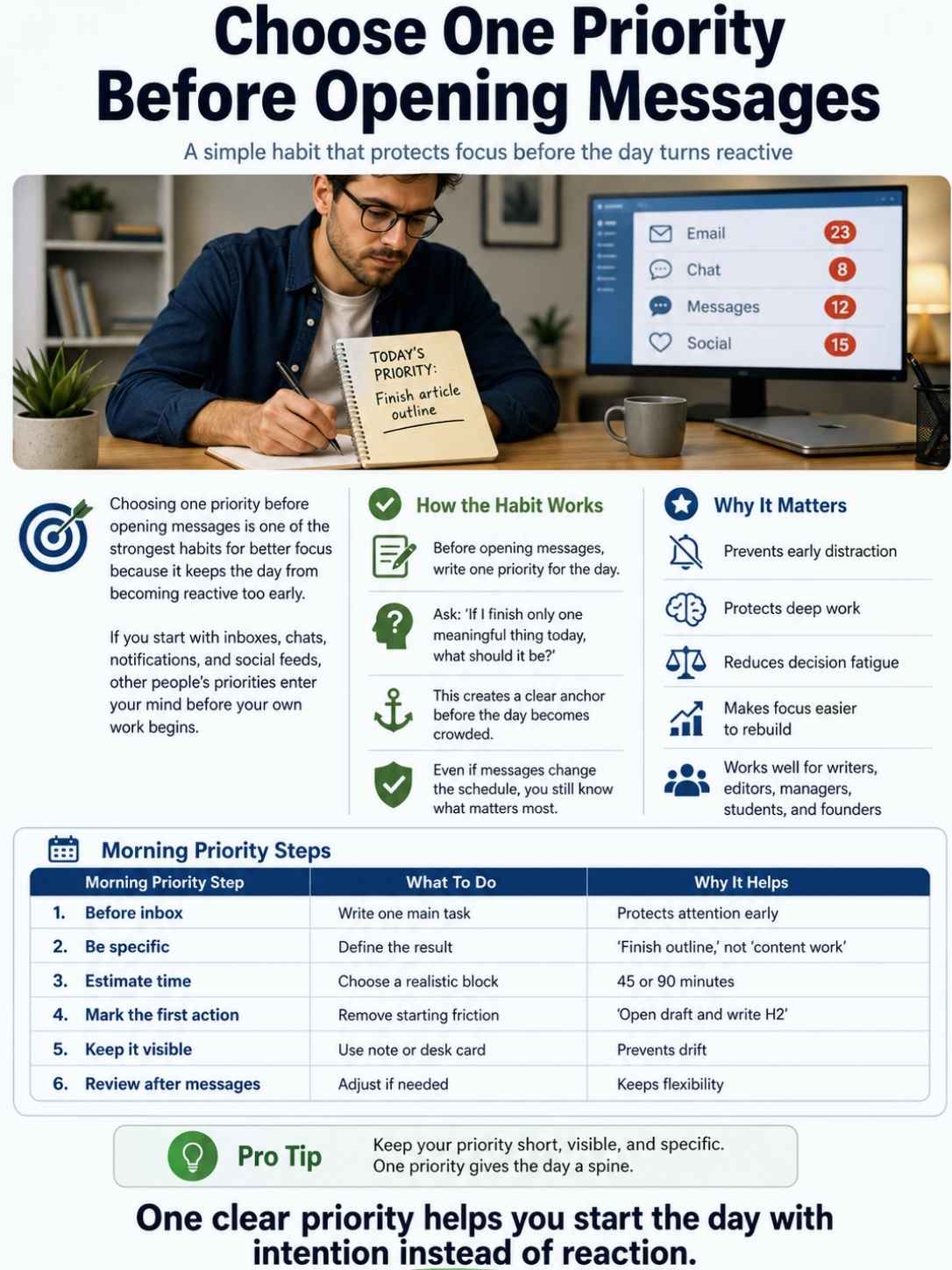
Choosing one priority before opening messages is one of the strongest habits for better focus because it protects the day from becoming reactive too early. If you start with inboxes, chats, notifications, and social feeds, other people’s priorities enter your mind before your own work has a chance. Sometimes that is necessary. Most days, it is not the best first move.
The habit is simple. Before opening messages, write one priority for the day. Not five. One. Ask, “If I finish only one meaningful thing today, what should it be?” That question cuts through noise. This does not mean ignoring urgent work. It means giving your brain a clear anchor before the day becomes crowded. Even if messages change the schedule, you know what matters.
For writers, editors, managers, students, and founders, this habit is powerful because deep work often dies in the first 20 minutes of the morning. Once attention is scattered, it is harder to rebuild. Write the priority somewhere visible. A notebook, sticky note, task app, calendar block, or whiteboard works. Keep it short enough to remember.
| Morning Priority Step | What To Do | Why It Helps |
| Before inbox | Write one main task | Protects attention early |
| Be specific | Define the result | “Finish outline,” not “content work” |
| Estimate time | Choose a realistic block | 45 or 90 minutes |
| Mark the first action | Remove starting friction | “Open draft and write H2” |
| Keep it visible | Use note or desk card | Prevents drift |
| Review after messages | Adjust if needed | Keeps flexibility |
One priority gives the day a spine.
2. Protect One Deep Work Block
A deep work block is protected time for one demanding task. It is where real focus building happens. This habit matters because hard work needs uninterrupted attention. Writing, planning, research, strategy, design, coding, editing, studying, and creative thinking all suffer when split into tiny pieces.
Start with one block per day if possible. It can be 25, 45, 60, or 90 minutes. The length matters less than the protection. During that time, one task gets your full attention. Protecting the block means closing messages, silencing notifications, putting the phone away, and telling yourself what counts as work. If the task is writing, writing counts. Research may count only if it is part of the block. Random browsing does not.
The mistake is waiting for a perfect quiet day. Most people never get that. Create a small protected block inside the messy day. Deep work blocks are especially useful for the corporate athlete because quality thinking is a competitive advantage. Busy is not the same as focused.
| Deep Work Block Element | Practical Setup |
| Task | One clear task only |
| Time | 25-90 minutes |
| Phone | Away from reach |
| Browser | Only needed tabs |
| Messages | Closed or muted |
| Timer | Set before starting |
| Break | Planned after the block |
One protected block can produce more real progress than three hours of scattered effort.
3. Use a Single-Task Rule
The single-task rule is simple: one screen, one task, one clear outcome. This habit fights the biggest lie of modern work: that multitasking saves time. In reality, many “multitasking” moments are just fast switching. You write, check email, reply to chat, reopen the draft, check a notification, then try to remember where you were.
The single-task rule helps you work with less mental friction. Choose the task. Close unrelated windows. Keep only the tool you need. If another thought appears, write it down instead of chasing it. This habit is not always possible for every job. Some roles require monitoring. But most people can still create single-task pockets during the day.
The rule also reduces anxiety. A task feels less overwhelming when it has a boundary. You are not trying to handle the whole day. You are handling this one thing. If the task feels too big, shrink it. “Work on report” becomes “write the first 300 words.” “Study chapter” becomes “review pages 1 to 5.” Specific tasks are easier to focus on.
| Multitasking Pattern | Single-Task Replacement |
| Writing while inbox is open | Write with inbox closed |
| Studying with phone nearby | Study with phone in another room |
| Editing with 12 tabs open | Keep only draft and source |
| Meeting while replying to chats | Attend or skip with intention |
| Planning while scrolling | Use paper or full-screen document |
| Research without limits | Use a timer and source list |
Single-tasking is not slower. It is cleaner.
4. Create Phone Distance
Phone distance is one of the most practical attention habits because the phone is designed to win attention. Keeping it beside you and expecting perfect focus is a hard game. The simplest fix is physical distance. Put the phone across the room, in a drawer, in another bag, or on a charging station away from the desk. Distance adds friction. Friction protects focus.
This habit works better than only using willpower. When the phone is beside your hand, checking it feels automatic. When you must stand up to get it, you have a moment to ask, “Do I actually need this?” Use do-not-disturb during deep work blocks. Allow calls from important contacts if needed. Remove non-essential notifications. Keep social apps off the home screen if they pull you in too easily.
The mistake is thinking every notification deserves immediate attention. Most do not. If something is truly urgent, create a separate channel for it. Everything else can wait for a message window. Phone distance also supports evening habits that improve sleep because the same device that breaks focus during work can break sleep at night.
| Phone Boundary | Best For | Practical Setup |
| Across the room | Deep work | Put phone on shelf |
| Drawer mode | Office work | Silent and out of sight |
| Charging station | Evening routine | Keep away from bed |
| Do-not-disturb | Focus blocks | Allow emergency contacts |
| App removal | Habit reset | Remove social apps from home screen |
| Scheduled checks | Reactive work | Check at set times |
| Grayscale mode | Lower stimulation | Make phone less appealing |
Your phone does not need to disappear. It needs boundaries.
5. Close Extra Tabs Before Work
Open tabs create visual noise. They remind you of unfinished tasks, possible distractions, things to read, things to buy, messages to answer, and ideas to chase. Closing extra tabs before focus work is a small habit with a big effect. It tells the brain, “This is the task now.”
If you need many tabs for research, separate them into a different window. Keep the active work window clean. You can also use bookmarks, read-later tools, or a temporary notes file to save links without keeping them open. This habit is especially useful for writers, editors, researchers, students, and digital workers. Browser clutter often becomes mental clutter.
The mistake is leaving everything open because you are afraid of losing it. That fear creates attention debt. Save the important tabs properly. Close the rest. A clean browser also helps you notice when you are drifting. If only the draft is open, opening a random site becomes a conscious action instead of a hidden slide.
| Tab Problem | Better Focus Habit |
| Too many research tabs | Save links in one note |
| Open inbox tab | Close during writing block |
| Social media tab | Remove from work browser |
| Shopping or news tab | Save for break time |
| Multiple projects open | Use separate windows |
| Fear of losing pages | Bookmark properly |
| Hard-to-find sources | Make a source list |
A cleaner browser makes the task feel less crowded.
6. Use a Focus Timer
A focus timer gives attention a container. It helps you start, stay, and stop without constantly asking how long you have been working. Timers work because they make focus feel finite. “Write for 45 minutes” is easier than “finish everything.” A clear time block reduces resistance.
You can use 25-minute blocks, 45-minute blocks, or 60 to 90-minute deep work blocks. The best length depends on the task and your current focus stamina. Beginners often do better with shorter blocks. Experienced workers may prefer longer blocks. The timer should not become another distraction. Use a simple timer, not an app that pulls you into analytics, badges, or notifications. The goal is structure, not performance theater.
When the timer starts, work on one task. When it ends, take a real break. Stand, stretch, walk, drink water, look away from the screen, or breathe. Do not turn every break into scrolling. This habit is useful because it trains concentration gradually. Focus is a skill. Time blocks are practice reps.
| Timer Style | Best For | Example |
| 25-minute block | Beginners or admin tasks | 25 work, 5 break |
| 45-minute block | Writing and editing | 45 work, 10 break |
| 60-minute block | Planning or research | 60 work, 10 break |
| 90-minute block | Deep creative work | 90 work, longer break |
| 10-minute start | Procrastination | Start only, then continue |
| 5-minute reset | Low-energy days | Clear one small task |
A timer turns focus from a vague wish into a visible commitment.
7. Take Movement-Based Breaks
Movement-based breaks are better than screen-based breaks for focus. If you work on a screen, taking a break by switching to another screen often does not feel like recovery. A useful break changes your state. Stand up. Walk. Stretch. Roll your shoulders. Do calf raises. Go outside for a few minutes. Refill water. Do a breathing walk. Move the body enough to reset attention.
This habit is especially important for sedentary workers. Long sitting can make the body restless and the mind dull. A short movement break can improve the work rhythm without requiring a full workout. The mistake is working until focus collapses, then scrolling because the brain feels tired. That usually extends the fog. A better habit is to pause before collapse.
Movement breaks also pair well with hydration habits. Refill water during the break. This gives the body two forms of support: fluid and movement. You do not need a long break every time. Two to five minutes can help, especially between deep work blocks.
| Break Type | Time Needed | Why It Helps |
| Walk around room | 2 minutes | Breaks sitting |
| Outdoor light break | 5 minutes | Refreshes attention |
| Shoulder and neck reset | 2 minutes | Reduces screen tension |
| Hip stretch | 2 minutes | Helps desk stiffness |
| Water refill walk | 2-3 minutes | Adds hydration cue |
| Stair walk | 3-5 minutes | Raises energy |
| Breathing walk | 5 minutes | Calms stress |
A movement break is not lost time. It is maintenance for the next focus block.
8. Build a Water and Snack Focus Cue
Focus often drops when energy drops. Sometimes the brain does not need a productivity trick. It needs water, food, or a better meal rhythm. A water and snack focus cue helps you check the basics before blaming your attention. When focus fades, ask: Have I had water? When did I last eat? Did lunch include protein and fiber? Am I tired, thirsty, hungry, or just avoiding a hard task?
This habit is not about snacking all day. It is about preventing preventable crashes. A planned snack can support focus when meals are far apart or the workday runs long. Good focus snacks usually include protein, fiber, or both. Examples include yogurt and fruit, nuts and an apple, boiled eggs, hummus with vegetables, roasted chickpeas, cottage cheese, or a simple protein-rich meal leftover.
Hydration matters too. Keep water visible. Drink before the afternoon slump gets too strong. Pair water with movement breaks. This habit connects with nutrition habits long term and hydration habits because concentration depends on the body’s daily fuel pattern.
| Focus Drop Signal | Check First | Better Choice |
| Afternoon fog | Water intake | Drink water and walk |
| Irritability | Meal timing | Eat a balanced snack |
| Headache | Hydration and screen time | Water plus eye break |
| Restless scrolling | Avoidance or low energy | 5-minute reset |
| Heavy thinking | Food quality | Protein and fiber at next meal |
| Caffeine craving | Sleep, water, hunger | Check basics before another cup |
Better focus often starts with better body support.
9. Use a Brain Dump for Open Loops

Open loops steal attention. An open loop is anything your brain keeps trying to remember: reply to that email, pay that bill, edit that section, call that person, book that appointment, fix that issue, check that idea. If you do not capture these thoughts, they interrupt your focus block. The brain keeps bringing them back because it does not trust you to remember.
A brain dump solves this. Before deep work, write every loose thought in one place. Tasks, worries, reminders, ideas, questions, and unfinished decisions. Do not organize at first. Just capture. Then choose what matters now and what can wait. This tells the brain, “We have stored it. We do not need to chase it during this work block.”
This habit is useful before work, after meetings, before bed, or whenever the mind feels crowded. It also supports mental health habits and evening habits that improve sleep. The mistake is trying to solve every item during the brain dump. Capture first. Organize later. The goal is to clear attention, not create another project.
| Open Loop Type | What to Write | Next Step |
| Work task | “Send report” | Add to task list |
| Personal reminder | “Buy medicine” | Add to errands |
| Worry | “What if deadline slips?” | Define next action |
| Idea | “New article angle” | Save in idea file |
| Message | “Reply to client” | Schedule message time |
| Decision | “Which plan to choose?” | Set review time |
| Random thought | “Look up book” | Save for later |
A brain dump gives your attention room to breathe.
10. Design a Focus-Friendly Workspace
Your workspace shapes your attention. A focus-friendly workspace does not need to be perfect or expensive. It needs to reduce friction. Start with what you can see. Remove objects that pull your mind away from the task. Keep only what supports the current work: laptop, notebook, water, timer, needed documents, and maybe one personal item that keeps the space calm.
Next, check comfort. If your chair, screen height, lighting, or desk setup makes your body uncomfortable, focus suffers. You may not notice it immediately, but discomfort builds across the day. Lighting matters too. Harsh light can feel draining. Too little light can make you sleepy. Natural light, a good lamp, or a well-lit workspace can help the mind feel more alert.
Sound matters as well. Some people need quiet. Others work better with soft background noise. Use headphones, white noise, or quiet music if it helps, but avoid audio that steals language attention during writing or reading. The goal is to make the right action obvious. When you sit down, your workspace should say, “This is where focused work happens.”
| Workspace Element | Focus-Friendly Upgrade |
| Desk surface | Keep only task-related items |
| Phone | Keep away from reach |
| Lighting | Use steady, comfortable light |
| Chair | Support upright work |
| Screen | Set at comfortable height |
| Noise | Use headphones or white noise if needed |
| Water | Keep visible |
| Notes | Keep one capture pad nearby |
A clean workspace cannot do the work for you, but it can stop fighting you.
11. End Work With a Shutdown Ritual
A shutdown ritual protects tomorrow’s focus. It gives the workday a clean ending instead of leaving every task floating in your head. This habit is simple. Review what you finished. Write tomorrow’s top three tasks. Capture open loops. Close tabs. Clear the desk. Set the first task for the next work session. Then stop.
The reason this works is that the brain hates uncertainty. If you end work with 15 loose thoughts and no plan, those thoughts follow you into the evening. They may show up during dinner, family time, sleep, or the next morning. A shutdown ritual also supports evening habits that improve sleep. When work has an ending, your nervous system gets a better chance to settle.
For remote workers, this habit matters even more because the office and home are often the same space. Closing the laptop is not always enough. You need a mental close too. Keep the ritual short. Five to 10 minutes is enough. Do not turn it into another work session.
| Shutdown Step | Time Needed | Why It Helps |
| Review completed work | 1 minute | Builds closure |
| Capture open loops | 2 minutes | Clears mental clutter |
| Choose tomorrow’s top 3 | 2 minutes | Reduces morning friction |
| Set first task | 1 minute | Makes starting easier |
| Close tabs | 1 minute | Ends visual noise |
| Clear desk | 1 minute | Resets workspace |
| Say work is done | 10 seconds | Creates mental boundary |
A better ending creates an easier beginning.
A Simple Daily Focus Routine
A daily focus routine should not be complicated. It should give your attention structure from morning to evening. Start by choosing one priority before opening messages. Then schedule one deep work block when your energy is strongest. Before the block starts, remove phone access, close extra tabs, set a timer, and write down any open loops.
After the block, take a movement-based break. Drink water, stretch, walk, or get light. Then move into lighter work, meetings, or admin tasks. Repeat another shorter focus block later if needed. During the afternoon, check energy before blaming focus. Water, food, movement, and a short reset may help more than forcing another hour at the desk.
End the day with a shutdown ritual. Capture loose tasks and choose tomorrow’s first action. This routine works because it treats focus like a rhythm, not a heroic mood.
| Time of Day | Focus Habit | Time Needed |
| Morning | Choose one priority | 2 minutes |
| Before deep work | Close tabs and move phone | 2 minutes |
| Deep work | Single-task focus block | 25-90 minutes |
| After block | Movement and water break | 5 minutes |
| Midday | Check food, water, and energy | 2 minutes |
| Afternoon | Short focus timer | 25-45 minutes |
| End of work | Shutdown ritual | 5-10 minutes |
Minimum version:
| Minimum Focus Routine | Action |
| Morning | Write one priority |
| Work block | Put phone away for 25 minutes |
| Break | Walk for 2 minutes |
| Afternoon | Drink water before another coffee |
| End | Write tomorrow’s first task |
A simple routine repeated often beats a perfect system used once.
Beginner Mistakes That Make Focus Harder
The first mistake is trying to focus without choosing a task. Sitting down to “be productive” is too vague. The brain needs a clear target.
The second mistake is keeping the phone nearby. Even if you do not touch it, its presence can create temptation. Physical distance is easier than constant resistance.
Another mistake is confusing busy work with focused work. Clearing inboxes, organizing files, checking dashboards, and replying to messages may be necessary, but they are not always the highest-value work. Deep work needs protection.
Many people also skip breaks until they crash. Then they take poor breaks, usually scrolling or checking more screens. That does not restore attention well. Movement breaks, water, light, and breathing are usually better.
A common mistake is using caffeine to cover every focus problem. Caffeine can help some people, but it cannot replace sleep, hydration, food, movement, and realistic workload planning.
Finally, some people blame themselves when the real issue is workload. If the task list is impossible, focus habits help but cannot fix everything. Sometimes better boundaries, delegation, planning, or support are needed.
| Mistake | Why It Hurts Focus | Better Habit |
| No clear task | Attention drifts | Define one outcome |
| Phone on desk | Temptation stays visible | Move phone away |
| Inbox always open | Reactive work takes over | Check messages in windows |
| Too many tabs | Visual noise increases | Close unrelated tabs |
| No breaks | Mental fatigue builds | Use planned movement breaks |
| Caffeine-only strategy | Ignores root causes | Check sleep, food, water |
| Multitasking | Creates switching costs | Single-task |
| No shutdown | Tomorrow starts messy | End with a work close |
Focus is not only a personal trait. It is a system.
Focus Habits by Lifestyle Type
Different people need different focus habits. A remote worker may need stronger boundaries because home and work blend together. A student may need phone distance and timed study blocks. A founder may need priority selection because everything feels urgent. A writer may need tab control. A manager may need message windows. A parent working from home may need shorter focus blocks.
This is why generic productivity advice often fails. It ignores the real conditions of the day. A person with back-to-back meetings cannot use the same focus plan as someone with a quiet morning. A shift worker cannot use the same routine as someone with steady office hours.
The habit should match the pressure point. If you are interrupted by others, protect a time block. If you interrupt yourself, use single-tasking and phone distance. If you feel tired, fix sleep, hydration, movement, and food basics. If your mind is crowded, use brain dumps and shutdown rituals. Focus building is personal. The principles are shared, but the setup should fit your life.
| Lifestyle Type | Common Focus Problem | Best Habit to Start |
| Remote worker | Work-home blur | Shutdown ritual |
| Desk worker | Screen fatigue | Movement-based breaks |
| Student | Phone distraction | Phone distance and timer |
| Writer or editor | Tab overload | Close extra tabs |
| Founder or manager | Everything feels urgent | One priority before messages |
| Parent working from home | Interrupted time | Short focus blocks |
| Creator | Idea overload | Brain dump |
| Shift worker | Fatigue | Sleep and energy planning |
| Frequent traveler | Broken routine | Minimum focus routine |
The best focus habit is the one that solves your real attention leak.
How Focus Habits Support the Best Healthy Habits?
Focus habits support the best healthy habits because attention affects everything else. When focus is poor, the whole day can feel chaotic. You may skip movement, drink less water, eat randomly, sleep late, ignore recovery, and carry stress into the evening. Morning habits for better energy support focus by giving the day a calmer start. Light, water, movement, and one clear priority can make the first work block easier. Evening habits that improve sleep protect the next day’s attention by helping the brain recover.
Movement habits for sedentary lifestyles also support concentration. A short walk or desk reset can reduce stiffness and mental fog. Hydration habits matter because low fluid intake can make focus feel harder for some people. Nutrition habits long term support steady energy when meals include protein, fiber, and enough fuel.
Mental health habits and meditation aids tools also connect strongly. A brain dump, breathing card, short meditation timer, or emotional check-in can reduce mental clutter before deep work. Focus is not separate from wellness. It sits inside the same system.
| Focus Habit | Related Healthy Habit Topic |
| Morning priority | Morning habits for better energy |
| Shutdown ritual | Evening habits that improve sleep |
| Movement break | Movement habits for sedentary lifestyles |
| Water cue | Hydration habits |
| Planned snack | Nutrition habits long term |
| Brain dump | Mental health habits |
| Timer practice | Meditation aids tools |
| Deep work block | Best healthy habits |
| Phone boundary | Habits that reduce stress long term |
| Walk with coworker | Social wellness habits |
Better focus becomes easier when the body and mind are supported.
When Focus Problems Need Extra Support?
Focus habits can help many people, but they do not solve every attention problem. Sometimes poor focus is a sign of something deeper. If concentration problems are persistent, severe, or affecting work, school, relationships, safety, or daily life, it may be worth speaking with a healthcare professional or mental health professional. Sleep disorders, anxiety, depression, ADHD, chronic stress, medication effects, pain, burnout, and medical issues can all affect attention.
It is also important to notice sudden changes. If focus changes quickly or comes with confusion, severe fatigue, dizziness, mood changes, or other concerning symptoms, get medical guidance. Support is not failure. It is useful information. A good professional can help identify whether the issue is lifestyle, workload, sleep, mental health, attention regulation, or something else.
Focus habits are still valuable, but they should not become a way to blame yourself for something that needs care.
| Sign Extra Support May Help | Why It Matters |
| Focus problems last for months | May need assessment |
| Work or school is seriously affected | Daily function matters |
| Sleep is poor despite effort | Sleep issues may need care |
| Anxiety or low mood is persistent | Mental health affects attention |
| You feel burned out | Workload and recovery need review |
| Attention issues began suddenly | Medical guidance may be needed |
| You rely heavily on stimulants | Root causes may be ignored |
| Focus problems affect safety | Professional help is important |
Strong focus starts with honest support, not self-blame.
Final Thoughts
Habits for better focus do not need to be complicated. Start with one priority. Protect one deep work block. Move your phone away. Close extra tabs. Use a timer. Take movement breaks. Drink water. Eat in a way that supports energy. Capture open loops. Build a calmer workspace. End work with a shutdown ritual.
You do not need perfect focus all day. That is not real life. You need better returns.
When your mind drifts, return. When the day gets noisy, return. When the task feels hard, shrink the next step and return. Focus building is not about becoming a machine. It is about creating a daily system that respects how attention actually works.
That is how attention habits become stronger. That is how concentration practices become repeatable. And that is why habits better focus belong among the best healthy habits for energy, productivity, mental wellness, recovery, and long-term performance.
Frequently Asked Questions (FAQs) About Habits Better Focus
What are habits for better focus?
Habits for better focus are daily routines that protect attention and reduce distraction. They include choosing one priority, using deep work blocks, single-tasking, creating phone distance, closing extra tabs, taking movement breaks, and ending work with a shutdown ritual.
What is the easiest focus habit to start?
The easiest focus habit is choosing one priority before opening messages. Write one clear task you want to complete before the day becomes reactive.
How can I build focus quickly?
Start with a 25-minute timer, one task, phone away, and only the needed tabs open. After the block, take a short movement break. Repeat once if energy allows.
Why do I lose focus so easily?
You may lose focus because of task switching, phone distraction, poor sleep, stress, unclear priorities, long sitting, poor breaks, hunger, dehydration, or an overloaded schedule. Focus is affected by both environment and body state.
Do focus timers really help?
Yes, focus timers can help by giving attention a clear container. A timer makes the work period feel manageable and reduces the urge to keep checking the clock.
Is multitasking bad for concentration?
Multitasking often means switching rapidly between tasks. This can create mental switching costs, slow work down, increase mistakes, and make it harder to return to deep focus.
What are good concentration practices for desk workers?
Desk workers can use deep work blocks, phone distance, browser cleanup, water cues, movement breaks, posture resets, and a shutdown ritual. These practices reduce screen fatigue and attention drift.