Software used to get a free pass in sustainability conversations. Factories polluted. Planes emitted. Buildings waste energy. Software, by comparison, looked clean because nobody could see the servers, networks, devices, cooling systems, endless data transfers, background processes, and short hardware replacement cycles sitting behind the screen. That illusion is fading.
Today, software teams are being asked harder questions. How much energy does this app consume on real devices? Does this website burn resources because nobody checked its front-end weight? Is this cloud architecture efficient, or just expensive in both money and carbon? Are AI features being added because they are useful, or because everyone panicked and shipped something heavy?
France has become one of the more interesting markets for this shift. The country has a strong responsible-digital movement, tighter regulation around digital environmental impact, and a growing cluster of companies trying to make software sustainability measurable instead of decorative.
This list focuses on French sustainable software engineering startups and SMEs that help teams design, build, test, operate, or govern digital systems with environmental impact in mind.
They are not all the same kind of company. Some are developer tools. Some are GreenOps platforms. Some measure real-device energy consumption. Some help IT leaders turn digital sustainability into operational decisions. That variety is the point.
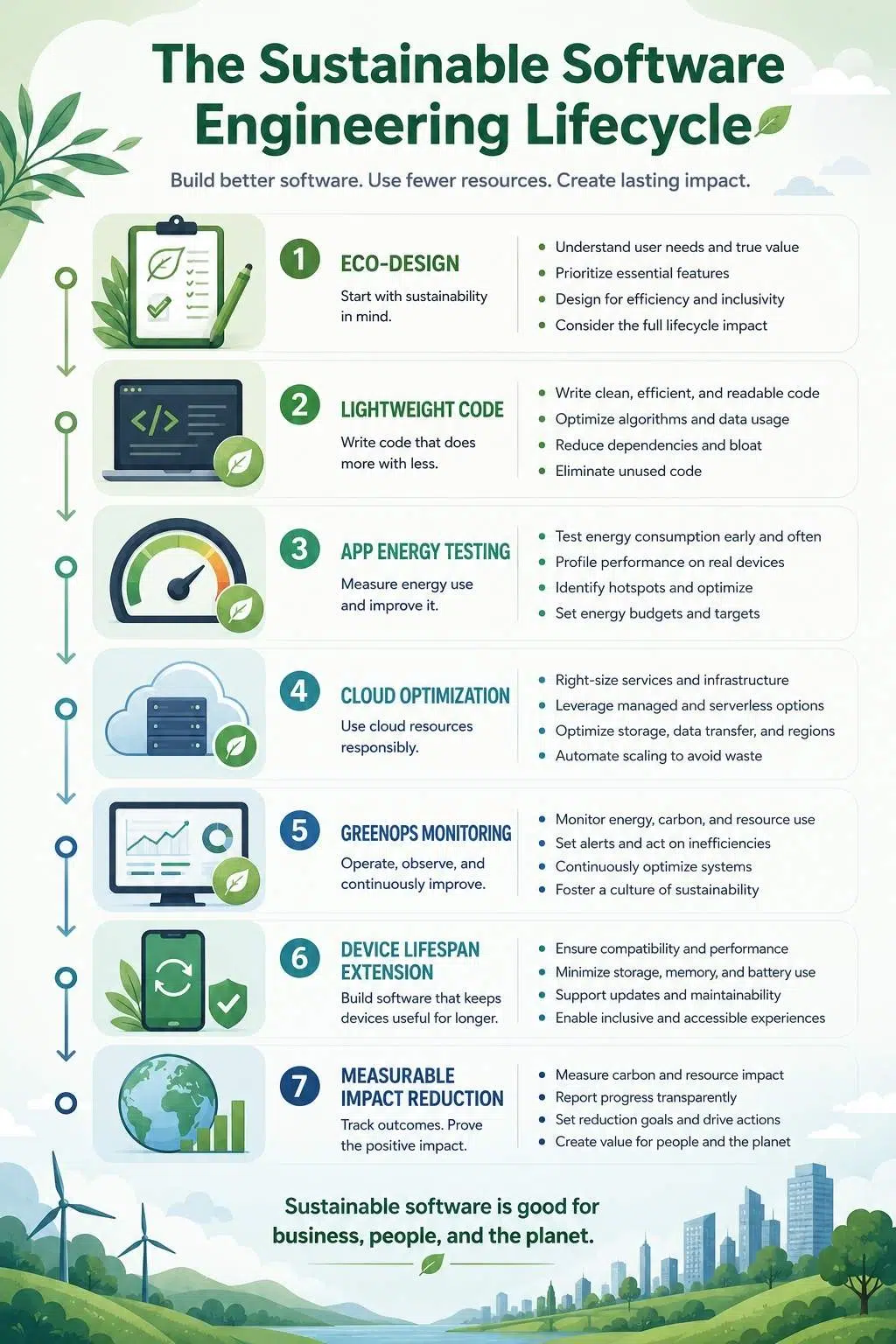
Sustainable software engineering is not only about writing fewer lines of code. It is about making better technical decisions across the whole software lifecycle.
How I Selected These Companies
I built this list around direct relevance to software, cloud, IT operations, digital eco-design, or engineering workflows. To be included, each company needed to meet most or all of the following criteria:
- It had to be based in France or clearly French-founded.
- It had to be active and publicly verifiable.
- It needed a clear link to sustainable software engineering, GreenOps, digital eco-design, cloud carbon measurement, app energy testing, or digital impact assessment.
- It had to offer a practical product, tool, platform, or expert service for digital teams.
- Its claims had to be specific enough to describe without inventing extra facts.
- It had to go beyond generic ESG reporting and show a real connection to software, infrastructure, application performance, or IT systems.
One important note: the article uses “startups and SMEs” deliberately. Some of the strongest French companies in this space are not brand-new startups. They are specialist software firms, impact companies, or mature SMEs that have been working on responsible digital technology for years.
1. GreenFrame by Marmelab
GreenFrame is one of the most developer-facing tools on this list.
Created by Marmelab, a France-based web and mobile development studio, GreenFrame helps developers estimate and reduce the carbon footprint of web applications. It is especially relevant because it fits into the software development workflow rather than sitting only in a sustainability report after the product is already live. That matters.
A lot of digital sustainability tools appear too late. They measure the problem after the website is bloated, the architecture is locked, and the team has already moved on to the next sprint. GreenFrame is more useful because it can be used earlier, including in development and continuous integration workflows.
Business Snapshot
| Field | Details |
| Main solution | Web application carbon footprint measurement |
| French connection | Built by Marmelab, a France-based software studio |
| Best suited for | Web developers, product teams, agencies, and engineering leads |
| Strongest use case | Detecting carbon impact changes during development |
| Engineering relevance | Fits into CLI, CI, and web application testing workflows |
What the Company Actually Does
GreenFrame estimates the carbon footprint of user scenarios on web applications. It can be used through a web interface, command line, or continuous integration setup.
This makes it different from simple website carbon calculators that give a one-off score for a page. GreenFrame is more developer-oriented. It can simulate user actions, compare results after changes, and help teams detect whether a new feature increases the footprint of a web experience.
That is useful because software sustainability is rarely solved by one grand redesign. It often improves through repeated engineering decisions: smaller payloads, fewer unnecessary scripts, leaner interfaces, faster pages, better caching, less wasteful user journeys, and fewer background processes.
GreenFrame gives teams a way to see whether those changes are actually moving in the right direction.
Why It Belongs on This List
GreenFrame belongs here because it brings sustainability closer to the developer’s everyday workflow.
A tool that can be used in continuous integration has a better chance of changing behavior than a PDF report that arrives three months later. If developers can see carbon changes alongside performance and quality checks, sustainability becomes part of the engineering discipline rather than a separate corporate slogan.
For web teams, that is a meaningful shift.
Business Reality Check
GreenFrame should not be treated as a complete measurement tool for every digital impact. Web application carbon measurement is complex, and estimates depend on assumptions, user scenarios, infrastructure, location, device types, and methodology.
Its value is strongest when teams use it for comparison, trend tracking, and improvement decisions, not as a single perfect number.
Best Fit
GreenFrame is best for web teams that want to integrate carbon awareness into development, testing, and continuous integration instead of treating sustainability as an afterthought.
2. Greenspector
Greenspector is one of France’s most established names in sustainable digital testing.
The company focuses on measuring and optimizing the energy consumption, performance, and environmental impact of mobile and web applications. That makes it especially relevant for software teams that care about real user devices, not just server-side dashboards.
This is important because a software product’s footprint is not only in the cloud. Poorly optimized apps can drain batteries, overload older phones, increase data transfer, force device upgrades, and make the user experience worse.
Greenspector’s strength is that it connects sustainability with performance and quality.
Business Snapshot
| Field | Details |
| Main solution | Energy and environmental testing for mobile and web apps |
| French connection | French sustainable digital technology company |
| Best suited for | Mobile teams, QA teams, product teams, and digital service owners |
| Strongest use case | Measuring app energy consumption under real-world conditions |
| Engineering relevance | Helps detect resource-heavy software behavior before or after release |
What the Company Actually Does
Greenspector measures the energy consumption, resource use, performance, and environmental impact of digital services, especially mobile and web applications.
Its approach is valuable because many teams already test functionality, security, accessibility, and performance. Greenspector adds another layer: sobriety and energy efficiency.
That can reveal problems developers might otherwise miss. A feature may work correctly but still consume too much battery. A tracking script may look harmless, but add unnecessary resource use. A mobile app may perform well on a recent device but punish older models.
In sustainability terms, that matters because software can contribute to hardware obsolescence. If apps become heavier every year, users are pushed toward newer devices sooner.
Why It Belongs on This List
Greenspector belongs here because it turns sustainable software from a design opinion into something measurable.
For engineering teams, measurement is everything. You cannot optimize what you cannot see. Greenspector helps teams identify where energy and resource consumption are happening, then connect those findings to performance, user experience, and environmental impact.
That makes the company useful not only for sustainability teams but also for developers, testers, product owners, and mobile leaders.
Business Reality Check
Greenspector is not a brand-new startup. It is better described as a specialist French SME and a pioneer in sustainable digital technology.
That is not a weakness. In a field where many tools are new and unproven, experience matters. The safer framing is that Greenspector is one of the more mature French companies helping teams measure and improve the environmental performance of software.
Best Fit
Greenspector is best for teams building or maintaining mobile apps, web apps, and digital services where energy consumption, performance, battery use, and accessibility across devices matter.
3. Fruggr by Digital4Better
Fruggr is built for organizations that want to manage their digital impact at a broader level.
Published by Digital4Better, Fruggr is a SaaS platform focused on responsible digital performance. It helps organizations assess their digital footprint, monitor ESG-related IT indicators, improve efficiency, and manage issues such as accessibility and AI governance.
This makes Fruggr slightly different from pure developer tools like GreenFrame. It is not mainly about a single codebase or one application test. It is closer to a digital sustainability cockpit for organizations that need to understand and improve the impact of their broader digital ecosystem.
Business Snapshot
| Field | Details |
| Main solution | Sustainable digital performance platform |
| French connection | French startup and platform by Digital4Better |
| Best suited for | CIOs, digital leaders, ESG teams, accessibility leads, and responsible digital teams |
| Strongest use case | Measuring and governing environmental and social impact across digital services |
| Engineering relevance | Helps prioritize digital efficiency, eco-design, accessibility, and IT impact improvements |
What the Company Actually Does
Fruggr helps organizations collect and interpret data from their digital ecosystem so they can understand environmental and social impact. Its platform covers areas such as ESG IT indicators, digital footprint analysis, accessibility, AI governance, and performance improvement.
That wider lens matters because sustainable software engineering is not only a developer problem.
A developer can optimize code, but if the organization keeps launching unnecessary platforms, duplicating tools, ignoring accessibility debt, overusing cloud resources, or deploying AI where a simpler system would work, the footprint will keep growing.
Fruggr helps larger organizations see those patterns and make better decisions.
Why It Belongs on This List
Fruggr belongs here because sustainable software engineering needs governance, not just good intentions.
Engineering teams often know where waste exists, but they need priorities, metrics, internal support, and business alignment. A platform like Fruggr can help connect responsible digital practices with cost, compliance, accessibility, and ESG goals.
That makes it useful for companies that want to move beyond “one green audit” and build a more continuous, responsible digital strategy.
Business Reality Check
Fruggr is not a code profiler. It will not replace hands-on engineering tools for measuring one app’s runtime behavior or one website’s front-end emissions.
Its strength is broader organizational visibility. That means it is best used alongside technical testing tools, not instead of them.
Best Fit
Fruggr is best for medium and large organizations that need to govern digital sustainability across multiple websites, applications, AI projects, infrastructure choices, accessibility obligations, and IT performance indicators.
4. Sopht
Sopht focuses on GreenOps and sustainable ITOps.
The company helps organizations measure, analyze, and reduce the environmental footprint of IT operations while also improving cost efficiency. That combination is important because many cloud and IT sustainability conversations fail when they are separated from operational reality.
IT teams are already under pressure to control cloud spending, manage devices, support applications, improve reliability, and report sustainability data. Sopht sits in that messy operating layer.
Business Snapshot
| Field | Details |
| Main solution | GreenOps and the IT carbon observability platform |
| French connection | French GreenOps startup |
| Best suited for | IT leaders, cloud teams, infrastructure teams, FinOps teams, and ESG data teams |
| Strongest use case | Measuring and reducing IT cost and carbon across the technology estate |
| Engineering relevance | Connects sustainability with cloud, infrastructure, workplace IT, applications, and operations |
What the Company Actually Does
Sopht automates IT data collection and turns it into environmental and financial optimization insights. Its platform is designed to give organizations a consolidated view of IT cost and carbon across areas such as cloud, infrastructure, applications, devices, and digital workplace systems.
That is useful because IT emissions are often scattered across tools. Cloud data sits in one place. Device data sits somewhere else. Application portfolios live in another system. ESG reporting may depend on spreadsheets. Engineering teams may have no shared view of where the biggest reduction levers are.
Sopht tries to connect those pieces.
Why It Belongs on This List
Sopht belongs here because sustainable software engineering does not stop at deployment.
Once software is running, it consumes cloud resources, storage, network traffic, monitoring tools, databases, devices, and operational effort. GreenOps brings sustainability into how those systems are operated.
That is where Sopht’s value sits. It helps organizations see where digital systems are expensive, wasteful, or carbon-heavy, then prioritize reduction actions.
Business Reality Check
Sopht is not a developer linting tool or mobile-app energy profiler. Its strongest fit is enterprise IT operations.
That means a small engineering team may not need it. A large organization with multiple cloud accounts, thousands of devices, a complex application portfolio, and reporting pressure is a better match.
Best Fit
Sopht is best for enterprise IT teams that want to connect sustainability with cloud optimization, IT asset management, FinOps, workplace IT, and environmental reporting.
5. Hubblo
Hubblo is one of the more technically interesting companies on this list because it works close to measurement methods, open-source tooling, and infrastructure-level impact assessment.
The company supports organizations in the socio-ecological transformation of digital technologies. Its work includes training, consulting, software, and methodological support. For engineering teams, the most relevant part is Scaphandre, an open-source metrology agent created by Hubblo to measure energy consumption metrics for tech services.
This makes Hubblo important because sustainable software engineering needs better measurement at the infrastructure layer.
Business Snapshot
| Field | Details |
| Main solution | Digital impact assessment, tooling, and training |
| French connection | Paris-based specialist sustainable digital company |
| Best suited for | Infrastructure teams, cloud teams, IT departments, public bodies, and responsible digital practitioners |
| Strongest use case | Measuring and understanding energy consumption patterns in servers and tech services |
| Engineering relevance | Supports open-source energy metrology through Scaphandre and digital impact methods |
What the Company Actually Does
Hubblo helps organizations assess and reduce the environmental impact of digital technologies. Its software work includes tools and integrations for measuring energy consumption and evaluating digital service impact.
Scaphandre is especially relevant for software and infrastructure teams. It is an open-source monitoring agent designed to collect energy consumption metrics from servers and expose that data through monitoring or analysis toolchains.
That kind of tooling matters because many teams still rely on rough estimates. If energy data can be brought closer to the systems developers and operators already use, sustainability becomes more practical.
Why It Belongs on This List
Hubblo belongs here because it contributes to the measurement layer beneath sustainable software engineering.
A lot of digital sustainability work depends on assumptions. Some assumptions are necessary, but teams still need better data wherever possible. Hubblo’s work with Scaphandre, Boavizta-related methods, and environmental assessment helps push the sector toward more transparent and operational measurement.
For software engineering, that is valuable because energy and carbon awareness need to enter observability, infrastructure decisions, and service design.
Business Reality Check
Hubblo is not a classic SaaS startup selling one simple dashboard. It is better described as a specialist sustainable digital company working across consulting, training, methods, and software.
That can be a strength for complex organizations, but buyers should be clear about what they need: a tool, an integration, a method, training, or strategic support.
Best Fit
Hubblo is best for organizations that want deeper measurement and methodology support for digital sustainability, especially around infrastructure, cloud, public-sector systems, and responsible digital transformation.
6. OxygenIT
OxygenIT brings sustainable software engineering into cloud planning and GreenOps.
The company helps organizations analyze and reduce the carbon footprint of cloud and IT operations. Its carbon calculator is especially relevant because it gives teams a way to estimate the carbon impact of future cloud projects before those decisions become expensive to reverse.
That is a practical shift. Many teams can estimate cloud cost before deployment, but they still struggle to estimate emissions during architecture planning.
OxygenIT tries to bring carbon into that earlier decision point.
Business Snapshot
| Field | Details |
| Main solution | GreenOps APIs and cloud carbon calculator |
| French connection | Paris-linked French GreenOps company |
| Best suited for | Cloud architects, DevOps teams, CIOs, PMOs, procurement, and ESG teams |
| Strongest use case | Estimating and monitoring cloud and IT carbon impact |
| Engineering relevance | Helps teams compare cloud design choices before and after deployment |
What the Company Actually Does
OxygenIT provides tools to analyze cloud and IT carbon footprint. Its carbon calculator lets teams estimate the impact of cloud projects using parameters such as provider, region, instance type, duration, and usage patterns.
This is useful for architecture decisions. A team may be choosing between regions, instance families, GPUs, storage options, or deployment patterns. Traditionally, those choices are compared mainly on cost, performance, and availability. OxygenIT adds carbon visibility to the same decision process.
The company also offers GreenOps APIs for real-time measurement and reduction insights across live IT operations.
Why It Belongs on This List
OxygenIT belongs here because cloud sustainability needs to move upstream.
If carbon data only appears after deployment, teams may discover the problem too late. By then, architecture choices are already approved, budgets are assigned, and migration plans are underway.
A design-stage calculator can help engineers and architects ask better questions earlier: Do we need this much compute? Is this region appropriate? Are we choosing the right instance type? Is the AI workload worth the infrastructure footprint?
That is sustainable software engineering in practice.
Business Reality Check
OxygenIT is strongest around cloud and IT operations, not front-end code or mobile app battery use.
It should not be treated as a replacement for tools like GreenFrame or Greenspector. It solves a different problem: cloud architecture, IT carbon visibility, and GreenOps decision support.
Best Fit
OxygenIT is best for cloud architects, DevOps teams, and IT leaders who want to compare cloud infrastructure options with carbon impact included alongside cost and performance.
Quick Overview of French Sustainable Software Engineering Startups and SMEs
| Company | Main Focus | Best Known For | Best Fit | Business Type |
| GreenFrame by Marmelab | Web app carbon measurement | CI-ready carbon checks for web applications | Developers and web teams | Developer tool / French software studio product |
| Greenspector | App energy and environmental testing | Measuring mobile and web app impact on real devices | QA, mobile, web, and product teams | Sustainable digital software SME |
| Fruggr by Digital4Better | Sustainable digital performance | ESG IT cockpit and digital footprint assessment | CIOs, digital leaders, compliance teams | SaaS startup / responsible digital platform |
| Sopht | GreenOps and ITOps sustainability | IT cost and carbon observability | Enterprise IT and cloud operations | GreenOps startup |
| Hubblo | Digital impact methods and open-source tooling | Scaphandre energy metrology agent | Infrastructure, cloud, and responsible IT teams | Specialist sustainable digital SME |
| OxygenIT | Cloud and IT carbon analysis | Cloud carbon calculator and GreenOps APIs | Cloud architects, DevOps, IT leaders | GreenOps startup |
What These French Companies Reveal About Sustainable Software Engineering
The most useful lesson from these companies is that sustainable software engineering is broader than green coding.
GreenFrame brings carbon checks into web development and CI. Greenspector measures the energy behavior of applications on real devices. Fruggr helps organizations manage responsible digital performance across a wider ecosystem. Sopht connects IT operations, carbon, and cost. Hubblo works on measurement methods and open-source infrastructure tools. OxygenIT brings carbon visibility into cloud architecture and operations.
Together, they show that software sustainability has several layers:
- Design decisions;
- Code and front-end efficiency;
- App performance on real devices;
- Cloud architecture;
- Infrastructure monitoring;
- IT asset and device impact;
- Accessibility and inclusion;
- GreenOps governance;
- AI and compute-heavy workload management;
- Reporting and compliance.
That is why a single tool will not solve the problem.
A company may need developer-level measurement, application testing, cloud carbon forecasting, infrastructure observability, and organizational governance. The right combination depends on the product, scale, user base, infrastructure, and sustainability maturity.
Business Opportunity in French Sustainable Software Engineering
France has an unusually strong foundation for sustainable software engineering. The country has responsible digital regulation, active public-sector interest, a mature eco-design conversation, and a strong community around Green IT and digital sobriety. That creates demand for tools that help companies prove, not just promise, that their digital systems are becoming more responsible.
The business opportunity is not just carbon reporting. It is much wider:
- Helping developers build lighter web applications;
- Testing mobile app energy consumption before release;
- Reducing cloud waste;
- Helping companies choose lower-impact architecture;
- Making AI projects more accountable;
- Connecting GreenOps with FinOps;
- Helping public bodies meet responsible digital expectations;
- Reducing digital exclusion through accessibility;
- Extending device life by making software less demanding;
- Giving CIOs reliable indicators for digital sustainability.
This is where French startups and SMEs can compete globally. The market needs more than broad ESG dashboards. It needs technical tools that make sustainability visible inside software and IT decisions.
Final Thoughts
The best French sustainable software engineering companies are not all solving the same problem.
GreenFrame is strong for developer-level web carbon checks. Greenspector is one of the clearest choices for app energy and environmental testing. Fruggr helps larger organizations govern sustainable digital performance. Sopht brings GreenOps into IT cost and carbon management. Hubblo contributes deep measurement, methods, and open-source tooling. OxygenIT helps cloud teams bring carbon into architecture and operations decisions.
The common thread is measurement. Sustainable software engineering cannot survive on vague promises about “clean digital.” Teams need to know what their applications consume, where waste hides, what technical choices create impact, and which changes actually reduce it.
That is why these French sustainable software engineering companies matter. They are helping turn digital sustainability from a nice intention into an engineering practice.
Frequently Asked Questions About French Sustainable Software Engineering
1. What is sustainable software engineering?
Sustainable software engineering is the practice of designing, building, testing, and operating software in ways that reduce environmental impact while still meeting user and business needs. It can include lighter code, efficient infrastructure, lower data transfer, better device compatibility, cloud optimization, and carbon-aware engineering decisions.
2. Why are French companies active in sustainable software engineering?
France has a strong responsible digital movement, public discussion around digital sobriety, and regulation aimed at reducing the environmental footprint of digital technology. This has helped create demand for tools that measure and improve software and IT impact.
3. Which French company is best for web app carbon measurement?
GreenFrame by Marmelab is one of the strongest French options for web app carbon measurement because it is developer-facing and can be integrated into CI workflows.
4. How can developers reduce software’s environmental impact?
Developers can reduce unnecessary scripts, improve performance, lower data transfer, optimize images and media, avoid wasteful background activity, test energy behavior, reduce cloud overprovisioning, and build features only when they provide real user value.
5. Should companies measure carbon only?
No. Carbon is important, but sustainable digital work should also consider energy use, hardware lifespan, device compatibility, resource use, accessibility, water impact, and whether the digital service is genuinely necessary.