
Social wellness habits matter because health is not only personal. It is also relational. The people you talk to, trust, help, listen to, and share life with can shape your stress, mood, confidence, habits, and recovery.
I used to think social wellness meant having more friends or being more outgoing. That is not the whole truth. Some people know many people and still feel alone. Some people have a small circle and feel deeply supported.
The real difference is relationship quality. For busy professionals, social health often slips quietly. Work grows. Screens take over. Messages become short. Plans get delayed. Friendships run on “we should catch up soon” for months.
Social fitness is the practice of keeping connection alive on purpose. It does not need grand gestures. It needs small, repeated care. These habits connect with the best healthy habits because connection supports mental health, sleep, stress control, movement, focus, and long-term wellness. The goal is not to be socially perfect. The goal is to stop letting important relationships survive only on accident.
Why Social Wellness Matters More Than People Think?
Social wellness matters because humans are not built to carry life alone. Work pressure, family responsibilities, health worries, financial stress, grief, ambition, and daily uncertainty all feel heavier when there is no safe place to share them. Many people underestimate social health because it does not always feel urgent. You can still work, exercise, eat, sleep, and complete tasks while slowly becoming disconnected. The problem often appears later as loneliness, irritability, emotional fatigue, poor motivation, or feeling unsupported during hard seasons.
Strong social wellness habits do not mean constant socializing. They mean having enough meaningful connection that your life does not become emotionally isolated. A few honest relationships can matter more than a large contact list. For remote workers and desk-heavy professionals, this is especially important. You may spend all day communicating through messages, emails, meetings, comments, and platforms. But digital contact is not always the same as emotional connection.
Friendship maintenance also becomes harder with age and responsibility. People move, marry, have children, change jobs, care for family, manage stress, and lose free time. Without intentional habits, even good relationships can fade. Social fitness gives relationships structure. It helps you reach out before months pass. It helps you listen better. It helps you ask for support before burnout. It helps you build a life where connection is not left to chance.
| Social Wellness Need | What It Looks Like | Habit That Helps |
| Emotional support | Someone safe to talk to | Honest check-ins |
| Belonging | Feeling part of a group or circle | Low-pressure community |
| Friendship maintenance | Keeping relationships warm | Scheduled catch-ups |
| Stress relief | Sharing pressure instead of hiding it | One real conversation |
| Trust | Feeling known and respected | Consistent listening |
| Healthy boundaries | Protecting emotional energy | Clear communication |
| Daily connection | Small moments of care | Voice notes, walks, appreciation |
Social wellness is not extra. It is part of a healthier life.
What Makes a Social Wellness Habit Actually Work?
A social wellness habit works when it is small, honest, repeatable, and respectful of both people’s lives. It should not feel like another performance task. The best social health habits are simple enough to repeat. Sending one thoughtful message is easier than planning a big gathering. Asking one real question is easier than forcing a long emotional conversation. Walking with a friend is easier than organizing a perfect event.
A useful habit also needs a clear cue. For example, message one friend every Friday. Call a family member during a walk. Send appreciation after a meeting. Check in with someone after finishing work. These cues make connection easier to remember. Another important part is authenticity. Social wellness is not about pretending everything is fine. It is also not about oversharing with everyone. It is about choosing the right level of honesty with the right person.
Boundaries matter too. Social fitness does not mean being available all the time. A healthy relationship allows space, respect, privacy, and different energy levels. Some days you connect deeply. Some days you simply send a kind message. The habit should also be two-way. If you are always giving and never receiving, the relationship may become draining. If you are always waiting for others to reach out, the connection may weaken. Healthy social habits include both offering care and accepting care.
| Social Habit Rule | What It Means | Practical Example |
| Keep it small | Make connection easy to repeat | Send one voice note |
| Use a cue | Attach it to a routine | Call someone during a walk |
| Be specific | Avoid vague “let’s catch up” plans | “Coffee Friday?” |
| Stay honest | Share something real when safe | “This week felt heavy.” |
| Respect energy | Do not force constant availability | Schedule connection |
| Make it two-way | Give and receive support | Ask and listen |
| Protect boundaries | Connection should not drain you | Say no kindly when needed |
Good social wellness habits make relationships easier to maintain, not harder to manage.
9 Social Wellness Habits
These 9 social wellness habits are designed for real life. They work for people with full calendars, remote jobs, family duties, social anxiety, introverted energy, or friendships that have gone quiet. You do not need to start all nine at once. Choose one habit that matches your current social gap. If you feel isolated, start with one honest check-in. If friendships are fading, start with a maintenance rhythm. If your relationships feel shallow, practice better listening. If you feel drained, build boundaries.
The goal is not to become socially busy. The goal is to become socially nourished. Social fitness improves through repetition. A small message today, a short walk next week, one sincere thank-you, one repaired misunderstanding, and one honest conversation can build a stronger support system over time.
| Habit | Main Benefit | Best For |
| 1. Send one honest check-in | Keeps connection alive | Busy friends and family |
| 2. Build a friendship maintenance rhythm | Prevents relationships from fading | Long-term friendships |
| 3. Practice active listening | Deepens trust | Shallow conversations |
| 4. Replace passive scrolling with real contact | Reduces digital loneliness | Social media overload |
| 5. Plan low-pressure connection | Makes socializing easier | Introverts and busy people |
| 6. Show appreciation clearly | Strengthens bonds | Work and personal relationships |
| 7. Ask for help before you are overwhelmed | Builds support | Stressful seasons |
| 8. Set healthy social boundaries | Protects energy | Draining relationships |
| 9. Join one recurring community space | Builds belonging | People craving consistency |
1. Send One Honest Check-In
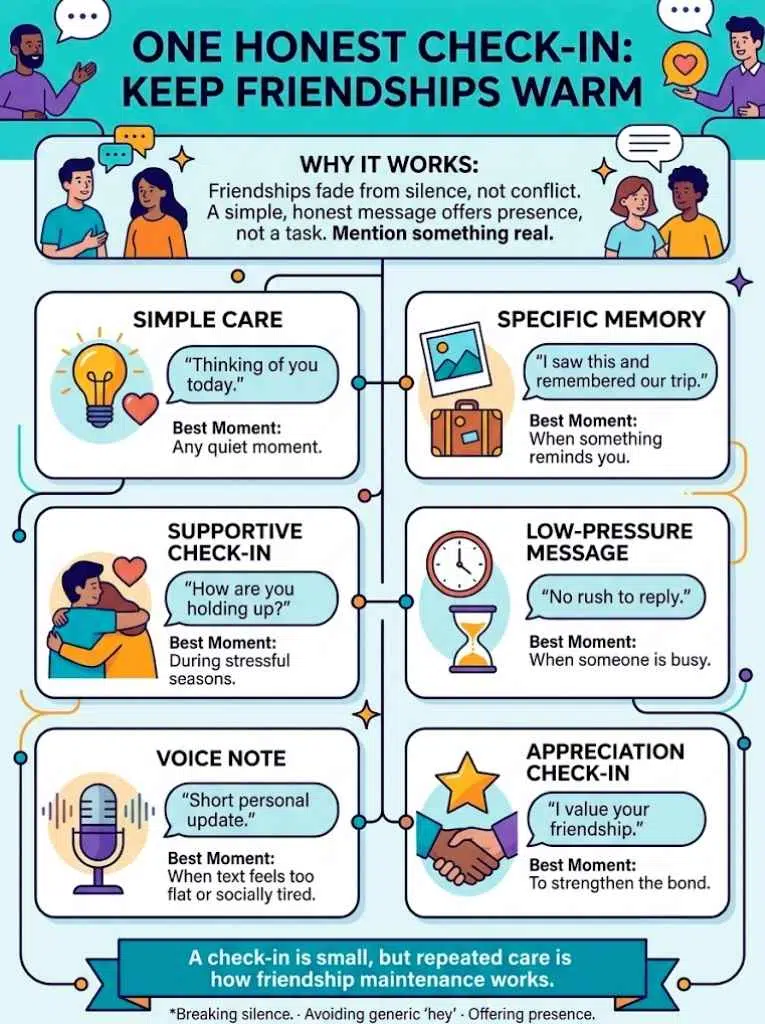
One honest check-in can keep a relationship warm without needing a long conversation. It can be as simple as, “I thought of you today. How have you really been?” or “No pressure to reply fast, but I wanted to check in.” The key is honesty. A generic “hey” is easy to ignore. A specific message feels human. Mention something real: their work, family, health, a shared memory, a recent challenge, or something you appreciate.
This habit is useful because friendships often fade from silence, not conflict. People get busy. Weeks pass. Everyone assumes the other person is too occupied. A small check-in breaks that silence. Do not turn this into a networking task. The goal is not to collect replies. The goal is to offer presence.
If you are socially tired, keep it short. A voice note can feel warmer than text and may take less energy. If the person is going through something hard, avoid trying to fix everything. Start by showing that you remember and care.
| Check-In Type | Example | Best Moment |
| Simple care | “Thinking of you today.” | Any quiet moment |
| Specific memory | “I saw this and remembered our trip.” | When something reminds you of them |
| Supportive check-in | “How are you holding up?” | During stressful seasons |
| Low-pressure message | “No rush to reply.” | When someone is busy |
| Voice note | Short personal update | When text feels too flat |
| Appreciation check-in | “I value your friendship.” | When you want to strengthen the bond |
A check-in is small, but repeated care is how friendship maintenance works.
2. Build a Friendship Maintenance Rhythm
Friendship maintenance becomes harder when life gets busy. Good relationships can fade simply because nobody creates a rhythm. A maintenance rhythm means you have a loose system for staying in touch. It does not need to be rigid. You might call one friend every Sunday, send two check-ins each week, plan one monthly coffee, or schedule a quarterly catch-up with old friends.
This habit works because it removes the pressure of remembering everything. Instead of waiting until guilt appears, you create a simple pattern. Many people avoid this because it feels unnatural to “schedule friendship.” But busy lives need structure. Scheduling does not make the relationship fake. It protects something valuable from being crowded out.
The best rhythm depends on the relationship. Close friends may need more frequent contact. Old friends may stay warm with occasional but meaningful check-ins. Family members may need a regular call. Work friends may need short moments of genuine conversation. Keep the rhythm realistic. If weekly calls feel too much, start monthly. If long calls feel hard, send voice notes.
| Relationship Type | Maintenance Rhythm | Practical Idea |
| Close friend | Weekly or biweekly | Short call or voice note |
| Old friend | Monthly or quarterly | Catch-up message |
| Family member | Weekly | Walk-and-call habit |
| Work friend | Weekly | Coffee break or lunch |
| Long-distance friend | Monthly | Video call or voice update |
| Group friendship | Monthly | Shared meal, game, or chat |
Friendship maintenance is not about pressure. It is about not letting good people disappear from your life by accident.
3. Practice Active Listening
Active listening is one of the strongest social health habits because people feel closer to those who make them feel heard. Most people listen halfway. They wait to reply. They check the phone. They prepare advice. They compare the story to their own. They interrupt with solutions before the other person has finished.
Active listening slows that down. It means giving attention, asking better questions, reflecting what you heard, and resisting the urge to fix too quickly. This habit can change both personal and work relationships. In friendships, it builds trust. In families, it reduces conflict. At work, it improves collaboration. In romantic relationships, it makes people feel emotionally safer.
A simple listening rule helps: Ask one more question before giving advice. Often, people do not need a solution immediately. They need space to explain what they are carrying. Put the phone down when the conversation matters. Look at the person if you are in the same room. If you are on a call, stop multitasking. Listening is not passive. It is a form of care.
| Listening Habit | What It Sounds Like | Why It Helps |
| Reflect back | “So the hardest part was the uncertainty?” | Shows understanding |
| Ask one more question | “What do you need most right now?” | Deepens the conversation |
| Avoid quick fixing | “Do you want advice or just space?” | Respects emotional needs |
| Name the emotion | “That sounds frustrating.” | Builds empathy |
| Remove distraction | Phone away | Signals importance |
| Pause before replying | Let silence breathe | Reduces interruption |
Active listening is social fitness. It strengthens connection through attention.
4. Replace Passive Scrolling With Real Contact
Social media can make people feel connected, but it can also create a strange kind of loneliness. You see updates from everyone, but you may not actually talk to anyone. Passive scrolling gives the feeling of social contact without the nourishment of real connection. You know what someone posted, but you do not know how they are doing. You react to a story, but you never have a conversation. You consume people’s lives, but you do not participate in them.
A better habit is to replace one scrolling moment with one real contact. If you find yourself scrolling for connection, message one person instead. Send a voice note. Ask a question. Share something specific. Invite someone for a walk or call. This does not mean social media is bad. It can help maintain weak ties, discover community, and stay updated. The problem starts when it replaces direct connection entirely.
Use scrolling as a cue. When you notice you are scrolling because you feel lonely, pause and reach out to one real person.
| Passive Habit | Better Social Wellness Habit |
| Watching stories silently | Reply with a genuine question |
| Scrolling old friends’ updates | Send a direct check-in |
| Liking posts only | Add a thoughtful comment or message |
| Comparing your life | Call someone who grounds you |
| Scrolling before bed | Send tomorrow’s catch-up message earlier |
| Reading group chats silently | Share one useful or kind message |
Real contact beats passive observation when your emotional need is connection.
5. Plan Low-Pressure Connection
Not every social habit needs to be a dinner, party, long call, or big plan. Low-pressure connection is often easier to maintain. Low-pressure connection can be walking together, having coffee, sending voice notes, eating lunch with a colleague, doing errands with a friend, joining a casual class, sharing a weekly check-in, or sitting together without needing constant conversation.
This is especially useful for introverts, busy professionals, parents, and people rebuilding social habits after isolation. When connection feels too demanding, people avoid it. When it feels easy, they return to it. The mistake is waiting for the perfect plan. Perfect plans take time, coordination, and energy. Simple plans happen more often.
A good low-pressure invitation is specific and easy to answer. Instead of “We should catch up sometime,” say, “Want to walk for 20 minutes on Saturday morning?” or “Coffee after work this Thursday?” Social fitness grows when connection becomes less intimidating.
| Low-Pressure Connection | Time Needed | Why It Works |
| Walk together | 15-30 minutes | Combines movement and conversation |
| Coffee catch-up | 20-45 minutes | Simple and familiar |
| Voice note exchange | 2-5 minutes | Easy for busy people |
| Lunch with colleague | 20-30 minutes | Builds workplace connection |
| Shared errand | Flexible | Makes ordinary tasks social |
| Weekly text check-in | 1 minute | Keeps relationship active |
| Casual class or club | Weekly | Creates repeated contact |
The easier the plan, the more likely it happens.
6. Show Appreciation Clearly
Appreciation is one of the simplest ways to strengthen social wellness. People often assume others know they matter. They usually appreciate hearing it. A clear thank-you can improve friendships, family relationships, work relationships, and community ties. It does not need to be dramatic. It should be specific.
Instead of saying, “Thanks,” say, “Thanks for checking on me yesterday. It helped more than you know.” Instead of “Good job,” say, “Your calmness in that meeting made the conversation easier.” Specific appreciation lands better. This habit works because it creates positive relationship signals. People feel seen. They feel valued. They know their effort mattered.
The mistake is saving appreciation for big moments only. Small moments count. A thoughtful reply, a ride, a listening ear, a kind message, a shared resource, or patience during a hard conversation all deserve recognition. Appreciation also helps at work. For the corporate athlete, strong professional relationships reduce friction and build trust. A healthier work culture often starts with simple respect expressed clearly.
| Appreciation Type | Example |
| Friendship appreciation | “I’m grateful you made time for me.” |
| Family appreciation | “I noticed how much you handled today.” |
| Work appreciation | “Your clear feedback helped me improve this.” |
| Support appreciation | “Thanks for listening without judging.” |
| Effort appreciation | “I know that took time. I appreciate it.” |
| Presence appreciation | “It meant a lot that you showed up.” |
Appreciation is a small habit with a long emotional afterlife.
7. Ask for Help Before You Are Overwhelmed

Many people wait too long to ask for help. They wait until stress becomes resentment, exhaustion, or crisis. Social wellness habits should include receiving support, not only giving it. Asking for help can feel uncomfortable. You may worry about being a burden. You may think you should handle everything alone. You may not know what to ask for. But healthy relationships need some level of mutual support.
The key is to ask clearly. People often want to help but do not know how. Instead of saying, “Everything is awful,” try, “Can you listen for 10 minutes?” or “Can you help me think through this decision?” or “Can you check in with me tomorrow?” Specific requests are easier to answer.
Help does not always mean a major favor. It can be emotional support, practical advice, accountability, childcare, a ride, a meal, a recommendation, a second opinion, or simply company during a hard moment. Asking early prevents silent overload. It also gives people a chance to show up for you.
| Support Need | Clear Ask |
| Emotional support | “Can you listen for a few minutes?” |
| Decision support | “Can I talk this through with you?” |
| Accountability | “Can you check in with me Friday?” |
| Practical help | “Can you help me with this task?” |
| Company | “Can we walk together?” |
| Encouragement | “Can you remind me I’m not failing?” |
| Professional guidance | “Do you know someone who can help?” |
Strong social health includes knowing how to receive care.
8. Set Healthy Social Boundaries
Social wellness is not about saying yes to everyone. Healthy connection needs boundaries. A boundary protects your time, energy, values, privacy, and emotional health. It helps relationships stay sustainable instead of becoming draining.
Some people avoid boundaries because they fear conflict. But unclear boundaries often create more conflict later. You say yes when you mean no. You overextend. You become resentful. The relationship suffers anyway. A good boundary is clear and respectful. “I cannot talk tonight, but I can call tomorrow.” “I am not available for work messages after dinner.” “I want to help, but I cannot take this on.” “I need some quiet time before we discuss this.”
Boundaries are especially important for people who are natural helpers. If you always support others but never protect your own recovery, connection can start to feel heavy. Social fitness includes both closeness and space. Healthy relationships can handle reasonable limits.
| Boundary Situation | Healthy Boundary Example |
| Late-night messages | “I’ll reply tomorrow when I’m rested.” |
| Emotional overload | “I want to listen, but I need a break first.” |
| Work-life blur | “I’m offline after dinner.” |
| Too many plans | “I can’t this week, but let’s choose another day.” |
| Personal privacy | “I’m not ready to discuss that yet.” |
| One-sided support | “I need this to feel more balanced.” |
| Conflict | “Let’s pause and talk when we’re calmer.” |
A boundary is not a wall. It is a healthier doorway.
9. Join One Recurring Community Space
A recurring community space builds belonging because it creates repeated contact. Repetition matters. Many friendships grow from seeing the same people regularly. This could be a fitness class, walking group, book club, faith group, volunteer team, language class, parenting group, coworking circle, hobby group, professional community, or local meetup.
The key is recurrence. One event can be nice, but repeated spaces allow trust to grow slowly. You start recognizing faces. Small conversations become easier. Familiarity reduces social friction. This habit is useful for adults because friendship does not happen as automatically as it did in school or college. You need shared spaces where connection can repeat.
Choose a space that fits your interests and energy. If you dislike loud events, choose a quieter group. If you enjoy movement, try walking, fitness, or sports. If you want professional growth, join a small industry community. Do not expect instant best friends. The goal is showing up enough times for familiarity to build.
| Community Type | Best For | Social Benefit |
| Walking group | Low-pressure connection | Movement and conversation |
| Fitness class | Routine and energy | Shared progress |
| Book club | Quiet socializing | Meaningful discussion |
| Volunteer group | Purpose-driven people | Shared values |
| Coworking group | Remote workers | Workday connection |
| Hobby class | Creative people | Natural conversation |
| Faith or spiritual group | Values and support | Belonging |
| Professional circle | Career growth | Trust and opportunity |
Belonging is easier when connection has a place to happen repeatedly.
A Simple Weekly Social Wellness Routine
A weekly social wellness routine helps connection become normal instead of accidental. It does not need to be packed. In fact, it should not feel overwhelming. The routine should include small daily contact, one deeper conversation, one act of appreciation, and one low-pressure plan when possible. This gives relationships steady care without turning your calendar into a social marathon.
Start by choosing your minimum version. Maybe that means two check-ins per week and one real conversation. That is enough to begin. Add more only when it feels natural. A weekly rhythm is useful because different relationships need different touchpoints. Some people need frequent contact. Others stay close with less frequent but meaningful updates. The goal is to avoid long silence with people who matter to you.
For busy professionals, social wellness can also be attached to existing habits. Call someone during a walk. Send a message after lunch. Plan coffee near an errand. Share appreciation after a meeting. The best routine is the one that keeps connection alive without creating guilt.
| Day or Rhythm | Social Wellness Habit | Time Needed |
| Daily | Send one small message or reply thoughtfully | 1-3 minutes |
| Twice weekly | Check in with a friend or family member | 5 minutes |
| Weekly | Have one real conversation | 10-30 minutes |
| Weekly | Show appreciation clearly | 1 minute |
| Weekly | Share a walk, meal, or call | 20-60 minutes |
| Monthly | Reconnect with an old friend | 10 minutes |
| Monthly | Attend one community space | Flexible |
If the full version feels too much, use the minimum version.
| Minimum Social Wellness Plan | Action |
| Monday | Send one honest check-in |
| Wednesday | Call or voice-note one person |
| Friday | Thank someone specifically |
| Weekend | Walk, eat, or talk with one person |
Small connection repeated often keeps relationships from going cold.
Beginner Mistakes That Weaken Social Wellness
The first mistake is confusing contact with connection. You may message many people, attend meetings, scroll feeds, and reply to comments while still not feeling supported. Social wellness depends on quality, not only quantity.
The second mistake is waiting for others to always reach out first. If both people wait, the relationship fades. Reaching out does not make you needy. It means you value the connection.
Another mistake is making social plans too complicated. If every catch-up requires perfect timing, a fancy location, or a long evening, it may not happen. Simple plans are more sustainable.
Some people also ignore boundaries. They say yes to every request, listen to everyone’s problems, and leave no space for their own recovery. That can turn connection into emotional exhaustion.
A common modern mistake is relying too much on passive social media. Watching someone’s life is not the same as being part of it. Real contact matters.
Finally, many people avoid repair. Small misunderstandings happen in every relationship. Avoiding them can create distance. A simple apology, clarification, or honest conversation can protect trust.
| Mistake | Why It Hurts | Better Habit |
| Confusing contact with connection | Many interactions still feel empty | Have one real conversation |
| Waiting for others | Relationships fade from silence | Send the first check-in |
| Overcomplicating plans | Catch-ups never happen | Use low-pressure connection |
| Ignoring boundaries | Connection becomes draining | Set kind limits |
| Passive scrolling only | Creates digital loneliness | Message directly |
| Avoiding repair | Small issues grow | Apologize or clarify early |
| Only talking when in crisis | Relationships feel one-sided | Maintain connection in calm times |
| Trying to please everyone | Causes resentment | Choose sustainable availability |
Social wellness grows through honest care, not perfect performance.
Social Wellness Habits by Lifestyle Type
Different people need different social wellness habits. A remote worker may need more intentional connection because casual office moments are missing. A parent may need low-pressure adult conversation. A student may need healthier peer connection. A founder may need trusted people outside work. A desk worker may need social movement, like walking with someone. The best habit depends on the gap. If you feel lonely, build check-ins. If you feel socially exhausted, build boundaries. If you have many weak ties but few deep relationships, build active listening and honest conversations. If you lack belonging, join a recurring community space.
This is why generic advice like “be more social” does not help much. Social health habits need to match real life. For introverts, social wellness may mean fewer but deeper connections. For extroverts, it may mean more intentional and less scattered connection. For caregivers, it may mean asking for help earlier. For remote workers, it may mean scheduled calls or coworking.
Social fitness should support your energy, not erase it.
| Lifestyle Type | Common Social Challenge | Best Habit to Start |
| Remote worker | Isolation and blurred work-life boundaries | Weekly real conversation |
| Desk worker | Too much screen contact, too little human contact | Walking call or lunch connection |
| Parent | Limited adult conversation | Low-pressure check-in |
| Student | Social comparison and group pressure | Active listening and boundaries |
| Founder or manager | Few safe spaces to be honest | Trusted support circle |
| Introvert | Social fatigue | Small planned connection |
| Extrovert | Scattered connection | Deeper one-on-one time |
| Caregiver | Giving more than receiving | Ask for help earlier |
| Frequent traveler | Relationship gaps | Voice notes and scheduled calls |
A healthy social routine should fit your energy and responsibilities.
How Social Wellness Habits Support the Best Healthy Habits?
Social wellness habits support the best healthy habits because connection affects how people manage stress, sleep, movement, food, focus, and recovery. When you feel supported, stress often feels easier to carry. When you have a walking partner, movement becomes easier. When a friend checks in, recovery routines feel less lonely. When you have a trusted person to talk to, mental health habits become more natural.
Social connection also supports habits for better focus. A clear conversation can reduce mental clutter. A healthy boundary can protect deep work. A supportive community can make goals feel more realistic. Social wellness also connects with movement habits for sedentary lifestyles. Walking with a friend, taking calls standing, joining a fitness class, or attending a hobby group all turn movement into a social habit.
Evening habits that improve sleep can also benefit from social boundaries. If late-night messages or conflict keep you wired, a clear communication habit can protect rest. Friendship maintenance is not separate from wellness. It is part of the system that keeps daily life emotionally stronger.
| Social Wellness Habit | Related Healthy Habit Topic |
| Walk with a friend | Movement habits for sedentary lifestyles |
| Honest check-in | Mental health habits |
| Clear evening boundary | Evening habits that improve sleep |
| Social workout or class | Full body workouts busy |
| Recovery walk with someone | Recovery day routines |
| Shared healthy meal | Nutrition habits that work long term |
| Water or coffee catch-up | Hydration habits |
| Supportive conversation | Habits that reduce stress long term |
| Coworking group | Habits for better focus |
| Morning call or walk | Morning habits for better energy |
Healthy relationships make other healthy habits easier to repeat.
When Social Wellness Needs Extra Support?
Social wellness habits can help, but they are not a replacement for deeper support when someone feels persistently isolated, unsafe, emotionally overwhelmed, or trapped in unhealthy relationships. If loneliness feels constant, it may help to talk with a trusted person, counselor, therapist, healthcare provider, faith leader, or community support group. If a relationship involves control, fear, threats, abuse, or harm, safety and professional support matter.
Sometimes people blame themselves for feeling disconnected. But loneliness is not always a personal failure. Life changes, grief, moving, remote work, caregiving, illness, conflict, and demanding schedules can all shrink social connection. Getting support is a strong step. It can help you rebuild connection, set boundaries, repair relationships, or leave harmful situations.
If someone feels at risk of self-harm or harm from someone else, urgent help is needed. Contact local emergency services, a crisis line, or a trusted person immediately. Social wellness should feel supportive, not unsafe. Healthy connection respects dignity, consent, boundaries, and emotional safety.
| Sign Extra Support May Help | Why It Matters |
| Loneliness feels constant | Support may be needed beyond small habits |
| You feel unsafe in a relationship | Safety planning matters |
| Social anxiety blocks daily life | Professional tools may help |
| Conflict keeps repeating | Mediation or counseling may help |
| You have no one to call in crisis | Build support intentionally |
| You feel emotionally drained by one person | Boundaries may be needed |
| Isolation follows grief or major change | Support groups can help |
| Self-harm thoughts appear | Urgent support is needed |
Strong social wellness includes knowing when to ask for help.
Final Thoughts
Social wellness habits do not need to be big to matter. A short message can keep a friendship alive. A real question can deepen trust. A walk with someone can support both movement and connection. A clear boundary can protect a relationship from resentment. A community space can create belonging over time.
The goal is not to become socially busy. The goal is to become socially supported. Start with one habit. Send one honest check-in. Schedule one low-pressure catch-up. Practice listening without fixing. Thank someone clearly. Ask for help earlier. Join one recurring space.
Small social health habits compound because relationships grow through repeated care. That is how friendship maintenance becomes easier.
That is how social fitness becomes real. And that is how social wellness habits support the best healthy habits for mental health, stress control, energy, focus, sleep, movement, and long-term well-being.
Frequently Asked Questions (FAQs) About Social Wellness Habits
Social wellness habits are small routines that help you build, maintain, and protect meaningful relationships. They include checking in with people, listening well, maintaining friendships, showing appreciation, setting boundaries, asking for help, and joining supportive communities.
Social health habits matter because connection can support emotional resilience, stress management, belonging, and daily well-being. Strong relationships can make difficult seasons feel less isolating and healthy habits easier to maintain.
Social fitness is the practice of strengthening relationships through repeated small actions. Just like physical fitness, it improves through consistency. Check-ins, honest conversations, listening, appreciation, and community participation all build social fitness.
How can I maintain friendships when I am busy?
Use a simple friendship maintenance rhythm. Send one check-in each week, schedule a monthly catch-up, call during a walk, use voice notes, and make plans easy to accept. Small repeated contact works better than waiting for the perfect moment.
Send one honest check-in today. Choose one person and write something specific. For example, “I was thinking about you today. How have you been lately?” Keep it simple and real.
Social media can help people stay updated, but passive scrolling usually does not replace real connection. Direct messages, calls, voice notes, shared walks, and honest conversations create stronger social wellness.