Have you ever picked up your phone to check a quick text message, only to look up and realize an hour had just vanished? Your neck aches, your eyes feel strained, and you cannot even remember what you just watched. You tell yourself you will put the phone down, yet your thumb keeps swiping to the next video. Millions of Americans fight this exact same battle every single day. The apps you use daily do not just hold your attention by accident. The truth is, understanding how social media is rewiring our brains changes everything you know about willpower.
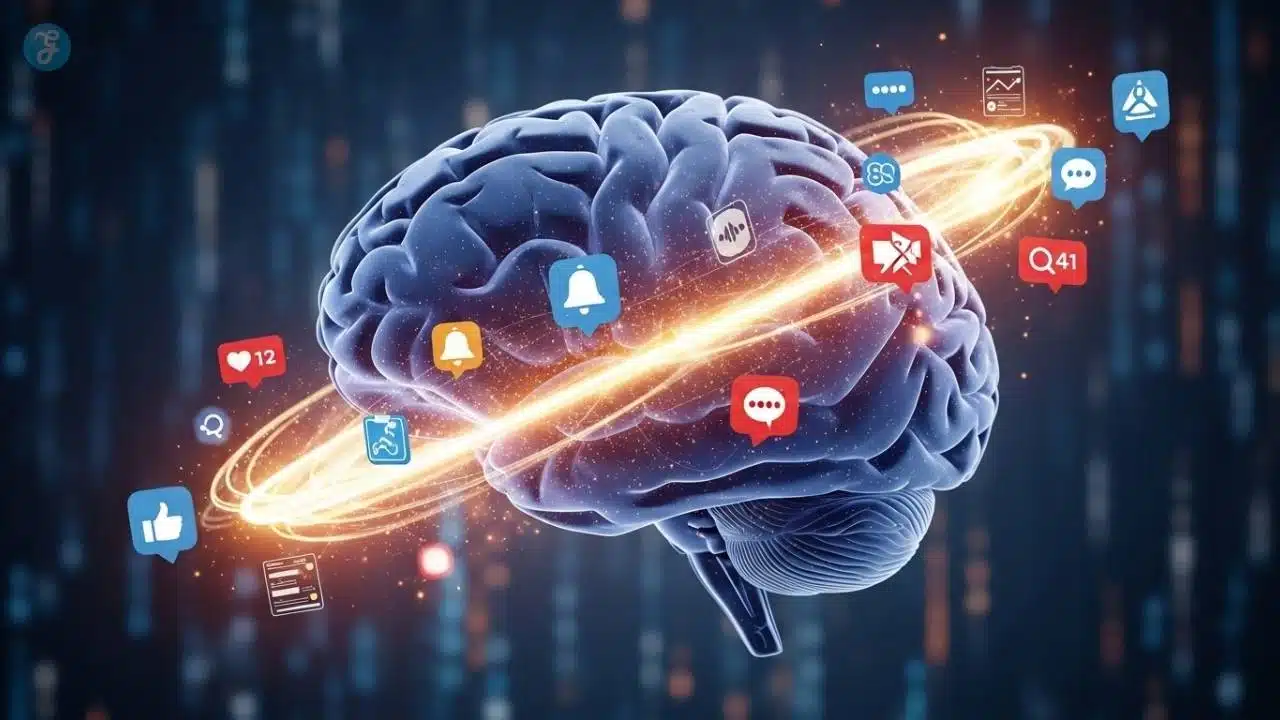
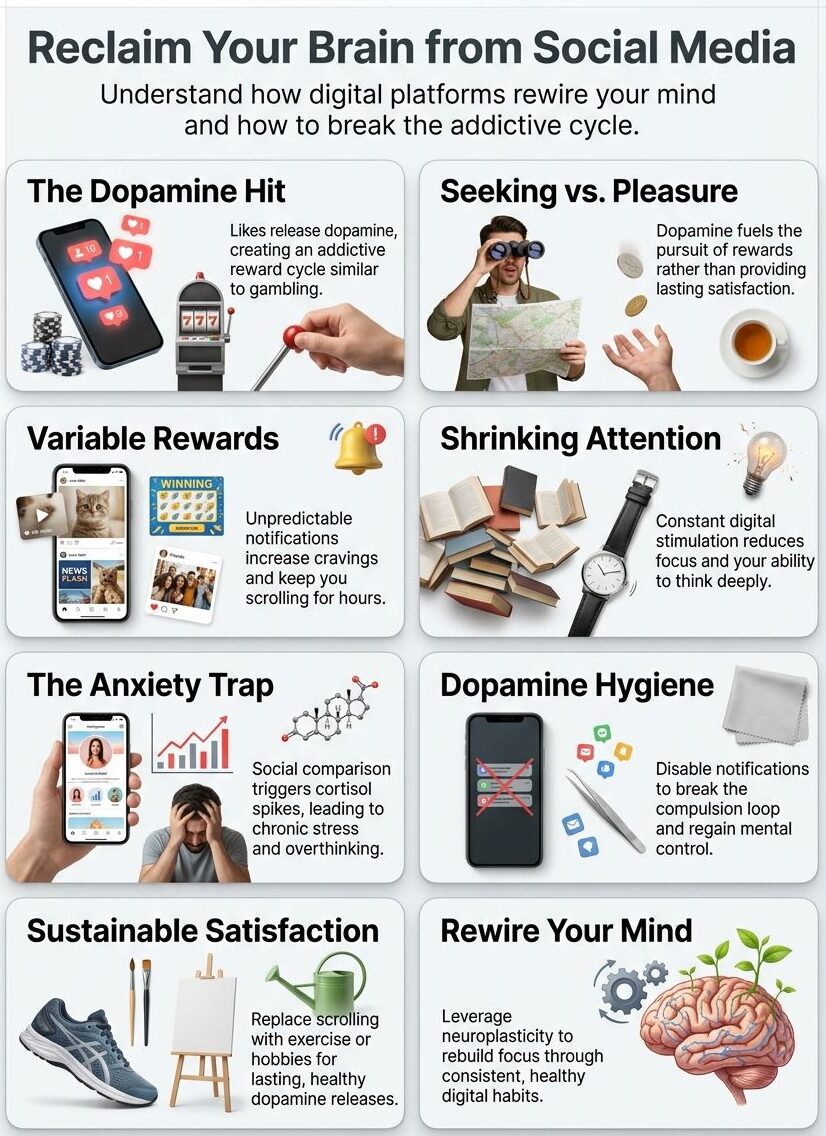
Your brain releases a powerful chemical called dopamine every time you get a like, a new comment, or a buzzing notification. Scientists have studied this process extensively, and they found that this digital dopamine loop looks exactly like the reward patterns seen in traditional addictions.
I am going to walk you through exactly what happens in your head when you open these apps. Grab a cup of coffee, and let’s go through it together. I will show you exactly why you feel stuck and give you simple, proven tricks to take back your time.
The Science Behind How Social Media Is Rewiring Our Brains
Your brain runs on a chemical messenger called dopamine, and it shapes almost every choice you make throughout the day. This powerful chemical controls how you feel pleasure, chase your goals, and keep coming back for more stimulation.
Dopamine and the Reward System
Your brain releases dopamine when something genuinely good happens to you. This chemical makes you feel happy, highly motivated, and deeply satisfied with your efforts. The reward system in your brain uses this dopamine as a built-in messenger. It basically tells your body to repeat whatever action just caused that good feeling.
To understand the mechanics, we have to look at two specific areas inside your head. Your ventral tegmental area produces dopamine, and then a region called the nucleus accumbens receives it.
A survey from the American Psychiatric Association revealed that over 30% of US adults feel addicted to their smart devices. This statistic makes perfect sense when you realize these two brain regions communicate constantly while you scroll.
Your brain learns to crave the specific activities that trigger a dopamine release. This is exactly where the real magic, and the real danger, begins for all of us.
The Dopamine Seeking-Reward Loop
Your brain operates on a very simple and efficient system. It actively craves rewards, and dopamine is the chemical that pushes you to seek them out.
Dr. Anna Lembke, the Chief of the Stanford Addiction Medicine Dual Diagnosis Clinic, points out something fascinating. She explains that the modern smartphone is essentially a digital hypodermic needle that delivers dopamine straight to your brain.
The seeking-reward loop kicks into gear the moment something triggers your brain to expect a payoff. Social platforms use a concept called a variable ratio reward schedule to keep you hooked.
Psychologist B.F. Skinner discovered this concept decades ago. He found that rewards given at random, unpredictable times create the strongest, most addictive habits.
Dopamine is not about pleasure; it is about the pursuit of pleasure. – Dr. Andrew Huberman
You never know exactly when you will get a new comment or a funny video. This unpredictability forces your brain to stay alert, constantly waiting for the next hit of digital validation.
How Social Media Triggers Dopamine
Tech companies engineer their systems to hit your brain’s reward center with incredible, surgical precision. Every notification floods your brain with the exact chemical that makes you feel good and keeps you coming back.
The Compulsion Loop: Why We Keep Scrolling
Your thumb keeps moving up the screen, and your brain keeps rewarding you for the effort. You see a new post, and your mind assumes the next one will be even better.
Aza Raskin actually invented the infinite scroll feature back in 2006. He later explained that he designed it to keep users looking at content without giving their brains a natural stopping point.
This design choice feeds right into the compulsion loop. In early 2025, mobile analytics firm Data.ai reported that the average US consumer spends roughly two and a half hours daily just on social apps.
Your attention span shrinks rapidly as the digital stimulation grows stronger. You are not weak for scrolling endlessly because your own neuroscience is working against you.
The Role of Social Validation and Likes
Social validation through digital likes fuels a massive psychological engine inside your brain. Every single notification acts as a trigger.
Justin Rosenstein helped create the famous Facebook Like button in 2009. Years later, he compared the feature to bright rings of pseudopleasure that manipulate our psychology. Your brain treats digital likes as real social currency. This triggers a specific reaction in your head.
- The Striatum Activates: This part of your brain processes social rewards. It lights up exactly the same way whether someone praises you in person or likes your photo online.
- The Comparison Trap Starts: You scroll through curated highlight reels and measure your own life against heavily edited images.
- The Feedback Loop Locks In: Low engagement triggers feelings of sadness. This pushes you to post even more content to chase the validation you missed.
Anticipation and Instant Gratification
Your brain absolutely loves a good mystery. Before you even see a like on your newest post, your brain starts firing up dopamine neurons just expecting a reward. Think about the pull-to-refresh motion on your phone. Software engineer Loren Brichter created this feature, and tech experts often compare it to pulling the lever on a casino slot machine.
You swipe down, the screen spins, and you wait a split second to see what you won. Neuroscience shows us that this brief anticipation phase activates your reward system harder than the actual content does.
Instant gratification then seals the deal. You post a photo, and the notifications flood in within seconds. The problem is that your brain adapts extremely fast. Yesterday’s dopamine high becomes your baseline today, meaning you need even more screen time to feel that same buzz.
Cognitive and Emotional Impacts of Social Media
Spending hours online scrambles your ability to focus deeply. Your emotions take a heavy hit as the constant scrolling feeds anxiety and mood swings that leave you feeling totally drained.

Reduced Attention Span
Your brain really struggles to focus on one single task anymore. Scrolling through fast-paced feeds trains your attention span to shrink, much like a muscle that wastes away from disuse.
Dr. Gloria Mark, an attention researcher at the University of California, Irvine, tracks this precise issue. Her 2024 data reveals that our average attention span on any screen has plummeted to a mere 47 seconds. You jump constantly from task to task, unable to stick with anything meaningful. This multitasking trap leaves your brain exhausted.
Information overload floods your mind constantly, which prevents any real depth of thinking. You find yourself skimming articles instead of reading them fully.
Increased Anxiety and Overthinking
Every digital notification triggers a small spike in cortisol, which is the stress hormone that floods our bodies. We scroll through feeds and compare our messy behind-the-scenes to everyone else’s highlight reels.
In his recent national advisory, US Surgeon General Dr. Vivek Murthy issued a stark warning. He stated that social media poses a profound risk of harm to the mental health and well-being of young people in America.
Constant comparison creates a mental loop where we replay conversations, analyze our likes, and obsess over negative comments. Our brains get stuck in permanent overdrive.
This anxiety builds up rapidly as we wait for validation through engagement metrics. We feel intense pressure to respond quickly and maintain a perfect online image.
Patterns of Conflict and Argumentation
Your overthinking brain faces another huge challenge online. The anxiety you feel does not stay quiet, and it actively pushes you toward digital arguments.
Social media algorithms are specifically programmed to favor high-arousal emotions. A 2025 social behavior study showed that posts expressing anger spread up to five times faster on platforms like X than positive posts do. This algorithmic preference changes how you act.
- The Rise of Doomscrolling: You actively seek out negative news because your brain is wired to prioritize threats.
- Faster Reactivity: Your nervous system stays on high alert, causing you to jump into disputes faster than you ever would face-to-face.
- Conflict as a Reward: Each angry reply you type triggers a dopamine release, teaching your brain that fighting online feels productive.
Breaking Free from the Dopamine Loop
You can take real, concrete steps right now to break free from this digital trap. Reclaiming your brain’s natural balance is entirely possible with a few simple habit changes.
Practicing Dopamine Hygiene
Managing your digital environment is essential for your mental health. A great trick I use is treating my phone like a tool, not a toy.
- Use App Blockers: Download an app like Opal or Freedom. These tools physically block your access to social apps during your work hours.
- Turn Off Non-Human Alerts: Go into your settings and disable every notification that does not come directly from a real person trying to reach you.
- Delete Apps from the Home Screen: Move your social apps to the second or third page of your phone, or access them only through your mobile web browser.
- Set Specific Times: Schedule a dedicated 15-minute window after lunch and another after dinner to check your feeds.
Choosing Sustainable Rewards
Your brain craves rewards, but you have to choose rewards that actually stick around. Escaping the trap means finding activities that build your focus instead of draining it.
Neuroscience shows us a massive difference between online validation and physical activity. Let’s look at how different activities affect your brain’s chemistry.
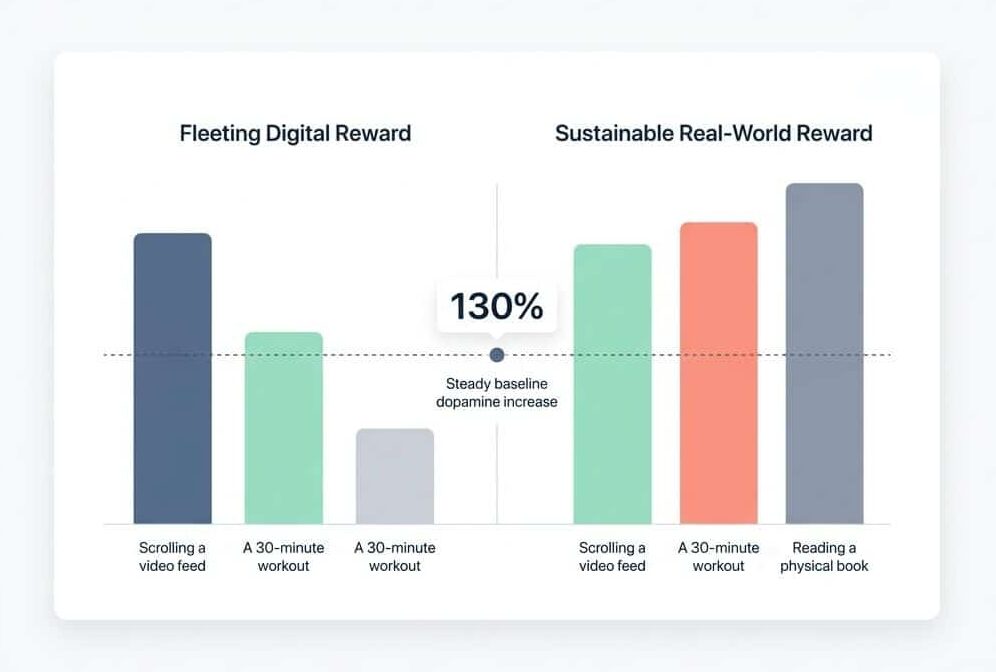
| Reward Type | The Activity | The Brain’s Response |
|---|---|---|
| Fleeting Digital Reward | Scrolling a video feed | Causes a rapid, sharp spike in dopamine, followed by a crash that leaves you wanting more. |
| Sustainable Real-World Reward | A 30-minute workout | Increases baseline dopamine steadily by up to 130%, keeping your mood elevated for hours. |
| Sustainable Real-World Reward | Reading a physical book | Builds cognitive focus, lowers cortisol levels, and strengthens your attention span. |
Face-to-face conversations create genuine emotional connections that virtual communication cannot match. Your brain recognizes real human interaction and responds with lasting, calm satisfaction.
Setting Boundaries with Social Media
Establishing firm boundaries protects your attention span and prevents daily anxiety from taking over. You have to create friction between yourself and the screen.
- Try the 20-20-20 Rule: Every 20 minutes you spend on a screen, look at an object 20 feet away for 20 seconds. This resets your eye strain and breaks your visual trance.
- Use Grayscale Mode: Go into your phone’s accessibility settings and turn the screen to black and white. Removing the bright red notification badges instantly makes the phone less stimulating.
- Establish a Phone-Free Hour: Leave your phone charging in the kitchen one hour before you go to sleep. This single habit massively improves your sleep quality.
Long-Term Implications for Brain Health
Your brain changes its physical shape over time based on what you do most often. Heavy screen time rewires your neural pathways in ways that make focusing on real life much harder.
Potential for Addiction
Social media platforms operate exactly like slot machines for your brain. The constant dopamine release drives the same compulsive behavior you see in gambling or substance abuse issues.
The medical community is paying very close attention to this trend. The DSM-5, which is the manual doctors use to diagnose mental health conditions, now officially recognizes Internet Gaming Disorder.
Many psychologists believe this classification paves the way for understanding severe social media addiction. The cycle strengthens with every post you share and every comment you receive.
The more time you spend swiping, the more your brain adapts to expect that intense, rapid-fire stimulation. Depression spikes when this dopamine-seeking behavior goes unchecked.
Neuroplasticity and Behavioral Change
Your brain possesses an amazing ability called neuroplasticity. This simply means your brain physically rewires itself based on the actions you repeat every single day.
Shifting your online behavior takes real effort, but this neuroplasticity works right in your favor. Phillippa Lally, a prominent health psychology researcher at University College London, studied exactly how long this process takes.
Her famous study found that it takes an average of 66 days for a new behavior to become automatic. Breaking your digital habits happens in phases.
- Days 1 to 22: The destruction phase. This is when resisting your phone feels the hardest and anxiety spikes the most.
- Days 23 to 44: The installation phase. Your brain starts forming new neural pathways, and reading a book or taking a walk begins to feel naturally rewarding.
- Days 45 to 66: The integration phase. Reaching for your phone is no longer your default reaction to boredom.
Wrapping Up
You now know exactly how social media is rewiring our brains, and the science behind it is crystal clear. Our reward systems respond to digital likes in ways that keep us trapped on our couches for hours. This digital interaction has actually changed our gray matter, making it tougher to focus on our goals.
The good news is that your brain is incredibly adaptable, and you can reshape these patterns through intentional choices starting right now. Notice how your mood shifts when you put the phone in another room. Your brain is listening to every choice you make, and it is entirely ready to heal.
Frequently Asked Questions (FAQs) on The Dopamine Loop of Social Media
Social media triggers dopamine release every time you get a like or comment, similar to how gambling activates reward centers in your brain. This makes it harder for you to focus on slower activities that don’t give instant feedback.
2. Why do people find it hard to stop scrolling on their phones?
Apps like TikTok use an infinite scroll design, which removes natural stopping points and keeps feeding you new content. Your brain keeps chasing that next interesting video, making it tough to put your phone down.
Yes, and the impact is significant. A 2022 UC Irvine study found that heavy social media users take longer to refocus after interruptions compared to light users. Those constant notifications train your brain to expect disruptions, which weakens your ability to concentrate deeply.
4. Are there ways to protect our minds from too much screen time?
The 20-20-20 rule works well: every 20 minutes of screen time, look at something 20 feet away for 20 seconds. Setting phone-free zones during meals or an hour before bed helps your brain reset its reward patterns.