


Most mainstream video games are a constant test of your central nervous system. They demand pixel-perfect aim, flawless frame data, and split-second reaction times. But there is a massive, thriving corner of the gaming world that couldn’t care less about your reflexes.
Instead, this space relies entirely on your ability to read, reason, and live with the consequences of your choices.
When looking at visual novels and narrative games, we are looking at a genre that flips traditional game design on its head. By prioritizing story over complex mechanical systems, these games offer a deeply immersive experience that reads like a book but strikes with the emotional gut-punch that only an interactive medium can deliver.
The Anatomy of Choice: How Visual Novels Work
At its absolute baseline, a traditional visual novel is a piece of interactive fiction. You move through the experience by reading text boxes, which are layered over character sprites, expressive anime-style backgrounds, and atmospheric musical scores.
But don’t mistake simplicity for a lack of depth. The true gameplay lies in the branching paths. Instead of dodging a bullet, you are navigating an ideological minefield. A single dialogue choice can completely derail the plot, alienate a companion, trigger a tragic “Bad Ending,” or unlock a hidden, twenty-hour narrative arc. The focus isn’t on mastering physical controls; it’s about interpreting character motivations and guessing how your decisions will ripple across the entire story timeline.
Expanding the Blueprint: The Rise of Modern Narrative Games
As the gaming industry has evolved, the strict boundaries of the genre have started to blur. Developers have taken the core philosophy of interactive text and expanded it into fully realized, cinematic spaces.
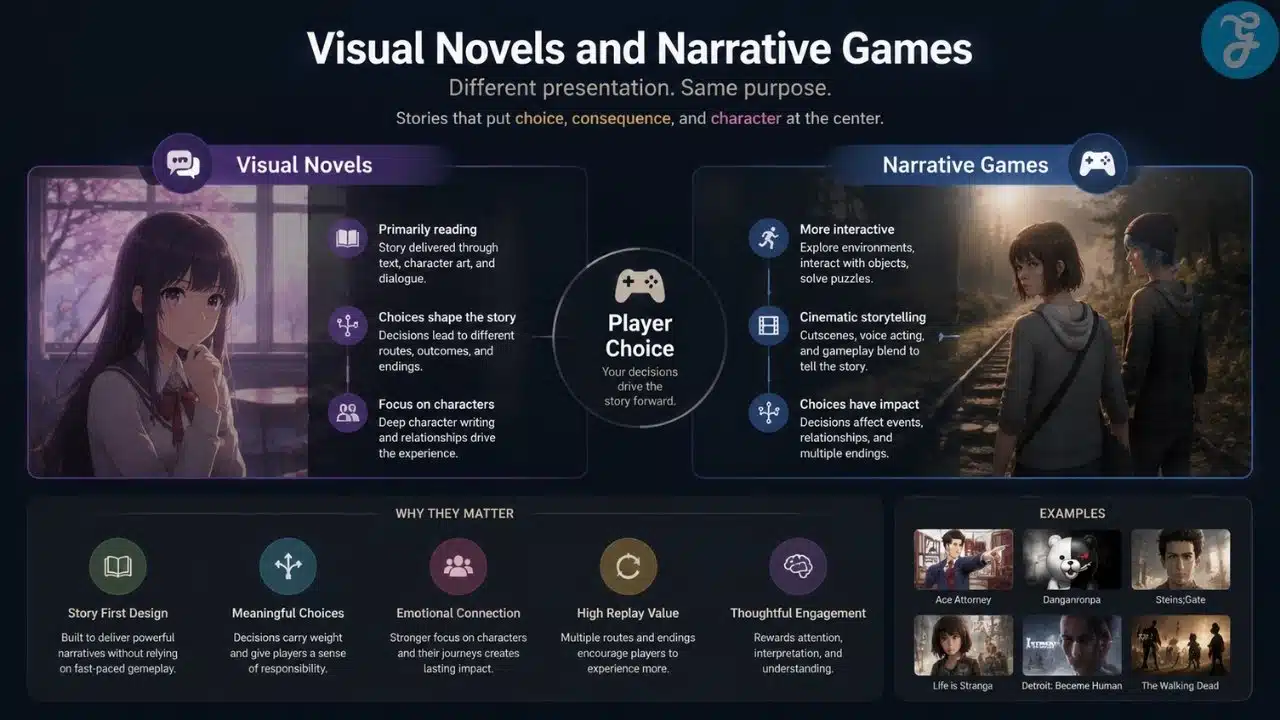
This evolution is where the broader category of visual novels and narrative games really shines, split across a few distinct design styles:
-
The Cinematic Powerhouses: Games like Life is Strange or Detroit: Become Human trade static 2D backgrounds for fully explorable 3D environments. You walk around, pick up objects to learn about the world, and engage in high-stakes, timed dialogue sequences that dramatically alter the script.
-
The Logic-Based Hybrids: Cult classics like Ace Attorney and Danganronpa inject traditional visual novel setups with active investigation mechanics. You aren’t just clicking through text; you are actively hunting for contradictions in a courtroom or solving locked-room murders by presenting evidence at the exact right moment.
In every single one of these variations, the rule remains identical: gameplay mechanics exist purely to serve the plot, not the other way around.
Gatekeeping and the “But Is It Really a Game?” Debate
Because the barrier to entry is so mechanically low, the genre frequently finds itself in the crosshairs of a weirdly intense community debate: Are these actually video games, or are they just glorified digital books?
It’s a valid question if your definition of a game requires a win condition or a skill gap. But that kind of gatekeeping misses the point of interactivity.
A traditional novel is a passive experience; the author decides who lives, who dies, and how the mystery is solved. In a narrative-driven game, you are the co-author. The moment your active input changes the outcome of the narrative—even if that input is just selecting an option from a text box—it becomes a game. The challenge isn’t mechanical skill; it’s a test of ethics, logic, and emotional intelligence.
Masterclasses in Narrative Design
Different developers approach this style of storytelling through entirely unique lenses, proving just how versatile the medium can be.
Steins Gate (The Sci-Fi Masterpiece): This game takes the concept of time travel and ties it directly to the player’s choices. Instead of clear dialogue prompts, you make decisions by choosing whether or not to answer your in-game cell phone or reply to text messages. It creates an incredibly grounded, paranoid atmosphere where a simple text reply can accidentally doom humanity.
Ace Attorney (The Courtroom Drama): Here, the narrative is a puzzle. Progress is completely locked behind your own reading comprehension. If you don’t pay close attention to the dialogue and cross-reference it with your organizer’s evidence, you will fail the trial and send an innocent client to prison.
The Slow Burn: Why This Audience is So Loyal
The pacing of a visual novel can feel incredibly jarring if you’re coming straight from a fast-paced multiplayer shooter. There is zero rush. The rhythm is entirely dictated by your own reading speed.
But this slow-burn approach allows for a level of character development and world-building that standard action games simply don’t have the real estate to pull off. When a game doesn’t have to worry about spacing out its story beats with mandatory combat encounters or mindless open-world fetch quests, the writing gets to breathe. You get to sit inside a character’s head, understand their flaws, and build a genuine emotional attachment over forty or fifty hours.
The New Interactive Horizon
We are seeing the DNA of visual novels and narrative games bleeding into almost every major AAA release on the market today. Modern RPGs and action-adventure blockbusters routinely copy the branching dialogue trees, romance mechanics, and multi-ending structures that this genre pioneered decades ago.
But while mainstream gaming uses these elements as a side dish, narrative-centric titles keep them as the main course. By stripping away the noise of combat loops and gear scores, they remind us of the purest reason we play games in the first place: to step inside someone else’s story, make a choice, and see what happens next.





















