


The Canadian interactive landscape has long been the global gold standard for large-scale production, anchored by generous tax incentives and a massive talent pool. In 2026, the sector is undergoing a significant transformation; while the scale remains “Triple-A,” the operational structures are becoming more agile. Many AAA Gaming Studios in Canada are pivoting away from risk-heavy original IPs toward robust co-development partnerships and “forever game” maintenance.
This shift has created a unique environment where massive satellite offices function with the specialized focus of an SME while wielding the technical resources of global conglomerates. Selecting the right studio for collaboration or employment in this high-stakes environment requires a look at recent project stability and technical expertise.
Our Selection Criteria
Our selection process for 2026 prioritized studios that have demonstrated resilience during recent industry-wide restructuring while maintaining high-fidelity output. We focused on entities that lead major global franchises from within Canadian borders.
-
Project Continuity. Continued development on major “evergreen” franchises or confirmed next-gen remakes.
-
Operational Scale. Studios with the infrastructure to support hundreds of developers and multi-year production cycles.
-
Technological Leadership. Expertise in proprietary engines (Snowdrop, Anvil, Frostbite) or leadership in emerging fields like VR and AI integration.
-
Regional Influence. Studios that act as anchors for the gaming ecosystems in Montreal, Vancouver, Toronto, and Quebec City.
Understanding these benchmarks provides the necessary context for evaluating the specific developers currently leading the Canadian market.
Evaluating the Top 15 AAA Gaming Studios in Canada
The following organizations represent the absolute peak of interactive entertainment production in North America. Here is our curated breakdown of the developers defining the Canadian gaming scene in 2026.
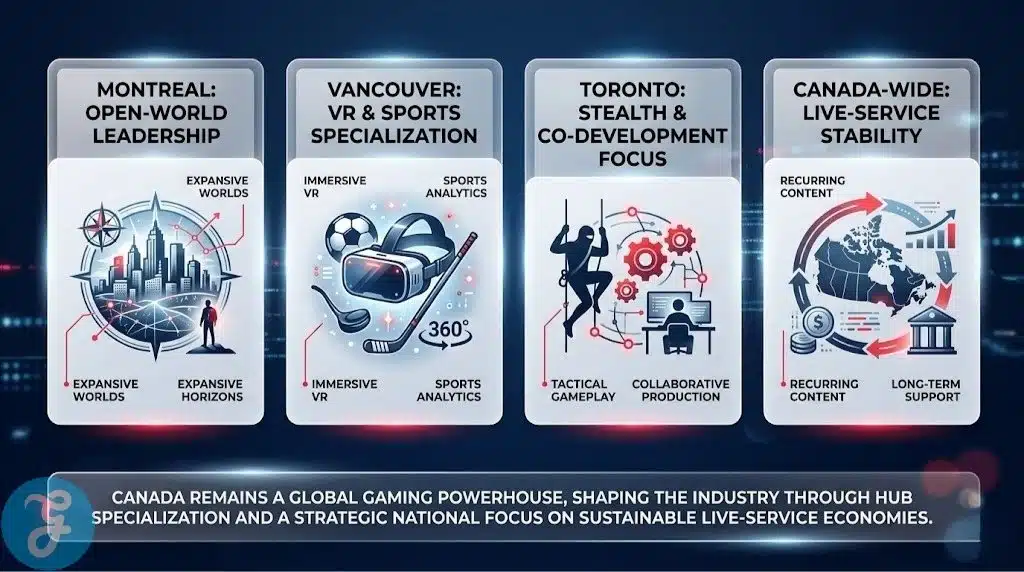
Montreal remains the undisputed capital of global game development, housing the largest single-site studio on the planet.
1. Ubisoft Montréal
As of 2026, Ubisoft Montréal continues to be the primary engine of the Assassin’s Creed and Far Cry franchises. Most recently, the studio successfully launched the Claws of Awaji expansion for Assassin’s Creed Shadows in May 2026, further cementing its expertise in massive, open-world live-service maintenance. Despite global restructuring, the Montreal hub remains the vital heart of Ubisoft’s creative strategy.
Best for: Large-scale open-world worldbuilding and high-fidelity environmental storytelling.
Why We Chose It: It remains the largest single game development studio in the world, wielding unmatched production capacity.
Things to consider: The studio is heavily reliant on established franchises, making original experimental IPs a rarity within its walls.
Transitioning to the Ontario hub, we find a studio focused on revitalizing legendary stealth-action legacies.
2. Ubisoft Toronto
Following a targeted restructuring in early 2026 that saw 40 roles eliminated, Ubisoft Toronto has doubled down on its core projects. The studio is currently the lead developer on the highly anticipated Splinter Cell Remake, built from the ground up in the Snowdrop engine. It also serves as a critical co-development partner for the Rainbow Six franchise and various open-world initiatives.
Best for: High-stakes stealth mechanics and collaborative multi-studio production.
Why We Chose It: It has successfully navigated 2026’s cost-saving measures while protecting the development of its most culturally significant remake.
Things to consider: The studio has faced recent downsizing, which may impact timelines for its secondary co-development projects.
In the west, sports simulation remains a multi-billion dollar pillar of the Canadian economy.
3. EA Sports Burnaby
The Vancouver-based EA Sports Burnaby (EA Vancouver) remains the epicenter of the world’s most profitable sports franchises. In early 2026, the studio unveiled EA SPORTS FC 26, which notably introduced advanced reinforcement learning to power more realistic AI behavior. This studio is a technical powerhouse, managing the year-over-year delivery of NHL and the global FC series.
Best for: Massive-scale sports simulation and cutting-edge AI integration in competitive gaming.
Why We Chose It: Its consistent commercial performance and technical innovation in sports physics are unparalleled in the industry.
Things to consider: The annual release cycle demands a high-pressure environment that leaves little room for non-sports creative exploration.
Returning to Edmonton, the masters of the narrative RPG continue to refine their legendary universes.
4. BioWare Edmonton
Following the successful launch of Dragon Age: The Veilguard, BioWare Edmonton has fully shifted its focus to the next chapter of the Mass Effect universe. In 2026, the studio remains the standard-bearer for choice-driven narrative design in Canada. While it has streamlined its operations, its identity is firmly tied to the deep, cinematic storytelling that defined the RPG genre.
Best for: Cinematic, narrative-heavy RPGs and expansive character-driven worldbuilding.
Why We Chose It: The studio maintains a legacy of high-quality role-playing mechanics that few other Canadian entities can replicate.
Things to consider: The prolonged development cycles of its major titles mean years of silence between high-profile releases.
Recent shifts in corporate strategy have forced even the most established studios to pivot toward collaboration.
5. Eidos Montréal
In March 2026, Eidos Montréal underwent a major strategic shift following the cancellation of its long-term project, codenamed “P11,” and the departure of long-time studio head David Anfossi. The studio is currently pivoting away from leading its own original IPs to take on high-level co-development roles for major titles like the Fable reboot and Grounded 2.
Best for: High-level technical co-development and immersive sim mechanics.
Why We Chose It: Despite recent project cancellations, the studio’s technical talent in world-building remains among the best in the Quebec ecosystem.
Things to consider: The shift to a co-development model means the studio may not release a standalone original title for several years.
Specialization in specific comic-book IPs allows certain studios to maintain a distinct market niche.
6. Warner Bros. Montréal
Warner Bros. Montréal experienced a staff reduction in early 2026 as part of a broader “rebuilding” phase for the Warner Bros. Games division. While its co-development work on the Wonder Woman project has seen shifts, the studio remains the regional expert in DC intellectual property, leveraging its history with the Arkham and Gotham Knights series.
Best for: Third-person action adventures and the technical execution of massive licensed comic book IPs.
Why We Chose It: Its deep integration with the DC multiverse makes it a unique and vital player in Montreal’s licensed gaming scene.
Things to consider: The studio is currently in a transitional “rebuilding” phase, which often involves internal project shifts.
Quality assurance and PC porting have become a massive sector within the Quebec City tech corridor.
7. Beenox (Activision)
Located in Québec City, Beenox has become the industry’s premier partner for the Call of Duty franchise. In 2026, they remain the lead for Call of Duty PC versions and continue to support the massive live-service updates for Warzone, such as the “Winter Rebirth Island” launch in February 2026. Their technical expertise in optimization is critical to Activision’s global success.
Best for: PC optimization, high-performance porting, and supporting massive live-service ecosystems.
Why We Chose It: They are the unsung heroes of the Call of Duty franchise, ensuring technical parity across diverse hardware platforms.
Things to consider: Their role is primarily supportive, meaning they rarely lead the development of their own original intellectual properties.
Maintaining independence while competing at the AAA level requires a focus on asymmetrical multiplayer.
8. Behaviour Interactive
As Canada’s largest independent developer, Montreal-based Behaviour Interactive continues to dominate the horror genre with Dead by Daylight. In April 2026, the studio underwent a strategic restructuring to focus on its most profitable internal IPs and partnerships with studios like The Fun Pimps. They remain a rare example of a highly profitable, self-governing Canadian AAA entity.
Best for: Asymmetrical multiplayer and managing long-term, high-growth live-service horror games.
Why We Chose It: They have successfully maintained total independence while growing their workforce to over 1,000 employees in Montreal.
Things to consider: A recent decline in demand for casual/mobile external development has led to a tighter focus on their core horror titles.
Regaining independence after a decade of corporate ownership has revitalized one of Vancouver’s most legendary names.
9. Relic Entertainment
Following its departure from SEGA in 2024, Relic Entertainment is operating as a fully independent studio again in 2026. The Vancouver-based developer is currently self-publishing definitive editions of its classic catalog, including Warhammer 40k: Dawn of War, while continuing to support the competitive ecosystem of Company of Heroes 3.
Best for: High-fidelity Real-Time Strategy (RTS) games and complex tactical simulation.
Why We Chose It: Their return to independence has allowed them to reclaim their creative voice in the RTS genre they helped define.
Things to consider: Operating without a major publisher’s safety net requires a more cautious approach to new, massive-scale projects.
Immersive simulation and hard-science fiction remain a strong niche for Vancouver’s mid-to-large developers.
10. Blackbird Interactive
Blackbird Interactive has transitioned into a maintenance and expansion phase for the Homeworld universe following the release of Homeworld 3. In 2026, they are focused on server security and maintenance updates for their portfolio, including the highly acclaimed Hardspace: Shipbreaker. They are known for a distinct industrial aesthetic that sets them apart from the competition.
Best for: Physics-based simulation and grand-scale space strategy games.
Why We Chose It: They have carved out a unique aesthetic niche in the industry, blending high-fidelity graphics with complex, rewarding gameplay systems.
Things to consider: The studio focuses heavily on niche sci-fi genres, which may not appeal to a broad, casual audience.
Managing the ongoing content cycle of a global battle royale requires dedicated regional hubs.
11. Respawn Vancouver
Respawn Vancouver functions as a critical development engine for both Apex Legends and the Star Wars franchise. In 2026, the studio serves as a primary content hub for Apex’s seasonal updates, leveraging its physical studio space in the EA Vancouver building to collaborate with the global Respawn team in Los Angeles.
Best for: Live-service shooter content and collaborative production on major licensed action titles.
Why We Chose It: It provides the critical technical support and creative energy required to keep one of the world’s largest shooters running smoothly.
Things to consider: Much of their work is focused on supporting the vision of the primary Respawn studio in California.
Vancouver continues to lead the way in high-fidelity virtual reality experiences.
12. Archiact
Based in Vancouver, Archiact is a frontrunner in the VR gaming industry with over 100 developers. In 2026, they continue to build on the success of Journey to Foundation, a self-published VR adventure based on the Isaac Asimov series. They are recognized for their ability to bring massive IPs like DOOM into the immersive VR space.
Best for: High-fidelity VR development and adapting complex literary or gaming IPs for immersive platforms.
Why We Chose It: They are one of the few Canadian studios successfully self-publishing AAA-quality VR titles.
Things to consider: Their games are strictly for VR hardware, which limits their reach compared to traditional flat-screen developers.
Live-service success in Canada is often defined by long-term community trust and frequent updates.
13. Digital Extremes
Operating out of London, Ontario, Digital Extremes is the creator of the massively successful Warframe. In early 2026, the studio launched Warframe on Android and introduced the Shadowgrapher expansion. With TennoCon 2026 scheduled for July, the studio remains a textbook example of how a Canadian developer can sustain a single global franchise for over a decade.
Best for: Community-driven live-service development and free-to-play monetization models.
Why We Chose It: Their transparent relationship with their player base has made them one of the most respected developers in the world.
Things to consider: Their massive focus on Warframe and the upcoming Soulframe leaves little room for other projects.
Blending indie creativity with AAA production values has made this Vancouver studio a household name.
14. Klei Entertainment
While maintaining its creative independence, Klei Entertainment remains a significant player in the Vancouver scene, supported by its partnership with Tencent. In 2026, the studio continues to provide massive updates for Don’t Starve Together and Oxygen Not Included. They are known for their distinct 2D hand-drawn art styles and punishingly deep survival mechanics.
Best for: Hand-drawn 2D aesthetics and complex survival-simulation gameplay.
Why We Chose It: They have managed to scale their production to the AAA level while retaining the unique artistic soul of an indie studio.
Things to consider: Their games are notoriously difficult, which can be a barrier for players seeking a more relaxed experience.
Virtual reality mastery often leads to acquisition by the world’s largest tech platforms.
15. Sanzaru Games (Meta)
Sanzaru Games, which operates a key Canadian satellite studio called Kitazaru, is now a primary pillar of Meta’s Oculus Studios. In 2026, they are focused on supporting and expanding the Asgard’s Wrath universe, which represents the current peak of AAA action-RPGs in VR. Their Canadian presence is vital to Meta’s immersive content strategy.
Best for: VR-first action RPGs and high-fidelity physics-based combat in 3D environments.
Why We Chose It: They are currently producing the most ambitious, large-scale VR titles available on the market.
Things to consider: As a subsidiary of Meta, their games are locked to the Quest ecosystem, excluding players on other VR platforms.
Reviewing the current status of these major hubs helps clarify the direction of the Canadian market.
An Overview of the Canadian AAA Gaming Industry in 2026
Examining these distinct providers collectively provides a clear perspective on the digital infrastructure available in Canada. The following data points highlight the primary functional differences between these regional powerhouses.
Overview Comparison Table
Comparing these specific metrics highlights the structural differences between massive conglomerate divisions and large-scale independent studios.
| Studio Entity | Location | Primary 2026 Focus | Notable Status Update |
| Ubisoft Montréal | Montreal, QC | Assassin’s Creed | Claws of Awaji expansion (May 2026) |
| Ubisoft Toronto | Toronto, ON | Splinter Cell Remake | Restructured; 40 roles cut (Feb 2026) |
| EA Sports Burnaby | Vancouver, BC | FC 26 / NHL | AI Reinforcement Learning update |
| BioWare Edmonton | Edmonton, AB | Mass Effect / Dragon Age | Focus shifted to next Mass Effect |
| Eidos Montréal | Montreal, QC | Co-Development | Canceled “P11”; 124 layoffs (Mar 2026) |
| WB Montréal | Montreal, QC | DC Universe IPs | Rebuilding phase; staff cuts (Mar 2026) |
| Beenox | Quebec City, QC | Call of Duty Support | Winter Rebirth Island update (Feb 2026) |
| Behaviour Interactive | Montreal, QC | Dead by Daylight | Strategic job cuts (April 2026) |
| Relic Entertainment | Vancouver, BC | Strategy / RTS | Now fully independent; self-publishing |
| Blackbird Interactive | Vancouver, BC | Homeworld 3 | Focus on security & maintenance |
| Respawn Vancouver | Vancouver, BC | Apex Legends | Seasonal content hub for global team |
| Archiact | Vancouver, BC | VR Adventures | Self-publishing Journey to Foundation |
| Digital Extremes | London, ON | Warframe | Launched on Android (Feb 2026) |
| Klei Entertainment | Vancouver, BC | Survival Games | Continued support for Don’t Starve |
| Sanzaru Games | Canada (Kitazaru) | VR Action-RPGs | Asgard’s Wrath 2 support |
Evaluating these diverse creative houses naturally leads to our primary recommendations for specific industry needs.
Our Top 3 Picks and Why
Narrowing down the field highlights three developers making exceptional contributions to the Canadian ecosystem in 2026. Ubisoft Montréal remains the undisputed leader in production scale, providing the stability and infrastructure that anchors the entire Quebec region. Digital Extremes stands out for its unmatched community management and the successful longevity of its live-service model. Finally, Relic Entertainment is our pick for resilience; by regaining its independence in 2024, it has preserved a vital RTS legacy that is essential to Canada’s genre diversity.
Selecting the right studio to partner with requires a deep understanding of their current project lifecycle.
How to Choose the Right AAA Gaming Studio in Canada by Yourself
Navigating the landscape of Canadian development requires identifying which studio aligns with your technical requirements or career goals.
-
Verify Project Stability. In 2026, many studios are “rebuilding” or shifting to co-development; ensure the studio has a confirmed, long-term project pipeline.
-
Assess Regional Benefits. Different provinces offer varying tax credits and living costs; Montreal offers the largest hub, while Vancouver excels in VR and live-service.
-
Check Technological Specialization. Match your needs to the studio’s proprietary engine expertise (e.g., Ubisoft’s Snowdrop vs. BioWare’s Frostbite/Unreal transitions).
-
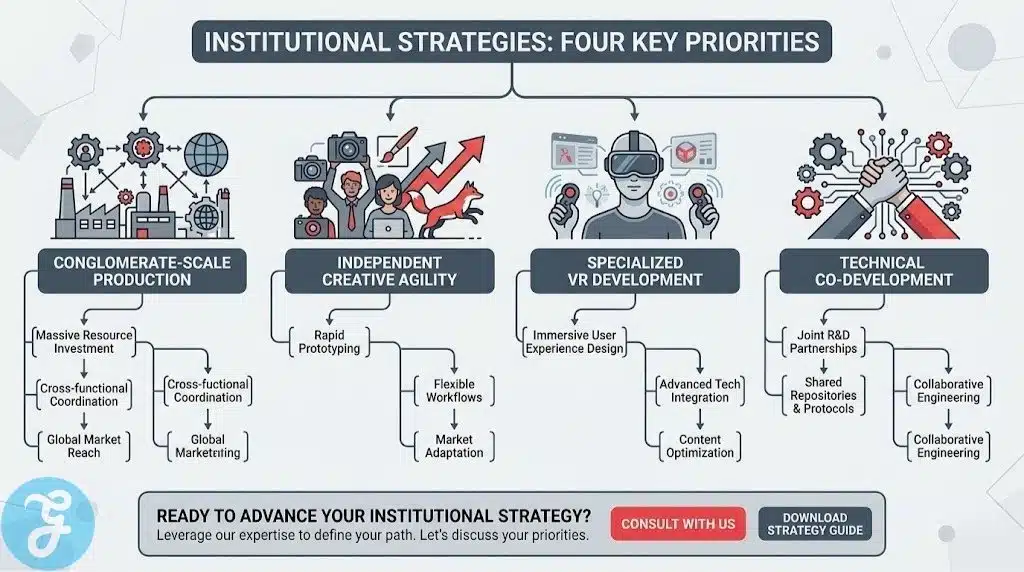
Evaluate Organizational Structure. Determine if you prefer the vast resources of a conglomerate (EA, Ubisoft) or the relative creative flexibility of a large independent (Behaviour).
Applying this framework directly to your specific needs ensures you are engaging with the right tier of the Canadian industry.
Decision Matrix
Matching your specific professional or creative priorities with the right developer ensures a successful partnership.
| Choose This Studio… | If You Prioritize… |
| Ubisoft Montréal or EA Sports | Unmatched production scale and working on global, billion-dollar franchises. |
| Behaviour or Relic | Supporting the independent sector and specialized genre leadership. |
| Digital Extremes or Respawn | Long-term live-service stability and deep community engagement. |
| Archiact or Sanzaru Games | Leading the charge in the rapidly expanding AAA Virtual Reality market. |
Before finalizing an agreement or career move, running through a final verification process is vital.
The Final Checklist
Running through this quick verification process guarantees you are aligning with a stable, high-performance entity.
-
Confirm the studio’s current headcount and recent layoff history to gauge organizational stability.
-
Verify the primary game engine used for their active projects to ensure technical compatibility.
-
Check the studio’s recent release cadence to determine if they are in early pre-production or nearing launch.
-
Ensure the developer has a robust remote/hybrid work policy, which has become standard across the Canadian tech sector in 2026.
-
Review the studio’s track record of co-development if you are looking for a partner to support a secondary production pipeline.
Understanding the broader context of the 2026 industry provides the final layer of necessary insight.
The Resilience of Northern Development
As we move through 2026, it is clear that the landscape for AAA Gaming Studios in Canada is defined by a hard-earned resilience. Reflecting on the recent layoffs at major hubs like Eidos Montréal and the restructuring at Ubisoft Toronto, one might feel a sense of trepidation about the industry’s future.
However, a deeper look reveals a sector that is not shrinking, but rather maturing into a more sustainable version of itself. The shift toward co-development and specialized technical partnerships is not a sign of weakness, but a strategic adaptation to the astronomical costs of modern game production. Canada remains the “Silicon Valley of Gaming” because it has the unique ability to reinvent its operational models without losing its creative soul.
Whether it is a solo-developer success story in Vancouver or a thousand-person expansion in Montreal, the spirit of innovation in the north remains unbroken. Supporting this ecosystem means recognizing that the best interactive experiences are built through collaboration and the courage to pivot when the market demands it.
To further clarify the state of the Canadian gaming industry, addressing common logistical questions is essential.
Frequently Asked Questions (FAQs) About AAA Gaming Studios in Canada
Why are so many AAA Gaming studios located in Canada?
Canada, particularly Quebec and British Columbia, offers some of the most competitive tax credits in the world for interactive digital media. These incentives, combined with a highly educated workforce and a lower cost of living compared to California, make it the ideal location for massive game development hubs.
Is Montreal still the best place to find gaming jobs in 2026?
Yes. Despite recent 2026 layoffs, Montreal remains the largest gaming hub in the world by employee count. The density of studios means that even during restructuring, there is a constant rotation of talent and a robust support network for new startups.
Are Canadian studios still using their own custom game engines?
While many studios (like Ubisoft) still use powerful proprietary engines like Snowdrop and Anvil, there is a noticeable industry-wide shift in 2026 toward Unreal Engine 5 for major narrative projects (like BioWare’s next Mass Effect) to streamline development and talent recruitment.
How has the 2026 restructuring affected the “independent” AAA scene?
Studios like Behaviour Interactive and the newly independent Relic Entertainment have had to become more focused. While they remain “AAA” in scale, they are prioritizing operational efficiency over rapid expansion, often focusing on a single high-performing IP to ensure long-term stability.
Can international developers easily move to Canada to work at these studios?
Most major Canadian AAA studios have dedicated immigration teams to assist with Global Skills Strategy visas. While the 2026 market is more competitive, high-level technical talent (engineers and technical artists) remains in high demand across all provinces.





















