
Some days do not leave enough space for a long workout. Work runs late. A child needs attention. The gym feels too far away. By the time an hour opens up, the energy to train is already gone.
That is where HIIT routines under 20 minutes can help. They are not magic, and they do not replace every other kind of training. But when they are planned well, short interval sessions can give you a focused, demanding workout without needing a gym, machines, or a perfect schedule.
The important words are “planned well.” HIIT is not random sweating. It is hard effort followed by enough recovery to make the next interval useful. If every round turns into sloppy movement, the workout is too hard, too fast, or too poorly matched to your current fitness level.
The seven routines below are built for real-life constraints: small rooms, apartments, limited time, light dumbbells, outdoor stairs, and days when you want intensity without wrecking your joints. Pick the one that matches your body and your day, not the one that looks hardest on paper.
What Counts as HIIT?
HIIT stands for high-intensity interval training. It alternates short bursts of hard effort with easier recovery periods. During the hard part, your breathing should be heavy enough that speaking in full sentences is difficult. During recovery, your breathing should come down enough for you to repeat the next round with control.
For most general fitness workouts, the hard intervals should feel like a 7 to 9 out of 10 effort. You do not need to hit maximum effort every time. In fact, all-out effort often creates more problems than benefits for beginners: poor form, sore joints, dizziness, and a workout you do not want to repeat.
Use this simple effort scale:
| Effort Level | What It Feels Like | Best Use |
|---|---|---|
| 3–4 out of 10 | Easy movement, comfortable breathing | Warm-up and cool-down |
| 5–6 out of 10 | Moderate effort, short sentences are easy | Recovery intervals |
| 7–9 out of 10 | Hard effort, breathing is heavy | Main HIIT intervals |
| 10 out of 10 | Maximum effort | Rarely needed for everyday fitness |
Heart-rate watches can help, but they are not perfect. The talk test is often more practical. If you can chat easily, the interval is probably too easy. If you feel dizzy, lose coordination, or feel sharp pain, stop.
A Quick Safety Check Before Starting
HIIT is demanding. That does not make it unsafe for everyone, but it does mean the workout needs to match the person.
Get medical guidance before hard intervals if you have chest pain, unexplained shortness of breath, dizziness during exercise, a known heart condition, uncontrolled high blood pressure, recent surgery, or an injury that changes how you move. People managing diabetes, pregnancy, joint pain, or long-term medical conditions may still be able to train, but the routine may need adjustment.
Pain is not a badge of effort. Muscle fatigue is normal. Sharp knee pain, chest tightness, sudden dizziness, or lower-back pain that changes your movement is a signal to stop or scale down.
Also, warm up. Even if the whole session is short, spend at least three to five minutes getting your body ready. If you are older, stiff, returning after a long break, or training in cold weather, take longer.
How Often Should You Do HIIT?
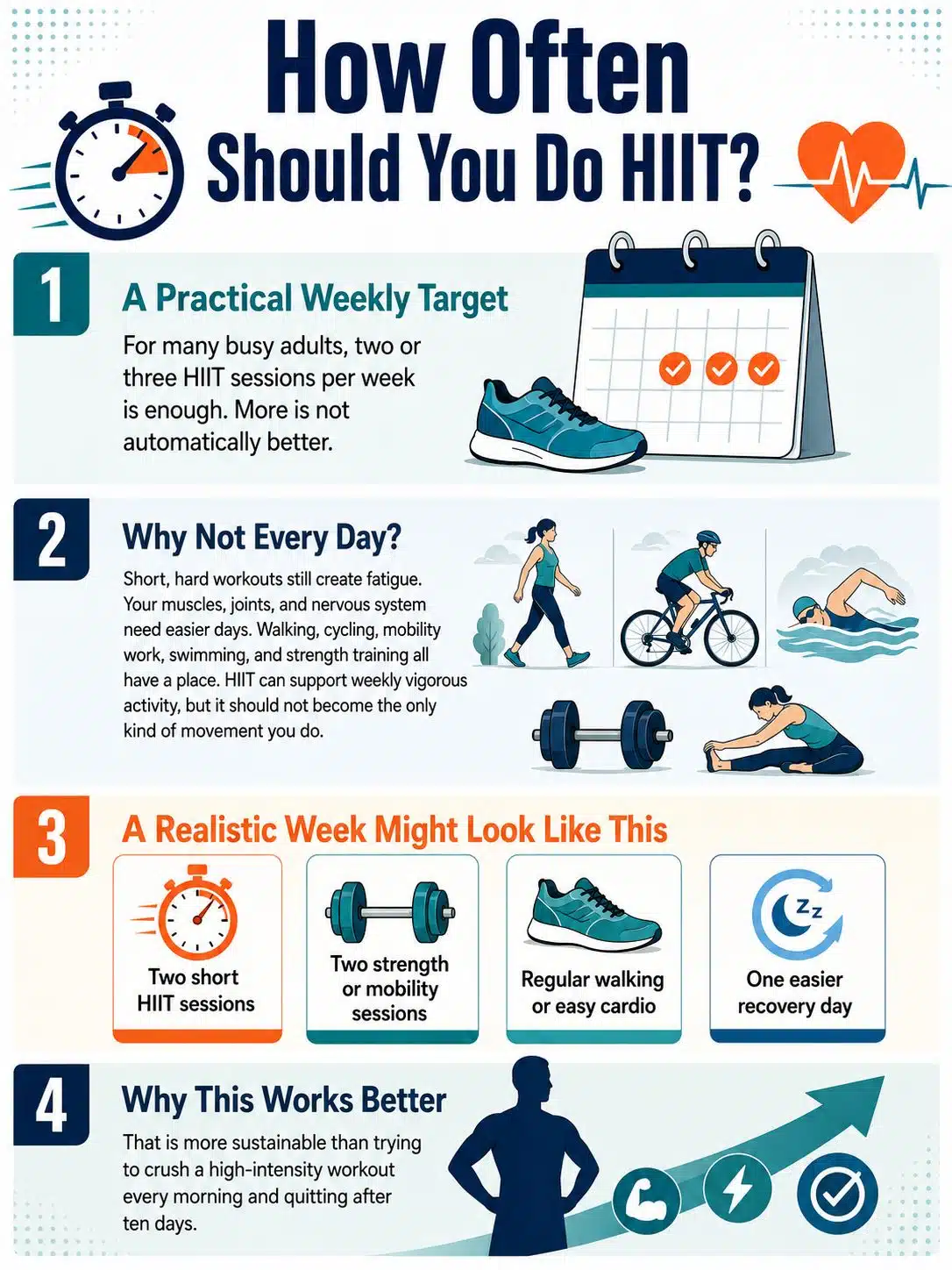
For many busy adults, two or three HIIT sessions per week is enough. More is not automatically better.
Short, hard workouts still create fatigue. Your muscles, joints, and nervous system need easier days. Walking, cycling, mobility work, swimming, and strength training all have a place. HIIT can support weekly vigorous activity, but it should not become the only kind of movement you do.
A realistic week might look like this:
- Two short HIIT sessions
- Two strength or mobility sessions
- Regular walking or easy cardio
- One easier recovery day
That is more sustainable than trying to crush a high-intensity workout every morning and quitting after ten days.
1. The 15-Minute Beginner Bodyweight HIIT
This is the best starting point if you are new to intervals, coming back after a break, or unsure how your body will handle high-intensity work. The exercises are familiar, and the rest periods are generous enough to protect your form.
Total time: 15 minutes
Equipment: None
Best for: Beginners, travel days, small rooms, busy mornings
Start with three minutes of easy movement: marching in place, arm circles, bodyweight good mornings, slow squats, and side steps. Do not rush this part. The warm-up should make the first round feel smoother, not harder.
For the main workout, complete two rounds:
- Bodyweight squats — 40 seconds
- Incline push-ups against a wall, table, or bench — 40 seconds
- Reverse lunges — 40 seconds
- Mountain climbers, slow or fast — 40 seconds
- Plank shoulder taps — 40 seconds
Rest for 20 seconds between exercises.
Cool down with two minutes of slow walking and gentle stretching for the calves, hip flexors, and chest.
The main mistake is treating beginner HIIT like a punishment session. Keep the squats controlled. Step back carefully during lunges. If mountain climbers feel too hard, place your hands on a bench or sturdy chair. A clean first week matters more than a heroic first session.
2. The 18-Minute Low-Impact Apartment Routine
Low-impact HIIT is often more useful than people admit. It is quieter, kinder to the joints, and easier to repeat in a real home. No jumping is required, but the session should still feel purposeful.
Total time: 18 minutes
Equipment: None
Best for: Apartments, upstairs rooms, knee-sensitive training, early mornings
Warm up for four minutes with marching, hip circles, arm swings, slow lateral steps, and half squats.
Then complete three rounds of the following circuit. Work for 45 seconds and rest for 15 seconds.
- Fast step-out squats
- Standing knee drives, right side
- Standing knee drives, left side
- Elevated plank hold
- Alternating reverse lunges
- Shadow boxing
During shadow boxing, do not flail your arms. Keep the core braced, shoulders relaxed, and punches sharp but controlled. During reverse lunges, shorten the range if your knees feel irritated.
This routine is a good choice when you want intensity without annoying your downstairs neighbor or pounding your ankles. It is also useful on days when jumping feels unnecessary but you still want to sweat.
3. The 16-Minute Dumbbell HIIT Circuit
This routine adds resistance, but it is still a conditioning workout. The dumbbells should make the exercises more demanding, not turn the session into a form breakdown.
Total time: 16 minutes
Equipment: One pair of dumbbells
Best for: People who want strength and cardio in one short session
Use the first three minutes for easy squats, arm circles, hip hinges, and slow lunges. If your shoulders feel tight, add a few gentle overhead reaches before picking up the dumbbells.
The workout is simple: 30 seconds of work, 30 seconds of rest, for three rounds.
- Dumbbell thrusters
- Dumbbell Romanian deadlifts
- Push-ups or incline push-ups
- Dumbbell push press
Choose lighter dumbbells than you would use for slow strength training. A weight that feels “just right” in minute one may feel too heavy by minute ten. If your lower back starts taking over during deadlifts or thrusters, lower the weight, slow the pace, or stop the set early.
This is not the best first HIIT routine for someone who has never practiced a squat, hinge, or overhead press. Learn the movements first. Once the technique feels steady, this becomes one of the more efficient HIIT routines under 20 minutes because it trains both muscles and lungs.
4. The 12-Minute Tabata-Style Finisher
This is the shortest routine in the list, but it is not the easiest. Tabata-style intervals use 20 seconds of hard work followed by 10 seconds of rest. The rest feels almost too short by the end.
Total time: 12 minutes
Equipment: None
Best for: Short finishers, experienced exercisers, very tight schedules
Take four minutes to warm up with marching, squats, shoulder circles, and easy mountain climbers. The warm-up matters more here because the work intervals arrive quickly.
For six minutes, alternate between:
- 20 seconds squat thrusts
- 10 seconds rest
- 20 seconds high knees or fast marching
- 10 seconds rest
Repeat until six minutes are complete.
Cool down for two minutes with slow walking and relaxed breathing.
Do not add extra exercises just because six minutes sounds short. If the intervals are done with real effort, the final minute will be enough. If squat thrusts bother your wrists, elevate your hands on a bench or switch to step-back squat thrusts. If high knees feel jarring, use fast marching with strong arm drive.
This one is best used as a finisher after a lighter strength session or as a quick standalone workout on a packed day. It is not the best choice when you are exhausted before starting.
5. The 19-Minute Stair or Hill Interval Routine
Stairs and hills make intensity easy to find. You do not need choreography, equipment, or a playlist. You do need a safe surface and sensible pacing.
Total time: 19 minutes
Equipment: Stairs, a hill, or a safe incline
Best for: Outdoor cardio, runners, people who dislike complicated circuits
Start with five minutes of flat walking. Then add a few gentle uphill steps or stair climbs so your legs know what is coming.
For the main workout, repeat six rounds:
- 20 seconds hard uphill or stair effort
- 1 minute 40 seconds walking recovery
Finish with two minutes of slow walking on flat ground.
Do not sprint down stairs. Walk down carefully and treat that time as recovery. Avoid wet steps, loose gravel, broken pavement, traffic, and crowded areas.
The first hard effort should feel strong, not desperate. If your legs are heavy by round three, shorten your stride and keep the pace controlled. This routine is excellent for people who want outdoor intensity, but it can be rough on calves, knees, and lungs if you start too aggressively.
6. The 17-Minute Core-and-Cardio HIIT
Not every HIIT workout needs burpees. This routine mixes core control with heart-rate work, which makes it useful on days when you want conditioning without constant jumping.
Total time: 17 minutes
Equipment: Mat optional
Best for: Home workouts, core control, lower-jump training
Warm up with cat-cow, marching, hip circles, and slow inchworms for about three minutes.
Then complete three rounds. Work for 35 seconds and rest for 25 seconds.
- Dead bug
- Skater steps or skater jumps
- Plank step-outs or plank jacks
- Squat to calf raise
The dead bug is not filler. Use it to control your ribs, pelvis, and breathing before the faster movements. If your lower back arches, reduce the range of motion. If plank jacks irritate your shoulders or lower back, use plank step-outs instead.
This routine is underrated for people who sit a lot. It asks the core to stabilize, then challenges you to keep that control while moving faster. It will not replace a full strength program, but it is a smart short session when you want sweat without chaos.
7. The 20-Minute EMOM Routine
EMOM means “every minute on the minute.” At the start of each minute, complete the assigned work. Whatever time remains in that minute is your rest.
This format is useful because it exposes pacing. If you finish each minute too quickly, the workout is probably too easy. If you are still working when the next minute begins, the reps are too high.
Total time: 20 minutes
Equipment: None
Best for: People who like structure and measurable progress
Warm up for four minutes with easy squats, shoulder taps, hip hinges, and light marching or jogging.
Then cycle through these seven minutes twice:
| Minute | Exercise |
|---|---|
| 1 | 12 squats |
| 2 | 8–12 push-ups or incline push-ups |
| 3 | 20 mountain climbers |
| 4 | 10 reverse lunges per side |
| 5 | 12 hip bridges |
| 6 | 30 seconds shadow boxing |
| 7 | 6–8 burpees or step-back burpees |
Cool down with two minutes of slow walking and gentle stretching for the chest, hips, and calves.
Aim to finish most minutes with about 15 to 25 seconds of rest. If you only get five seconds of rest, reduce the reps. If you finish in 20 seconds every time, increase the reps slightly or choose a harder variation.
For a quieter version, use step-back burpees and elevated mountain climbers. For a joint-friendlier version, remove burpees completely and use squat-to-calf-raise instead.
Choosing the Right Routine for Today
The best workout is not always the hardest one.
Choose the beginner bodyweight routine if you are new to HIIT or returning after time off. Choose the low-impact apartment routine if noise, knees, or upstairs floors are a concern. Use the dumbbell circuit when you want a stronger muscle challenge, but only if your technique is steady.
The Tabata-style finisher is best when time is extremely tight and you already tolerate hard intervals. The stair or hill routine suits people who prefer outdoor cardio, but it needs careful pacing. The core-and-cardio session is useful when you want intensity without too much jumping. The EMOM routine is best if you like structure and want an easy way to track progress.
If you slept badly, feel unusually sore, or are already stressed, choose the quieter option or go for a brisk walk. Forcing maximum intensity on a tired body is not discipline. Often, it is just poor planning.
Mistakes That Make Short HIIT Workouts Less Effective
The first mistake is skipping the warm-up. A short workout still asks your heart, joints, and muscles to move quickly. Give your body a few minutes to get ready.
The second mistake is choosing exercises you cannot control. Burpees, jump lunges, and fast mountain climbers are not required. A simpler movement done hard and clean is usually better than an advanced movement done badly.
The third mistake is resting too little. Constant movement is not the same as HIIT. If recovery is too short, your hard intervals stop being hard and the session becomes tired, messy cardio.
The fourth mistake is doing HIIT every day. High-intensity work needs recovery. Two or three short sessions per week can be plenty, especially if you also walk, lift, cycle, or play sports.
The fifth mistake is treating calorie burn as the only score. Fitness watches can be motivating, but calorie estimates vary by body size, fitness level, movement choice, intensity, and device accuracy. Better signs of progress include steadier pacing, cleaner movement, faster recovery between rounds, and better stamina during normal daily activity.
A Realistic Weekly Plan
A useful week does not need to look impressive. It needs to be repeatable.
Try this structure:
- Monday: 15-minute beginner bodyweight HIIT
- Tuesday: 30-minute walk
- Wednesday: Dumbbell HIIT circuit
- Thursday: Mobility, stretching, or easy cycling
- Friday: Low-impact HIIT or EMOM
- Saturday: Longer walk, sport, light strength session, or active family time
- Sunday: Rest or gentle movement
This gives you intensity, recovery, and flexibility. It also leaves room for work, family, sleep, and the imperfect parts of real life.
When HIIT Is Not the Smartest Option
A short HIIT session is useful, but it is not always the right answer.
Skip it or scale it down if you are sick, lightheaded, recovering from poor sleep, dealing with sharp pain, or training in extreme heat. Avoid hard intervals right after a heavy meal. Be cautious with outdoor sprints in humid weather, especially if you are not used to it.
If your main goal is building muscle, HIIT should not replace progressive strength training. If your main goal is endurance, you still need easier cardio sessions that last longer. If your main goal is weight loss, HIIT can help, but eating habits, daily movement, sleep, and consistency will matter more over time.
Short workouts reduce friction. They do not remove the need for recovery.
Final Thoughts
The best HIIT routines under 20 minutes are not the ones that leave you wrecked. They are the ones you can do with effort, control, and enough recovery to repeat next week.
Start with the routine that matches your current level. Keep the warm-up. Respect the rest periods. Modify exercises before your form falls apart. Use harder versions only when the simpler version feels steady.
HIIT works best as focused training, not punishment. Use it two or three times a week, mix in easier movement, and build the habit around your real schedule. A short workout done well is still a real workout.