
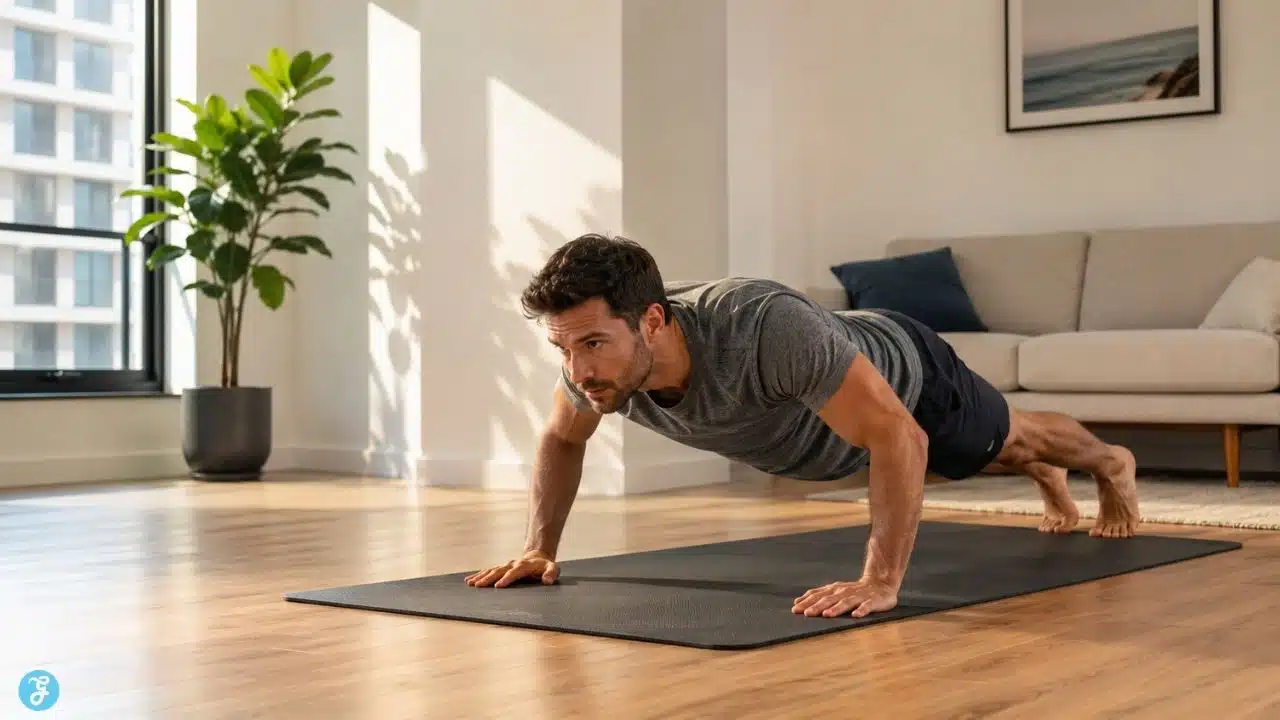
You do not need a full gym setup to get stronger. That is the good news. The less exciting news is that you still have to train with intention.
A few rushed push-ups before a shower will not do much. Neither will 100 squats done with loose knees and no control. Bodyweight workouts strength works best when you treat them like strength training, not just a way to sweat in your living room.
The basics are simple. Pick exercises that make your muscles work. Use a version you can control. Rest enough to keep your form clean. Then make the work slightly harder over time.
That last part matters. Progress does not always mean adding more reps. It can mean lowering slower, pausing at the hardest point, using a deeper range of motion, switching to a harder variation, or doing the same movement with better control than last week.
Bodyweight training also fits real life. You can do it in a bedroom, a hotel room, a quiet office corner, or a small apartment where jumping would annoy everyone downstairs. It is not perfect for everything, especially pulling strength, but it is more useful than many people give it credit for.
One note before starting: if you have an injury, a medical condition, pregnancy-related concerns, dizziness, sharp joint pain, or a long break from exercise, get proper guidance before pushing hard. Muscle effort is fine. Pain that changes your movement is not.
What a Good Bodyweight Strength Routine Needs
A useful routine should cover more than one muscle group and more than one movement pattern. Push-ups are great, but push-ups alone are not a program.
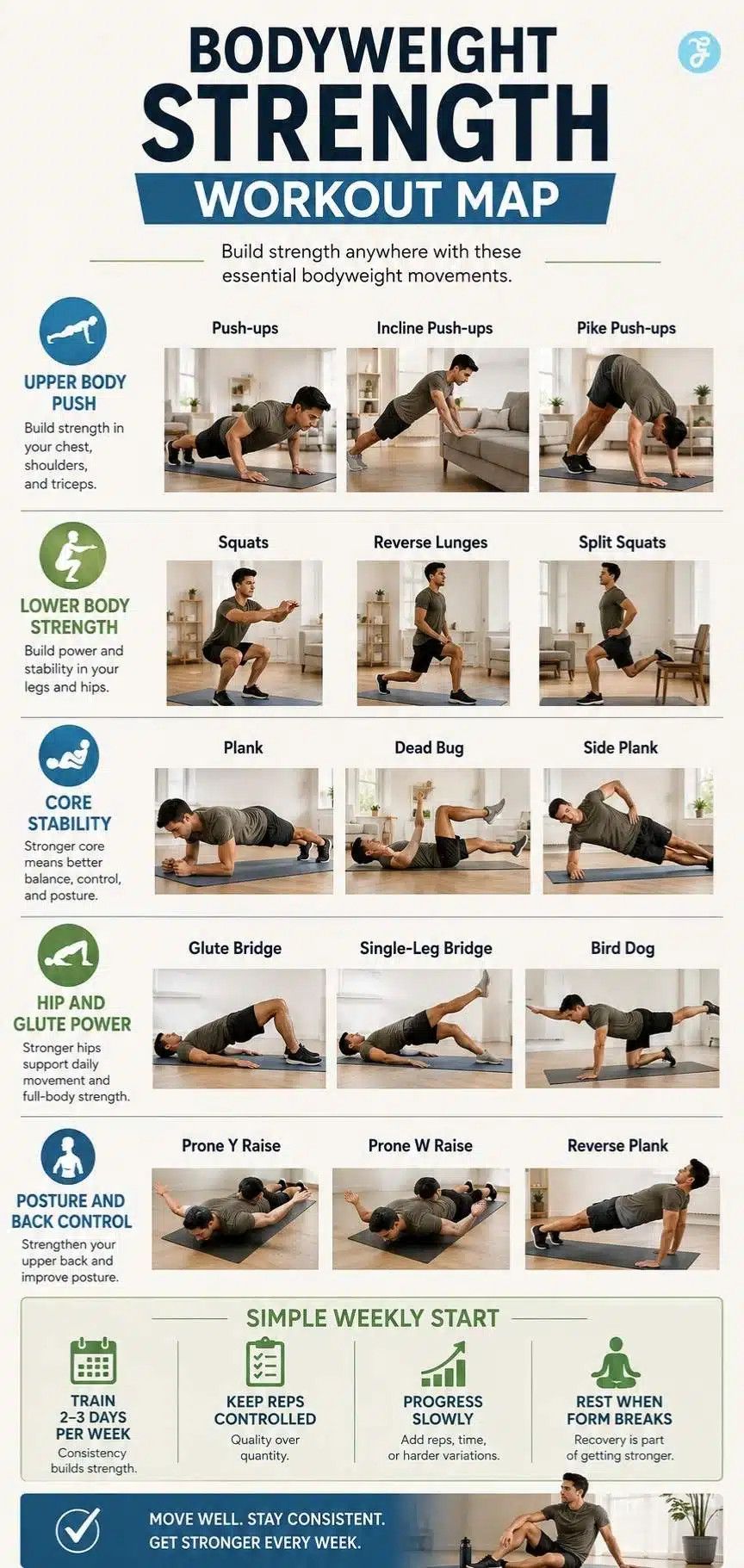
A balanced bodyweight workout strength plan usually includes some version of:
- Pushing
- Squatting
- Lunging
- Hip extension
- Core bracing
- Single-leg control
- Upper-back or posture work
You do not have to train everything every day. Two or three well-built sessions per week can be enough for many beginners. The real difference comes from repeating the work and improving it gradually.
A strength session should not feel like a race. Rest when you need to. If your breathing is so frantic that every rep turns ugly, slow down. A hard workout is not automatically a good workout.
1. Push-Up Ladder
Push-ups are easy to dismiss because everyone knows them. That is also why many people do them badly.
A clean push-up trains the chest, shoulders, triceps, core, and upper-body control. A sloppy one mostly teaches you to drop your hips and survive the rep.
For this ladder, start low and climb gradually:
- 2 push-ups
- Rest 30 seconds
- 4 push-ups
- Rest 45 seconds
- 6 push-ups
- Rest 60 seconds
- 8 push-ups
- Rest 60-90 seconds
- Then come back down: 6, 4, 2
Use the version that lets you stay in control. Wall push-ups are fine for beginners. Incline push-ups on a sturdy counter, desk, or bench are often better than forcing ugly floor reps. Knee push-ups can work too, as long as your body stays straight from head to knee.
Keep your elbows slightly angled instead of flared straight out. Brace your stomach before you lower. Stop the set when your hips start to sag, not five reps later.
To make this harder, do not just chase more reps. Try lowering for three seconds on each push-up. That small change makes the exercise feel very different.
2. Squat and Reverse Lunge Session
Lower-body strength shows up in boring but important ways. Stairs get easier. Getting up from a low chair feels smoother. Carrying groceries takes less effort. You notice it when daily movement stops feeling like work.
Use this session when you want a simple leg day without equipment:
- Bodyweight squats: 3 sets of 10-15 reps
- Reverse lunges: 3 sets of 8-10 reps per leg
- Wall sit: 2 rounds of 30-60 seconds
- Standing calf raises: 3 sets of 15-20 reps
Reverse lunges are often friendlier than forward lunges for beginners. You step back, the front leg stays more stable, and the movement is easier to control.
If balance is a problem, hold a wall or chair lightly. That does not make the exercise useless. It lets you train the legs instead of spending the whole set wobbling.
For squats, control matters more than depth. A steady half squat is better than a deep squat where your heels lift and your knees collapse inward. Try to keep your knees moving in the same direction as your toes.
The wall sit is the part people underestimate. It looks like a break. It is not. If your knees or lower back complain, come up a little higher or shorten the hold.
3. Core Control Routine
A stronger core is not only about visible abs. It helps your trunk stay steady while your arms and legs move. That matters during push-ups, lunges, squats, running, lifting, and even sitting for long stretches.
This routine avoids the usual trap of rushing through crunches:
- Forearm plank: 3 rounds of 20-45 seconds
- Dead bug: 3 sets of 8-10 reps per side
- Side plank: 2 rounds of 15-30 seconds per side
- Hollow body hold: 3 rounds of 10-30 seconds
The dead bug is easy to fake. Lie on your back, raise your arms and legs, then lower one arm and the opposite leg slowly. If your lower back lifts off the floor, shorten the movement. Smaller and cleaner is better.
For planks, do not worship the timer. A clean 25-second plank beats a 90-second plank where your hips are hanging like a hammock. Squeeze your glutes, brace your stomach, and keep your head in line with your spine.
The hollow hold is usually the hardest piece. Bend your knees if needed. If your lower back arches, you are not failing; you just need an easier version.
4. Slow-Rep Bodyweight Workout
When normal bodyweight exercises become too easy, people often jump straight into advanced variations. That is not always necessary. Sometimes the better move is to slow everything down.
Try this:
- Slow squats: 3 sets of 8-12 reps
- Slow push-ups: 3 sets of 5-10 reps
- Slow glute bridges: 3 sets of 10-15 reps
- Slow mountain climbers: 2 sets of 20 total reps
Use a three-second lowering phase. Pause briefly. Return with control. This exposes weak points quickly. A slow squat shows whether your knees stay steady. A slow push-up reveals whether your core is actually holding the body in one line. A slow glute bridge makes it harder to cheat by arching your lower back.
Keep the session short. Slow reps create fatigue faster than they look on paper. When the form starts to unravel, end the set.
For extra difficulty, pause where the exercise feels hardest: near the bottom of a push-up, at the bottom of a squat, or at the top of a glute bridge.
5. Glute Bridge and Hip Strength Work
A lot of home workouts hammer the front of the body. Push-ups, squats, and crunches get the attention. The hips and glutes are treated like an afterthought. That is a mistake.
Strong glutes help with hip extension, lower-body control, and stability. This routine is quiet, low-impact, and useful if you spend long hours sitting.
Start here:
- Glute bridges: 3 sets of 12-15 reps
- Glute bridge hold: 3 rounds of 20-40 seconds
- Bird dog: 2 sets of 8-10 reps per side
- Donkey kicks: 2 sets of 10-15 reps per side
Add single-leg glute bridges only when the two-leg version feels stable. During a glute bridge, press through your heels and lift by squeezing your glutes. Stop when your hips are extended. Do not turn it into a lower-back arching contest.
Single-leg bridges are useful, but they are often added too soon. If one hip drops or your pelvis twists, go back to the basic bridge and hold the top position longer.
Bird dogs should feel controlled, not dramatic. Reach the opposite arm and leg, keep your hips level, and reduce the range if your body rotates.
6. No-Equipment Back and Posture Work
Here is the honest limitation of bodyweight training: pulling strength is hard to train without equipment.
Push-ups are simple. Rows and pull-ups are not, unless you have a pull-up bar, rings, bands, a suspension trainer, or a safe table setup. Still, you can do useful upper-back and posture work on the floor.
Use this as a support routine, especially if your week includes a lot of push-ups:
- Prone Y raises: 2 sets of 8-12 reps
- Prone W raises: 2 sets of 8-12 reps
- Superman hold: 3 rounds of 10-25 seconds
- Reverse plank: 3 rounds of 15-40 seconds
- Scapular push-ups: 2 sets of 8-12 reps
For prone Y and W raises, keep the movement small. Lie face down, lift your arms slightly, and avoid cranking your neck upward. The work should come from your upper back and shoulder blades.
Scapular push-ups are not regular push-ups. Keep your elbows straight and move only through your shoulder blades. It feels strange at first, but it teaches control around the upper back and shoulders.
This routine helps balance push-heavy training. It does not fully replace rows or pull-ups. If upper-back strength becomes a serious goal, you will eventually want some kind of pulling setup.
7. Apartment-Friendly Full-Body Circuit
Not every full-body workout needs burpees, jumping, or loud floor work. You can build strength quietly if the exercises are chosen well. This circuit is useful for apartments, beginners, heavier exercisers, or anyone who wants a low-impact session.
Complete 3 rounds:
- Squats: 10-15 reps
- Incline or standard push-ups: 6-12 reps
- Reverse lunges: 8 reps per leg
- Plank shoulder taps: 10 taps per side
- Glute bridges: 12-15 reps
Rest 60-90 seconds between rounds. The plank shoulder tap is where most people get sloppy. Widen your feet, move slowly, and try not to let your hips swing side to side. It should feel like a core drill, not a dance move.
Beginners can start with two rounds. Add the third only when the first two feel controlled. This is not the flashiest workout in the list, but it may be the easiest one to repeat every week.
8. Single-Leg Strength and Balance
Single-leg work belongs in a strength plan because life is not perfectly symmetrical. Walking, climbing stairs, stepping off a curb, and changing direction all ask one leg to support you while the other moves.
This session builds leg strength, ankle control, hip stability, and balance:
- Assisted split squats: 3 sets of 8-10 reps per leg
- Single-leg Romanian deadlift reach: 3 sets of 6-8 reps per leg
- Step-back lunges: 2 sets of 8 reps per leg
- Single-leg calf raises: 2 sets of 10-15 reps per leg
- Standing knee-drive hold: 2 rounds of 15-25 seconds per side
For the single-leg Romanian deadlift reach, hinge at the hips, reach your hands forward, and let one leg move behind you. You do not need weight. Your body weight is enough if you move slowly.
Do not chase a huge range of motion. A small, steady reach is better than a dramatic one with twisting hips. If one side feels weaker, train that side first. Then match the stronger side to the same number of clean reps. Otherwise, the strong side quietly keeps getting more work.
9. Push-Up Variation Day
Once basic push-ups feel manageable, variations can keep the exercise challenging. The mistake is moving to harder versions before your standard push-up is solid.
Use this session if you can already do several clean floor push-ups or strong incline push-ups:
- Incline push-ups: 2 sets of 8-12 reps
- Standard push-ups: 3 sets of 6-12 reps
- Close-grip push-ups: 2 sets of 5-10 reps
- Pike push-ups: 3 sets of 5-8 reps
- Slow lowering push-ups: 2 sets of 3-5 reps
Close-grip push-ups ask more from the triceps. Pike push-ups shift more work toward the shoulders. Slow lowering push-ups build control during the hardest part of the movement.
If your wrists feel uncomfortable, use an incline. If your shoulders feel irritated, reduce the depth or return to an easier version. A harder push-up is only useful if it still looks like a push-up.
10. Isometric Hold Session
Isometric exercises make your muscles work without visible movement. They are useful because they teach you how to create tension and hold a position.
This session is short, quiet, and harder than it appears:
- Wall sit: 3 rounds of 30-60 seconds
- Push-up bottom hold: 3 rounds of 10-20 seconds
- Glute bridge hold: 3 rounds of 30-45 seconds
- Side plank: 2 rounds per side
- Squat hold: 2 rounds of 20-40 seconds
The push-up bottom hold should happen slightly above the floor. Do not collapse into your shoulders. Use an incline or knee position if the full version is too difficult.
The useful thing about isometric work is the feedback. A squat hold shows whether your knees and feet stay aligned. A side plank shows whether your trunk can resist dropping. A bridge hold shows whether your glutes can stay active without your lower back taking over.
This works well as a light-day session or as a short finisher after another workout.
11. The 20-Minute Whole-Body Routine
This is the simplest place to start if you want one dependable routine.
Set a timer for 20 minutes and move through steady rounds of:
- Push-ups: 6-12 reps
- Squats: 12-15 reps
- Reverse lunges: 8 reps per leg
- Glute bridges: 12-15 reps
- Forearm plank: 30 seconds
- Prone W raises: 10 reps
Rest when needed. Do not chase the highest number of rounds. Clean reps matter more than speed. Progress one thing at a time. Add a rep or two. Slow the lowering phase. Reduce rest slightly. Move to a harder variation. Do not make every exercise harder in the same week, or the routine can fall apart quickly.
For most busy people, this is enough to build a habit and a strength base.
What Bodyweight Training Cannot Do Perfectly
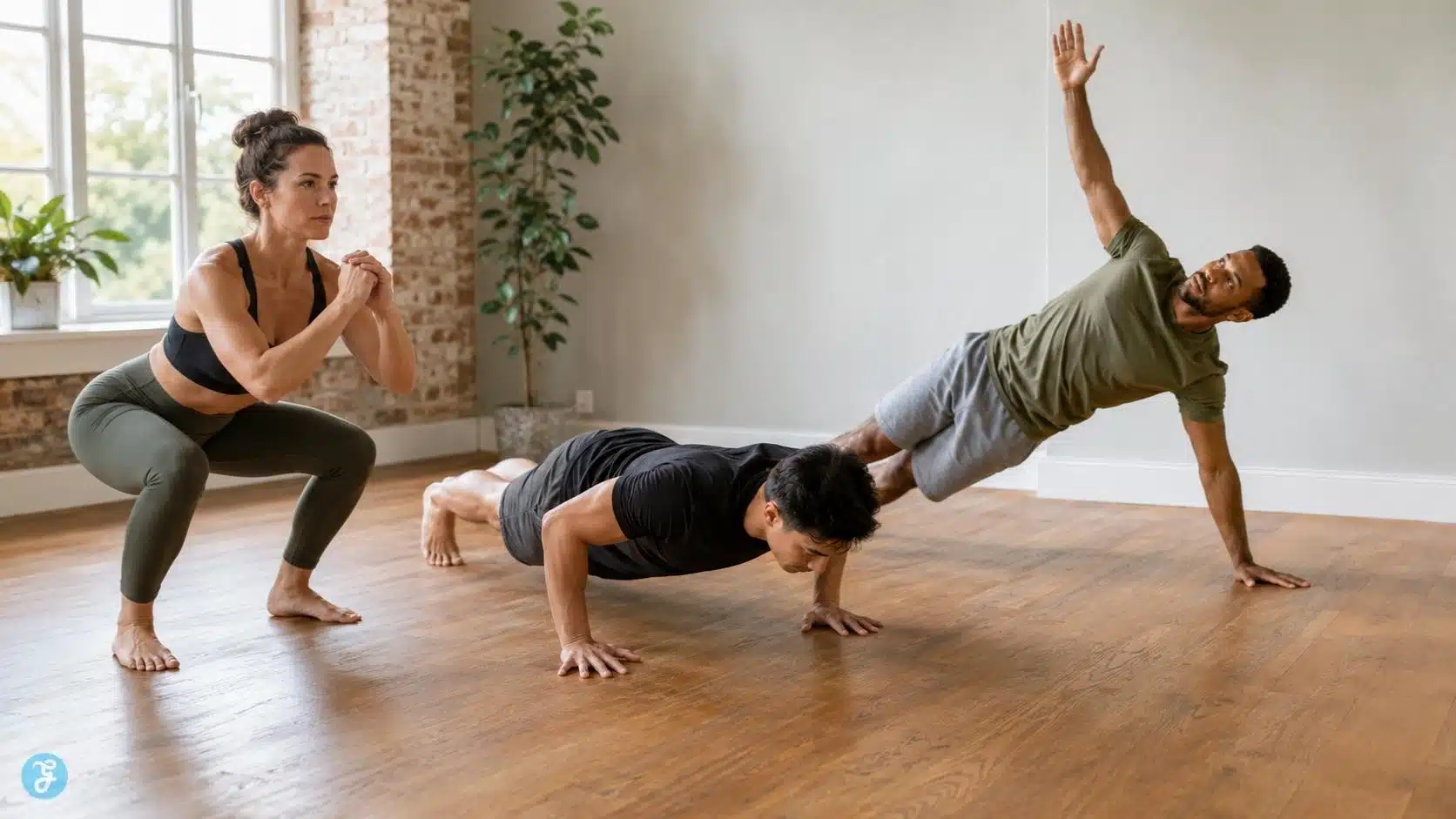
Bodyweight training is convenient, but it has limits. It is excellent for push-ups, squats, lunges, planks, glute bridges, holds, and balance work. It is less complete for pulling strength. It also becomes harder to keep progressing the legs once basic squat and lunge variations feel easy.
That does not make bodyweight training weak. It just means you should be honest about the ceiling. Beginners and many intermediate trainees can build a strong base with no equipment. More advanced trainees may eventually need a pull-up bar, resistance bands, rings, dumbbells, or heavier loading.
Recovery matters too. More workouts do not automatically mean more strength. If your reps get worse, your joints feel irritated, your sleep suffers, or your motivation drops sharply, the workload may be too high. A good plan should challenge you and still leave you able to train again.
A Simple Weekly Plan
Here is a practical starting week:
| Day | Session |
| Monday | 20-minute whole-body routine |
| Tuesday | Walking, mobility, or rest |
| Wednesday | Push-up ladder plus core work |
| Thursday | Rest or gentle movement |
| Friday | Squat, reverse lunge, and glute bridge work |
| Saturday | Optional low-impact circuit |
| Sunday | Rest |
If four training days feel like too much, remove Saturday. If two days are all you can manage, do Monday and Friday.
The best plan is not the one that looks impressive. It is the one you can repeat.
Mistakes That Make Bodyweight Training Less Effective
Rushing every rep is the first mistake. Fast movement can hide weak form. Slow down enough to feel what is working.
Training only the front of the body is another problem. Push-ups and crunches are not a complete plan. Add glute work, single-leg training, side planks, and some upper-back work.
Do not make every workout exhausting. Hard sessions have a place, but constant fatigue usually ruins technique.
Do not ignore pain. Muscle burn is normal. Sharp joint pain is a warning.
And do not assume more reps always mean more strength. Very high-rep sets often become endurance work. For strength, harder variations, slower tempo, pauses, and a cleaner range of motion can be more useful.
Final Thoughts
Bodyweight training works when you treat it seriously. The exercises are simple. The execution should not be careless. Start with the version you can control. Use an incline if floor push-ups are too difficult. Hold a wall if lunges feel unstable. Stop a plank at 20 seconds if your hips start to drop at 21.
Then build slowly. The goal is not to destroy yourself in one heroic workout. The goal is to perform the movements well, repeat them consistently, and make them harder only when your form is ready.
That is enough to build real strength without waiting for the perfect gym setup.