

In today’s digital world, users unknowingly give away their data to tech giants in exchange for free services. Platforms like Facebook, Google, and Amazon collect and control vast amounts of personal information, leaving users with little say in how their data is used.
The centralized nature of Web2 means that corporations hold the power, often leading to privacy breaches, data leaks, and misuse of personal information.
Web3 is changing this narrative. With its decentralized and blockchain-based approach, Web3 aims to give users complete control over their data. This means users can decide how their data is stored, shared, and monetized without relying on centralized intermediaries. In this article, we explore 10 key ways Web3 will improve data ownership and user control and why it is a game-changer for digital privacy and security.
What is Web3 and Why Does It Matter?
Web3 is the next phase of the internet, built on blockchain technology and decentralized networks. Unlike Web2, where corporations control user data, Web3 gives power back to individuals by enabling self-sovereign identity, smart contracts, and decentralized storage. It aims to create a more secure, private, and user-controlled internet experience.
| Feature | Web2 (Centralized) | Web3 (Decentralized) |
| Data Ownership | Companies own user data | Users control their data |
| Identity | Platform-based accounts | Self-sovereign identity |
| Security | Vulnerable to hacks | Blockchain encryption |
| Monetization | Companies profit from user data | Users can monetize their data |
Now, let’s explore the top 10 ways Web3 will improve data ownership and user control.
1. Decentralization Eliminates Centralized Control
One of the biggest advantages of Web3 is decentralization. In Web2, platforms like Google and Facebook store user data on centralized servers, which makes them vulnerable to hacking and data breaches. Web3 eliminates this risk by distributing data across blockchain networks.
Additionally, decentralization ensures that users are not subject to unilateral policy changes by large corporations. With no single point of failure, data remains safer from cyberattacks and government surveillance. This shift gives power back to individuals, allowing them to dictate how their personal information is stored and accessed.
Moreover, decentralized networks offer increased reliability and uptime, as there is no dependence on a single server or entity to keep services operational.
How Decentralization Helps Users
| Benefit | Explanation |
| Less Data Breaches | No single point of failure for hackers to exploit |
| User Autonomy | Users control their data without corporate oversight |
| Greater Privacy | No third-party access to personal information |
2. Self-Sovereign Identity (SSI) for Greater Privacy
Self-sovereign identity (SSI) allows users to manage their digital identity without relying on a central authority. With SSI, users own their credentials and decide when and where to share them.
By leveraging blockchain technology, users can verify their identity without exposing excessive personal data. This reduces the risk of identity theft and ensures more secure online interactions. SSI also eliminates the need for passwords, replacing them with cryptographic authentication methods that are far more secure.
Furthermore, SSI reduces identity fraud, as each identity is unique and verifiable on the blockchain, making impersonation nearly impossible.
Key Benefits of SSI
| Feature | Impact |
| User Ownership | Users have full control over their identity |
| Privacy | No need to share unnecessary personal data |
| Security | Data is encrypted and verifiable via blockchain |
3. Blockchain Transparency Enhances Trust
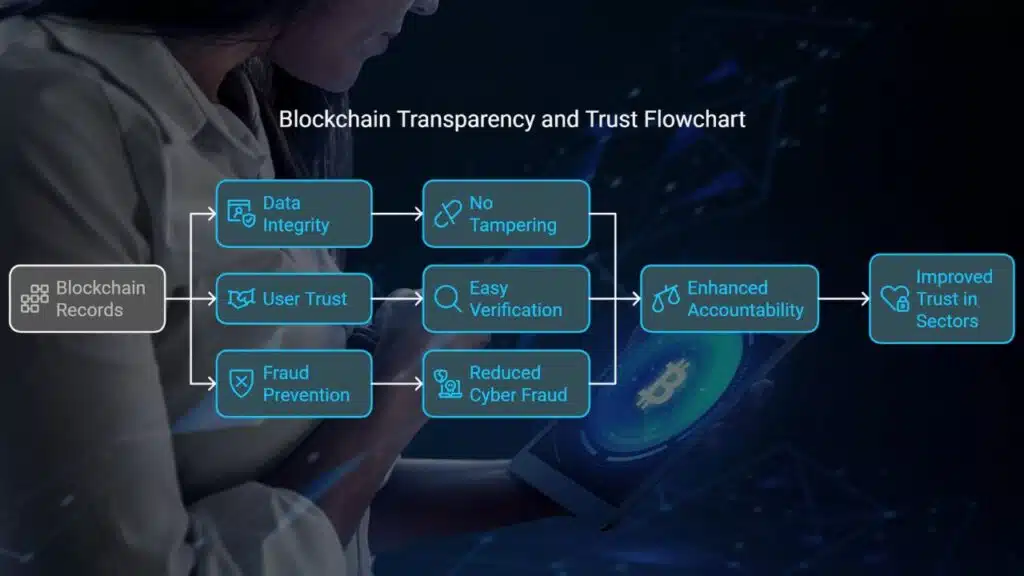
Blockchain ensures transparency by storing data on a public, immutable ledger. Every transaction is recorded, making it impossible to alter or delete past records.
This increased transparency holds companies accountable for how they handle user data. Additionally, users can audit transactions and verify the integrity of stored information. As a result, blockchain builds greater trust between users and platforms, reducing fraudulent activities.
Furthermore, blockchain enhances accountability in various sectors, such as finance, healthcare, and digital identity management, by providing clear records of interactions.
Why Blockchain Transparency Matters
| Benefit | Explanation |
| Data Integrity | No tampering or data manipulation possible |
| User Trust | Users can verify data ownership easily |
| Fraud Prevention | Reduces fake identities and cyber fraud |
4. Smart Contracts Enable Secure Data Agreements
Smart contracts are self-executing agreements coded on the blockchain. They ensure that data-sharing agreements between users and platforms are transparent and automated.
Unlike traditional contracts, smart contracts eliminate the need for intermediaries, reducing costs and increasing efficiency. They also ensure that agreements are enforced automatically, reducing disputes and enhancing trust between parties.
Additionally, smart contracts improve efficiency in various sectors, such as real estate and supply chain management, by eliminating paperwork and enabling instant settlements.
How Smart Contracts Protect Users
| Advantage | Explanation |
| No Middlemen | Eliminates third-party interference |
| Secure Transactions | Contracts execute only when conditions are met |
| Automated Processes | Reduces manual handling of sensitive data |
5. Data Portability Across Platforms
Currently, switching platforms means losing data. Web3 allows users to carry their data across different platforms seamlessly using decentralized protocols.
This means users are no longer locked into a single service provider. Whether it’s social media, financial apps, or gaming platforms, Web3 enables seamless data interoperability. This fosters greater competition and innovation, giving users more choices and control.
Moreover, data portability enhances user experience by allowing seamless access across different ecosystems without redundant sign-ups or verification processes.
Why Data Portability is Important?
| Feature | Impact |
| User Flexibility | Move data between services without restrictions |
| No Vendor Lock-In | Users are not tied to a single platform |
| Increased Freedom | Users can choose better alternatives |
6. Privacy-Focused Data Monetization
In Web3, users can earn from their data instead of giving it away for free. Blockchain-based models like Basic Attention Token (BAT) allow users to get paid for sharing their data.
With Web3, advertisers must pay users directly for engagement, ensuring fair compensation. This model benefits users by providing transparency in how data is used while offering financial incentives. More businesses are exploring this approach as consumers demand greater control over their digital interactions.
Moreover, decentralized finance (DeFi) platforms can integrate user data monetization models, creating an additional income stream for users.
How Users Can Profit from Their Data?
| Method | How It Works |
| Data Tokens | Users receive tokens for sharing data securely |
| Ad Revenue | Users get a share of ad profits for viewing ads |
| NFT Ownership | Data can be tokenized as NFTs for monetization |
7. Secure and Censorship-Resistant Content
Web3 enables decentralized content storage, ensuring that information cannot be deleted or censored by a central authority.
This ensures free speech and protection against arbitrary content takedowns by corporations or governments. Users can store data on censorship-resistant platforms like IPFS and Arweave, ensuring longevity and data availability.
Additionally, Web3 platforms encourage open discussions and content permanence, leading to a more transparent internet ecosystem.
Why Censorship Resistance Matters?
| Challenge | Web3 Solution |
| Content Deletion | Data stored on blockchain remains permanent |
| Free Expression | Users can share ideas without fear of removal |
| Fairer Systems | No single entity controls narratives |
8. Zero-Knowledge Proofs (ZKPs) for Data Protection
Zero-knowledge proofs (ZKPs) allow users to verify their identity without revealing private data.
ZKPs enhance privacy by enabling secure transactions and identity verification without exposing sensitive information. This technology is already being integrated into financial applications to protect user data while maintaining transparency.
Beyond finance, ZKPs can revolutionize voting systems, private messaging, and digital interactions by ensuring data security and confidentiality.
Benefits of ZKPs
| Feature | Impact |
| Privacy | No need to share unnecessary details |
| Security | Prevents identity theft and fraud |
| Efficiency | Reduces verification time |
9. DAOs Empower Users in Governance
Decentralized Autonomous Organizations (DAOs) allow users to participate in decision-making on digital platforms.
With DAOs, users gain voting power proportional to their holdings or contributions, ensuring fairer governance models. Unlike traditional corporations where decisions are made behind closed doors, DAOs provide full transparency.
DAOs can govern social media platforms, DeFi projects, and digital communities, giving users an active role in shaping policies and rules.
How DAOs Improve User Control
| Feature | Advantage |
| Decentralized Voting | Users influence platform policies |
| No Single Authority | Prevents monopolistic control |
| Transparent Rules | Governance is recorded on blockchain |
10. Web3 Storage Solutions for True Data Ownership
Decentralized storage systems like IPFS and Filecoin allow users to store data securely without relying on companies like Google or Amazon.
Web3 storage solutions ensure data redundancy, meaning files are available even if certain nodes go offline. This enhances reliability while maintaining privacy and security.
Additionally, Web3 storage solutions are more cost-efficient and provide users with complete control over who can access their data.
Web3 vs. Traditional Storage
| Factor | Traditional Cloud | Web3 Storage |
| Ownership | Companies control data | Users control data |
| Privacy | Third-party access | Fully encrypted |
| Security | Prone to hacks | Blockchain-protected |
Takeaways
Web3 is revolutionizing data ownership and user control by eliminating centralized power structures, enhancing privacy, and enabling users to profit from their data. With features like decentralization, blockchain transparency, smart contracts, and self-sovereign identity, Web3 will improve data ownership and user control like never before.
As Web3 adoption grows, users will enjoy greater autonomy, privacy, and security in the digital world. Now is the time to explore and embrace Web3 technologies for a future where you own your data.





















