

The rise of blockchain technology has introduced revolutionary concepts in governance, finance, and business models. One of the most significant innovations in this space is Decentralized Autonomous Organizations (DAOs).
These organizations leverage smart contracts and decentralized decision-making to function without centralized leadership. The applications of decentralized autonomous organizations are reshaping industries by ensuring transparency, efficiency, and community-driven governance.
As blockchain adoption grows, so does the relevance of DAOs in various sectors. This article explores seven real-world applications of decentralized autonomous organizations, demonstrating their transformative potential.
Each section includes real-world examples, key benefits, and a detailed breakdown for maximum clarity.
How DAOs Work: A Brief Overview
DAOs are organizations that operate on blockchain technology, where governance decisions are made through smart contracts and community voting. Unlike traditional corporations, DAOs eliminate hierarchical management structures, enabling decentralized decision-making.
Key Features of DAOs:
- Smart Contracts: Automate processes and enforce rules.
- Token-Based Governance: Members vote using governance tokens.
- Transparency: Transactions and decisions are recorded on a public ledger.
- Community-Driven: Participants have a direct say in decision-making.
With these features, the applications of decentralized autonomous organizations extend beyond finance into gaming, media, real estate, and more.
7 Real-World Applications of Decentralized Autonomous Organizations (DAOs)
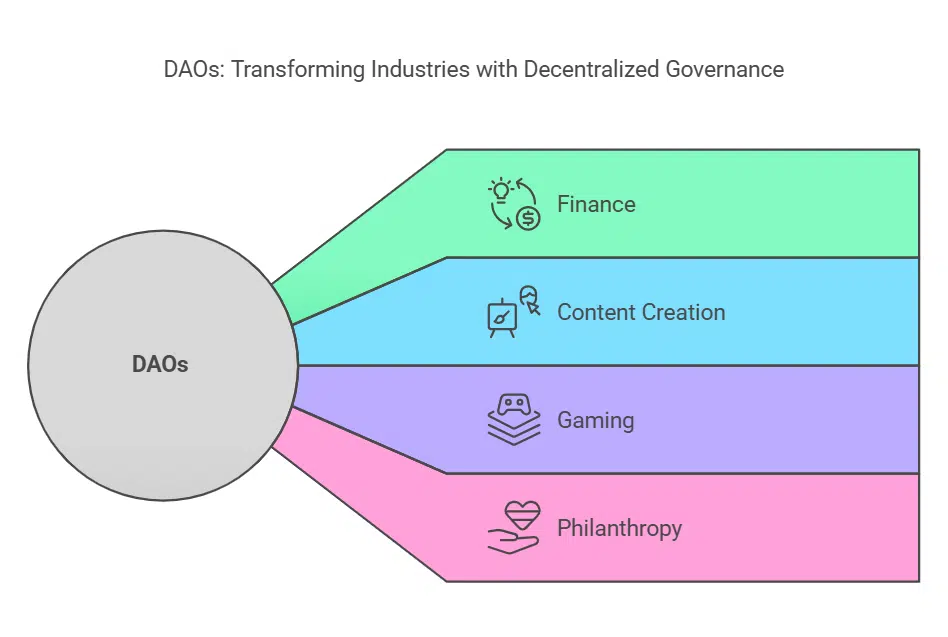
Decentralized Autonomous Organizations (DAOs) are increasingly becoming a cornerstone of the blockchain ecosystem, driving innovation and governance across multiple sectors.
These entities allow for decision-making processes that are transparent, automated, and community-driven, eliminating the need for traditional hierarchies.
As industries seek decentralized solutions, DAOs are demonstrating their transformative power in finance, content creation, gaming, and even philanthropy.
1. DAOs in Decentralized Finance (DeFi)
The DeFi sector has seen explosive growth, with DAOs playing a crucial role in enabling decentralized banking services, lending protocols, and asset management. These platforms allow users to earn interest, borrow assets, and participate in financial governance without intermediaries. By utilizing DAOs, DeFi projects enhance transparency, security, and accessibility, making financial services available to a global audience.
Examples:
- MakerDAO: Manages DAI, a decentralized stablecoin ensuring financial stability.
- Aave: A lending protocol governed by a DAO community that offers flexible loans.
| Feature | Benefits |
| Decentralized Lending | Removes banks and intermediaries, reducing costs |
| Liquidity Pools | Allows users to earn passive income from lending |
| Transparent Governance | Ensures fair decision-making through community votes |
2. DAOs in Venture Capital and Crowdfunding
Traditional venture capital (VC) investment is often exclusive, requiring significant capital and connections. DAOs revolutionize this process by enabling collective investment, allowing anyone to contribute funds and participate in decision-making. By leveraging DAOs, startups can raise funds without traditional VC gatekeepers while ensuring fair distribution of profits among investors.
Examples:
- The LAO: A DAO that funds blockchain startups with pooled capital.
- MetaCartel Ventures: A decentralized investment group that finances Web3 projects.
| Feature | Benefits |
| Community Investing | Enables smaller investors to participate |
| Transparent Fund Allocation | Ensures fairness in distributing funds |
| Smart Contracts | Automates investment agreements |
3. DAOs in Gaming and Play-to-Earn (P2E) Models
Gaming is one of the fastest-growing industries adopting DAOs. Blockchain-powered gaming platforms enable Play-to-Earn (P2E) models, where players can earn real-world rewards, own in-game assets, and participate in governance. DAOs help gaming communities shape game development, in-game economies, and reward distribution.
Examples:
- Yield Guild Games (YGG): A DAO that invests in P2E game assets and shares profits with members.
- Decentraland DAO: Governs the Decentraland metaverse through user voting.
| Feature | Benefits |
| Player-Owned Economies | Users own in-game assets as NFTs |
| Community Governance | Players vote on game updates and policies |
| Financial Incentives | Players can earn tokens and NFTs |
4. DAOs in Content Creation and Media
Decentralized media platforms allow creators to control content ownership, receive fair compensation, and operate without corporate gatekeepers. DAOs in content creation provide crowdfunding opportunities, fair revenue sharing, and community-led decision-making, ensuring that media remains independent and user-driven.
Examples:
- Mirror.xyz: A blockchain-based publishing platform where writers earn from readers directly.
- BanklessDAO: Funds and supports decentralized media initiatives focused on crypto education.
| Feature | Benefits |
| Direct Monetization | Writers earn without intermediaries |
| Censorship Resistance | Ensures free speech and independent publishing |
| Community Funding | Readers support creators through DAOs |
5. DAOs in Real Estate and Property Management

Tokenized real estate investments and community-driven property management are among the emerging applications of decentralized autonomous organizations. DAOs facilitate fractional property ownership, making real estate investment more accessible.
Examples:
- RealT: Allows fractional ownership of real estate using blockchain tokens.
- Lofty AI: Provides a DAO-driven approach to property investment.
| Feature | Benefits |
| Fractional Ownership | Reduces barriers to entry for investors |
| Transparent Transactions | Ensures fair property management |
| Community Voting | Stakeholders decide on property operations |
6. DAOs in Social Impact and Philanthropy
DAOs are transforming philanthropy by ensuring transparency and efficiency in charitable giving. These organizations allocate funds directly to causes based on community voting, reducing administrative costs and increasing trust in donations.
Examples:
- Gitcoin Grants: Funds open-source projects through community contributions.
- Giveth: A DAO-based platform that supports decentralized philanthropy.
| Feature | Benefits |
| Transparent Giving | Every donation is traceable on-chain |
| Community Governance | Donors decide on fund allocation |
| Smart Contract Automation | Reduces administrative costs |
7. DAOs in Digital Identity and Reputation Systems
Digital identity solutions powered by DAOs are improving security, privacy, and trust in online interactions. Self-sovereign identity (SSI) solutions allow users to control their personal data while reducing identity fraud.
Examples:
- BrightID: A decentralized identity verification system that prevents Sybil attacks.
- Proof of Humanity: Ensures unique digital identities for fair governance.
| Feature | Benefits |
| Decentralized Identity | Prevents fraud and identity theft |
| Privacy Protection | Users control their data access |
| Trustless Verification | Removes reliance on centralized authorities |
Takeaways
The applications of decentralized autonomous organizations are revolutionizing multiple industries, from finance and gaming to media and real estate.
By eliminating intermediaries and empowering communities, DAOs pave the way for a more transparent and decentralized future.
As blockchain technology advances, DAOs will continue to evolve, offering innovative solutions to traditional governance and economic models.
Whether you’re an investor, developer, or enthusiast, understanding and engaging with DAOs can provide valuable opportunities in the decentralized landscape.
Are you ready to explore the world of DAOs? Join a DAO today and become part of the decentralized future!
























