


My nephew Zayan is five. He could sing the alphabet song at three, so I assumed the letters would follow. They did not. Well past his fourth birthday he still pointed at a lowercase d and called it b, and after about ten minutes at the table he was finished listening.
That gap between the song and the letters is where home teaching usually stalls. Teaching alphabets to children at home does not need a classroom, a printed curriculum, or an hour a day. It needs a short routine you repeat, a way to check what your child truly knows, and patience with the four or five letters that always take longer.
Short answer: ten focused minutes a day, two new letters a week, taught by shape, name, and sound together, with letters found around the house instead of drilled on a worksheet.
Knowing the Alphabet Is Really Three Skills
Parents often treat “knows the alphabet” as one thing. It is three:
- Shape — spotting the letter and telling it apart from lookalikes.
- Name — calling it bee.
- Sound — saying /b/.
A child can have one without the others. Zayan had the song, which is only the order. He could recite twenty-six names in a row and still not pick f out of a page. Reading research has pointed the same way for years: letter name and letter sound knowledge are among the strongest early predictors of how well a child later reads, and sound knowledge sits closest to actual decoding. Order comes last in usefulness, even though it is what most families teach first.
If you want the fuller case for why this skill carries so much weight, we covered it in alphabet recognition and why it matters.
Ten Minutes Beats an Hour
Zayan’s limit was roughly ten minutes. I timed it more than once, hoping for a better number. It never came.
That turned out to be useful rather than limiting. Short daily practice holds far better than one long weekend session, and a five-year-old who stops while still interested comes back willingly the next day. The rule I settled on: end the session before the child wants it to end. If they ask for one more letter, that is the moment to stop.
Pick a fixed slot. After breakfast, or before the evening bath. The time of day matters less than it being the same time.
A Daily Routine for Teaching Alphabets to Children at Home
This is the whole session. Ten minutes, four short blocks.
| Block | Time | What you do |
|---|---|---|
| Warm-up | 2 min | Show 4–5 letters already learned. Ask for the name, then the sound. Quick, no correcting tone. |
| New letter | 3 min | Introduce one letter. Say the name, say the sound, and trace it with a finger in the air and on paper. |
| Find it | 3 min | Hunt for that letter on packets, books, doors, and clothing tags. |
| Close | 2 min | Name three things that start with the sound. Stop there. |
The weekly shape matters as much as the daily one. Two new letters a week is enough for most four- and five-year-olds. Day six is review only. Day seven, nothing.
Do not teach in ABC order. Start with the letters in your child’s name, because those already mean something to them. Then move to letters with clean, common sounds: m, s, t, a, p, f. Save c, g, y and the vowels’ second sounds for later. And keep b and d in different weeks, which I will come back to.
The Two Things that Worked Best at Home
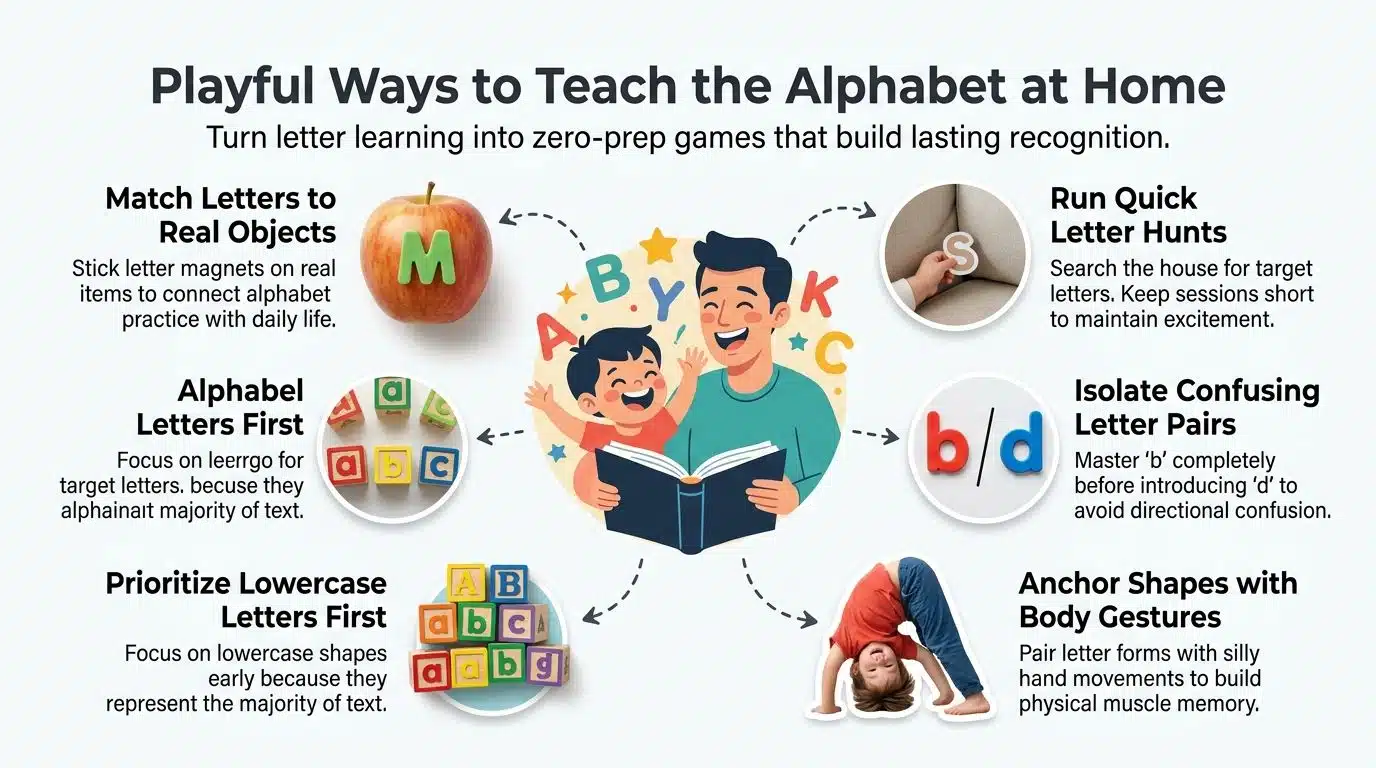
Everything I tried with Zayan fell into two piles: things that felt like school and things that felt like a game. Only the second pile stuck.
Matching letters to real objects: A fridge magnet m placed on the milk carton. The s from his name was found on a shampoo bottle. This does more than entertain. It moves the letter out of the practice sheet and into his actual world, so the letter stops being a table activity and becomes something that exists everywhere.
Letter hunts: One letter of the day, then a walk or a room sweep to find it. Five sightings and he was done, pleased with himself. On slow afternoons we hid paper letters around the room and he had to name each one before keeping it.
Neither needed preparation, which is the honest reason they survived. Structured games work too, and there are stronger and weaker ones: our roundup of alphabet learning games for kids sorts through the better options, and there is a longer explanation of why games teach the alphabet better than repetition drills.
Fixing b, d, p and q
This was Zayan’s hardest month, and it is the most common complaint I hear from parents.
First, some relief: these four letters are the same shape facing different directions, and young children are wired to treat a flipped object as the same object. A cup is a cup from either side. Letters are the exception, and learning that exception takes time. Reversals are normal well past age five, and most children stop making them by around seven. Frequent, consistent confusion after that is worth raising with a teacher.
What helped:
- Teach one, then wait: We worked on b alone until it was solid, then left it a week before introducing d. Teaching the pair together teaches the confusion.
- Anchor each letter to one word and one motion: For b, a fist for the stick and the other hand for the belly. Silly is fine. Silly is memorable.
- Correct without heat: “That one is d. Show me b.” Then move on. A long explanation at this age adds pressure, not clarity.
- Practice in lowercase: Most text a child will ever read is lowercase, and it is the harder set. Uppercase is easier and tends to look like progress, which is why it gets over-taught.
If the mix-ups have already settled into a habit, the repair process is a bit different from first teaching, and we walk through it in how to rebuild alphabet skills.
What You Actually Need to Buy
Very little. Paper, a marker, a set of lowercase magnets, and a chart on the wall at your child’s eye height, not yours. Charts vary in quality more than parents expect, and a bad one teaches bad associations, so it is worth reading what makes an alphabet chart actually useful before buying.
On apps, I should declare an interest: I work as a chief technical advisor on a children’s alphabet app, Alphabet Magic: Trace & Phonics, available on Android as well. Building it did not change my view that an app is a practice tool, not a teacher. Tracing on a screen reinforces a shape your child has already met with you. It does not replace the ten minutes. Current pediatric guidance for ages two to five still points to about an hour a day of high-quality content, and the 2026 update leans harder on what the child is watching and whether it is crowding out sleep and play than on the stopwatch.
How to Tell It Is Working
Watch for these, roughly in this order:
- Your child names a letter shown out of alphabetical order.
- They give the sound without being asked for the name first.
- They point out a letter outside practice time, on a sign, or on a cereal box.
That third one is the real milestone. Progress also runs slower than most parents expect and unevenly: five letters in a week, then nothing for ten days. We looked at realistic timelines in how long it takes a child to learn the alphabet, and it is worth reading before you decide your child is behind.
Final Thoughts
Teaching alphabets to children at home works when you make it small and boring to plan and interesting to do. Ten minutes, two letters a week, one letter hunted down on a cereal box. Zayan got there, slowly, and the b/d confusion faded on its own timetable rather than mine.
Pick your slot tomorrow morning, start with the first letter of your child’s name, and do not add a second letter until the first one is easy.





















