
A child can come back from summer vacation, illness, travel, or another long break and suddenly look uncertain about letters that once seemed familiar. Lowercase forms may cause hesitation. A few letter sounds disappear. Writing feels slower. The ABC song may still come easily even when identifying a random letter does not.
That does not mean you need to start over.
To rebuild alphabet skills, first work out what your child still knows. Then spend more time on the connections that have become shaky: letter names, uppercase and lowercase forms, sounds, or writing. For preschoolers and kindergarteners, targeted review is usually more useful than pushing through all 26 letters in order.
The first job is not teaching. It is finding the gap.
Check What Your Child Actually Remembers
Keep the first review informal.
Show a mixture of uppercase and lowercase letters in random order rather than beginning with A and moving through the alphabet. A child who has memorized the ABC sequence may still struggle to recognize individual letters away from that sequence.
Try a few prompts:
- “What letter is this?”
- “Can you find the lowercase m?”
- “What sound does this letter usually make?”
- “Can you write it?”
- “Which picture starts with this sound?”
You do not need to ask every question for every letter. That quickly becomes a test instead of a useful check.
Look for patterns instead.
A child may know B but hesitate over b. Another may name M immediately but forget its common sound. A kindergartener may recognize a letter without difficulty yet struggle to form it from memory.
Those are different gaps. Treating all of them as “forgetting the alphabet” leads to unnecessary repetition.
This home check is not meant to diagnose a reading problem. It simply tells you what deserves attention next.
Knowing the Alphabet Is More Than Singing It
Alphabet knowledge brings several skills together. Children learn to recognize letters, name them, connect uppercase and lowercase forms, associate letters with sounds, and eventually produce those letters in writing.
These connections help children understand the alphabetic principle: written letters and letter patterns represent sounds in spoken language.
That is why the ABC song is useful but limited.
A child may sing the entire sequence because it has been memorized almost like a nursery rhyme. Seeing a printed G in the middle of a book cover and identifying it without the sequence is a different task. So is recognizing g as the same letter.
Keep singing the song if your child enjoys it. Just do not use it as the only evidence that alphabet knowledge is secure.
Rebuild the Weak Connections, Not the Entire Alphabet
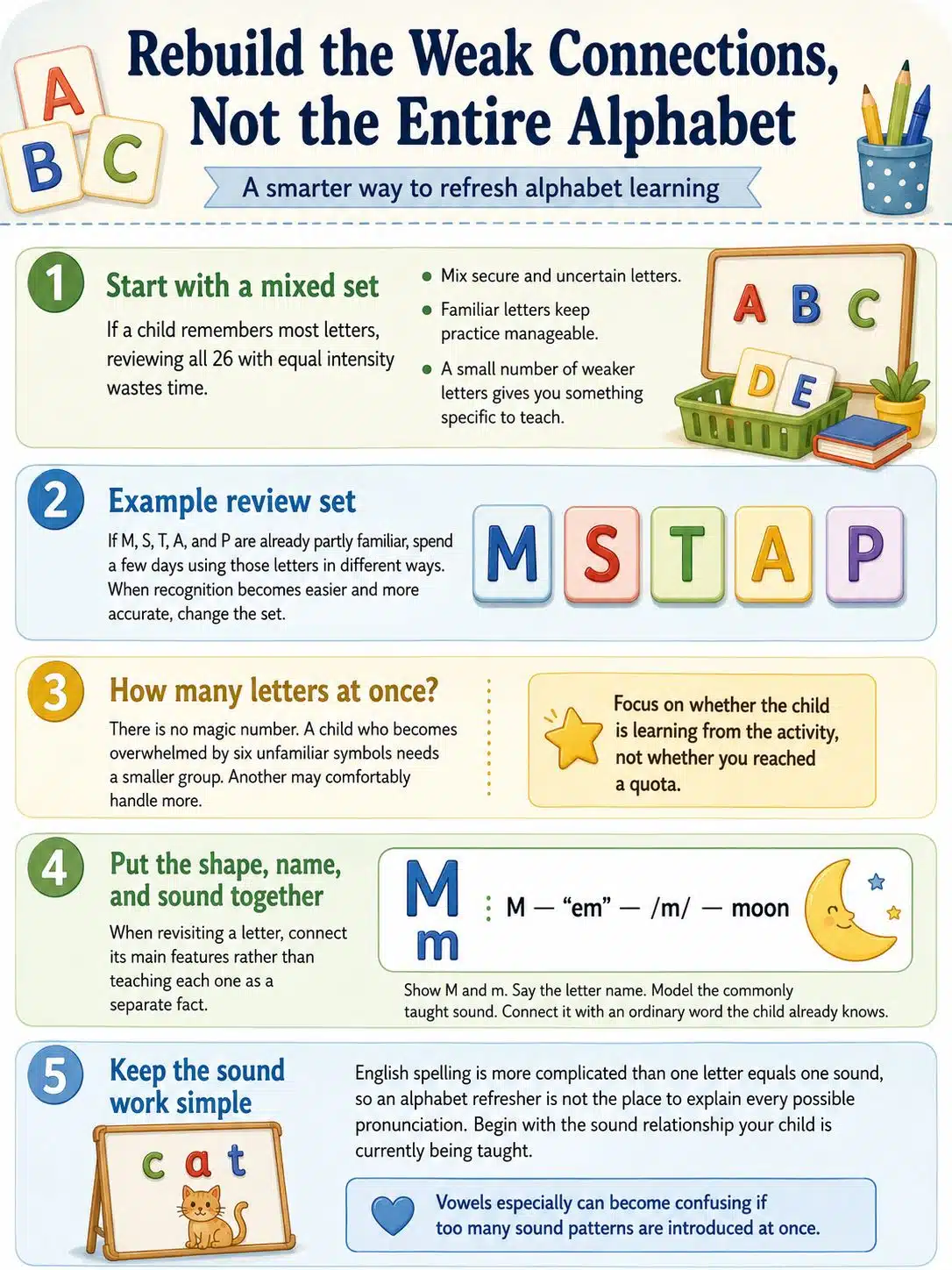
If a child remembers most letters, reviewing all 26 with equal intensity wastes time.
Start with a mixture of secure and uncertain letters. Familiar ones keep the activity manageable. A small number of weaker letters gives you something specific to teach.
Suppose M, S, T, A, and P are already partly familiar. You might spend a few days using those letters in different ways rather than spreading attention across the whole alphabet. When recognition becomes easier and more accurate, change the set.
There is no magic number of letters to practice at once. A child who becomes overwhelmed by six unfamiliar symbols needs a smaller group. Another may comfortably handle more.
The useful question is whether the child is learning from the activity, not whether you reached a particular quota.
Put the shape, name, and sound together
When revisiting a letter, connect its main features rather than teaching each one as a separate fact.
For example:
M — “em” — /m/ — moon
Show M and m. Say the letter name. Model the commonly taught sound. Connect it with an ordinary word the child already knows.
English spelling is more complicated than “one letter equals one sound,” so an alphabet refresher is not the place to explain every possible pronunciation. Begin with the sound relationship your child is currently being taught.
Vowels especially can become confusing if too many sound patterns are introduced at once.
Do Not Forget Lowercase Letters
Uppercase letters often get more attention on posters, puzzles, and beginner alphabet toys, but most of the print children eventually read is lowercase.
Some pairs are visually easy to connect:
C/c, O/o, S/s
Others look noticeably different:
A/a, G/g, R/r
A child who instantly recognizes capital R may still hesitate over r.
Simple matching activities are enough. Write uppercase letters on one set of cards and lowercase versions on another, then ask your child to make pairs.
After that, move beyond the cards.
Find the same letters in a picture book, on a food package, on a name label, or in another piece of ordinary print. Children should eventually recognize a letter even when the font, size, and surrounding design change.
Practice Sounds Without Showing Any Letters
Some alphabet difficulty is really a sound-awareness problem.
Before children can make full use of letter-sound relationships, they need to notice that spoken words contain smaller sound units. You can work on that without paper, pencils, or flashcards.
Ask:
“Which two start the same: sun, sock, and map?”
“What sound do you hear first in fish?”
“Say moon. What sound comes first?”
For children who are earlier in their literacy development, rhyming and clapping syllables can also help them pay attention to how words sound.
Then reconnect the spoken sound with print.
If your child identifies /m/ at the beginning of moon, show M and m. Now the printed symbol has a job to do.
This is more useful than memorizing a letter card without understanding what the letter represents.
Writing Can Help, but Do Not Turn It Into a Handwriting Battle
Writing gives children another way to retrieve a letter from memory instead of simply recognizing one that an adult has shown them.
That makes it useful during alphabet review.
The writing does not need to be tiny or perfect. A child can practice with:
- Crayons or markers
- Chalk
- A whiteboard
- Finger writing in sand or another suitable sensory material
- Large “air writing” before moving to paper
If a child repeatedly forms a letter in a way that makes it difficult to produce accurately, model the movement again and let them retry.
Avoid turning every crooked line into an error that needs immediate correction.
A whole sheet of dotted letters can create a lot of pencil movement without requiring much recall. A few letters written deliberately from memory may tell you more about what the child actually knows.
Use a Child’s Name, but Do Not Stop There
Names are useful because they are familiar and meaningful.
A child who sees the same letters on a backpack, drawing, bedroom sign, or school label has many natural chances to recognize them. Family members’ names can provide the same advantage.
Then expand.
If you are working on M, notice it in Mom, milk, or moon. If T is the target, look for it in a book title or while writing a short shopping list.
Everyday print makes letters feel useful instead of abstract.
There is one easy way to ruin this: turning every book, package, and street sign into a quiz.
Shared reading still needs room for stories, pictures, new words, predictions, jokes, and conversation. Point out a letter occasionally. You do not need to interrupt every page.
A Short Restart Routine Is Enough
Parents often assume that lost ground requires longer lessons. With young children, longer is not automatically better.
A simple practice session might begin with several letters the child already knows, move to one or two weaker letters, include a quick sound game, and finish with writing or building one of the target letters.
That could take only a few useful minutes.
If the child is engaged, keep going. If attention disappears and every answer turns into guessing, stop.
The point is repeatable practice. The same letter can appear again tomorrow, during bedtime reading, on a label at breakfast, or in a drawing later in the week.
Consistency matters more than turning one session into a catch-up marathon.
What to Do About b, d, p, and q
Similar-looking letters can cause confusion, especially while children are still building stable mental representations of their shapes.
If b and d are repeatedly mixed up, avoid making every exercise a rapid “Which one is it?” comparison.
Give each letter its own identity first.
Practice b with its name, sound, formation, and a familiar keyword. Do the same separately with d. Once each letter is more secure, comparison activities become more useful.
Letter reversals also need some perspective.
Young children can reverse or confuse letters while learning to read and write. A reversal on its own does not identify dyslexia or another learning disorder.
On the other hand, persistent reversals should not become a reason to dismiss wider difficulties. If they occur alongside ongoing problems with letter-sound relationships, decoding, spelling, or awareness of speech sounds, the broader pattern is worth discussing with the child’s teacher or another qualified professional.
Move Into Simple Words When the Foundation Is Ready
Children should not remain in endless alphabet drills once several letter-sound relationships are secure.
A kindergartener who knows enough useful sounds and can hear individual sounds in simple words can begin using those skills to build and read words.
Letter tiles work well because a child can physically change one part of a word.
For example:
sat → mat
The child can see that changing one letter changes one sound and produces a different word.
You can do the same with other simple words using letter-sound relationships the child already knows.
This is not a reason to rush a preschooler into formal reading lessons. If individual letters are still uncertain, strengthen them first.
But once the foundations are there, word building gives alphabet knowledge a purpose. Children begin to see that letters are not a collection of symbols to memorize. They are part of a system for representing language.
Common Catch-Up Mistakes
The urge to recover lost skills quickly can make alphabet practice harder than it needs to be.
Reviewing all 26 letters every time is unnecessary when only a few are weak. Keep familiar letters in circulation, but spend more attention where it is needed.
Using worksheets as the entire plan limits the kind of learning children get. They also need to hear sounds, say them, find letters, compare shapes, manipulate letters, and write from memory.
Correcting every imperfect response can make a hesitant child even more cautious. Correct important errors, model the answer, and give another chance.
Making the work harder as soon as it becomes easy is another common mistake. Quick, accurate letter recognition is exactly what you want. Familiarity is not a sign that the activity has stopped being useful.
And do not assume the break caused every difficulty you notice. Sometimes returning to structured practice simply exposes a weakness that was already there.
When the Difficulty Seems Bigger Than a Long Break
There is no reliable rule saying a child should regain uncertain alphabet knowledge within a fixed number of days or weeks.
Age, previous instruction, practice, and the child’s starting point all matter.
What deserves closer attention is difficulty that remains substantial despite clear, appropriate teaching.
For a school-aged child, begin with the teacher. Ask which foundational reading skills are currently being taught, what the child can do independently in class, and whether the same problems appear there.
If you also have concerns about speech, language, hearing, vision, attention, motor development, or learning more broadly, those questions deserve appropriate professional attention rather than another stack of alphabet worksheets.
A single sign does not diagnose a reading disorder. The wider pattern matters.
There is also little advantage in waiting until a child is badly frustrated before raising a concern.
If Your Child Is Learning More Than One Language
Do not stop using a child’s home language because English alphabet learning feels difficult.
Learning more than one language does not itself cause a speech or language disorder. Children still benefit from rich conversation, stories, songs, play, and reading in the languages their families use.
What sometimes needs extra attention is the connection between a particular language’s sounds and its writing system.
Letters may not represent sounds in exactly the same way across languages. When teaching English letter-sound relationships, make those English connections clear rather than assuming knowledge transfers automatically.
If there is a genuine speech or language difficulty, it should be considered across the child’s languages and overall communication development. Bilingualism should not be treated as the explanation by default.
Final Thoughts
When a child comes back from a long break, resist the urge to restart the alphabet from page one.
First find the connection that has weakened.
If uppercase letters are secure but lowercase forms are not, work there. If letter names come easily but sounds do not, shift the emphasis. If several sounds are secure, begin using them in simple words instead of extending alphabet drills indefinitely.
The most effective way to rebuild alphabet skills is usually quiet and fairly ordinary: short practice, repeated exposure, shared reading, spoken-sound play, some writing, and enough patience for familiar knowledge to become automatic again.
If those foundations remain unusually difficult despite good instruction, ask questions early. Otherwise, keep the restart focused and manageable. Children do not need to relearn everything. They need help reconnecting what has become uncertain.
FAQs About How to Rebuild Alphabet Skills After a Long Break
How long does it usually take a child to rebuild alphabet skills after a break?
There is no fixed recovery timeline. Some children become confident again after a short period of regular review, while others need more repetition because the skills were not fully secure before the break. Look for steady improvement rather than expecting every letter to return within a certain number of days.
Should I practice the alphabet every day?
Frequent practice can help, but it does not need to feel like a daily lesson. Short activities during reading, drawing, name writing, or ordinary routines can be enough. A few focused minutes are generally more productive than forcing a tired or frustrated child through a long session.
What should I do if my child knows letter names but forgets the sounds?
Shift more of the practice toward sound-letter connections. Say a familiar word, isolate its beginning sound, and then connect that sound to the printed letter. For example, use moon to reinforce /m/ and M/m rather than repeatedly asking only, “What sound does M make?”
Is it normal for a child to forget some letters after summer vacation?
Some temporary hesitation after a long break is not unusual, especially with skills that were still developing. What matters is how the child responds when practice resumes. If letter names, sounds, or early reading skills remain consistently difficult despite clear instruction and regular review, it is worth discussing the pattern with the child’s teacher.