My nephew is four. Every evening he sat next to his mother and read the alphabet out loud, start to finish, without a mistake. A to Z. Every single night. His mother was proud of him, and honestly, so was I.
Then one evening I printed the letters on paper, cut them up, and shuffled them. I held one up. He said, “A.” I held up “C.” He said “C.” I held up “R.” Nothing. S: Nothing. W, nothing. Everything after L had vanished. He could sing the whole alphabet, but he could only recognize about half of it.
He was not learning letters. He was learning a song. And the song only works while the letters stay in line.
That evening pushed me to look harder at something I already worked on. I am the chief technical advisor for two kids’ learning apps built by our team, and letter learning is the core of one of them. The A-to-L wall my nephew hit is the single most common thing we design around. Here is what I have learned about why it happens and why a game gets past it when a drill does not.
The Short Answer
A drill lets a child ride the sequence. A game takes the sequence away.
When your child recites the alphabet, each letter is being pulled up by the one before it. K arrives because J just happened. That is chained recall, and it is a real memory skill, but it is not letter knowledge. Letter knowledge means a child can look at one letter, alone, with nothing before it, and know what it is.
A good game forces exactly that. One letter, no order, and an immediate response. Do it fifty times in five minutes and the chain never gets a chance to help. This is why alphabet recognition matters more than reciting for what comes next in reading.
Why the Wall Usually Sits in the Middle
My nephew’s A-to-L split was not bad luck. Researchers have studied the order in which children pick up letters, and the pattern is well documented. A 2006 study in Early Childhood Research Quarterly tested 339 four-year-olds and examined the letter-order hypothesis, which holds that letters appearing earlier in the alphabet string get learned before letters appearing later. The same body of work shows children usually learn the first letter of their own name before other letters.
The reason is exposure. A child who recites the alphabet ten times a week says A ten times and Z ten times, but A is always said with a fresh voice and full attention. By the time the song reaches the second half, the child is coasting. Early letters get real practice. Late letters get mumbled.
More recitation makes the gap worse, not better. A wall chart has the same weakness if it only ever gets read left to right, which is one reason what makes an alphabet chart actually useful comes down to how you point at it, not what is printed on it.
Three Problems a Drill Could Not Fix for Us
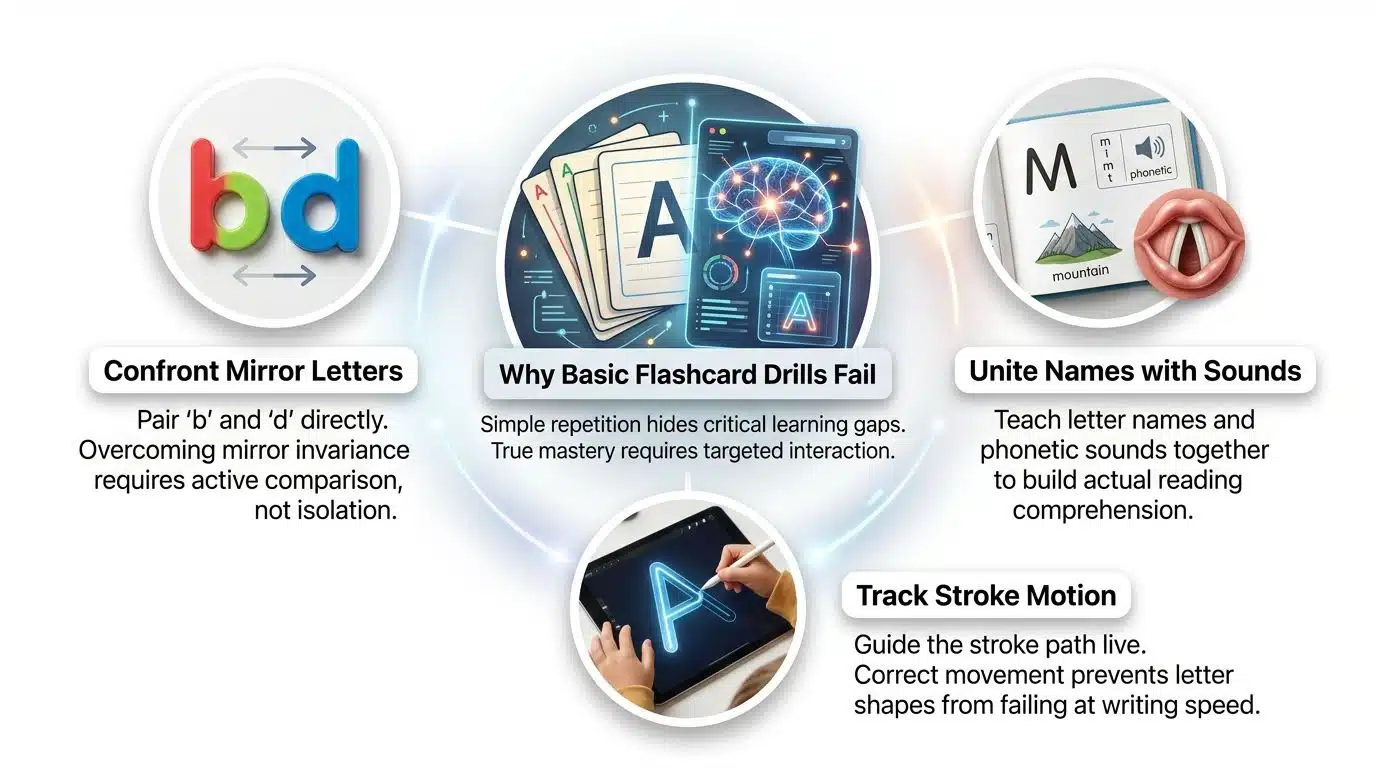
When we started building, we assumed our job was to put flashcards on a screen. That assumption broke on three specific problems.
B and D
This is the one every parent asks about. The two letters are the same shape, mirrored, and there is no other feature to tell them apart. There is a good reason children struggle with it. The brain has a useful ability called “mirror invariance,” which lets us recognize an object as the same object whether it faces left or right, and this works against children when they start learning letters. A cup is a cup from either side. B is not a d.
A flashcard drill actively hides this problem. Show ‘b’ on its own and a child says ‘b’ because there is nothing to confuse it with. She looks correct. She is not. The moment b and d appear on the same page, the confusion returns.
So we stopped separating them. In our tracing app, b and d are deliberately placed on screen together, and the child has to pick one and act on it. That is uncomfortable in a way a card stack never is, and it is the whole point.
Reversals of this kind stay developmentally typical until roughly age seven, so a four-year-old mixing them up is not a warning sign. It just needs the right kind of practice.
Stroke order
Watch a child copy the letter b on paper. Many of them draw the circle first, then add the line. The finished letter looks right, so the adult marking it says, “Well done.” But the child has learned a shape, not a movement, and that shape falls apart at writing speed.
Paper cannot catch this. The page only holds the result. A screen holds the whole path, so the app can stop a child who starts at the bottom or who lifts and starts the circle first and put her back on the correct start point.
This is the clearest advantage a game has over a worksheet, and it has nothing to do with animation or sound. It is simply that the game can see the process while paper only sees the product.
Letter names versus letter sounds
This one caused the most arguments on our team. C is called “see” but says /k/. W is called “double-you” and says nothing like it. A child drilled purely on names can name every letter on the chart and still be unable to read a three-letter word.
The research does not say pick one. A randomized study of preschoolers found that combined letter name and sound instruction produced better letter-sound learning than sound-only instruction. Children need both connected. Our letter screens now say the name and the sound in the same interaction, every time, and a few of our own early ideas about this turned out to be alphabet teaching myths we had absorbed without checking.
The Feature We Built and then Deleted
Early on we added a star score for tracing accuracy. Three stars for staying inside the line, one star for wobbling out. It looked motivating on paper.
It was a mistake. Children started playing the line instead of the letter. They watched the edge of the shape, chased the third star, and stopped attending to which letter they were even drawing. The scoring had quietly replaced the learning goal with a different, easier goal.
We pulled it and replaced the reward with something tied to the actual skill: the child hears the letter sound the moment the stroke is completed correctly. The reward is the letter itself, not a score attached to it. Engagement dropped slightly. Learning did not. That is a trade I would make again.
This is the trap most badly built letter apps fall into, and it is worth checking for when you look at alphabet learning games for kids. If the reward has nothing to do with the letter, the child will optimize for the reward.
What Teachers Spotted that We Did Not
We did not test only inside the office. Teachers, a school, and a parent group used early builds and sent back notes, and the most useful feedback came from people watching several children at once rather than one.
Two things came out of that. First, children who looked confident in a one-to-one session often froze in a group, because in a group nobody is quietly feeding them the next letter. That gap told us more about real letter knowledge than any score in the app did.
Second, teachers wanted the letters to come up in a different order for each child, not the same order every session. A fixed order recreates the exact problem the alphabet song creates. It is a small technical change and it matters more than most visual features.
Where Drills Still Earn their Place
I am not against repetition. I am against repeating doing a job I was never good at.
Drills are a maintenance tool, not a teaching tool. Once a child can already identify a letter out of sequence, short repeated practice keeps it sharp and speeds up recall. That is genuinely useful. The problem is starting there. Beginning with the song and the chart, then hoping recognition appears on its own, is how a child ends up like my nephew: fluent for thirty seconds a night, blank the rest of the time.
It is also worth keeping expectations sane. A meta-analysis in Reading Research Quarterly found the effects of alphabet instruction were small to moderate, with little evidence that alphabet gains transferred to early reading or spelling skills on their own. Knowing letters is a starting line, not a finish line. No app, ours included, changes that.
The Five-Minute Test You Can Run Tonight
You do not need any product to check whether your child is in the same position my nephew was in.
- Write the letters on paper and cut them apart.
- Shuffle them properly, so the order is nothing like the alphabet.
- Show one at a time. Ask what it is, then ask what sound it makes.
- Keep two piles: knows it and does not know it.
- Stop after two minutes, whatever happens. This is not a test the child should feel.
Whatever ends up in the second pile is your actual starting point. In most cases it is heavier towards the back half of the alphabet, and the child has been sailing through the song every night without anyone noticing.
Then work on those letters out of order, mixed with letters she already knows, in short bursts. Five minutes beats thirty. That is all a good letter game is doing underneath the animation.
Where My Nephew is Now
He got past the wall. Not because of an app, and not overnight. It happened because the people around him stopped asking him to sing and started asking him to point. The letters after L needed the same attention A had been getting it for a year.
If there is one thing to take from this, it is that a perfect recitation is not evidence of anything. Shuffle the cards. See what is really there.
The drill was never the problem. Doing the drill first was.