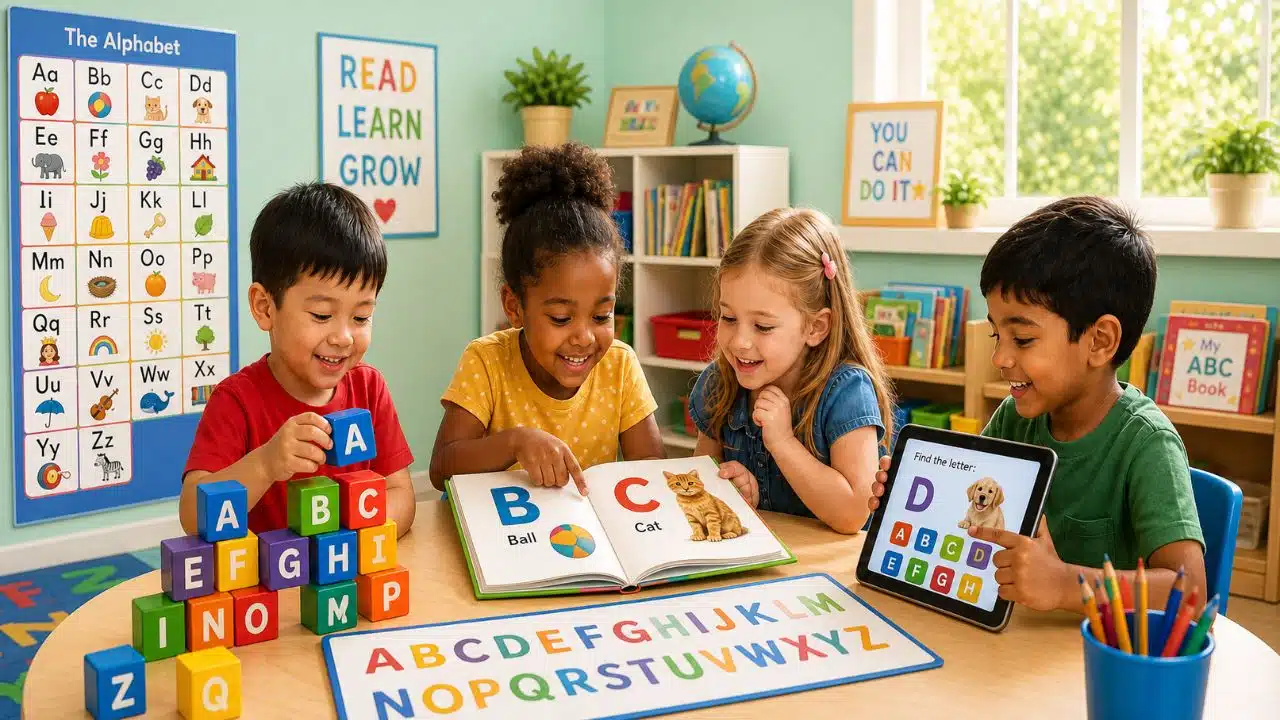
Most parents I speak to believe their child knows the alphabet, because the child can sing it. Then they open a picture book, point to a word, and ask the child to find the letter M. The singing stops. The child touches two or three wrong letters and looks away.
That gap is the whole story of alphabet recognition. Singing 26 letters in order is a memory trick. Knowing a letter when you see it, out of order, in a book, on a shop sign, or in a friend’s handwriting is a different skill. One does not give you the other.
I work in edtech, and most of my time goes into our in-house alphabet and number learning app. I sit in on test sessions, watch where children get stuck, and then we go back and change the app. A lot of what I thought was true before that job turned out to be wrong. This is what I wish someone had told me on day one.
What Alphabet Recognition Actually Means
Alphabet recognition is the ability to look at a letter and know which letter it is.
It has three small parts:
- The shape. The child can tell one letter from another letter, even when they look alike.
- The name. The child can say, “That is em,” when they see M.
- The sound. The child knows M usually says /m/, like in “mango.”
Researchers usually call this whole thing alphabet knowledge or letter knowledge. Parents call it “knowing the ABCs.” They mean roughly the same thing, but the research version includes sounds, and that part gets skipped at home more often than anything else.
There is a fourth part that people forget. A child needs to know the letter in more than one costume. Big A and small a. The A in a storybook, the A in a road sign, and the A your uncle writes by hand. Adults do this without thinking. A four-year-old does not.
The ABC Song is Doing Less than You Think
The song is fine. It gives the child the letter names and a nice rhythm, and it makes them feel good about letters. Keep it.
But a child can sing the song and still not know a single letter by sight. The song builds a sound chain, where one part pulls the next part along. Break the chain and ask for a letter from the middle, and many children have nothing to work with. We saw this in our own test sessions. Kids who could sing every letter still tapped wrong when we showed them four letters and asked for one.
Why Alphabet Recognition Matters More than Parents Expect
Here is the simple version. A child already knows a lot of spoken words. Reading is the job of matching those spoken words to marks on a page. Letters are the bridge. If the bridge is weak, nothing crosses.
Research on early reading has been saying this for a long time. When researchers look at what predicts how well a child will read and spell later, letter knowledge sits near the top of the list, along with the child’s ability to hear and play with sounds in words. It is not a small extra skill. It is one of the main things school is looking for on day one.
There is also a quieter reason, and I only understood it after watching children read out loud. Reading takes effort. A child has a small amount of that effort to spend. If half of it goes into working out whether that shape is a ‘b’ or a ‘d’, there is not much left for the word, and even less for what the sentence means. When letter recognition becomes fast and automatic, that effort gets freed up for meaning. Slow letter knowledge does not just slow reading. It makes reading feel heavy, and children avoid what feels heavy.
Children who start school knowing very few letters are not doomed. But they start behind, and the gap tends to grow instead of close, because everything after that lesson assumes the letters are already there.
What We Learned from Watching Kids Use Our App
Some of this was uncomfortable. We had to remove features we were proud of.
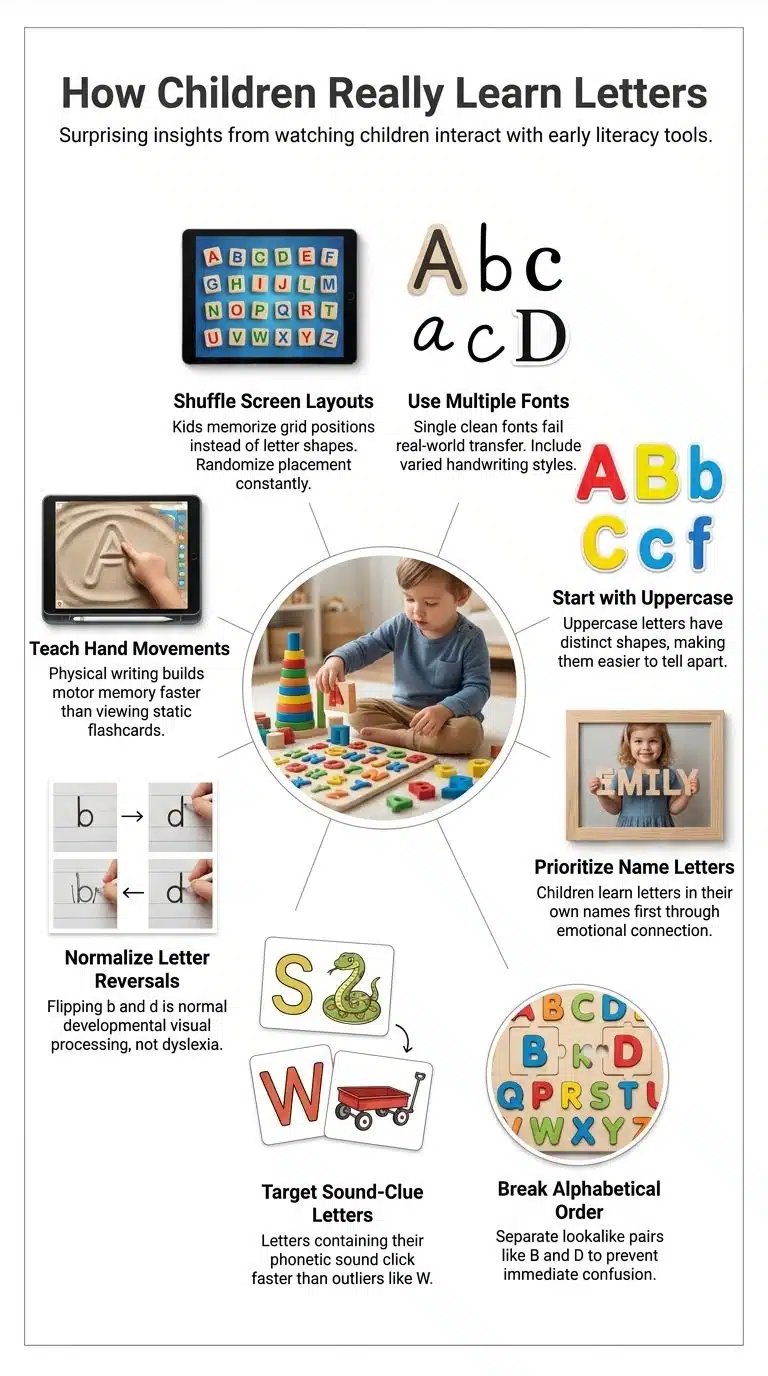
Children memorize position, not shape: Our first letter-matching screen kept the letters in the same place every time. Kids got fast scores, and we felt clever. Then we shuffled the positions and the scores fell apart. They had learned the grid, not the letters. Now everything shuffles.
One font is a trap: We built the app in one clean, rounded font. Children who scored well inside the app often failed the same letters on a printed worksheet because the printed ‘a’ has a little hook on top and the app’s ‘a’ did not. We added more letter styles, including a handwriting style. It looked messier. It worked better.
Uppercase comes easier: Big letters have more distinct shapes, and children meet them everywhere. Lowercase letters look more alike and are harder to keep apart. We stopped expecting both at the same speed.
Name letters first, always: Children learn the letters in their own names before anything else. The letter that starts their name usually has an emotional pull that no lesson can copy. We now let a parent enter the child’s name and we push those letters into the early lessons.
A to Z order is a habit, not a method: Teaching strictly A, B, C, and D means putting B and D close together, which is the worst possible pairing for a beginner. We spread them far apart. It made a visible difference.
One more thing, small but useful. Some letters are kinder than others. Letters whose name contains their sound, like B, D, and T, seem to click faster than letters like H, W, or Y, where the name gives the child no clue about the sound. If your child is stuck on W, that is not a sign of anything. W is just a bad letter.
The Letters that Cause Most of the Trouble
Almost every child gets tangled in the same small group: b, d, p, and q. Add m and w, n and u, and i and j.
The reason is not eyesight, and it is usually not a learning problem. Before reading, a child’s brain has spent years learning that an object stays the same object when you turn it around. A cup is a cup facing left or right. Then we hand them b and d, which are the same shape facing two ways, and tell them these are two different things with different sounds. That is a strange rule, and it takes time to accept.
Mixing up letters like this, and writing them backwards, is common in young children and usually fades as reading and writing get stronger, often by around age seven. On its own, it is not a sign of dyslexia. That myth is very common and it worries a lot of parents for no reason. What matters more is the bigger picture: can the child hear sounds in words, rhyme, blend simple sounds together, and remember letters over time?
The fix that helped most in our testing was not more flashcards. It was writing. When a child learns where a letter starts and which way the hand moves, the hand starts to remember what the eye keeps guessing.
Small Daily Habits that Beat Drilling
- Short and often beats long and rare. Five to ten minutes is plenty for a preschooler. Two short ones in a day are better than one long one.
- Start with the letters in the child’s name, then the letters in words they care about, like the first letter of a favorite food or a pet’s name.
- Say the sound along with the name. “This is ’em,’ and it says /m/.” Many children learn 26 names and no sounds and then get stuck at the exact moment reading begins.
- Hunt for letters in real life. Biscuit packets, doors, number plates, and the front of a bus. This is where recognition gets tested properly, because nothing out there is in a neat row.
- Let the child trace. Finger on the table, finger in flour or sand, big letters in the air. Small hands are often not ready for a pencil, but they are ready to move.
And keep pointing at words while you read together. The child does not need to read them. They just need to see that these marks are the thing your mouth is doing.
Mistakes I would Avoid Now
Trying to teach all 26 letters at once. Three or four letters, learned well, are worth more than 26 half-known ones.
Testing instead of playing. The moment a child feels checked, most of them shut down. We removed all the wrong-answer buzzer sounds from our app for this reason. A soft nudge and another try works better than a red X.
Handing over the screen and walking away. In our own testing, the same app worked far better when an adult sat there and talked. The app is a tool. It is not a teacher, and mine is no exception.
Waiting for school to handle it. School moves fast, and the child who arrives already knowing letters is treated as normal, not as advanced.
If You Are Worried
Children vary a lot, and early is not a race. Still, if a child is around six or seven and knows only a handful of letters, or struggles to hear rhymes and sounds in words, raise it with their teacher instead of waiting another year. Early help is easy help.
Final Thoughts
Alphabet recognition is not a decoration on early learning. It is the piece the rest of reading sits on, and it is one of the few early skills where a small amount of daily attention at home clearly pays off.
If you take one thing from this, make it the shift from singing to seeing. Sing the song, then close it and show your child three real letters on a page. Start with the ones in their name. Say the name and the sound together. Do it for a week and you will know exactly where your child stands, which is more than most parents find out before school starts.
Frequently Asked Questions (FAQs)
1. Should we teach capital letters or small letters first?
Start with capitals, but do not stay there. Capital shapes are easier to tell apart, so children get an early win. The catch is that almost everything they will actually read is in small letters, so introduce lowercase alongside the capitals they already know, one pair at a time.
2. My child learns two languages. Is that a problem?
It is more work, not a defect. Children handling two scripts often take longer to get fluent in each one, and that is normal. In our app we saw the most confusion when both scripts were taught in the same session, back to back. Keeping them in separate sessions helped.
3. Are letter apps actually useful or just entertainment?
Honestly, both exist, and it is hard to tell them apart from the store listing. A useful one shuffles the answers, shows letters in more than one style, teaches sounds and not just names, and does not reward random tapping. If a child can win by guessing quickly, the app is measuring speed, not learning.
4. How many letters should a five-year-old know?
There is no single number that fits every child or every school system, so treat any figure you see as a rough guide rather than a target. What tells you more than the count is whether the number is going up over a few months. A child moving from six letters to fourteen is doing fine. A child stuck at six for a year needs a closer look.