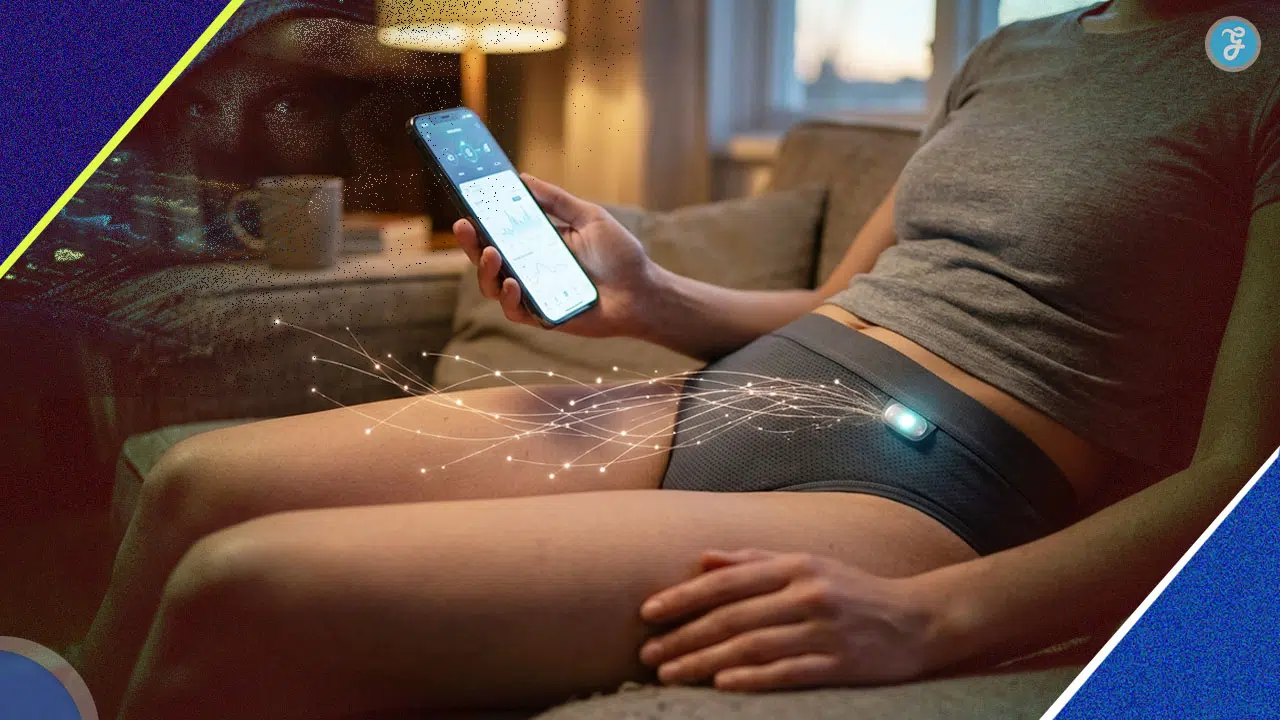
It feels like nothing at all. A second skin. Soft, breathable, almost forgettable. That is the illusion. Because stitched into that quiet comfort are sensors that do not blink, do not pause, do not forget. This is Smart Underwear. Not a gadget you can take off and place on a table, but something that lives against your body, listening in. It does not track steps. It traces you. Your breath, your core, your most private rhythms quietly converted into data points you will never fully see.
We call it empowerment. We tell ourselves this is control. That knowing more means living better. But there is a shift here, subtle and irreversible. The body is no longer felt. It is read. Interpreted. Outsourced to a dashboard. What once belonged to instinct now belongs to an interface.
The contradiction is almost absurd. We guard our phones like vaults. We encrypt conversations. We fear the leak, the hack, the unseen observer. And then we choose to wear one. Wrapped not around our devices, but around ourselves. A garment that knows more than any app ever could, quietly syncing our biology to distant servers.
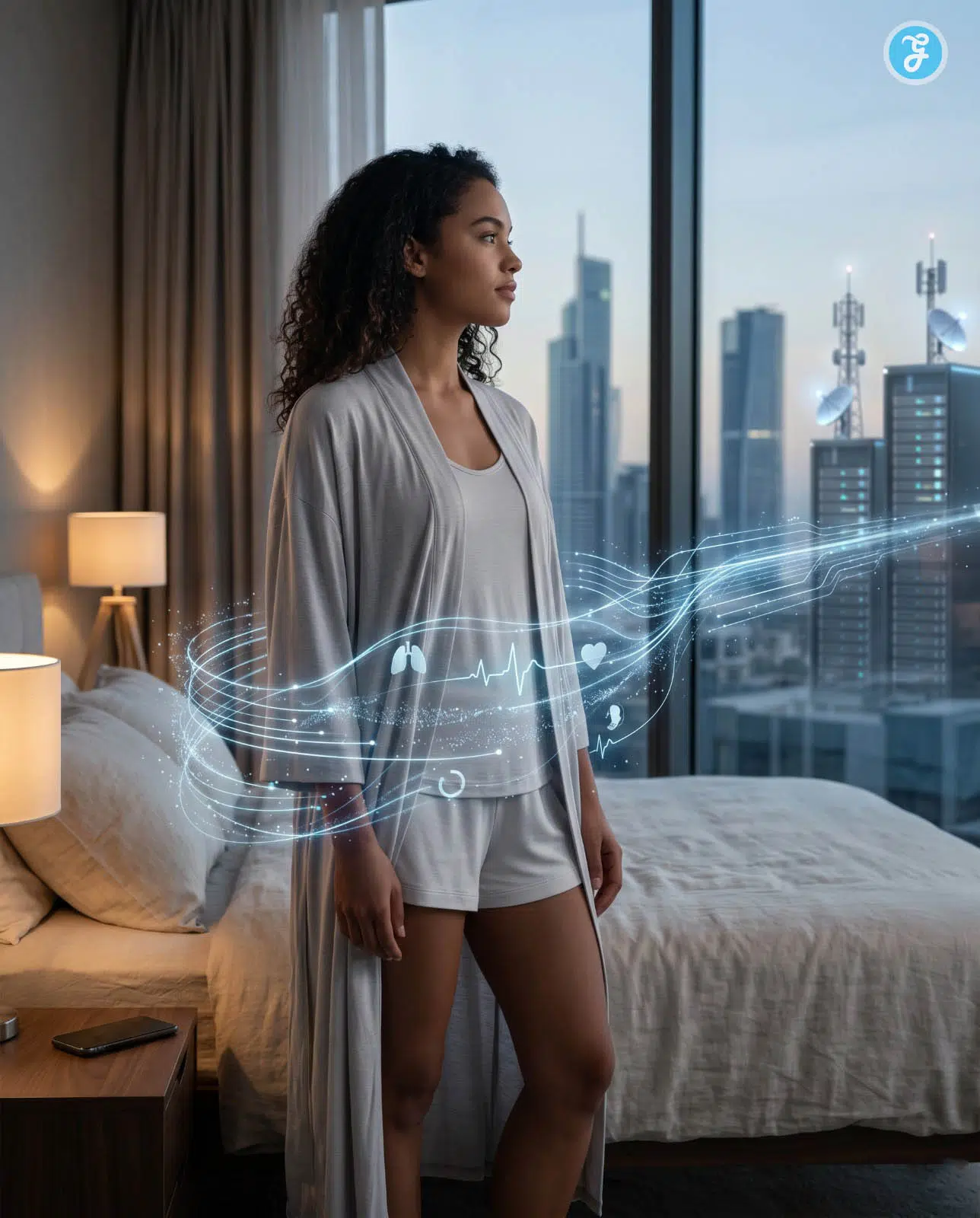
This is not a novelty. This is the direction. A culture that cannot stop measuring has finally reached the body’s core. Smart Underwear does not feel invasive. That is precisely why it is. It arrives as care, as wellness, as progress. But beneath the softness is a deeper truth. In trying to optimize every signal our bodies send, we are learning to live under constant observation. Not by others alone, but by systems we willingly invite in.
The most intimate space we have left is no longer private. It is quantified. And once something can be measured, it can be stored. Shared. Sold.
The Marketing Myth and the Reality of Data
The pitch is seductive. It promises a world where you never have to guess how you feel. Companies frame Smart Underwear as a tool for liberation. They use soft colors and clinical language to sell a future of perfect health. But behind the promise of “knowing yourself” lies a different story. It is a transition from living your life to managing your metrics.
The Sales Pitch for Your Private Parts
Marketing departments have mastered the art of the gentle sell. They target specific anxieties. For some, it is the “fertility optimizer” that promises to track basal body temperature and hormonal shifts with pinpoint accuracy. For others, it is the “posture corrector” that promises to fix a slumping back through a vibrating thread. Brands like Siren or Myant position these items as essential health companions. They use terms like “body literacy” to make the act of wearing a sensor feel like an educational choice. It is branded as empowerment.
The Shift from Feeling to Predicting
This tech changes how we experience pain and wellness. We used to be reactive. You felt a twinge in your back and you sat up straighter. You felt a cramp and you reached for a heating pad.

Now, we are moving toward predictive health. We let an app tell us when a problem is coming before we can even feel it. This sounds efficient. In practice, it creates a delay between the body and the mind. We stop checking in with ourselves. Instead, we check our phones to see if we are allowed to feel tired.
The Death of the Gut Feeling
The nudges never stop. Breathe now. Sit straight. Relax. Repeat. At first, it feels helpful. Then it becomes instruction. Then dependence. If a device tells you to calm down ten times a day, you forget how to arrive there on your own. You wait for the cue. You outsource the instinct. This is the quiet loss. Not privacy alone, but perception. Your body becomes something you observe, not inhabit. And when an algorithm becomes the first witness to your life, your own voice begins to sound uncertain.
Normalizing the Extreme Through Biometric Creep
The boundary of privacy is not fixed. It moves. Quietly, but relentlessly. There was a time when a step counting watch felt like a leap. Slightly intrusive, slightly futuristic. A small compromise for better health. That compromise has traveled. Off the wrist. Into fabric. Onto the most intimate parts of the body. This is how surveillance grows. Not through shock, but through softness.
We adjust. We rationalize. We accept. What once felt excessive now feels routine. What once felt private now feels measurable. The language shifts first. Then the comfort follows.
Skin becomes surface. Surface becomes a sensor. And without any real moment of consent, just a series of small approvals, we arrive at a new normal. The human body, in its entirety, as a continuous stream of data.
The Migration from Wrist to Core
Wearable technology did not arrive fully formed. It advanced in stages. Each step subtle enough to feel harmless. It began on the wrist. A counter. A tracker. A gentle nudge toward movement. Then it moved inward. Chest straps for athletes. More precision. More seriousness.
Now it sits at the core. Closer than ever before. This is not accidental. It is a deliberate progression. The closer the sensor moves to the body’s center, the stronger the claim of accuracy. Not estimation, but proximity. Not inference, but access.
And with that proximity comes something deeper than data. It begins to feel inescapable. A watch can be taken off. Set aside. Ignored. What rests against your core does not leave so easily. It blends into routine. Into habit. Into identity. The body is no longer just something you live in. It becomes something that is constantly being read.
Coding the Human Rhythm
The promise is simple. Better insight. Smarter health. More control. But the technology does not stop at observation. It moves into interpretation. Every breath. Every shift in posture. Every moment of restlessness. Captured, processed, and translated into patterns. Patterns you did not ask to see, but are now expected to respond to.
This is where the shift happens. From tracking to shaping. A vibration signals correction. A notification suggests adjustment. Sit straighter. Breathe deeper. Move now. It feels like assistance. It behaves like instruction. Over time, a loop forms. You act. The system responds. You adjust. The system refines.
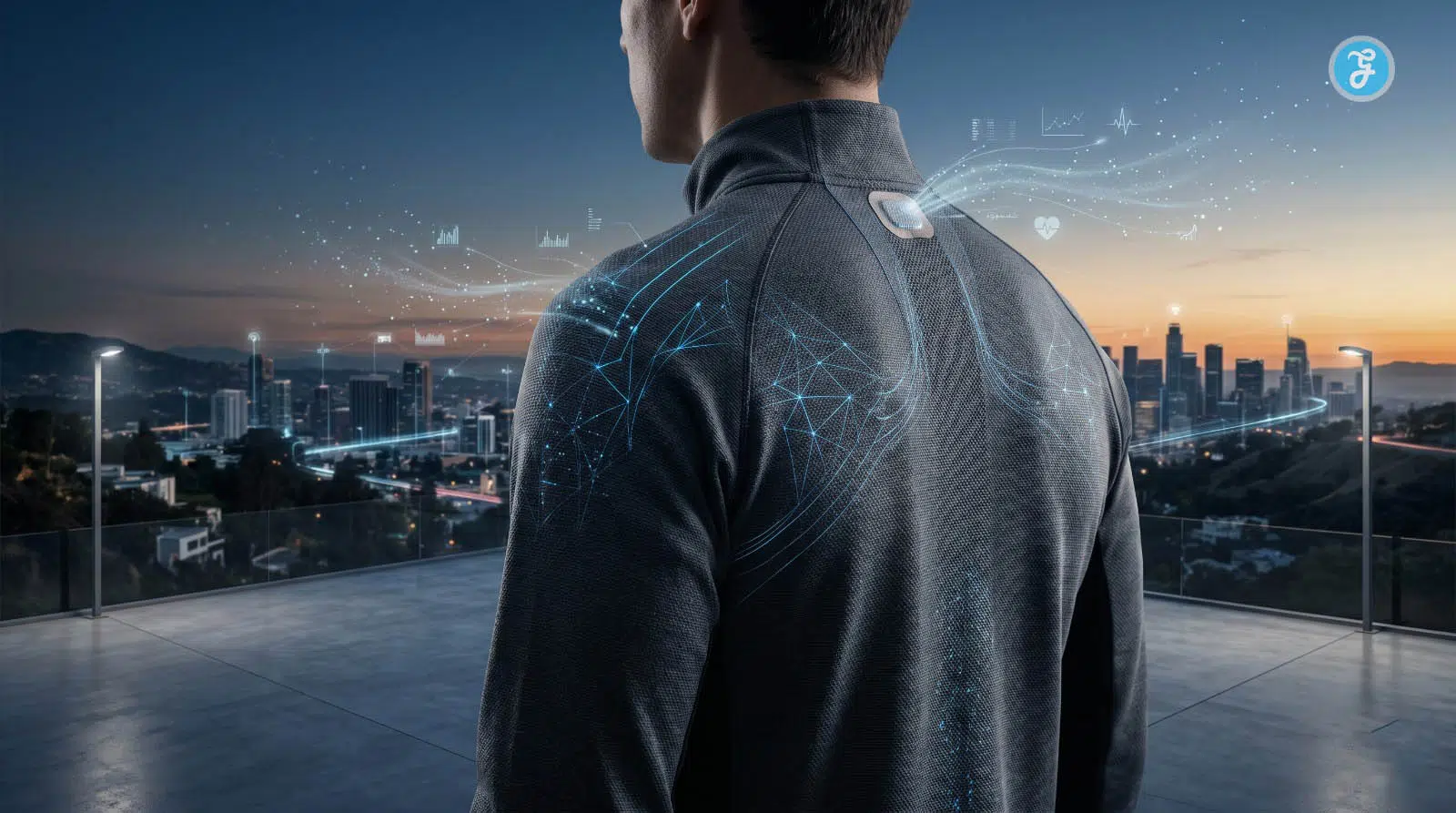
Gradually, your natural rhythm is no longer something you trust. It becomes something you verify. Something you optimize. Instinct gives way to programming. Experience gives way to metrics. The body is no longer simply lived. It is managed.
The Players in the Intimate Space
This shift is not theoretical. It is already unfolding, quietly and at scale. Myant is embedding sensors directly into fabric, turning clothing itself into a computing surface. Its Skiin line offers continuous, passive monitoring designed to blend effortlessly into everyday life. Siren focuses on prevention, using temperature sensing garments to detect early signs of injury, particularly for vulnerable patients. Chronolife goes further, integrating multiple physiological signals into a single stream, creating a layered and persistent view of the body in motion.
These are not just garments. They are infrastructures. Each fiber carries information. Each layer functions as a node. Together, they form a system that does not switch off when you do. The experience is designed to feel frictionless. Invisible. Even comforting. And that is precisely what makes it powerful. When surveillance feels natural, it stops being questioned. When it feels like care, it becomes something we defend.
Beyond the Fabric: The Tech Beneath the Surface
The engineering behind these garments is far more than a gimmick. It is a quiet revolution in materials science that turns cotton and lace into a medical grade laboratory.
- Clinical Accuracy: Unlike the light sensors on a watch, these garments use ECG sensors knitted into the waistband for hospital grade heart monitoring.
- Friction Power: Future prototypes skip batteries entirely, using nanogenerators that turn your body heat and movement into electricity.
- Conductive Threads: The “intelligence” comes from silver coated yarns and liquid metal inks designed to survive dozens of industrial wash cycles.
- Active Therapy: Some intimate wearables go beyond watching, using micro vibrations to treat chronic pain and strengthen core muscles.
- Metabolic Mapping: Recent breakthroughs at the University of Maryland include sensors that track gut microbiome activity by measuring hydrogen levels in real time. This is the first objective way to map internal metabolic health directly through the fibers of your clothing.
The Data Goldmine: Who Owns Your Biology?
We treat the body as the last private territory. What happens beneath the skin feels owned. Untouched. Ours alone. But the moment biology turns into data, ownership begins to slip.
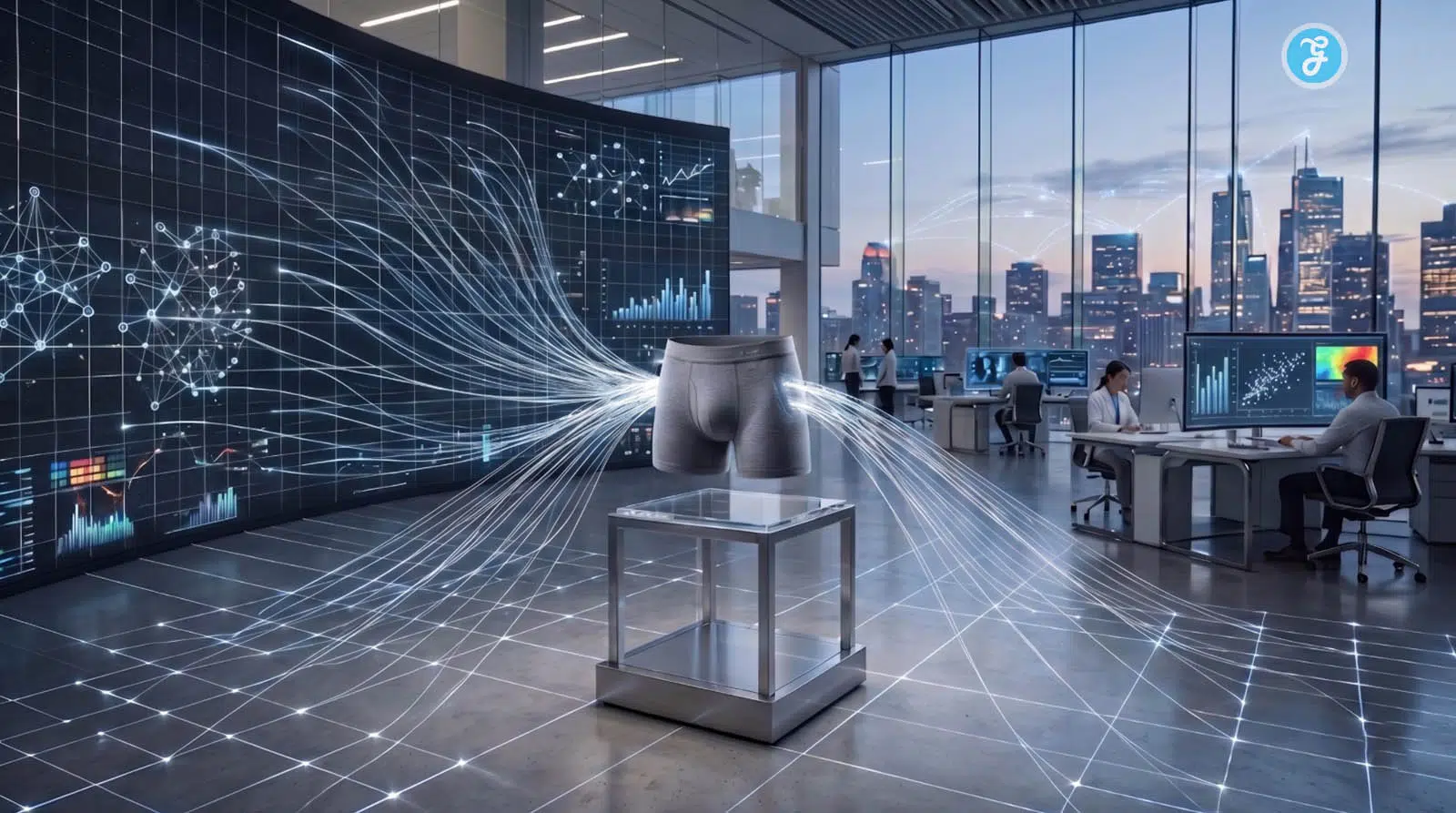
It leaves the body and enters the system. Smart Underwear does not simply store information. It extracts it. Continuously. Quietly. At scale. And in this economy, data is never neutral. It is value. It is leverage. It is currency. Your breath. Your pulse. Your rhythms. Not just signals of life, but assets. The most intimate form of capital we have ever produced.
When Control Feels Like Choice
Step outside the narrative for a moment. This is not just about Smart Underwear or even wearables. It is about a deeper shift in how power operates. Control no longer looks like force. It looks like participation. The system does not need to watch you. It needs you to watch yourself. That is the real innovation. Surveillance has been internalized. You adjust before you are told. You optimize before you are asked. What feels like self-improvement is often pre-compliance.
The body becomes both the subject and the instrument of control. Data is not just collected to understand you. It is used to shape what you become next. The more intimate the data, the more precise the influence. This is why the move to the body’s core matters. It is not about better health alone. It is about building a feedback loop where behavior, biology, and economics merge. Once that loop is complete, opting out is no longer a simple choice. It becomes a disadvantage. And that is the quiet endgame. Not coercion, but dependency. Not surveillance imposed from outside, but a system sustained from within.
The Privacy Blindspot in the Gray Zone
There is a dangerous assumption that health data is always protected. We think of the strict walls of a hospital or the confidentiality of a doctor. But consumer wearables live in a legal gray zone. In the United States, HIPAA regulations generally do not apply to the data you generate on a personal app or a sensor-laden garment. This information is not a medical record. It is a corporate asset. It exists in a space where the rules are written by the people who stand to profit. When your underwear tracks your heart rate, that data is not a secret. It is a product.
The Truth You Cannot Fake
Advertisers and insurers are tired of search histories. They know people lie to search engines. They know people curate their social media. But you cannot lie to your own nervous system. Intimate biological data is “truthful” in a way that clicks and likes can never be. It is the raw, unedited signal of your physical state. To an insurance company, knowing your real-time stress levels or your respiratory health is worth more than any questionnaire. This is the monetization of the subconscious. Your body is telling stories about your future health and your daily habits. Stories you might not even know yourself.
The Fifty Page Consent Trap
We do not read the terms. We click “accept” because we want the features. We want the “recovery score” and the “sleep insight.” This is the consent trap. Companies bury the reality of data ownership in fifty pages of dense fine print. We “unlock” our health insights by locking ourselves into a contract we do not understand. We trade the rights to our biological history for a colorful graph on a screen.
True consent requires a clear understanding of where that data goes and who eventually buys it. Instead, we are given a choice between participation and exclusion. We choose to participate. And in doing so, we hand over the last truly private thing we own.
The Sociological Cost: Living as a Digital Twin
We are becoming ghosts in our own machines. As we feed data into our garments, a digital version of our physical self begins to take shape. This twin lives in the cloud, perfect and measurable. But the more we focus on the twin, the less we inhabit the original. We are starting to view our existence through the lens of a performance review.
Living for the Score
The experience of health is being replaced by the performance of health. We no longer ask if we feel rested. We check our sleep score. If the data says we slept poorly, we feel sluggish. If the metrics say we are “optimized,” we feel capable. This is the gamification of the human body. We are chasing numbers rather than sensations. We move to close rings. We breathe to satisfy an app. As Shoshana Zuboff notes in her work on surveillance capitalism, this is the extraction of human experience for the purpose of behavioral modification. We are no longer the masters of our habits. We are the subjects of our own data streams.
The New Class Divide of Optimization
A new social hierarchy is emerging. It is built on biological transparency. In the future, “optimized” bodies might become a requirement for the professional elite. High performance roles may demand the data to prove you can handle the stress. On the other end of the scale, this tech could become a tool for coercion. Will lower insurance premiums be reserved only for those who agree to wear their sensors? Will a job offer depend on your “resilience score”? The Quantified Self movement began as a hobby for tech enthusiasts. It is quickly becoming a prerequisite for participation in a data driven society.
The Mirror of Surveillance
When every intimate rhythm is recorded, the mirror we look into is no longer made of glass. It is made of code. This constant observation changes how we perceive our own value. We begin to see ourselves as a collection of risks and efficiencies. We lose the right to be messy or unpredictable. In a world of Smart Underwear and persistent monitoring, the body is no longer a sanctuary. It is a workplace. We are constantly on the clock, performing for an audience of algorithms that never look away. The cost of this digital twin is the loss of the private, unmeasured self.
Reclaiming the Body in a Quantified World
Privacy once had shape. It was skin. It was walls. It was the quiet certainty that what happened inside the body stayed there. Now it dissolves into code. Streams. Signals. Stored somewhere you cannot see. We have reached a strange threshold. Even the most basic rhythms of being human are filtered, tracked, translated. Measured before they are even felt.

And so the question lingers. If every sensation becomes data, what remains of the self?
Where do you end, and the system begins?
The Need for a Biological Bill of Rights
This is not a call to reject technology. It can heal. It can protect. It can extend life. But it also needs limits. We need a new language for ownership. A new boundary that cannot be coded away. A biological bill of rights grounded in one simple idea. Your body is not a dataset. Smart Underwear may capture your signals, but it should not claim them. Not store them as assets. Not trade them as value. Biometric data is not just information. It is identity in its rawest form. And beyond law, there is something more urgent. A return.
To feeling without checking. To sensing without confirming. To trusting the body without waiting for permission from a screen. Health is not a graph. It is a relationship. Between mind and muscle. Between instinct and awareness. Lived, not logged.
The Digital Tether
Go back to the fabric. Soft. Breathable. Effortless. Still a second skin. But now you see it differently. Smart Underwear is no longer just a wellness tool. It is a connection point. A quiet wire linking your most private moments to a vast, invisible network. Every signal travels. Every rhythm is captured. Every pattern has value. This is the trade. Comfort for access. Insight for exposure.
It is sold as empowerment. But real power is quieter than that. It is the freedom to exist without being recorded. To feel without being measured. To live without being translated into data. At some point, the body has to belong to itself again. Not to the cloud. Not to the system. Not to the market. Just to you.