

As of January 2026, the era of the physical passport stamp is effectively over for the world’s busiest travel hubs. With the European Union’s Entry/Exit System (EES) navigating its critical rollout phase and Singapore’s Changi Airport operating a fully “token-less” clearance for millions, the border is no longer a gate you walk through—it is a network you log into.
This shift from paper booklets to biometric algorithms represents the most significant transformation in sovereignty and mobility since the League of Nations standardized passports in 1920.
The Digital Rubicon: How We Got Here
The journey to 2026 did not happen overnight. It began with the introduction of the machine-readable passport in the 1980s, followed by the e-passport (biometric chip) post-9/11. For two decades, we lived in a hybrid state: digital data trapped in a physical booklet.
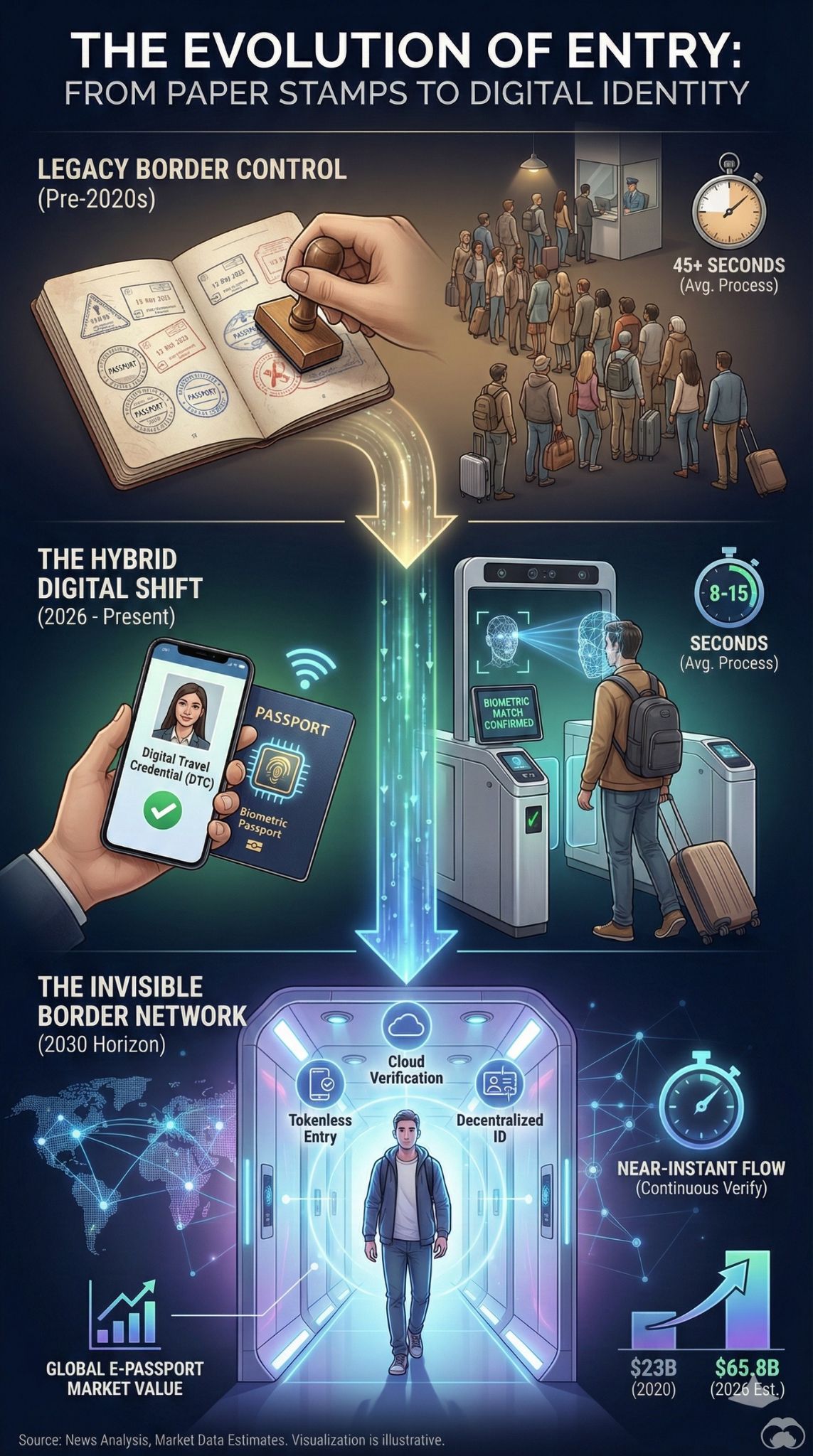
However, the post-pandemic travel surge of 2024-2025 broke the old model.1 Airports could not build physical lanes fast enough to handle the volume. The solution was the Digital Travel Credential (DTC)—a virtual identity stored on a smartphone, derived from the physical passport but capable of being sent to border authorities before the traveler even leaves their house.
By late 2025, two major geopolitical shifts cemented this reality: the mandatory enforcement of facial biometrics for non-citizens entering the U.S. (finalized Dec 2025) and the operational launch of the EU’s biometric dragnet, the EES.2
The Invisible Border – Tech Behind the Curtains
The current transformation relies on two distinct technologies converging: Biometric Corridors and the DTC.
The International Civil Aviation Organization (ICAO) defines the DTC in three types.3 As of early 2026, we are transitioning from Type 1 to Type 2.
- DTC Type 1 (The Current Standard): A digital copy on your phone, but you must still carry the physical book as a backup.4 Pilots in Finland and the Netherlands proved this could cut processing times by nearly 40%.
- DTC Type 2 (The 2026 Frontier): A standalone digital file signed by the government.5 This allows for true “wallet-based” travel, where your phone is your passport.
In Singapore, this is already reality. The “New Clearance Concept” (NCC) uses iris and facial recognition to allow passengers to clear immigration without presenting a passport or even a phone at the gate—their face is the only token required.
The Economic Engine of Identity
The business of borders is booming. The shift to digital isn’t just about security; it is a massive economic engine. The global e-passport and digital identity market has surged, driven by government contracts for biometric hardware and cloud verification services.
Key Market Statistics (2026 Estimates)
- Global E-Passport Market Value: ~$65.8 Billion7
- Identity Verification Market Value: ~$15.8 Billion8
- Processing Time Reduction: Automated lanes reduce per-passenger processing from ~45 seconds (manual) to ~8-12 seconds.
This economic shift has created a new sector of “BorderTech” giants—companies like Thales, IDEMIA, and Entrust—who now effectively manage the keys to national entry. For airports, the math is simple: faster processing means passengers spend less time in queues and more time in duty-free shops, directly boosting non-aeronautical revenue.
The “Fortress” Effect and Global Inequality
While the Global North enjoys the convenience of “walk-through” borders, the Global South faces a different reality. The rise of E-Passports creates a “Passport Apartheid.”
High-tech borders require high-tech passports. Citizens of nations that cannot afford to issue ICAO-compliant electronic passports are increasingly fenced out. Furthermore, the interoperability of these systems—where the EU’s database talks to the US’s database—creates a digital fortress.
For a traveler from a “high-risk” nation, the digital border doesn’t offer convenience; it offers pre-emptive exclusion.9 Algorithms analyze travel history, financial data, and biometrics to issue a “No Board” directive before the passenger even packs their bag. The border has moved from the airport arrival hall to the server room in the departure country.
The Operational “Transition Chaos”
We are currently living through the “messy middle.” The rollout of the EU’s Entry/Exit System (EES) in late 2025 demonstrated the friction of progress. While designed to replace stamping, the initial requirement to capture fingerprints and facial scans for first-time entrants caused significant bottlenecks at land borders like Dover and rail hubs like St Pancras.
This “Transition Chaos” highlights a critical flaw: Legacy Infrastructure. Many land and sea ports were never designed for the footprint of biometric kiosks. While Changi Airport was built for this, the Port of Dover was not. The result is a two-tier travel experience: seamless flow for air travelers, and gridlock for land/sea travelers.
Privacy and the “Forever Record”
The most profound shift is the permanence of the data. Under the new US DHS rules effective December 2026, facial images of non-citizens can be retained for up to 75 years. The EU’s EES retains data for three to five years to track “overstayers.”
This turns border crossing into a lifelong digital footprint. Privacy advocates argue this is a massive expansion of state surveillance, prone to “function creep.”10 Data collected for border control is increasingly accessed by local law enforcement for routine crime fighting. The “consent” given by a traveler is coercive—you either consent to the biometric scan, or you do not enter the country.
Comparative Analysis: The Old World vs. The New World
The following table contrasts the traditional border control model with the Digital ID ecosystem of 2026.
| Feature | Traditional Border (Pre-2020) | Digital Border (2026) |
| Primary Token | Physical Paper Booklet | Biometric Data (Face/Iris) |
| Verification Time | 30–60 seconds (Manual) | 8–15 seconds (Automated) |
| Data Storage | Local stamps in a book | Centralized Cloud Databases |
| Security Focus | Forgery detection of the book | Identity verification of the person |
| Vetting Timing | At the arrival gate | 24-72 hours Pre-departure |
| Privacy | High (Data stays on the page) | Low (Data shared across agencies) |
Expert Perspectives
The Technologist’s View:
“We are moving from a ‘show me’ document model to a ‘tell me’ data model. The phone is just the carrier; the real credential is the cryptographic key signed by the issuing state. This eliminates forgery almost entirely.” — Senior Analyst, Border Management Technologies.
The Privacy Advocate’s View:
“We are building a global panopticon disguised as a fast-pass. When you normalize the collection of face prints for tourism, you desensitize the population to mass surveillance. The risk of data breaches in these centralized ‘honeypots’ of biometric data is catastrophic.” — Digital Rights Campaigner, European Privacy Forum.
Future Outlook: The Borderless 2030?
Looking ahead, the next milestone is 2028-2030, where we expect the standardization of DTC Type 3. This would entail a fully digital identity stored on a personal device with no physical backup requirement globally.11
- Prediction 1: The Death of the Visa Sticker. By 2028, physical visa stickers will vanish entirely, replaced by Electronic Travel Authorizations (ETAs) linked directly to the digital passport.
- Prediction 2: Decentralized Identity (Web3). To counter privacy fears, we may see a shift toward “Self-Sovereign Identity” (SSI) wallets, where the user proves they are eligible to enter without sharing their raw biometric data with the host government’s central server.
- Prediction 3: Biometrics Beyond Borders. The identity token you use to cross the border will become the same token you use to rent a car, check into a hotel, and access age-restricted services, creating a seamless, albeit surveilled, “traveler lifestyle.”
Conclusion
The rise of the E-Passport and Digital ID is not merely an upgrade in travel technology; it is a fundamental rewriting of the social contract between the citizen and the state. For the frequent flyer, it promises a friction-free world where the face is the only key needed. But for the global community, it raises urgent questions about privacy, equity, and the power of data. As we move through 2026, the lines on the map remain the same, but the walls guarding them have become invisible, intelligent, and infinite.





















