Welcome to today’s deep-dive historical archive. As we peel back the layers of time, August 16 emerges as a remarkably dense date in human history. It is a day marked by towering cultural milestones, devastating political tragedies, engineering triumphs, and the birth and passing of some of the most influential figures of the modern era.
Whether you are a student of history, a cultural anthropologist at heart, or just someone curious about how the past continues to shape our present, understanding the events of this day offers profound insights. From the blood-stained streets of 1946 Calcutta to the birth of global telecommunications, and the untimely deaths of American pop culture royalty, let us journey through the definitive, global history of August 16.
The Bangalee Sphere
The Indian subcontinent, particularly the Bengal region, has witnessed some of its most transformative and tragic moments on this day. The history of this region is a complex tapestry of colonial resistance, communal struggles, and rich cultural heritage.
Historical Events
-
1946: Direct Action Day (The Great Calcutta Killings)
Arguably the most consequential event in modern Bengali history occurred on August 16, 1946. The All-India Muslim League, under the leadership of Muhammad Ali Jinnah, called for a general strike—”Direct Action Day”—to forcefully demand the creation of Pakistan. The political posturing instantly spiraled out of control in Calcutta (now Kolkata), leading to unprecedented communal riots between Hindus and Muslims. Over the next several days, thousands were slaughtered, and tens of thousands were left homeless. This tragedy completely fractured communal trust in Bengal, essentially cementing the inevitability of the 1947 Partition of India and the brutal carving up of the Bengal province itself.
-
1687: The Sutanuti Agreement
Long before it became the glittering capital of the British Raj, Kolkata was a cluster of humble villages. On this day, Job Charnock, an administrator for the English East India Company, secured permission from the Mughals to establish a factory and naval base in Sutanuti. This settlement eventually absorbed neighboring villages (Gobindapur and Kalikata) to become the megacity of Calcutta, deeply shaping the commercial and colonial history of South Asia.
-
1972 & 1975: Diplomatic Milestones for Bangladesh
The geopolitical recognition of Bangladesh was a gradual, hard-fought process. In 1972, the African nation of Uganda officially recognized the newly independent state. Exactly three years later, in 1975, Saudi Arabia and Sudan extended formal diplomatic recognition. The 1975 recognitions came on the exact day after the tragic assassination of Bangladesh’s founding father, Bangabandhu Sheikh Mujibur Rahman, marking a complex transition in the country’s international standing.
-
2019: Chalantika Slum Fire in Dhaka
In a more recent tragedy, a massive fire broke out in the Chalantika slums of Bangladesh’s capital on August 16, 2019. Over 1,200 tin-roofed homes were destroyed, leaving roughly 10,000 people instantly homeless and highlighting the ongoing urban infrastructural challenges in the rapidly growing metropolis.
Famous Births & Deaths in the Subcontinent
-
Birth – Saif Ali Khan (1970): A prominent Indian Bollywood actor and the 10th Nawab of Pataudi. He has carved out a versatile career in modern Indian cinema, winning a National Film Award and starring in critically acclaimed films and streaming series.
-
Birth – Subhadra Kumari Chauhan (1904): A legendary Indian poet whose fiercely patriotic Hindi poem Jhansi Ki Rani became a rallying cry for the Indian independence movement against British rule.
-
Death – Ramakrishna Paramahamsa (1886): One of the most influential Bengali Hindu mystics of the 19th century. His profound teachings on the fundamental unity of all religions shaped modern Hinduism. His chief disciple, Swami Vivekananda, would go on to found the Ramakrishna Math and Mission, projecting these ideals globally.
-
Death – Atal Bihari Vajpayee (2018): A three-time Prime Minister of India, celebrated poet, and towering statesman. He was instrumental in shaping India’s modern foreign policy, authorizing the Pokhran-II nuclear tests, and driving massive economic and infrastructural reforms.
-
Death – Nusrat Fateh Ali Khan (1997): Though Pakistani, his influence blankets the entire subcontinent. Known as the “Shahenshah-e-Qawwali” (The King of Kings of Qawwali), he possessed one of the greatest voices ever recorded and introduced Sufi devotional music to the global stage.
International Observances & Holidays
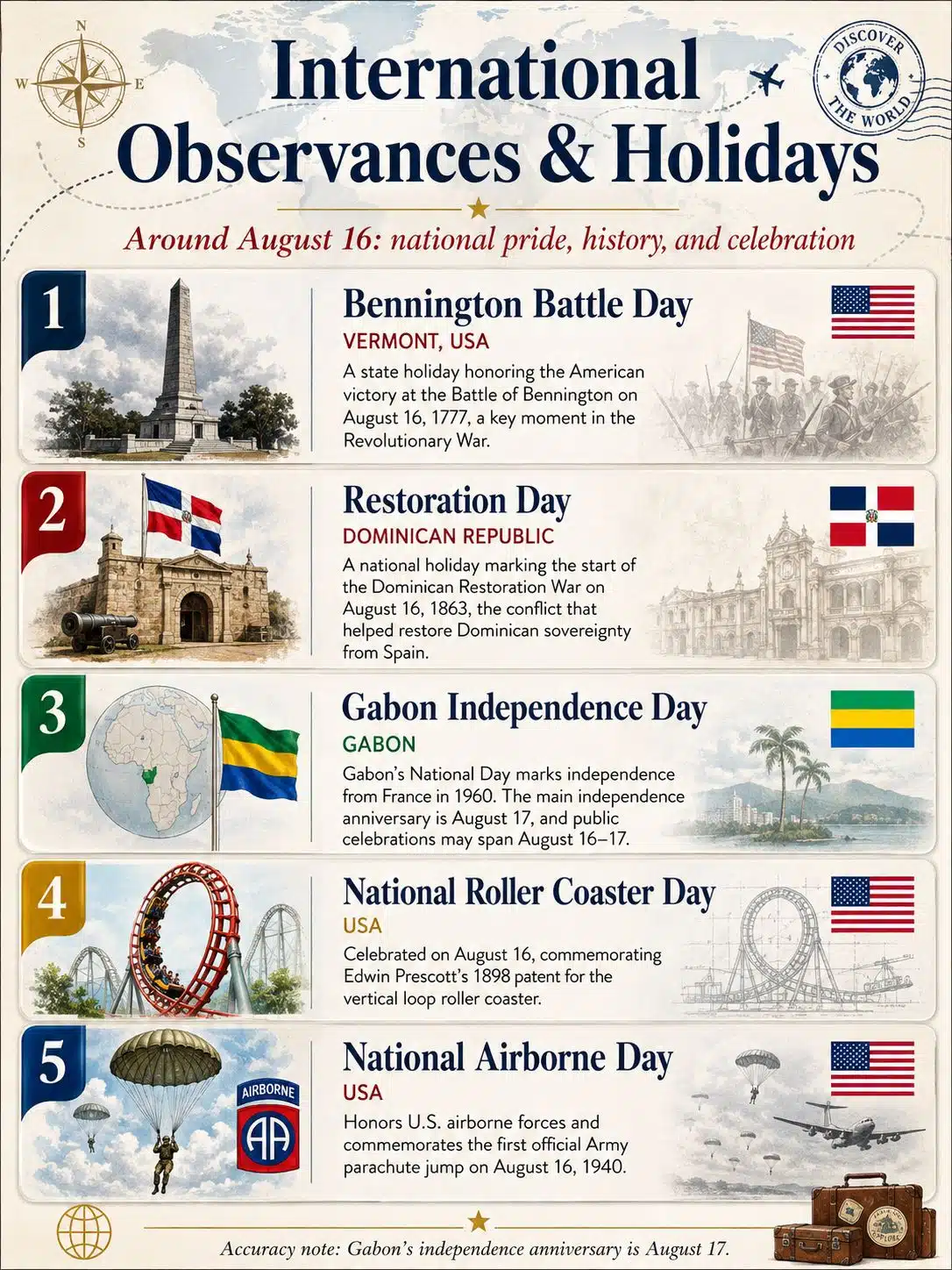
Around the world, August 16 is a day of national pride, strange historical anniversaries, and joyful celebrations.
-
Bennington Battle Day (Vermont, USA): A state holiday honoring the American victory over British forces at the Battle of Bennington in 1777, a crucial turning point in the American Revolutionary War.
-
Restoration Day (Dominican Republic): A deeply significant national holiday celebrating the start of the Dominican Restoration War in 1863. This conflict eventually freed the Caribbean nation from a brief period of Spanish re-colonization.
-
Independence Day (Gabon): The West African nation of Gabon celebrates its full independence from France, achieved in 1960.
-
National Roller Coaster Day (USA): Celebrated annually to mark the anniversary of Edwin Prescott receiving the patent for the vertical loop roller coaster in 1898, forever changing the landscape of amusement parks.
-
National Airborne Day (USA): Designated by Congress to honor the United States’ airborne forces, marking the anniversary of the first official Army parachute jump on August 16, 1940.
Global History
History is rarely isolated. As the Indian subcontinent navigated its destiny, the rest of the world was undergoing its own dramatic transformations on August 16.
United States: Innovation and Gold
-
1858 – First Transatlantic Telegraph: In a moment that fundamentally shrank the globe, Britain’s Queen Victoria sent the very first official transatlantic telegraph message to US President James Buchanan. Though the cable failed just weeks later, it proved that instantaneous intercontinental communication was possible, ushering in the telecommunications age.
-
1896 – The Klondike Gold Rush Begins: Gold was discovered in Rabbit Creek (later renamed Bonanza Creek) in the Yukon territory near the Alaskan border. The ensuing news sparked a massive stampede of over 100,000 prospectors, vastly altering the demographics, economy, and indigenous landscapes of Northwestern Canada and Alaska.
-
1954 – Sports Illustrated Debuts: The iconic American magazine hit the newsstands for the very first time. It revolutionized sports journalism by introducing high-quality color photography and in-depth, long-form reporting to athletic coverage.
-
1987 – Harmonic Convergence: The world witnessed the first globally synchronized meditation event. Spearheaded by New Age author José Argüelles, thousands gathered at sacred sites globally, believing a rare planetary alignment signaled a shift in human consciousness.
United Kingdom & Europe: Strife and Sovereignty
-
1819 – The Peterloo Massacre: In St Peter’s Field, Manchester, England, cavalry charged into a crowd of roughly 60,000 peaceful pro-democracy and anti-poverty protesters demanding parliamentary reform. The massacre resulted in an estimated 18 deaths and hundreds of brutal injuries. It became a defining moment in British working-class history, eventually leading to the founding of The Guardian newspaper and broader democratic reforms.
-
1960 – Cyprus Gains Independence: The Mediterranean island of Cyprus officially broke free from British colonial rule to become an independent republic. The transition was complex, setting up a fragile power-sharing agreement between Greek and Turkish Cypriots that would later fracture.
Australia: Indigenous Land Rights
-
1975 – Wave Hill Walk-Off Handover: In a deeply symbolic and highly emotional event, Australian Prime Minister Gough Whitlam poured red earth into the hands of Gurindji elder Vincent Lingiari. This gesture ended a grueling eight-year strike by Indigenous pastoral workers and marked the first time the Australian government legally recognized Indigenous land rights, changing the nation’s legal landscape forever.
Africa & The Rest of the World: Human Rights and Struggles
-
2012 – Marikana Massacre (South Africa): In one of the most lethal and shocking uses of force by South African security forces since the end of the apartheid era, heavily armed police opened fire on a crowd of striking platinum mine workers. The massacre resulted in 34 deaths and drew international condemnation, highlighting severe, ongoing socio-economic disparities in the country.
Notable Births & Deaths (Global)
August 16 has welcomed brilliant visionaries into the world, but it is equally infamous as a day of immense loss, particularly for American pop culture.
Famous Births
-
Madonna (1958, American): The undeniable “Queen of Pop.” Born Madonna Louise Ciccone, she revolutionized the music industry in the 1980s and 90s, taking unprecedented control over her career, pushing the boundaries of lyrical content and visual aesthetics, and becoming one of the best-selling female recording artists in history.
-
James Cameron (1954, Canadian): The visionary, uncompromising film director. He is responsible for pushing the absolute limits of special effects and box-office records with cultural juggernauts like The Terminator, Aliens, Titanic, and the Avatar franchise.
-
T. E. Lawrence (1888, British): Better known to history as “Lawrence of Arabia.” An archaeologist, military officer, and diplomat who played a vital, legendary role in the Arab Revolt against the Ottoman Empire during World War I.
-
Menachem Begin (1913, Polish-Israeli): A militant Zionist leader who evolved into a statesman, serving as the 6th Prime Minister of Israel. He famously signed the 1978 Camp David Accords with Egypt’s Anwar Sadat, for which they jointly received the Nobel Peace Prize.
-
Steve Carell (1962, American): A beloved comedic actor, producer, and writer, forever immortalized in television history for his role as the bumbling, well-intentioned Michael Scott in The Office.
-
Angela Bassett (1958, American): Academy Award-nominated actress celebrated for her powerful portrayal of historical and strong-willed women, including her iconic turn as Tina Turner in What’s Love Got to Do with It.
-
Taika Waititi (1975, New Zealand): The eccentric, Academy Award-winning filmmaker, actor, and comedian known for injecting a unique, quirky humor into indie films and massive Marvel blockbusters alike.
Famous Deaths
-
Elvis Presley (1977, American): The cultural titan and undisputed “King of Rock and Roll” passed away at his Graceland estate in Memphis, Tennessee, at the age of 42. His death from heart failure, exacerbated by heavy prescription drug use, shocked the world and triggered an outpouring of global grief rarely seen before.
-
Babe Ruth (1948, American): George Herman “Babe” Ruth Jr., arguably the greatest baseball player in history, died of throat cancer at age 53. He revolutionized the game, moving it out of the “dead-ball era” into an era of massive home runs and superstar celebrity.
-
Aretha Franklin (2018, American): The “Queen of Soul”. Possessing one of the most powerful, emotive voices of the 20th century, Franklin’s hits like “Respect” and “Chain of Fools” became anthems for the civil rights and women’s liberation movements. She died of pancreatic cancer at age 76.
-
Idi Amin (2003, Ugandan): One of modern history’s most brutal military dictators. As the President of Uganda in the 1970s, his regime was characterized by extreme human rights abuses, ethnic persecution, and the deaths of up to half a million people. He died in exile in Saudi Arabia.
-
Robert Johnson (1938, American): The pioneer of the Delta blues. Despite a brief life and a tiny catalog of recordings, his intricate guitar playing and the enduring legend that he sold his soul to the devil at a Mississippi crossroads made him a foundational figure for all of rock and roll music.
-
Bela Lugosi (1956, Hungarian-American): The iconic horror actor whose portrayal of Count Dracula in the 1931 film defined the aristocratic, terrifying vampire archetype for generations to come.
“Did You Know?” Trivia
Looking for the perfect dinner table conversation starter? August 16 has some of the most bizarre and intriguing footnotes in history.
-
The Day the Music (and Sports) Died: If you follow American culture, August 16 is a strangely cursed date. Three of the most towering, irreplaceable figures in 20th-century entertainment—Babe Ruth (1948), Elvis Presley (1977), and Aretha Franklin (2018)—all drew their final breaths on this exact day.
-
The Ghost Blimp Mystery: On August 16, 1942, during the height of WWII, a U.S. Navy L-8 blimp on a routine submarine-hunting patrol drifted inland and crashed into a street in Daly City, California. When baffled rescuers approached the completely intact gondola, they found the radio working, the parachutes untouched, and the door open—but both pilots had vanished into thin air. They were never found, and the mystery remains entirely unsolved.
-
A Fatal Pitch in Baseball: In a grim piece of sports trivia, on this day in 1920, Cleveland Indians shortstop Ray Chapman was hit in the head by a pitch thrown by the Yankees’ Carl Mays. Chapman tragically died the following day. To this day, he remains the only Major League Baseball player in history to die from an injury directly sustained on the field.
-
The Dawn of the Talkie Cartoon: Did you know that August 16, 1930, saw the release of the world’s very first colored cartoon with synchronized sound? Produced by Ub Iwerks (Mickey Mouse’s co-creator), the six-minute short was called Flip the Frog – Fiddlesticks.
Quote of the Day
To reflect on the incredible depth of human ambition and the weight of history witnessed on this day, we look to a man born on August 16, 1888:
“All men dream, but not equally. Those who dream by the dusty recesses of the night awake in the day to find that it was vanity: but the dreamers of the day are dangerous men, for they may act their dreams with open eyes, to make it possible.”
— T. E. Lawrence (Lawrence of Arabia)
Final Thoughts
From the heartbreaking communal violence of Direct Action Day in Calcutta to the triumphant first telegraph connecting two continents, August 16 is a microcosm of the human experience. It is a day that gave the world unparalleled musical royalty like Madonna, yet took away cultural titans like Elvis Presley and Aretha Franklin.
Exploring “On This Day” history allows us to connect the dots between geography, politics, and culture, revealing how a single spin of the Earth can alter the trajectory of our global society forever. History is not just a series of dates—it is the ongoing story of us all.