
Have you ever looked at your company’s digital vaults and wondered if they are truly safe for the next decade? You are definitely not the only one feeling that pressure. I talk to leaders every week who worry about quantum computers cracking our current security, and the technical jargon makes it incredibly hard to know where to start. I am here to help you make sense of it all.
After spending years managing organizational security and researching cryptography standards, I found some highly practical ways to tackle this issue. We will explore post-quantum cryptography. Grab a cup of coffee, and let’s go through it step by step. I will show you exactly what you need to protect your digital assets.
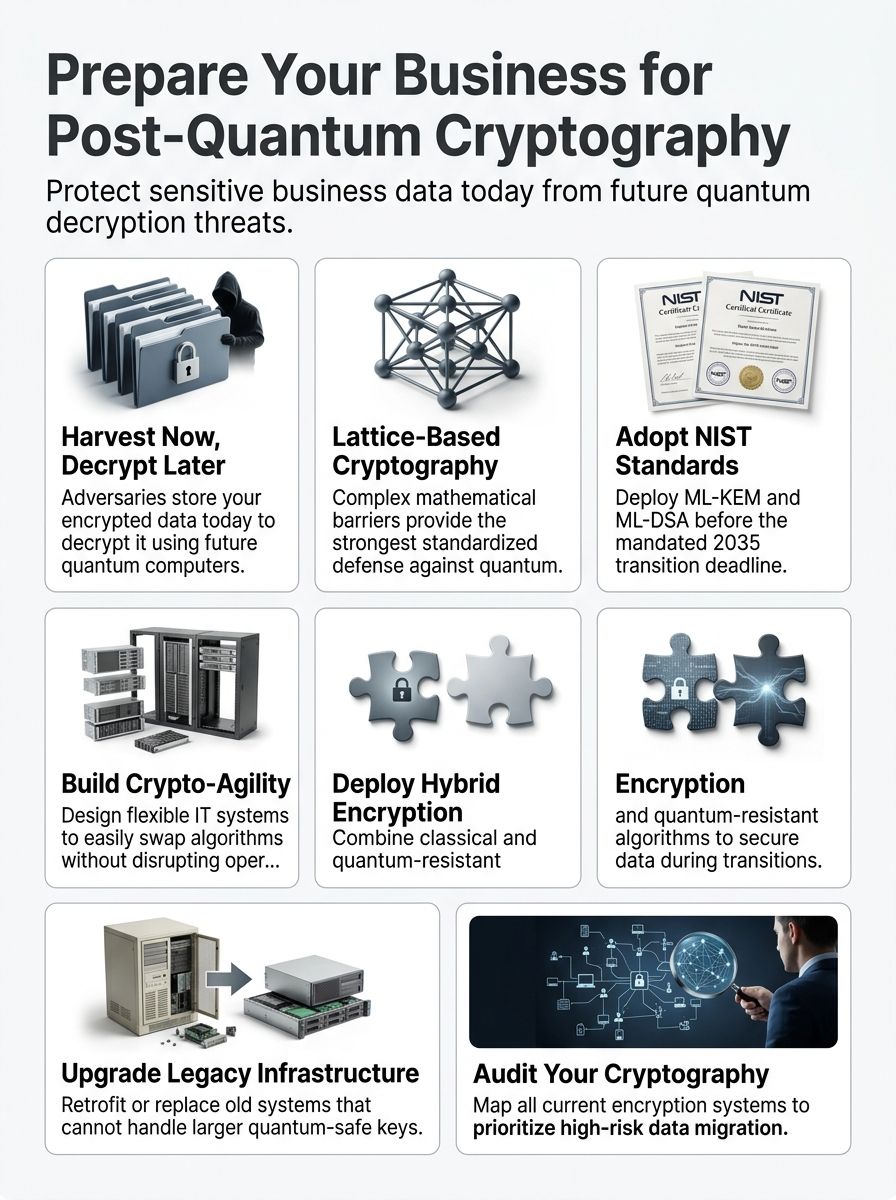
Why Post-Quantum Cryptography (PQC) Matters
Quantum computers will crack today’s encryption methods wide open, and that threat is real right now. Hackers are already collecting your encrypted data today, planning to decode it once quantum machines become powerful enough.
The threat of quantum computing to current encryption
I face a sobering reality in my role overseeing organizational security every single day. Today’s encryption relies on mathematical problems that take classical computers thousands of years to solve.
Quantum computers will completely shatter this assumption. These machines can efficiently solve the math that our public-key cryptographic algorithms depend on. This renders our current encryption vulnerable to attacks very soon.
In June 2026, President Trump signed Executive Order 14412, setting a strict December 31, 2030 deadline for US federal agencies to transition their sensitive systems to post-quantum encryption.
My team handles highly sensitive data that competitors and bad actors would love to access. Standard encryption protects that personal data now, but quantum computers change the entire landscape.
The math that keeps our secrets safe today will become obsolete tomorrow. This is exactly why that US federal deadline matters so much for private businesses, too. It sets the standard for regulatory compliance across every industry.
The “harvest now, decrypt later” risk
Adversaries are collecting encrypted data today, banking on the fact that quantum computers will crack it tomorrow. I call this the “harvest now, decrypt later” threat, and it keeps me up at night.
Hackers do not need to break your security right now. They simply grab your sensitive information, store it, and wait. Your financial records, trade secrets, and digital assets sit quietly in their vaults.
I recently read a May 2026 report from the Cloud Security Alliance that highlighted a terrifying new target for this attack. Here are the AI assets they found are most at risk:
- Training Datasets: Huge collections of sensitive personal data used to train AI models.
- Proprietary Model Weights: The core logic of expensive AI systems that companies spend millions developing.
- Internal Inference Feeds: The real-time data streams that feed into enterprise decision-making algorithms.
Current public-key cryptographic algorithms fall apart against quantum attacks, putting all of this at risk. Organizations must act now to prevent this scenario from unfolding.
I recommend shifting toward post-quantum cryptography before quantum computers arrive on the scene. Maintaining crypto-agility in your IT infrastructure lets you swap out vulnerable algorithms without tearing everything apart.
Key Post-Quantum Cryptographic Algorithms
Several mathematical approaches exist to protect your data against quantum threats. I will walk you through the main methods that security experts are betting on right now.
Lattice-based cryptography
I find lattice-based cryptography to be the most practical solution for protecting your data right now. This approach relies on mathematical grids that are so complex that even quantum computers struggle to break them.
NIST finalized their primary lattice-based algorithms in August 2024. You should know about these two specific US standards:
- FIPS 203 (ML-KEM): This standard secures your key exchange, which is the process of setting up a secure connection.
- FIPS 204 (ML-DSA): This standard handles digital signatures, proving that a document truly came from you.
Your organization gains real protection because these lattice-based methods work well with our current computer systems. They do not require massive hardware upgrades right away.
Lattice-based cryptography stops the harvest threat cold. Its mathematical complexity protects your information both now and in the future.
Multivariate cryptography
Multivariate cryptography operates on a principle that sounds simple but proves remarkably powerful. It relies on solving complex systems of multivariate equations.
I base this approach on the difficulty of cracking these mathematical puzzles, which gives it strong resistance to quantum attacks. Unlike some other cryptographic approaches, multivariate systems rely on mathematical strength that quantum computers struggle to break down.
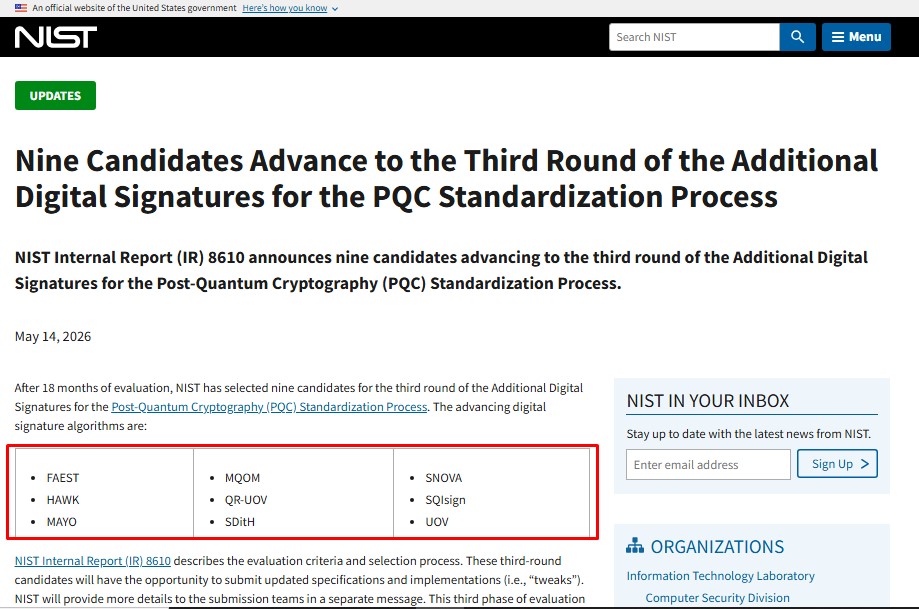
In May 2026, NIST advanced nine new digital signature candidates to a third evaluation round, heavily featuring multivariate schemes like MAYO and UOV.
My assessment of multivariate cryptography includes an important caveat. Not all implementations succeed equally, as the Rainbow signature scheme was compromised a few years ago.
The newly advanced schemes show incredible promise for creating very short digital signatures. I recommend that organizations treat multivariate cryptography as a fantastic supplementary option alongside the main lattice-based standards.
Hash-based cryptography
I want to move away from complex math puzzles and talk about something built on proven foundations. Hash-based cryptography relies on the proven security of cryptographic hash functions rather than new mathematical concepts.
NIST formalized this approach in August 2024 with a specific standard. They released FIPS 205, which is the Stateless Hash-Based Digital Signature Standard.
I love this approach for a very specific reason. Here are the main benefits of using hash-based schemes:
- Proven Security: It uses the same fundamental math we have trusted for decades.
- Algorithm Diversity: If a flaw is ever found in lattice-based math, this provides a safe backup plan.
- Small Signatures: Schemes like SPHINCS+ achieve a significant reduction in signature size, making them highly efficient.
These hash-based signatures protect brilliantly against quantum computing threats. Your organization gains real protection through these algorithms that do not depend on vulnerable math problems.
Code-based cryptography
Code-based cryptography stands out as a powerful defense against quantum threats. I find it fascinating how this approach harnesses error-correcting codes to protect your data.
The Classic McEliece scheme was created decades ago and has demonstrated remarkable resilience for over 40 years. This proves that this specific method can easily withstand the test of time.
In March 2025, NIST officially selected a code-based algorithm called HQC as the primary backup standard to ML-KEM.
Systems like BIKE and HQC give organizations multiple pathways to quantum resistance. The US government recognizes these as critical fallback options if primary standards ever fail.
I should note that code-based cryptographic systems do come with a few trade-offs. Some require a large public key size, making them less practical for quick internet transmission. Despite these challenges, code-based cryptography demonstrates genuine resistance to quantum computing threats.
Isogeny-based cryptography
I find isogeny-based cryptography fascinating because it takes a completely different mathematical path. This approach uses graphs of elliptic curves to create secure key exchanges and signatures.
The security rests on a simple but powerful idea. It is extremely hard to process these complex curves without the secret key. What makes this method stand out is that it offers incredibly small key sizes.
I always appreciate small key sizes when thinking about limited internet bandwidth. Here are the current frontrunners in this space:
- SQIsign: In May 2026, NIST advanced this digital signature algorithm to its third evaluation round.
- CSIDH: This approach continues to show potential for specific types of key exchanges.
I should note that isogeny-based cryptography did not make it into the first batch of NIST standards. Researchers continue exploring this mathematical avenue because it offers something completely distinct from other methods. The ongoing work in this field presents genuine opportunities for developing secure communications.
Understanding NIST Standards for PQC
I need to understand what NIST actually approved, because these standards shape how my organization will protect data. The standards give me a clear roadmap for which algorithms my team should adopt.
ML-KEM for encryption and key establishment
NIST standardized ML-KEM as FIPS 203 in August 2024. I find this development critical because ML-KEM relies on a mathematical challenge that quantum computers cannot easily solve.
This algorithm protects the key establishment processes that keep our digital communications safe. Organizations must grasp that ML-KEM represents the absolute future of public-key cryptography.
I recommend hybrid cryptographic deployments during your transition to ML-KEM. Here is how you can use a hybrid approach safely:
- Combine Old and New: Run your traditional encryption right alongside the new ML-KEM standard.
- Maintain Compliance: Use approved protocols that satisfy both current regulations and future requirements.
- Test Without Panic: Monitor the new post-quantum algorithms in a live environment without risking a total outage.
Adversaries collect encrypted data today to decrypt it once quantum computers become powerful enough. ML-KEM adoption prevents this scenario by making harvested data worthless to attackers. Your organization’s key establishment processes will gain incredible quantum resistance through this standard.
ML-DSA for digital signatures
I have watched ML-DSA transform from a theoretical concept into practical reality. NIST standardized this Module-Lattice-Based Digital Signature Standard as FIPS 204 back in August 2024.
Built on complex math, ML-DSA shields your organization from quantum attacks that classical digital signature schemes cannot withstand. Companies like Google already integrate ML-DSA into their security frameworks, proving that this technology works in the real world.

My team sees FIPS 204 as the foundational standard for long-term identity protection and digital trust across our entire US operation.
I recommend moving toward hybrid solutions that pair ML-DSA with your existing classical digital signature schemes. This approach lets you transition smoothly without ripping out your entire infrastructure overnight. Starting your migration now gives you breathing room to test ML-DSA performance safely.
Stateless hash-based signature schemes
Beyond ML-DSA, I want to introduce you to another powerful approach that NIST finalized in August 2024. Stateless hash-based signature schemes represent a different path forward for protecting your data.
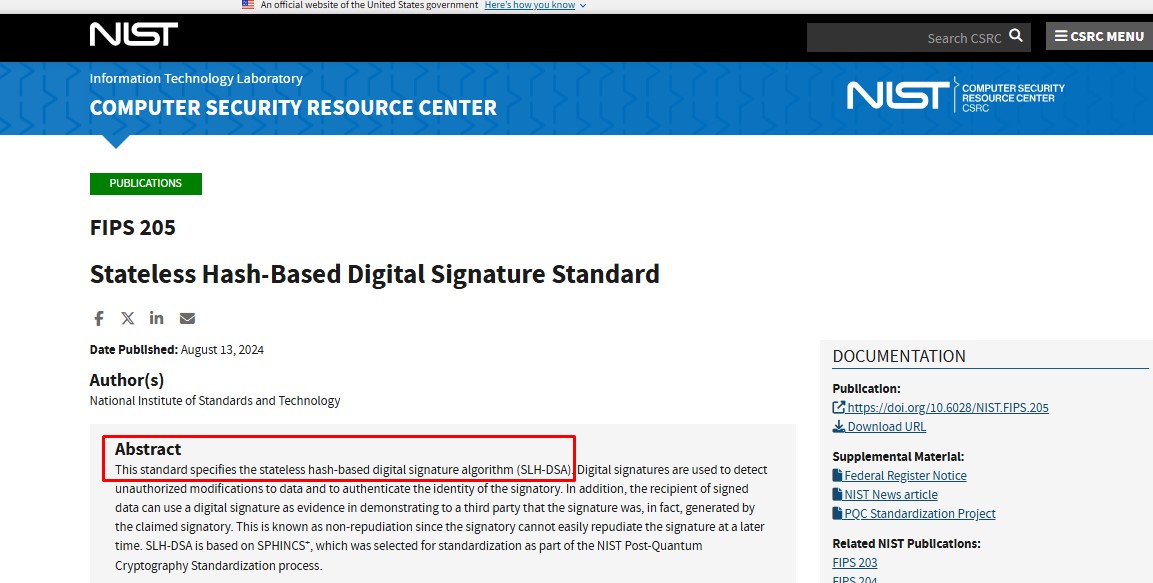
I discovered that FIPS 205 establishes the Stateless Hash-Based Digital Signature Standard, known as SLH-DSA. This scheme operates without needing to maintain a history of past signatures, which simplifies operations considerably.
I find this elegant because SPHINCS+ achieves remarkable efficiency by reducing signature sizes drastically. This matters for your organization for a few key reasons:
- Faster Processing: Smaller signatures mean your servers spend less time verifying identities.
- Reduced Storage Demands: You save money on database costs because the cryptographic proof takes up less space.
- Network Efficiency: Your digital assets travel across the internet with much less bandwidth overhead.
Your organization must eventually transition to SLH-DSA and other standardized post-quantum algorithms. What makes stateless hash-based signatures particularly attractive is their foundation in established cryptographic hash functions.
Migration to Post-Quantum Cryptography
Moving your organization to post-quantum cryptography requires careful planning and honest conversations with your technical teams. I will walk you through the practical steps that transform this shift into a manageable project.
Building crypto-agility in IT systems
I have learned that crypto-agility means building IT systems that can switch between different encryption methods without major disruptions. Think of it like having multiple locks on a door. If one lock becomes outdated, I can swap it out without replacing the entire door.
Organizations that adopt this approach gain incredible flexibility. They can transition to post-quantum cryptography much more smoothly than those stuck with rigid systems.
A 2025 State of Crypto Agility report by Sectigo revealed that only 19% of organizations feel very prepared for upcoming cryptographic shifts.
This lack of preparation is alarming because hybrid cryptographic deployments form the backbone of my migration strategy. I combine current encryption methods with post-quantum algorithms, so my systems remain secure during the transition period.
I establish a foundation of quantum-resistant cryptography through standards, and this helps me build resilient IT infrastructures. These hybrid systems also reduce operational complexity because I do not have to overhaul everything at once.
Hybrid encryption approaches
I have watched organizations struggle with a tough choice. They think they must abandon their current security systems entirely or risk exposure to quantum threats. Hybrid encryption approaches completely solve this dilemma by combining classical and post-quantum methods.
This strategy works because it layers protection. NIST standardized algorithms like ML-KEM for key establishment, giving organizations proven tools to build these hybrid systems.
I recently reviewed a pilot project at AcmeFinTech that perfectly illustrates these expectations. Here is exactly what they did to validate their hybrid approach:
- Targeted Testing: They migrated 12 customer-facing API endpoints to a hybrid configuration.
- Measured Impact: The average handshake CPU time increased by 18 percent, and connection sizes grew slightly.
- Seamless Execution: No service outages occurred, and throughput dropped just 4 percent during peak load tests.
The pilot proved hybrid encryption is operationally viable for customer applications. Organizations can replace quantum-vulnerable algorithms gradually with manageable performance impacts.
Incorporating PQC into risk management
Hybrid encryption approaches give me a foundation to build something stronger, and that foundation leads directly into my risk assessment strategy. I incorporate NIST’s post-quantum cryptography standards as the absolute bedrock of my organization’s plans.
This means I prioritize high-risk systems first. I recently read a White House report estimating a $7.1 billion cost to migrate US Federal Civilian Systems to PQC over ten years. That massive budget highlights just how seriously we must take this transition.
I apply a simple framework to prioritize my migration efforts:
- Data Lifespan: If sensitive information stays valuable for twenty years, I upgrade its protection immediately.
- System Criticality: Identity management servers and financial transaction databases always get upgraded first.
- Exposure Risk: Any system exposed directly to the public internet requires faster attention than isolated internal tools.
My risk management approach treats the data harvesting threat as a serious vulnerability. Migration itself becomes part of my daily risk strategy, rather than a separate, isolated project.
Challenges in PQC Implementation
Moving to post-quantum cryptography brings real obstacles that organizations must face head-on. I will show you exactly what stands in your way.
Performance and resource constraints
PQC algorithms demand more computational muscle than what your current systems were built to handle. I have seen organizations realize this the hard way, and it is a conversation worth having right now.
| Constraint Type | Impact on Your Operations | What This Means for Implementation |
| Larger Key Sizes | PQC algorithms require larger key sizes than traditional public-key algorithms. This directly impacts computational efficiency. | Your systems will need hardware upgrades to process these bigger keys. Storage costs increase, and network bandwidth takes a hit. |
| Computational Overhead | Increased computational overhead becomes necessary. Your servers work much harder during encryption and decryption operations. | Plan for infrastructure upgrades now. Processing times will slow unless you invest in better hardware for your data centers. |
| Signature Size Expansion | Larger key and signature sizes in PQC can affect transaction sizes and network bandwidth in traditional data transmission methods. | Your network pipes need to handle more data flowing through them simultaneously. Every digital transaction becomes heavier. |
| Hybrid Approach Trade-offs | Hybrid cryptographic solutions are needed to maintain backward compatibility. You will run both old and new systems side by side. | Your teams manage dual systems for a while. Performance dips slightly as both algorithms run in parallel. |
| Legacy System Adaptation | Existing infrastructure was not designed for PQC demands. Retrofitting old systems creates massive operational bottlenecks. | Budget for replacements and upgrades. Some legacy systems might need complete overhauls rather than simple software patches. |
I need to be completely straight with you about these constraints. They are real business considerations that will impact your bottom line. Your IT team will likely tell you that implementing PQC means spending money on better servers and faster processors.
The computational overhead is not just a technical headache, either. Real applications slow down when they switch to PQC algorithms. Storage constraints hit your wallet because larger keys mean bigger databases.
Adapting legacy systems
I have tackled the reality that most organizations still operate on systems built decades ago. These old systems present a genuine headache when shifting to post-quantum cryptography.
Legacy systems were not designed with quantum threats in mind. Ripping them out and replacing them overnight is simply not practical or financially smart for any business.
Instead, I highly recommend creating a Cryptographic Bill of Materials, or CBOM, to map out exactly what legacy systems you own before making any changes.
This approach buys time and reduces operational disruption. It matters tremendously when you are managing mission-critical applications that absolutely cannot afford downtime. Migration to post-quantum cryptography involves a long-term process that considers the massive operational complexity of adapting old hardware.
The path forward demands immense patience and strategic planning. You must be willing to work alongside technical experts who truly understand your existing infrastructure.
Operational complexities
Operational challenges pile up fast when I start shifting my organization toward post-quantum cryptography. Larger key sizes require more storage space and slower transmission speeds, which directly impacts my operational efficiency.
My teams must constantly manage hybrid systems that run both old and new encryption methods side by side. Here are the main operational hurdles we face daily:
- Hardware Refresh Cycles: Coordinating software upgrades with the physical replacement of aging servers and network routers.
- Cloud Migration Delays: Waiting for third-party cloud providers to update their platforms to support the new FIPS standards.
- Key Management Messes: Tracking which encryption methods protect which specific data sets across a massive enterprise.
Adapting legacy systems to support these new security protocols takes serious time and money. The transition timeline must stay flexible enough to absorb new developments in quantum computing while remaining realistic. These operational hurdles heavily shape how I approach practical security measures.
Practical Steps for Nontechnical Leaders
You do not need a computer science degree to lead your organization through this shift. I will walk you through the concrete actions that matter most for protecting your company’s data.
Establish cryptographic visibility in your organization
I always start by mapping out what encryption systems my organization actually uses. Most leaders discover they have absolutely no clear picture of their cryptographic landscape.
Many companies operate with encryption scattered across departments, legacy systems, and cloud platforms. Nobody maintains a comprehensive inventory of these digital assets.
I recommend using modern cryptographic discovery tools to generate a comprehensive Cryptographic Bill of Materials. In 2026, several US enterprise tools lead the market for this exact purpose:
- SandboxAQ AQtive Guard: This platform uses artificial intelligence to scan vast networks and catalog cryptographic assets automatically.
- IBM Quantum Safe Explorer: This tool excels at analyzing enterprise codebases and mainframe environments for hidden vulnerabilities.
By establishing this visibility now, I position my organization to adopt NIST’s post-quantum encryption standards smoothly. I establish clear ownership of cryptographic decisions across all departments.
Partner with experts for seamless migration
I have learned that trying to handle post-quantum cryptography migration alone is a huge mistake. It feels like trying to fix a complex car engine without knowing what a carburetor does.
Expert partnerships become my absolute lifeline here. Organizations must carefully identify and replace quantum-vulnerable algorithms. Skilled advisors step in to guide strict compliance with NIST’s timelines.
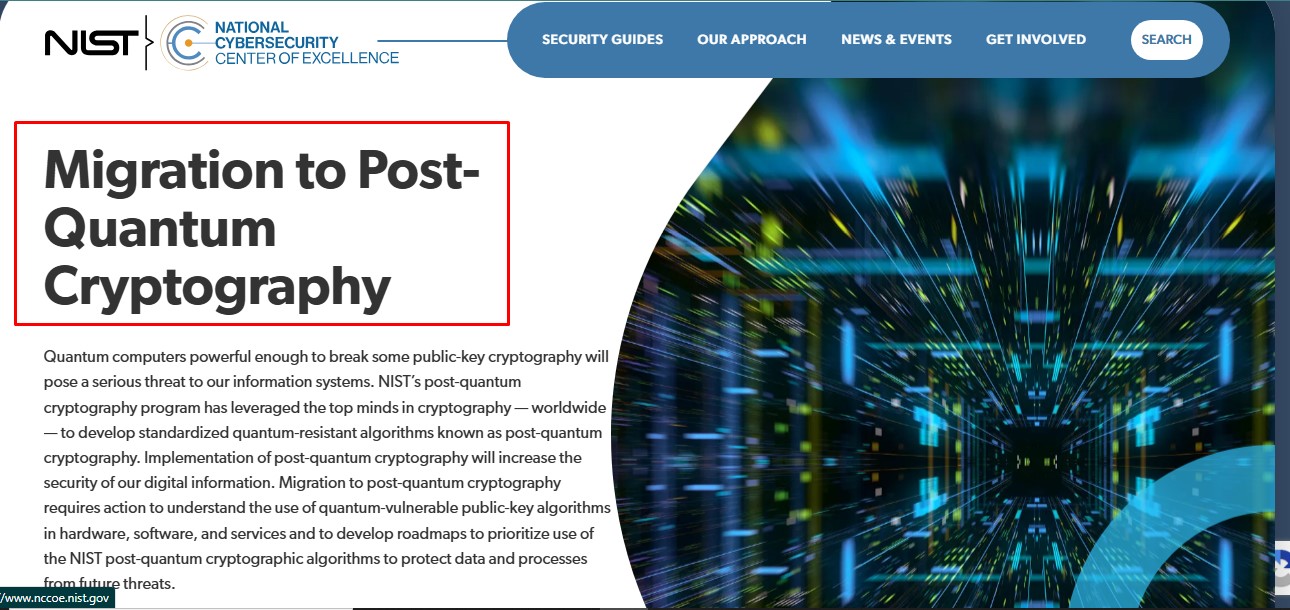
I highly recommend looking into the US National Cybersecurity Center of Excellence’s Migration to PQC project, which offers fantastic free guidance for businesses.
These specialists help me understand which systems need attention first and what resources I will actually need. They translate dense technical requirements into simple business decisions. Hybrid cryptographic deployments and crypto-agility work so much better with expert advice guiding each crucial step.
Monitor advancements in quantum computing
I track quantum computing progress closely because it directly shapes my data protection strategy. Quantum computers pose a very real threat to current encryption methods, and organizations like mine cannot afford to ignore this reality.
A March 2026 whitepaper from Google Quantum AI completely changed how I view this timeline. Here is what that breakthrough research revealed:
- Fewer Resources Needed: Quantum computers can break standard encryption using far fewer qubits than experts previously estimated.
- Faster Timelines: Google set its own internal migration deadline to 2029, much earlier than the industry standard.
- Immediate Danger: Elliptic curve cryptography, which secures most of the internet today, is highly vulnerable to these new efficiency discoveries.
I subscribe to updates from leading security organizations to stay ahead of the curve. By paying close attention to quantum computing progress now, I avoid scrambling later when threats become urgent. This proactive approach gives my organization vital breathing room.
Future-Proofing Cybersecurity with PQC
I need to build strong defenses today that will stand up against tomorrow’s quantum computers. My organization gains incredible protection by shifting to post-quantum cryptography right now.
Long-term data protection strategies
I craft long-term data protection strategies by thinking decades ahead, not just a few years. Organizations face a critical window right now, and NIST established three principal standards to address this urgency.
My approach involves assessing migration urgency by evaluating how long my systems need to stay secure. US data retention laws require certain financial and medical records to be kept securely for seven to ten years.
I handle these strict requirements using a very specific strategy:
- Immediate PQC Adoption: I apply post-quantum encryption to any database storing regulated medical or financial information.
- Strict Retention Limits: I delete old data the moment it is legally allowed, reducing my overall attack surface.
- Continuous Auditing: I run quarterly checks to ensure my long-term storage vaults meet the latest FIPS compliance standards.
Early adoption of post-quantum algorithms completely counters the data harvesting danger. I secure critical information long before quantum computers arrive. My strategy involves establishing cryptographic visibility across the entire organization.
Importance of collaboration in PQC adoption
I have learned that post-quantum cryptography migration demands far more than just technical software fixes. It requires stakeholders across the government and private industry to work together as a unified force.
Joint efforts tackle the massive technical challenges tied to the increased computational demands of PQC. No single company or government agency can shoulder this enormous financial burden alone.
Working closely with federal agencies and contributing to open-source libraries transforms this chaotic transition into a highly coordinated movement toward stronger protection.
Organizations that partner with experts and contribute to industry standards position themselves far ahead of vulnerabilities. They strengthen the entire ecosystem’s resilience against quantum threats. I see this deep collaboration as the absolute backbone of cybersecurity’s future.
Wrapping Up
Post-quantum cryptography represents far more than a simple technical checkbox on your IT roadmap. The release of the final NIST FIPS standards signals that the time for real action has absolutely arrived.
I recognize that shifting your organization’s encryption foundation feels overwhelming right now. The data harvesting threat makes this transition completely non-negotiable for your business.
Starting your migration today positions your company miles ahead of competitors who are still clinging to vulnerable legacy systems. I advise you to gain clear visibility into where encryption lives across your infrastructure first. Tap into open-source resources to experiment with these new quantum-resistant algorithms safely.
Treat this vital migration as a long-term commitment shaped by your data longevity, not a frantic sprint.
Frequently Asked Questions on Post-Quantum Cryptography
1. What is post-quantum cryptography, and why should nontechnical leaders care?
Post-quantum cryptography protects your data from future quantum computers that could break today’s encryption like snapping a twig. I’ve seen growing concern because hackers are already stealing encrypted data now to crack it later when quantum machines arrive, a strategy the cybersecurity industry calls “harvest now, decrypt later.”
2. How does post-quantum cryptography differ from regular encryption?
Regular encryption like RSA uses math problems that take traditional computers centuries to solve, but quantum computers could crack them in hours. I think of post-quantum methods as using entirely different puzzles that stump even quantum machines.
3. Do I need to change all my security systems right now for post-quantum safety?
Not today, but I recommend starting your planning now since NIST released the first post-quantum cryptography standards in August 2024. Think of it as fixing your roof before the storm hits, not during.
4. Can someone without tech skills help their business get ready for post-quantum threats?
Absolutely, and I’ve seen nontechnical leaders make a real difference by simply starting the conversation and asking the right questions. Talk with your IT team about NIST’s 2024 standards and work together to create a migration plan before quantum threats become reality.