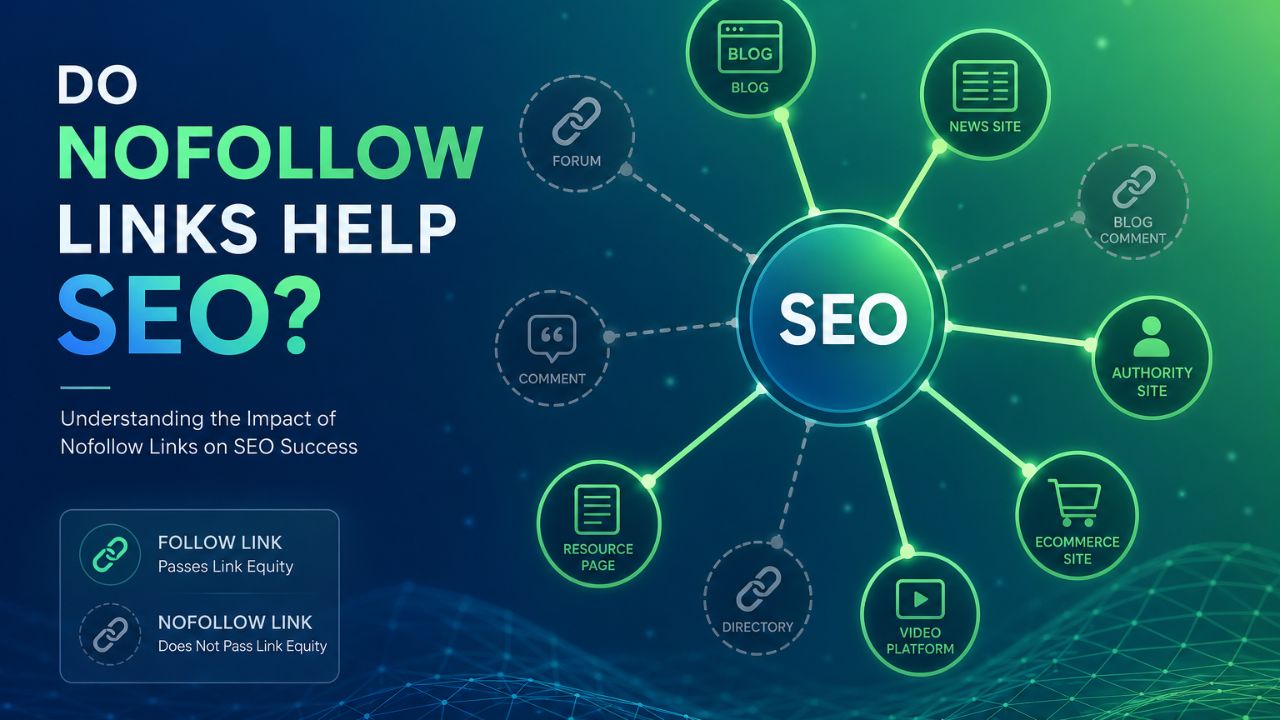
You put real work into your website. You write great content, and you earn links from other sites. So the big question matters: do nofollow links help SEO, or are they wasted effort? They help more than most people think.
Since March 2020, Google has treated nofollow links as hints instead of strict orders. That means a high-quality nofollow link can now contribute to your search rankings in the right context. Google looks at the quality and placement of each link, not just the tag attached to it.
Some site owners still dismiss these links completely. Others expect them to work magic. The truth sits in between, and it should shape your entire link-building strategy.
This guide breaks down what nofollow links really do for your site, which ones actually move the needle, and how to build a natural backlink profile that search engines trust. By the end, you’ll know exactly how to handle both dofollow and nofollow links in your SEO plan.
What Are Nofollow Links?
Nofollow links are hyperlinks that do not pass authority from one website to another. Search engines spot them through an HTML attribute called “rel=’nofollow’,” which tells web crawlers to skip passing link juice or PageRank to the destination page.
Unlike dofollow links, nofollow links don’t transfer SEO value, so they won’t boost your rankings directly. You’ll find them all over the web, from sponsored content to user-generated comments on blogs.
The nofollow link attribute signals to Google Search and other search engines that you’re not endorsing the linked page, even though you’re still sending traffic there. Regular visitors can’t tell the difference when they click, since both link types take them to the destination page just the same.
Nofollow links serve real purposes across the internet, especially for maintaining a natural link profile and protecting your site’s credibility. Many websites use the nofollow tag on affiliate links, paid ads, and untrusted sources to show they haven’t verified the content.
Want to check if a link is nofollow? It takes seconds:
- Open the page in your browser
- Right-click on the link and select “Inspect” or “Inspect Element.”
- Look at the “rel” attribute for the “nofollow” marker
A mix of both nofollow and dofollow backlinks creates a healthy, balanced link profile. That mix looks genuine to search engines and supports your overall SEO strategies.
How Do Nofollow Links Differ From Dofollow Links?
The core difference is simple: dofollow links pass authority and ranking power, while nofollow links do not. Everything else in your SEO strategy flows from that split, so here’s exactly what separates the two link types.

| Aspect | Dofollow Links | Nofollow Links |
|---|---|---|
| PageRank Transfer | Send PageRank signals to your website, enhancing your authority | Do not pass PageRank to your site, keeping authority contained |
| Authority Impact | Transfer authority directly, helping improve your search rankings | Have minimal impact on search rankings due to no authority transfer |
| Search Engine Treatment | Engines follow these links and count them as ranking signals | Engines largely ignore these links and do not transmit authority |
| HTML Attribute | Uses standard HTML without nofollow tags | Uses rel=”nofollow” attribute in the link code |
| Paid Link Compliance | Violates Google’s Webmaster Guidelines when used for paid placements | Complies with guidelines, recommended for all paid link arrangements |
| Referral Traffic | Drives visitors through link clicks to your site | Still attracts referral traffic despite lacking ranking benefits |
| Link Profile Balance | Should comprise a healthy portion of your backlink profile | Maintains natural balance when mixed with dofollow links |
| Spam Prevention | Can pass authority to low-quality sites if not carefully managed | Protects your authority by blocking links to questionable sources |
Dofollow links work like endorsements. When a respected website links to you without the nofollow tag, search engines view that connection as a vote of confidence. Your domain authority grows, your rankings improve, and your visibility expands across search results.
Paid dofollow links create serious problems, though. Google’s guidelines prohibit this practice, and violations can trigger penalties that tank your rankings. Businesses must use the nofollow attribute on all paid placements to stay compliant.
Referral traffic flows from both link types. Dofollow links bring visitors while passing ranking power, and nofollow links bring visitors without it. Many visitors who arrive through nofollow links become customers, which makes these connections valuable even without an authority transfer.
Link profile balance matters for your long-term SEO health. An imbalance between followed and nofollow links could trigger penalties from search engines and damage your page rankings. Natural websites contain a healthy mix of both types, which signals authenticity to search algorithms.
How Search Engines Treat Nofollow Links Today
Google now treats nofollow links as hints for ranking, crawling, and indexing, not as hard rules to ignore them. This is a major shift from how things worked for over a decade.
The change started on September 10, 2019. Google announced updates that changed how search engines view these links and introduced two new link attributes: rel=sponsored for paid links and rel=ugc for user-generated content.
At the same time, Google switched nofollow links from strict directives to hints for ranking purposes. Search engines no longer ignored nofollow links completely. Google’s algorithm could now consider them as suggestions rather than hard stops.
The change expanded on March 1, 2020, when Google extended the hint treatment to crawling and indexing decisions. Gary Illyes from Google explained that this happened to recover valuable ranking signals that had been lost due to overuse of nofollow.
Danny Sullivan, a Google Search Advocate, confirmed that nofollow links can provide ranking credit depending on their quality and context. Today, Google assesses whether a nofollow link contributes positively, negatively, or not at all to your site.
Do Nofollow Links Pass SEO Value?
Nofollow links don’t directly pass SEO value the way dofollow links do, but they can still help your rankings in indirect ways. For years, Google treated nofollow links as directives, meaning search engines simply ignored them.
That changed in 2020. Now search engines treat nofollow links as hints rather than hard rules. This shift matters because quality, contextually relevant nofollow links can potentially receive similar treatment to dofollow links, especially as Google focuses on high-quality content in 2026.
The data on AI search makes this even harder to dismiss. According to a 2025 Semrush study of 1,000 domains, nofollow links correlate with AI search visibility across ChatGPT, Perplexity, Google AI Overviews, and Gemini almost identically to dofollow links. The Pearson correlation came out to 0.340 for nofollow versus 0.334 for dofollow, a gap of just 0.6 percentage points. If part of your future traffic comes from AI-powered search, nofollow links appear to count there just as much as followed ones.
A controlled placement study on a mid-traffic niche forum showed the traditional shift in action. The study tracked a 30-page set where seven pages received high-visibility nofollow forum links. The results were quick:

- Within 48 hours, five of the seven pages were indexed by search engines
- Three pages showed a 6 to 10 position lift for tracked long-tail queries
- Control pages without forum links showed no indexing or ranking changes
In this controlled sample, high-visibility nofollow placements aided content discovery and gave measurable short-term ranking bumps. Placement quality and visibility matter more than the attribute itself.
High-quality nofollow backlinks deliver other real benefits too. These links won’t get any credit in the traditional sense, but they bring referral traffic and increase brand visibility.
They can also hurt when they’re spam. Majestic documented a case where spam nofollow backlinks caused ranking and traffic drops, which the site owner resolved using Google’s disavow tool. This shows nofollow links do matter for search engine optimization, even without passing authority like dofollow links.
You likely won’t hit a number one ranking with only nofollow links, because you need a natural link profile with diverse link types. Still, quality nofollow links support SEO by driving traffic, building your brand, and helping Google understand your content better.
Indirect SEO Benefits of Nofollow Links
Nofollow links do not pass direct ranking power, yet they create real value through channels that search engines recognize and reward. These links drive referral traffic, boost brand awareness, speed up content discovery, and help you build a natural link profile that Google trusts.
Brand Visibility and Recognition
Nofollow links boost your brand visibility in ways that go beyond traditional SEO value. Any form of link increases content visibility, and research shows that nofollow links from legitimate sources help establish brand authority.
Social media links, often set as nofollow, still increase brand visibility across platforms. Your brand gets discovered more often when nofollow links appear on high-visibility or industry-relevant sites.
These links signal that your content matters to real people and trusted sources. Brand mentions in high-quality nofollow links can lead to future followed backlinks, creating a snowball effect for your online presence.
Increased Referral Traffic
Nofollow links can drive significant referral traffic from high-authority sites, even without passing authority to your pages. A dog food company that gets a nofollow link from a popular pet blog may not gain ranking power, but it will attract real visitors.
These visitors come from readers who trust the source site and click through to learn more. High-quality placements on trusted sites bring people who may become paying customers, which makes referral traffic valuable for your business goals.
One two-week social media campaign proves the point. It used only nofollow links to a resource page and produced the following:

- 4,200 referral visits to the resource page
- 1.8 percent of visitors creating organic blog posts that linked back
- Two follow-up posts using dofollow editorial links
Initial nofollow exposure led to earned editorial backlinks when the content resonated with engaged audiences. Readers took the extra step to reference the work on their own platforms.
Social media platforms share nofollow links that result in referral traffic and secondary followed backlinks, according to SEMrush’s analysis. Top news sites that use nofollow as their default still drive large amounts of referral traffic to linked websites.
Content Discovery and Faster Indexing
Search engines treat nofollow links as hints for crawling and indexing since March 2020. Google’s algorithm now uses these links to discover new content faster.
Social media platforms share content with nofollow links, and this signals to Google that your material matters. Your pages get exposed to wider audiences and search crawlers through these shared links, so search engines find your new pages sooner.
High-visibility nofollow links from reputable sources can create measurable ranking improvements within 24 to 48 hours. Press releases and news mentions with nofollow links still result in faster indexing of your brand pages.
New sites benefit most during early-stage SEO efforts because both users and search crawlers discover them faster. Your content gets indexed more rapidly, which means your pages appear in search results sooner and reach your target audience faster.
A Natural and Balanced Link Profile
A natural and balanced link profile includes both dofollow and nofollow links from genuine sources. Your backlink profile should contain a mix of dofollow, nofollow, sponsored, and UGC links.
This variety shows search engines that your site earned links naturally, not through manipulation. Too many dofollow links can trigger spam signals and risk penalties from Google. A backlink profile with only followed links looks suspicious and unnatural.
Moz’s analysis recommends this balanced approach for SEO practices.

So what does “balanced” actually look like in numbers? Based on backlink-profile analysis reported by OutreachMonks and LinkResearchTools in their 2026 backlink-ratio guides, even large trusted publishers never run 100% dofollow. The Daily Mail’s link profile sits at about 89% dofollow to 11% nofollow, and Google.co.uk itself runs around 88% dofollow to 12% nofollow. For smaller sites, most SEO analysts recommend a working target of roughly 60-70% dofollow to 30-40% nofollow. That gives you a real benchmark instead of a vague instruction to “keep things natural.”
Search engines reward sites that have both types of links. An imbalance between followed and nofollow links could lead to penalties that hurt your rankings. Your link building strategy should focus on this natural mix rather than chasing only high-value dofollow links.
Quality content attracts links from diverse places, like forums, comments, and social media, and those places don’t always pass authority. A well-rounded backlink profile reflects genuine interest from other sites and shows your content truly matters to your audience.
Best Practices for Using Nofollow Links
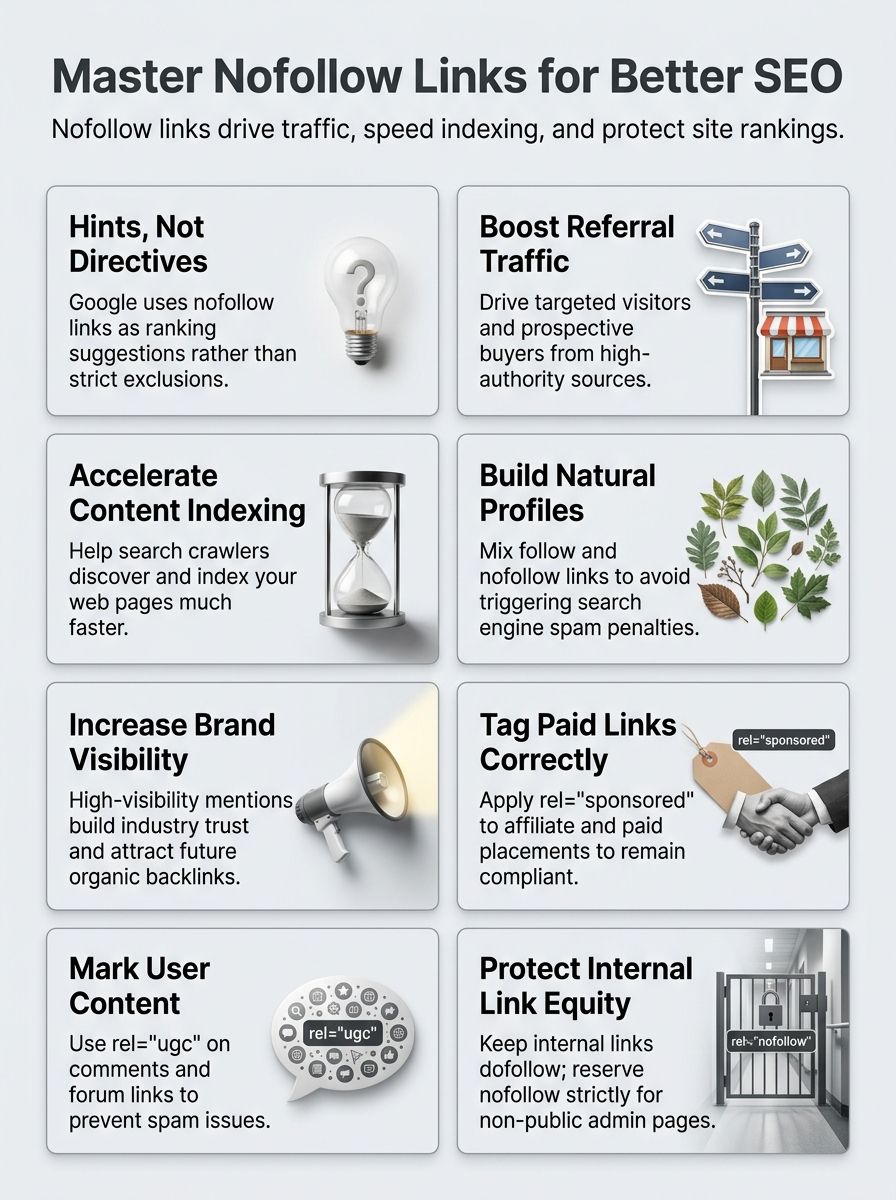
Use nofollow links correctly on paid links, user-generated content, and outbound links to tell search engines which pages you don’t endorse. Building a balanced backlink profile means you mix follow and nofollow links together, which creates a natural appearance that search engines recognize as authentic.
Proper Use of the Nofollow Attribute
Properly using nofollow links protects your site from passing authority to untrusted or low-quality pages. Since Google treats the rel=nofollow attribute as a hint, correct application matters for your SEO success.
- Mark paid links with the nofollow attribute to avoid penalties from Google that could harm your site’s ranking and traffic.
- Apply nofollow to links pointing toward spam sites or competitors to prevent passing authority to irrelevant domains.
- Tag user-generated content links with nofollow when you cannot verify the source’s trustworthiness or quality.
- Use nofollow for outbound links to low-quality accounts on social media platforms, even though nofollow links don’t directly pass SEO value.
- Implement nofollow on sponsored content and affiliate links to tell search engines these connections aren’t editorial endorsements.
- Add the nofollow attribute to links in comment sections and forum posts to keep control over your site’s authority distribution.
Handling Paid Links and User-Generated Content
Paid links and user-generated content require different nofollow strategies to keep your site safe. Google’s guidelines demand that you mark these links correctly to avoid penalties.
A simple rule-based flow for link attributes can cut review time and standardize tagging across editorial content. It works like this:
- Is the link paid? If yes, apply rel=sponsored.
- Is the content user created? If yes, use rel=ugc.
- Does the link point to an unverified third party or affiliate? If yes, apply rel=nofollow or rel=sponsored.
- Is it a trusted editorial citation? No attribute needed.

Applied across a 60-link sample, this flow cut manual reviews by 65 percent and created consistent tagging policies across content teams. It removes guesswork and helps editors tag links quickly without sacrificing compliance.
Beyond the flow itself, follow these rules:
- Apply rel=sponsored to all paid link placements. This tag tells search engines you received payment, which keeps you compliant with Google’s Webmaster Guidelines.
- Use rel=ugc for links inside comments, forums, and social media posts. This attribute shows search engines that users created the content, not your editorial team.
- Mark affiliate links with rel=sponsored or rel=nofollow. Affiliate links represent paid relationships, so Google expects you to tag them properly.
- Never use dofollow tags on paid links. Paid dofollow links violate Google’s Webmaster Guidelines and can trigger manual penalties. Google introduced rel=sponsored and rel=ugc in 2019 to clarify link intent, so use them.
- Implement nofollow on all blog comments automatically. This protects your site from spammers trying to gain rankings through comment sections.
- Train your content team to tag user-generated content correctly, document your paid link policy, and audit existing links quarterly to catch missing tags before they damage your credibility with search engines.
Should Internal Links Ever Be Nofollow?
Internal links should generally be dofollow to pass link equity and support a strong site structure. Most internal links on your website move authority from one page to another, which helps search engines understand your content hierarchy.
Certain pages are the exception. Login pages, admin areas, and pages you don’t want search engines to crawl can use nofollow tags. These exceptions protect sensitive content and keep crawlers off non-public resources.
Google itself has warned against going further than that. Per statements from Google’s Search Advocate John Mueller, reported by Search Engine Journal and Search Engine Roundtable, internal nofollow links don’t work as PageRank-sculpting tools, and blanket use is a mistake. Mueller has also noted that even sites with around 100,000 URLs usually won’t strain crawl budget on their own. In other words, internal nofollow is rarely needed just to “save crawl budget.”
An audit of a 120-page e-commerce site shows the damage overuse can cause. Developers had added rel=nofollow across internal product category links to limit crawl budget. The results:
- Organic impressions dropped 14 percent over eight weeks
- Indexable pages fell by 22 percent
- Reversing the change recovered 10 percent of impressions in the following month
Overusing internal nofollow harmed crawlability and visibility, and the rollback restored a large share of lost impressions. Internal nofollow can hurt indexing and organic visibility when misapplied across core navigation and category structures.
Final Words
So, do nofollow links help SEO? Not by passing authority directly, but they matter in ways many site owners overlook.
Google treats nofollow links as hints rather than strict commands. That means high-quality nofollow links can influence rankings based on their context and relevance.
Your backlink profile needs a natural mix of dofollow, nofollow, sponsored, and user-generated content links to avoid looking manipulative to search engines. A balanced link profile built from genuine sources strengthens your site’s credibility and drives real referral traffic.
Start treating nofollow links as assets, not obstacles, and watch how they contribute to your SEO success in 2026 and beyond.