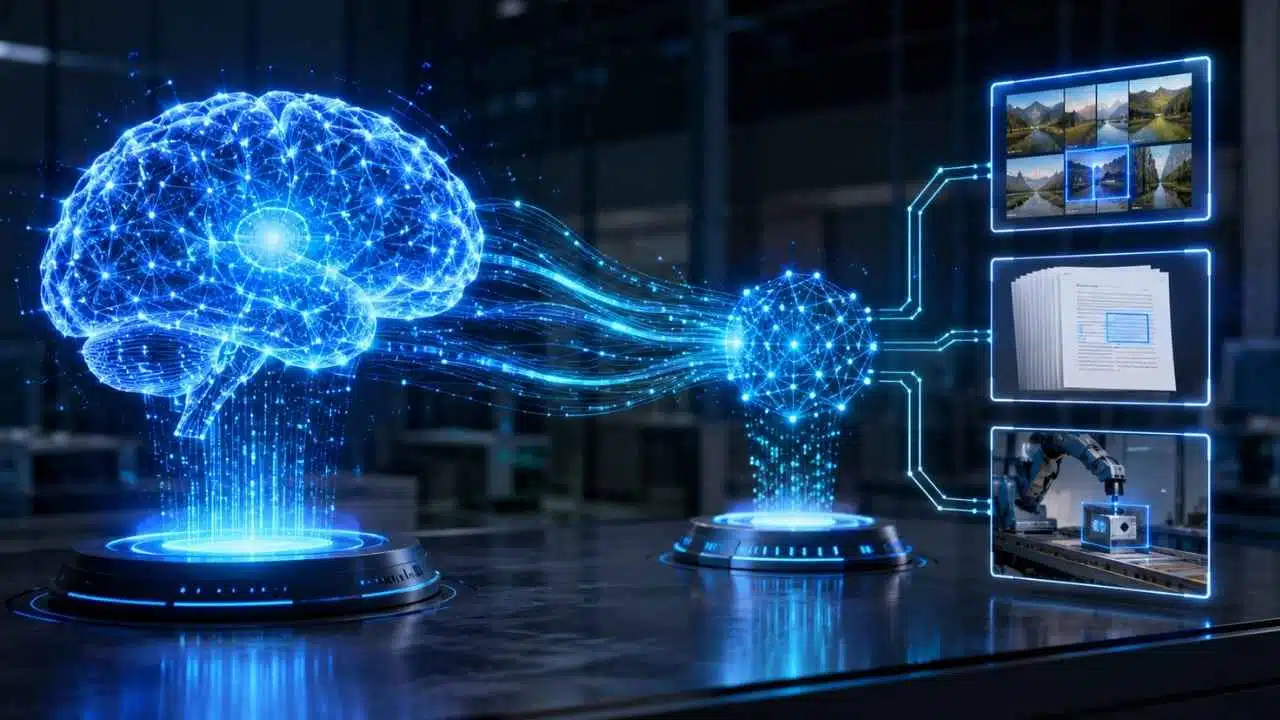
Training every AI model from scratch is expensive, slow, and often unnecessary. Transfer learning in AI gives developers a more practical starting point: take a model that has already learned useful patterns and adapt it to a related problem.
A vision model trained on a broad image collection may become the foundation for detecting damaged components on a factory line. A language model trained on general text can be adapted for document classification, support-ticket routing, information extraction, or domain-specific search.
This approach changed AI development because the most expensive learning stage no longer had to be repeated for every application. Smaller teams could build credible models with less task-specific data and compute.
The advantage is real, but it has limits. A pretrained model is useful only when its existing knowledge transfers well enough to the new task.
How Transfer Learning in AI Works
Transfer learning connects an original learning setting with a new one.
The source domain contains the data used to train the original model, while the source task describes what that model learned to do. The target domain contains the new data, and the target task is the problem the team now wants to solve.
The two settings do not need to be identical. They need enough shared structure for the original representations to remain useful.
Consider a model trained on millions of ordinary photographs. It may have learned to detect edges, textures, shapes, and object parts. Those features can still help when the new task is identifying cracks, corrosion, or missing components in industrial images.
Transfer learning is broader than fine-tuning. Knowledge may be transferred through learned features, pretrained parameters, selected layers, training examples, or small modules added to a frozen base model. Fine-tuning is simply the most common modern implementation.
The Typical Pretraining and Adaptation Process
Most projects begin with a pretrained checkpoint rather than random weights.
For a classification problem, the original task-specific output layer is often removed and replaced with a new head. The pretrained backbone is frozen, and only the new component is trained on target data.
This creates a quick baseline. If the frozen representations already separate the target classes well, further training may not be necessary.
When performance remains limited, the team can unfreeze part of the backbone and continue training with a low learning rate. The lower rate matters because aggressive updates can overwrite useful pretrained representations before the model has adapted properly.
Not every workflow replaces a classification head. A language model may continue pretraining on specialist documents, receive an adapter, fine-tune an existing decoder, or add an extraction layer. The implementation changes, but the central idea remains the same: reuse learned knowledge rather than rebuild it.
Three Ways to Adapt a Pretrained Model
Transfer learning is often discussed as one technique, but teams use several architectural patterns.
Frozen feature extraction
The simplest option keeps the pretrained model fixed and trains only a small task-specific component.
This is often the safest starting point when the target dataset is small and reasonably similar to the original data. Training is faster, memory use is lower, and fewer trainable parameters reduce the risk of overfitting.
The drawback is limited adaptability. A model trained on ordinary photographs may not provide sufficiently useful fixed features for thermal imaging, microscopy, or another sharply different visual domain.
Frozen features are best treated as a baseline, not the automatic final architecture.
Partial or full fine-tuning
Fine-tuning allows pretrained parameters to change.
A common approach is to train the new head first, then unfreeze the later layers of the model. In many convolutional networks, earlier layers capture relatively general patterns while later layers become more specific to the original task. That tendency is useful guidance, though it does not apply identically across every architecture.
Partial fine-tuning usually offers the best balance for many practical projects. It gives the model room to adapt without exposing every parameter to a small target dataset.
Full fine-tuning makes sense when the target data is large enough, the domain differs meaningfully from pretraining, or the application requires deeper behavioural change. It also demands more memory, more careful optimization, and stronger validation.
Updating the entire model because “more training must be better” is a common mistake.
Parameter-efficient fine-tuning
Large models make full fine-tuning difficult because each adapted version may require updating and storing billions of parameters.
Parameter-efficient methods train a much smaller set of weights while leaving most of the base model unchanged.
LoRA, or Low-Rank Adaptation, adds trainable low-rank updates to selected modules. The original weights stay frozen, while the smaller adaptation weights can be stored separately or merged for deployment.
This is especially useful when several teams need different versions of the same language model. One base model can support separate adapters for customer support, document extraction, classification, or internal search.
LoRA reduces the number of trainable parameters. It does not make large-model training free. Memory use, speed, and infrastructure requirements still depend on model size, precision, optimizer, sequence length, batch size, and the modules being adapted.
Why Transfer Learning Changed AI Development
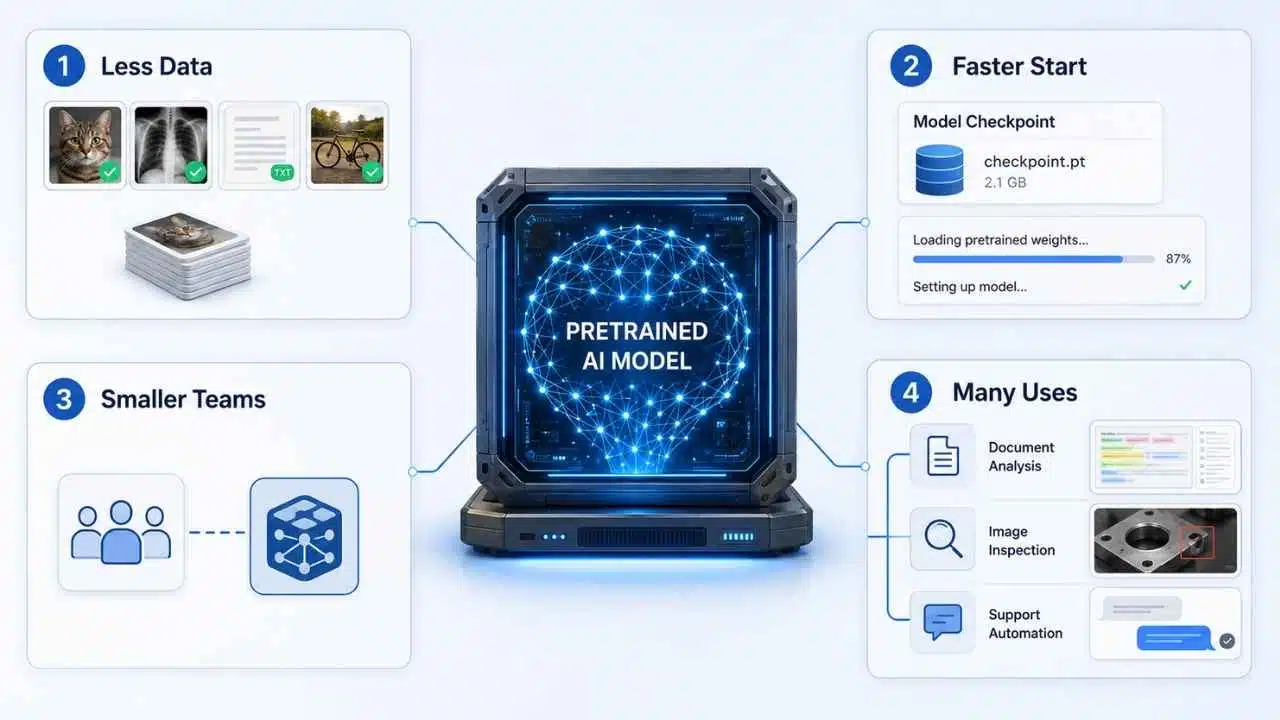
The largest change was not a single accuracy improvement. Transfer learning changed the default engineering workflow.
Teams can start with less labeled data
A model trained from random initialization must learn both general representations and the final task from the target dataset.
Transfer learning begins with some of those representations already developed. Target data can focus on the distinctions that matter for the application.
That does not mean a few examples are always enough. A speech model still needs examples of relevant accents and recording conditions. A medical model needs target data covering the equipment, patient population, and clinical setting where it will be used.
Transfer learning reduces the starting burden. It does not remove the need for representative data.
Useful baselines arrive sooner
Pretraining can require enormous computational resources. Reusing an existing checkpoint lets teams skip that stage and test the application much earlier.
A developer can often build a credible first model by loading a pretrained backbone, adding a small output component, and training it on the available target data.
That speed matters during product development. A team can discover that a use case is weak before funding a large annotation project or custom training pipeline.
Smaller teams can work with stronger models
Frameworks and model hubs now provide pretrained models for images, text, speech, audio, video, and multimodal tasks.
A team no longer needs to design every representation from the ground up. The difficult work shifts toward choosing a suitable checkpoint, preparing reliable data, controlling adaptation, and evaluating results honestly.
Model availability can also create false confidence. A popular checkpoint may be poorly matched to the target domain, too slow for deployment, restricted by its licence, or trained on data with unclear provenance.
The best-known model is not automatically the best starting point.
AI systems become easier to reuse
One pretrained base can support several products.
A company might adapt the same language model for support classification, document extraction, internal search, and compliance review. Each task can use its own head or adapter while sharing the same approved foundation.
This reduces duplicated training and can simplify governance. It also creates a new operational requirement: teams must track which base model, dataset, adapter, preprocessing pipeline, and evaluation version each product uses.
Transfer Learning in Computer Vision
Computer vision was one of the clearest early demonstrations of deep transfer learning.
Networks trained on broad image collections learn visual representations that can be reused for narrower tasks. A manufacturer might begin with a pretrained ResNet or EfficientNet backbone, replace the original classifier, and train it to recognise several defect types.
If the factory images resemble ordinary photographs, frozen features or limited fine-tuning may work well. If they come from infrared cameras, microscopes, X-ray scanners, or unusual industrial sensors, the gap from the source data becomes more serious.
That gap affects more than accuracy. Input resolution, colour channels, normalization, sensor noise, and image scale may all differ from what the pretrained model expects.
A pretrained model is still worth testing, but it should be compared with a smaller model trained from scratch. Without that baseline, the team cannot tell whether transfer actually helped.
Transfer Learning in Natural Language Processing
Transfer learning reshaped natural language processing by separating broad language learning from downstream adaptation.
BERT demonstrated that a model could first learn contextual language representations from large amounts of unlabeled text and then be fine-tuned for classification, question answering, and other tasks with relatively small architectural changes.
Modern language-model workflows extend this pattern through:
- Full fine-tuning
- LoRA and other adapter methods
- Instruction tuning
- Continued pretraining on domain text
- Task-specific heads for classification or extraction
These approaches are not interchangeable with prompting or retrieval.
Fine-tuning changes trained parameters. Prompt engineering changes the instructions supplied to the model. Retrieval-augmented generation brings external information into the model’s context at inference time.
A support assistant may use all three: an instruction-tuned model, a LoRA adapter for company-specific behaviour, and retrieval from current policy documents.
Choosing fine-tuning when the real problem is missing current information is an expensive mistake. Retrieval is often the better answer when facts change frequently.
When Transfer Learning Is Worth Using
Transfer learning deserves serious consideration when:
- Target labels are expensive or limited.
- A credible pretrained model exists for the same data type.
- The source and target problems share meaningful structure.
- Training from scratch would be operationally excessive.
- The team needs a strong baseline quickly.
- Deployment constraints allow the selected model.
The amount of adaptation should follow the evidence.
A small, closely related dataset may need only a frozen backbone. A larger dataset or stronger domain shift may justify partial fine-tuning. Full fine-tuning should earn its added cost through measurable improvement.
Where It Fails
Transfer learning can reduce performance rather than improve it. This is known as negative transfer.
It can happen when the source and target domains differ too much, when pretraining rewards the wrong distinctions, or when the model has learned shortcuts that do not survive in the new environment.
Common failures include:
- Using preprocessing that does not match the pretrained model
- Fine-tuning too aggressively on limited data
- Freezing the model despite a major domain shift
- Choosing a checkpoint because it is popular rather than relevant
- Splitting data in a way that leaks customers, devices, locations, or near-duplicate records across training and testing
- Ignoring licensing, provenance, bias, or security concerns
- Reporting transfer results without a simpler baseline
A pretrained checkpoint is a hypothesis. Evaluation must show that its knowledge helps.
A Practical Development Path
Start with the target problem, not the model catalogue.
Define the inputs, expected outputs, error costs, latency requirements, deployment hardware, and evaluation metric. Then shortlist models whose original data and task are reasonably aligned.
Build the cheapest credible baseline first:
- Load the pretrained model with its required preprocessing.
- Freeze the backbone.
- Train a small task-specific component.
- Evaluate it on a clean validation set.
- Unfreeze later layers or add an adapter if performance stalls.
- Compare the result with the frozen model and a simpler scratch-trained baseline.
- Test on data that resembles deployment.
The final step is where many projects fail. A random split may look strong while hiding duplicates or placing records from the same customer, device, patient, or location in both training and testing.
When the deployment environment varies by time, geography, hardware, or user group, the evaluation split should reflect that variation.
Final Thoughts
Transfer learning in AI changed development by making learned representations reusable. It gave teams a practical way to build on expensive pretraining instead of repeating it for every new application.
For most projects, the sensible starting point is a relevant pretrained model, frozen features, and a simple target-specific head. Fine-tune more of the model only when validation results justify the extra cost and risk.
LoRA and other parameter-efficient methods make large-model adaptation more manageable, but they do not remove the need for representative data, honest baselines, or deployment testing.
The size and reputation of the source model matter less than one question: does transferring its knowledge improve the target system under realistic conditions?