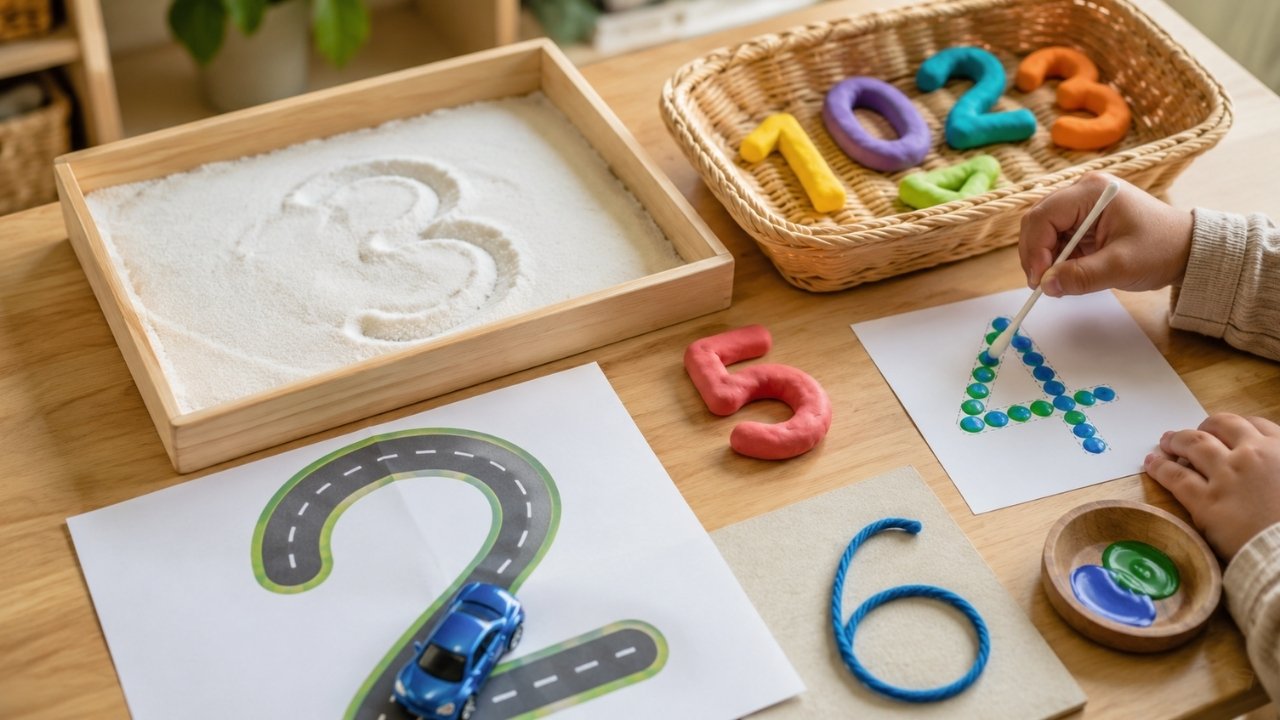
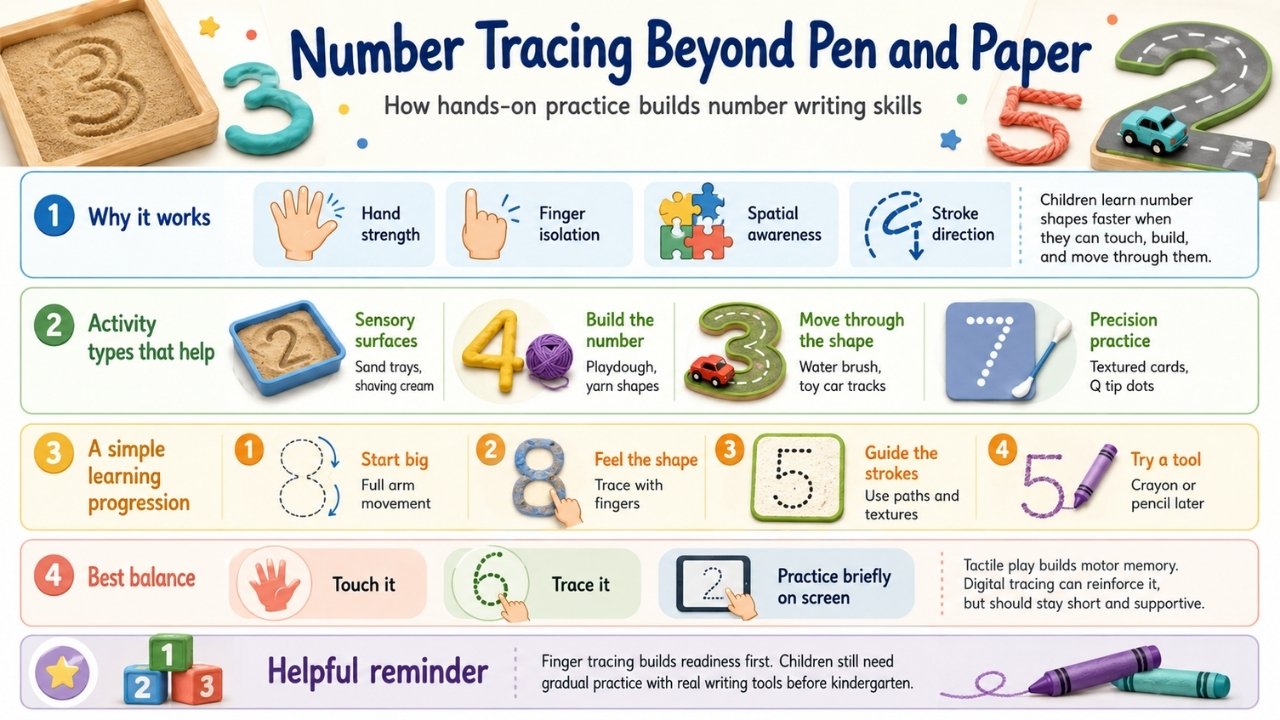
Learning to write numbers is a critical milestone in early childhood development, but traditional pencil-and-paper worksheets can quickly lead to frustration for young children. Before toddlers and preschoolers can comfortably grip a pencil, they need to build hand strength, finger independence, and spatial awareness through multi-sensory experiences.
Tactile, hands-on learning anchors character shapes into motor memory far better than static drills. Below are 8 creative number tracing activities that use sensory play to make learning numbers engaging, followed by a digital alternative for structured practice on the go.
8 Hands-On Number Tracing Activities for Preschoolers
1. Colored Sand or Salt Tray Tracing
Pouring a thin layer of brightly colored sand or salt into a shallow tray gives children immediate tactile feedback as they trace with their fingers.
-
How It Works: Fill a tray or baking sheet with colored sand or table salt. Show a number card, and ask the child to recreate the shape using their index finger. A simple shake resets the tray.
-
Key Learning Objective: Builds muscle memory through resistance while strengthening finger isolation.
Pro Tip: Place a piece of colorful paper at the bottom of the tray so the color pops through as the child traces.
2. Playdough Number Molding
Playdough offers substantial physical resistance, helping build the intrinsic hand muscles needed for future pencil control.
-
How It Works: Have the child roll playdough into long “snakes.” Guide them to bend and flatten the dough over large printed number outlines to form each character.
-
Key Learning Objective: Develops fine motor strength and spatial awareness by converting lines into physical curves and angles.
3. Shaving Cream Finger Painting
Shaving cream provides a low-pressure, high-sensory surface that makes mistake-making completely stress-free.
-
How It Works: Spread a thin layer of unscented shaving cream onto a plastic tabletop or cookie sheet. Children use their fingertips to sweep through the cream and form numbers from 0 to 9.
-
Key Learning Objective: Encourages bold, fluid arm movements and tactile exploration without fear of error.
-
Safety Note: Use sensitive-skin shaving cream or replace with whipped cream for younger toddlers who might put their fingers in their mouths.
4. Water Brush Painting on Concrete
outdoor movement turns large motor actions into fluid writing practice using basic household items.
-
How It Works: Draw large numbers on a patio or sidewalk using chalk. Give the child a thick paintbrush and a cup of water, and ask them to “paint away” the chalk by tracing over the lines with water.
-
Key Learning Objective: Engages full-arm coordination and visual tracking through large-scale motor movements.
5. Textured Sensory Flashcards
Adding physical texture to standard flashcards gives children a sensory path to follow with their fingertips.
-
How It Works: Create DIY flashcards using cardstock and materials like felt strips, yarn, sandpaper, or dried puffy paint to outline each number. Kids trace the rough surfaces while saying the number out loud.
-
Key Learning Objective: Connects tactile feedback directly to visual character recognition and verbal cues.
6. Drive-and-Trace Toy Car Tracks
Turning numbers into miniature roadways taps into imaginative play while teaching proper stroke direction.
-
How It Works: Draw large numbers formatted with dotted centerlines to look like road lanes. Children drive small toy cars along the path, following correct top-to-bottom stroke order.
-
Key Learning Objective: Reinforces correct stroke order and directional control through gamified play.
7. Q-Tip Paint Dotting
Using cotton swabs introduces early pincer grasp mechanics without the strain of holding a full-sized pencil.
-
How It Works: Print or draw numbers with dotted guidelines. Children dip a Q-tip into washable paint and dot along the guidelines to complete each number shape.
-
Key Learning Objective: Refines pincer grasp mechanics and precise visual-motor control.
8. Yarn and String Shape Formations
Working with flexible materials requires kids to manipulate soft lines into precise geometric curves.
-
How It Works: Provide pre-cut pieces of thick yarn or ribbon alongside glue sticks or clear contact paper. Children bend and stick the yarn along printed templates to assemble each digit.
-
Key Learning Objective: Enhances two-handed motor coordination and spatial planning.
A Digital Alternative: Interactive Screen-Based Practice
While physical sensory activities build physical strength and coordination, interactive mobile tools can bridge the gap toward precise stroke formation in a structured environment.
123 Magic Number Fun
A clean option in this category is 123 Magic Number Fun on Google Play, an early education app designed under the Edutorial venture. It translates multi-sensory tracing concepts into intuitive digital exercises.
-
Teacher Approved Status: Carries Google Play’s official Teacher Approved badge, signaling compliance with educational standards for age appropriateness and design safety.
-
Core Activities: Features guided number tracing from 1 through 50, interactive counting puzzles, and recognition mini-games.
-
Designed for Early Learners: Built with high-contrast visual paths and immediate visual prompts to encourage independent practice.
Balancing Tactile Tracing and Digital Practice
To maximize learning outcomes, parents and educators can alternate between physical play and screen-based practice:
-
Start Big, Then Scale Down: Begin with large physical movements (like outdoor water painting) before moving to refined finger tracing or digital apps.
-
Limit Digital Tracing Sessions: Keep app practice to brief 10-minute bursts to prevent eye fatigue while keeping enthusiasm high.
-
Pair Digital Success with Tactile Crafts: After tracing a number successfully in an app, challenge the child to mold that same number out of playdough.
Limitations & Trade-Offs
While non-traditional tracing methods boost engagement, parents should keep a few pragmatic factors in mind:
-
Preparation and Cleanup: Sensory setups like sand trays and shaving cream require adult supervision and setup time compared to pencil work.
-
Transitioning to Real Utensils: Finger tracing builds spatial awareness, but children still ultimately need practice holding actual crayons or pencils before kindergarten.
-
Variable Resistance: Physical mediums offer different levels of tactile drag, whereas smooth glass screens offer zero physical resistance.
Building Fine Motor Skills and Math Confidence
Teaching children how to write numbers does not have to mean sitting down with a stack of monotonous worksheets. By incorporating textured trays, dough, paint, and balanced digital tools, parents and teachers can turn early writing practice into a playful discovery process.
Frequently Asked Questions(FAQs) on Number Tracing Activities
Why is sensory number tracing better than paper worksheets for toddlers?
Sensory tracing engages multiple brain pathways simultaneously through touch, sight, and movement. This multi-sensory feedback makes shape recognition faster and less stressful than managing a pencil.
At what age should kids start practicing number tracing activities?
Children can begin informal sensory tracing around ages 2 to 3 using full fingers or large arm movements. Precise utensil-based tracing typically develops around ages 4 to 5.
How does finger tracing prepare children for pencil grip?
Finger tracing strengthens the hand muscles and builds spatial awareness of stroke direction without the added cognitive load of controlling an object like a pencil.