
Ever wish homework help could keep up with your pace and answer the real question behind How AI Tutoring Systems Work And Whether They Actually Help?
You are not imagining the shift. According to a 2025 College Board survey, 84% of U.S. high school students said they had used generative AI for schoolwork by May 2025.
That still leaves one big issue.
Some AI tools coach real learning with feedback, adaptive instruction, and strong instructional support. Others just make it easier to grab an answer and move on.
I’ll walk you through how these intelligent systems work, where they help most, and what to check before you trust one with serious learning.
What Are AI Tutoring Systems?
AI tutoring systems are educational technology tools built to act more like a coach than a search box. They study what a learner knows, notice mistakes, and adjust the next step so the lesson fits the student instead of forcing every student through the same path.
Definition and purpose
At the core, these systems mix a content library, a student model, and decision rules. Older platforms often use cognitive tutoring methods with fixed skill maps, while newer ones add generative AI so the tutor can explain ideas in plain language, ask follow-up questions, and respond in a more natural way.
Real products show what that looks like. ALEKS has been used by more than 50 million students and maps readiness topic by topic. Carnegie Learning’s MATHia focuses on grades 6 through 12 math with step-level coaching. Khan Academy’s Khanmigo works more like a conversational tutor that can guide practice, writing, and study support.
| System | What it focuses on | Why it matters to a learner |
|---|---|---|
| ALEKS | Adaptive math, chemistry, statistics, and more | Uses a short adaptive assessment to find what you are ready to learn next, which makes it useful for placement, catching gaps, and self-paced review. |
| MATHia | Grades 6 to 12 math | Tracks work step by step, so the feedback is tied to the exact part of the problem where a student gets stuck. |
| Khanmigo | Conversational tutoring and study help | Works well when a student needs guided explanation, brainstorming help, or a back-and-forth tutor style instead of a fixed worksheet. |
Key components of AI tutoring systems
Good AI tutoring systems usually share the same moving parts, even if the interface looks simple on the screen.
- Knowledge base: This is the lesson engine. It stores topics, worked examples, hints, and practice items so the tutor can give feedback that matches a real skill.
- Student model: This is the running estimate of what you know. It updates as you answer questions, spend time on tasks, or repeat the same kind of error.
- Adaptive engine: This decides what comes next, a harder problem, an easier one, a hint, a worked example, or a quick review.
- Feedback layer: This is where the student feels the value. Strong systems give immediate feedback that points to the mistake, not just a red X.
- Teacher or parent view: Systems like MATHia LiveLab, ASSISTments reports, and Khanmigo chat visibility give adults a way to step in before confusion turns into lost time.
- Safety controls: Age settings, moderation, privacy rules, and human oversight keep the tutor in a support role instead of letting it run on autopilot.
How AI Tutoring Systems Work And Whether They Actually Help
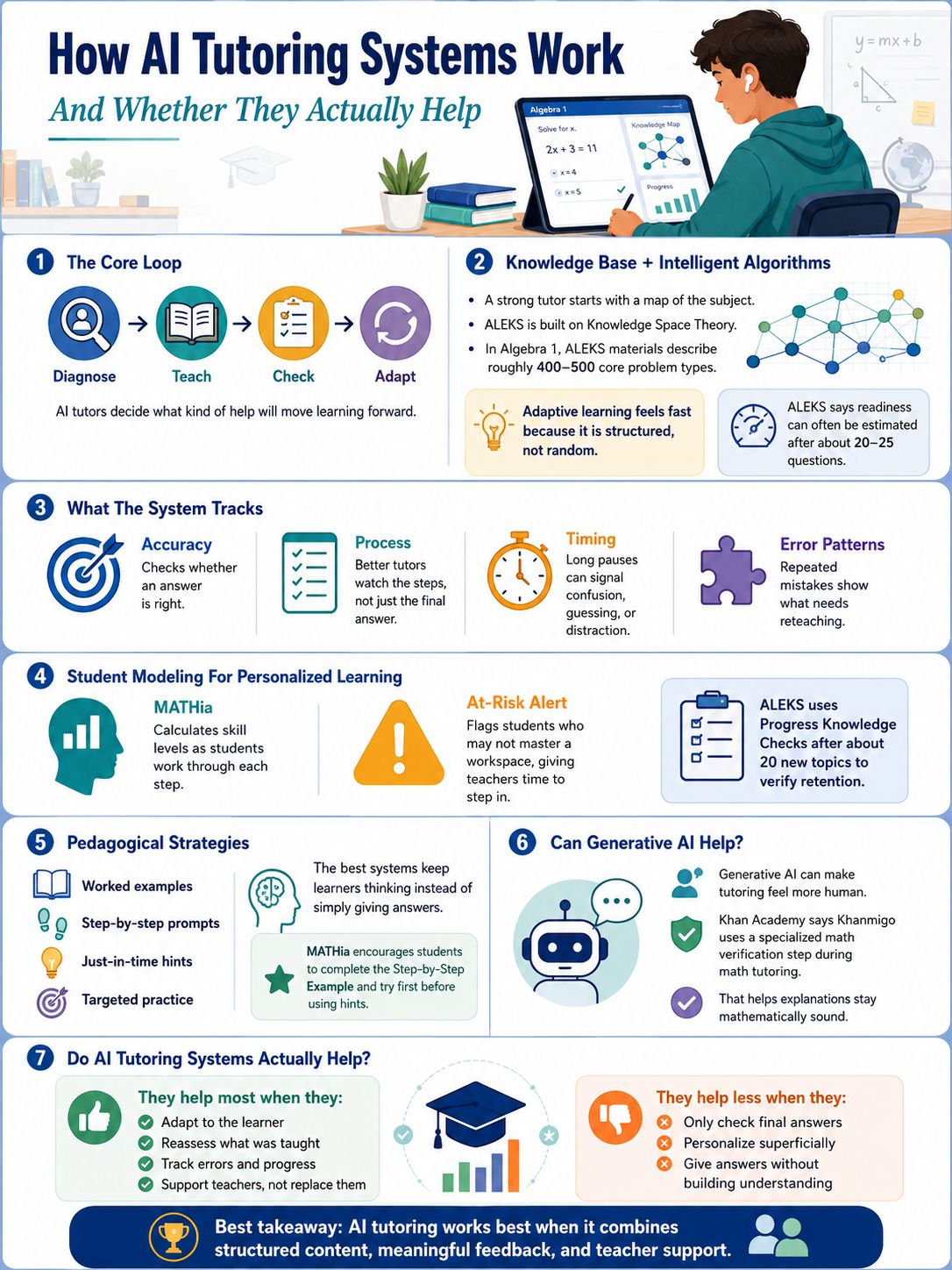
Most AI tutoring systems work through a simple loop: diagnose, teach, check, and adapt. The student sees a clean screen with questions and hints. Behind that screen, the software is constantly deciding what kind of help will move learning forward.
Knowledge base and intelligent algorithms
A strong tutor starts with a map of the subject. ALEKS, for example, is built on Knowledge Space Theory. In Algebra 1, its official materials describe a domain with roughly 400 to 500 core problem types, and the system uses that map to judge what a learner already knows and what should come next.
That is why adaptive learning can feel fast without being random. ALEKS says its assessment can usually estimate readiness after about 20 to 25 questions, or roughly 25 to 30 in student-facing materials. If you want a tutor for placement or gap-finding, that kind of structure matters more than flashy chat.
- Accuracy: The system checks whether an answer is right.
- Process: Better tutors watch the steps, not just the final answer.
- Timing: Long pauses can signal confusion, guessing, or distraction.
- Error patterns: Repeated mistakes on the same skill tell the tutor what to reteach.
Student modeling for personalized learning
This is the part that makes personalized learning real. MATHia, for instance, calculates skill levels as students work through each step in a problem. Its At-Risk alert flags students who may not master a workspace, which gives the teacher a chance to step in before the student quietly falls behind.
ALEKS uses a different rhythm. After a student learns about 20 new topics, the system gives a progress Knowledge Check to verify retention. That is a smart sign to look for in any tutoring platform. If a tool never reassesses what it taught, the personalization is probably shallow.
Pedagogical strategies for tailored instruction
The best systems do more than answer questions. They use worked examples, step-by-step prompts, just-in-time hints, and targeted practice to keep the learner thinking. In MATHia, students are told to complete the Step-by-Step Example and do their best first before leaning on hints. That is good advice for any AI tutor.
Generative AI can make this feel more human. Khan Academy says Khanmigo uses a specialized math verification step during math tutoring, which helps the system check calculations in real time. That kind of feature is useful because conversational tutoring only helps if the explanation is also mathematically sound.
Benefits of AI Tutoring Systems
When these systems are built well, they can save time, sharpen feedback, and make practice feel less generic. The biggest win is that they turn study time into a stream of small decisions that fit the learner in front of the screen.
Personalized learning experiences
A University of Florida-led 2025 U.S. meta-analysis reviewed 18 studies, 77 effect sizes, and 11 intelligent tutoring systems, and found a positive overall effect on K-12 learning outcomes. It also found that worked-out examples were one of the biggest drivers of better results.
That gives you a useful rule for choosing a tool. Pick the tutor that shows how to solve a problem, checks whether the student retained it, and changes the next task based on performance. Personalized learning works best when the system teaches a path, not just an answer.
| Where AI tutoring helps most | Why it works | What a human should still do |
|---|---|---|
| Math practice | Immediate feedback catches small mistakes before they turn into habits. | Check whether the student can explain the method out loud. |
| Writing feedback | The tutor can respond quickly with revision ideas and structure notes. | A teacher or parent should still judge voice, evidence, and originality. |
| Review and catch-up work | Adaptive instruction helps students spend more time on weak skills and less on easy ones. | Someone should set priorities, so the student does not drift into low-value busywork. |
Immediate feedback and progress tracking
This is where AI tutoring often beats a workbook. ASSISTments gives students immediate feedback and gives teachers reports by question, skill, standard, and student. MATHia reports time, sessions, workspaces, and problems. Those details make student support much more precise.
Khanmigo teacher tools push in the same direction. Its Class Snapshot can summarize recent student work, and district teachers can review student chat history. That kind of visibility helps adults spot whether a student is learning, guessing, or leaning too hard on the tool.
That changes what feedback feels like.
Instead of waiting days to learn what went wrong, the student can fix the mistake while the idea is still fresh. That usually leads to better engagement and less wasted practice.
Scalability and accessibility
In Khan Academy’s 2025 help updates, the company listed its U.S. Khanmigo learner and parent plans at $4 a month, while teacher tools were free and the read-aloud feature worked on desktop web, mobile web, and iOS. For many families and classrooms, that lowers the barrier to trying AI tutoring before making a bigger commitment.
Accessibility matters just as much as price. Khanmigo’s text-to-speech supports several languages, ALEKS publishes screen reader and color contrast support details, and Carnegie Learning says almost every image in MATHia includes alternative text. If a student needs read-aloud help, keyboard access, or clearer visual settings, those features should be checked before you judge the tutor’s academic value.
Challenges and Limitations of AI Tutoring Systems
AI tutoring systems can help a lot, but they also create new problems if schools or families use them casually. The biggest risks are privacy, weak thinking habits, and a false sense that fast help is the same as deep learning.
Data privacy and security concerns
Federal guidance is pretty clear on the pressure points: the FTC says services covered by COPPA must get parental consent before collecting personal information from children under 13, FERPA limits how schools can share education records with vendors, and the U.S. Department of Education has warned that AI can create discrimination if schools do not monitor how it is used.
That means a school or family should ask harder questions than “Does it work?” You also want to know who can see student chats, how long records are kept, whether student input trains the model, and what happens if the tool is wrong or biased.
- Who can view the student’s work and chat history?
- How long is the data stored, and can it be deleted?
- Is student input used to train the model or improve the product?
- Can teachers and parents audit the feedback the system gives?
Over-reliance on AI for learning
The biggest classroom mistake is easy to spot. A student opens the tutor before trying the problem. Carnegie Learning’s student guidance pushes the opposite habit: do your best first, use the Step-by-Step Example, and then ask for hints if you still need them. That sequence protects active learning.
If the AI becomes the first move every time, the student may stop practicing recall, planning, and productive struggle. The fix is simple. Use attempt-first prompts, ask students to show work before hints appear, and have a teacher or parent review a few sessions each week.
Bias, weak explanations, and uneven quality
Some tutors are carefully built around a skill map. Others are mostly a chatbot wrapped in school language. The second group can sound polished while still giving vague, off-target, or overly confident feedback.
A good test is to ask the tutor to explain the same concept three different ways, then check whether the explanations stay accurate and age-appropriate. If the quality shifts a lot from one prompt to the next, you are looking at a tool that still needs strong human oversight.
Final Thoughts
If you came here asking How AI Tutoring Systems Work And Whether They Actually Help, the short answer is yes, they can help when they diagnose gaps, give useful feedback, and still make the student do the thinking.
Start small, watch the quality of the hints, and keep a teacher, parent, or study plan in the loop. That mix usually works better than AI tutoring alone.
FAQs about How AI Tutoring Systems Work
1. What are AI tutoring systems?
AI tutoring systems are software that teach students, they offer personalized learning and adaptive learning paths, and they give real-time feedback like a coach.
2. How do AI tutoring systems work?
They collect student answers and behavior, analyze that data with models, including large language models, then adapt lessons, offer assessments, and give interactive exercises.
3. Do AI tutors actually help improve student performance?
Yes, they can boost student performance with regular practice and teacher support. They are not a silver bullet, results vary by design and subject.
4. What are the limits or risks of AI tutoring systems?
They can give wrong or outdated information, or mirror biases from training data, so human oversight is key, and privacy must be protected.