Early childhood math acquisition does not require formal workbooks or structured flashcards. Research in developmental psychology demonstrates that young children build foundational numeracy skills most effectively through context-rich, hands-on interactions during daily routines.
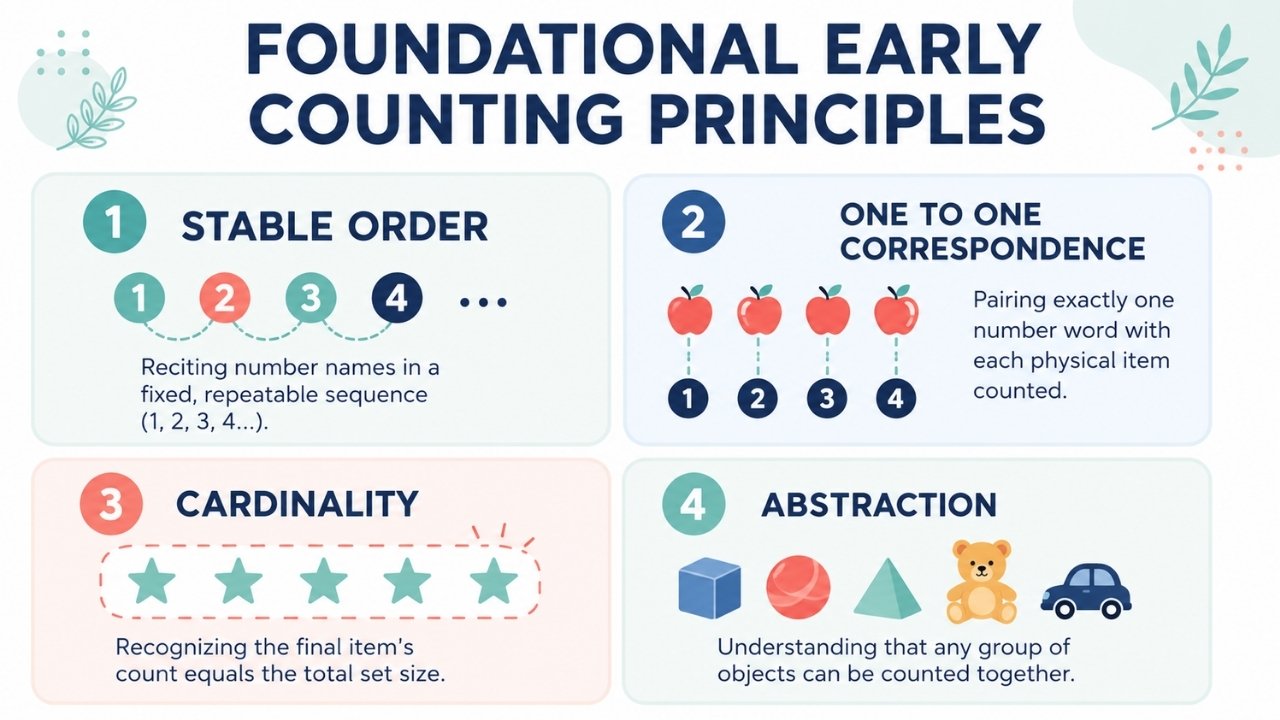
Integrating informal math into routine household moments helps children master foundational principles like one-to-one correspondence (matching exactly one number name to one physical object), cardinality (understanding that the final number counted represents the total set), and subitizing (instantly recognizing small quantities without counting individually). This guide explores 9 natural opportunities for everyday counting practice for kids across morning prep, household chores, and bedtime routines.
Mealtime and Kitchen Routines: Practical Math in Daily Household Tasks
Kitchen routines provide concrete, tactile objects that make abstract numerical concepts immediate and clear for young learners.
1. Setting the Dinner Table for the Family
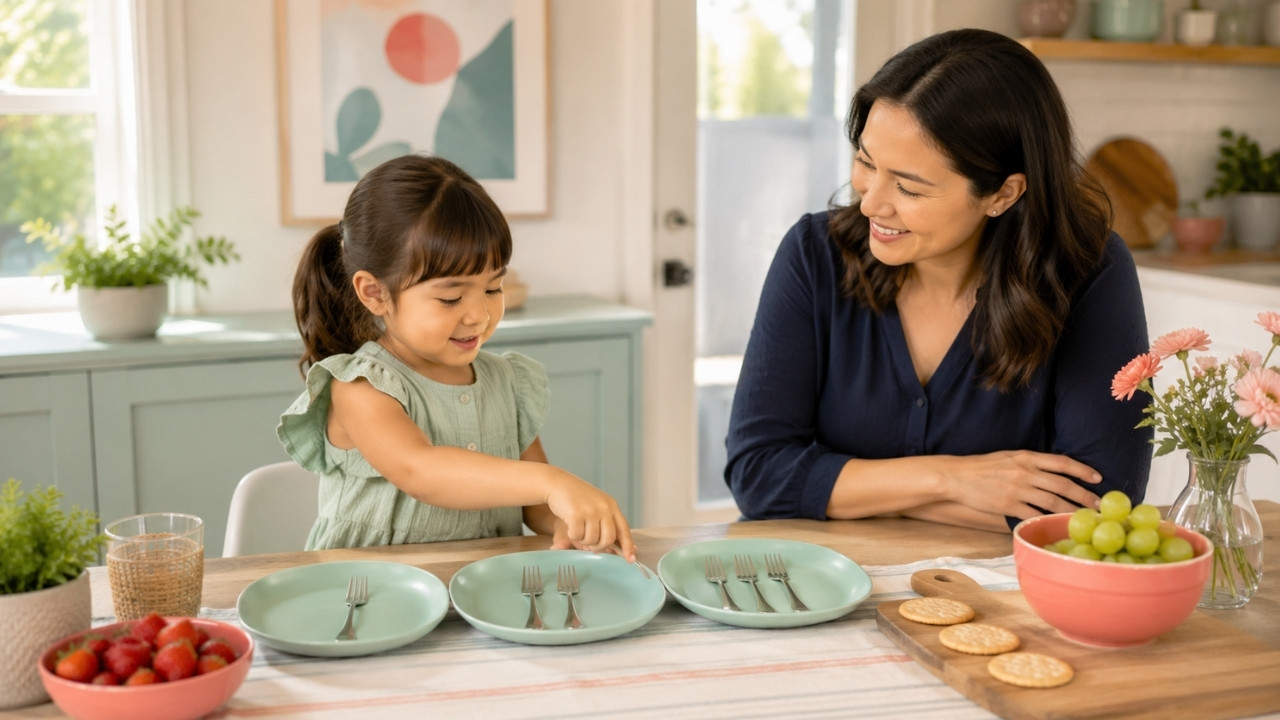
Setting the table is an ideal scenario for practicing one-to-one correspondence. Rather than handing a child a bundle of utensils, guide them to count out items based on the number of family members attending the meal.
-
Implementation: Ask your child, “There are 4 people sitting at the table. Can you count out 4 forks and place 1 fork next to each plate?”
-
Target Skill: One-to-one correspondence and spatial awareness.
2. Distributing Snacks and Portions
Snack time presents an engaging opportunity to introduce simple addition, subtraction, and equal sharing concepts. Counting small food items like pretzels, berries, or crackers connects math directly to real-world utility.
-
Implementation: Have your child count out 5 crackers onto their plate. Prompt simple problem-solving by asking, “If you eat 1 cracker, how many crackers do you have left?”
-
Target Skill: Subitizing, basic subtraction, and set comparison.
3. Measuring Ingredients During Cooking
Preparing meals involves volume, sequential steps, and counting physical scoops. Having a child count scoops of flour or spoonfuls of oil builds procedural counting patience and introduces early measurement concepts.
-
Implementation: Ask your child to count out loud as they dump 3 cups of oats or 4 spoonfuls of yogurt into a mixing bowl.
-
Target Skill: Stable order counting and volume awareness.
Errands and Active Transitions: Movement-Based Counting Practice
Movement-based math links physical actions to numeric words, helping kinesthetic learners retain number sequences more effectively.
4. Stair Climbing and Steps
Transiting up or down staircases provides a rhythmic, repeating structure for vocalizing numbers. Associating physical steps with spoken numbers reinforces number order.
-
Implementation: Count each step aloud as you ascend or descend stairs together, matching each footfall to a number word.
-
Target Skill: Rhythmic counting and sequential number order.
5. Selecting Produce at the Grocery Store
Grocery trips offer rich environmental math opportunities. Selecting specific quantities of fruits or vegetables turns routine errands into an interactive math hunt.
-
Implementation: Give your child a target quantity, such as: “We need 5 red apples. Can you put them into the bag one by one and count them for me?”
-
Target Skill: Target quantity selection and cardinality.
6. Buttoning Coats and Fastening Shirts
Dressing routines offer fine-motor skill building combined with tactile counting. Snaps, buttons, and shoe eyelets provide distinct physical touchpoints.
-
Implementation: Count buttons aloud as you or your child fasten a jacket or cardigan from bottom to top.
-
Target Skill: Fine-motor coordination paired with tactile one-to-one matching.
Tidying Up and Wind-Down Routines: Structured Organization Practices
Organizational tasks help children categorize objects by visual properties while counting discrete groups.
7. Sorting and Counting Laundry Socks
Matching laundry items introduces visual classification alongside numerical pairing. Sorting socks by color or pattern before counting pairs strengthens logical reasoning.
-
Implementation: Group matching socks together and ask your child, “How many sock pairs do we have in this pile? Let’s count them by twos.”
-
Target Skill: Categorical sorting, pairing, and early skip-counting concepts.
8. Toy Box Cleanup Routines
Turning cleanup time into a targeted counting activity reduces resistance while enforcing organization skills.
-
Implementation: Assign specific count goals during cleanup: “Pick up 10 building blocks and put them in the bin, counting aloud as each block drops in.”
-
Target Skill: Stop-count accuracy (stopping at a specified target number).
9. Bedtime Storybook Page and Illustration Tracking
Wind-down stories offer visual elements ideal for informal counting before sleep. Picture books contain consistent visual sets to identify and tally.
-
Implementation: Before turning a page, ask open-ended quantity questions: “How many stars do you see in the night sky on this page? Point to each one as you count.”
-
Target Skill: Visual tracking, pointer finger isolation, and picture-based cardinality.
Comparing Daily Counting Routines
| Routine Activity | Primary Math Concept | Age Appropriateness | Complexity / Prep Needed |
| Stair Climbing | Stable Order & Rhythm | Toddler (18m-3y) | None (Spontaneous) |
| Snack Distribution | Subitizing & Simple Subtraction | Preschool (2y-4y) | Low (Portioning snacks) |
| Table Setting | One-to-One Correspondence | Preschool (3y-5y) | Low (Mealtime setup) |
| Grocery Selection | Cardinality & Target Sets | Early Childhood (3y-6y) | Medium (Store supervision) |
| Laundry Sorting | Classification & Pair Counting | Pre-K / Kindergarten (4y-6y) | Low (Chore integration) |
Limitations and Trade-Offs of Everyday Counting Practice
While informal everyday counting is highly effective for building numerical intuition, parents and educators should keep key operational trade-offs in mind:
Risk of Rote Recitation Without Understanding
Children frequently learn to recite number sequences (1, 2, 3, 4, 5…) like a song without grasping that each number word corresponds to a physical quantity. If a child counts quickly without touching or point-tracking each item, they may miscount set totals. Caregivers must emphasize slow, tactile pointing over rapid recitation.
Parental Over-Correction and Pressure
Turning every daily moment into an explicit math test can cause fatigue or frustration in young children. The primary goal of informal counting practice is low-stress engagement. Forcing corrections when a child skips a number can diminish interest; modeling the correct sequence naturally works better than direct reprimand.
Integrating Playful Numeracy Into Your Household Routine
Building early math confidence in young learners does not require rigid study sessions or screen-based applications. By embedding simple everyday counting practice for kids into existing daily routines like snack time, errands, and bedtimes, parents and caregivers build a strong foundation for future mathematical reasoning. Focus on consistency, hands-on interaction, and low-pressure engagement to help children discover math in the world around them.
Frequently Asked Questions About Everyday Counting Practice
At what age should I start practicing everyday counting with my child?
You can start introducing number words and rhythmic counting during daily care routines during infancy (0-12 months). Toddlers generally begin participating actively by touching objects and repeating number names between 18 and 36 months of age.
What is the difference between counting by rote and one-to-one correspondence?
Rote counting is reciting numbers from memory in sequence without attaching them to physical items. One-to-one correspondence requires a child to touch or point to individual objects one at a time while saying one corresponding number name per object.
How do I know if my child understands cardinality?
A child understands cardinality when, after counting a group of items (e.g., “1, 2, 3, 4, 5”), you ask “How many are there in total?” and they confidently answer “5” without re-counting the set from the beginning.