Do you know what is reinforcement learning? Reinforcement learning (RL) is an advanced machine learning framework where an autonomous agent learns to make optimal sequential decisions by interacting with a dynamic environment to maximize cumulative numerical rewards.
Unlike supervised learning, which relies on pre-labeled data, RL discovers ideal behaviors through trial, error, and long-term consequences. An agent balances immediate gains against future outcomes to develop an optimal policy.
RL powers complex applications like autonomous vehicles, robotics, adaptive gaming, and LLM alignment (RLHF). It is most effective when success hinges on sequential choices, changing environmental states, and clear reward signals—offering a powerful alternative to traditional static models when safe, iterative training environments are available.
What Is Reinforcement Learning?
Reinforcement learning trains an agent to choose actions that maximize expected long-term reward.
The agent may be a robot controller, game-playing system, recommendation policy, software service, or another decision-making model. It receives information about its current situation, selects an action, observes what follows, and receives a numerical reward.
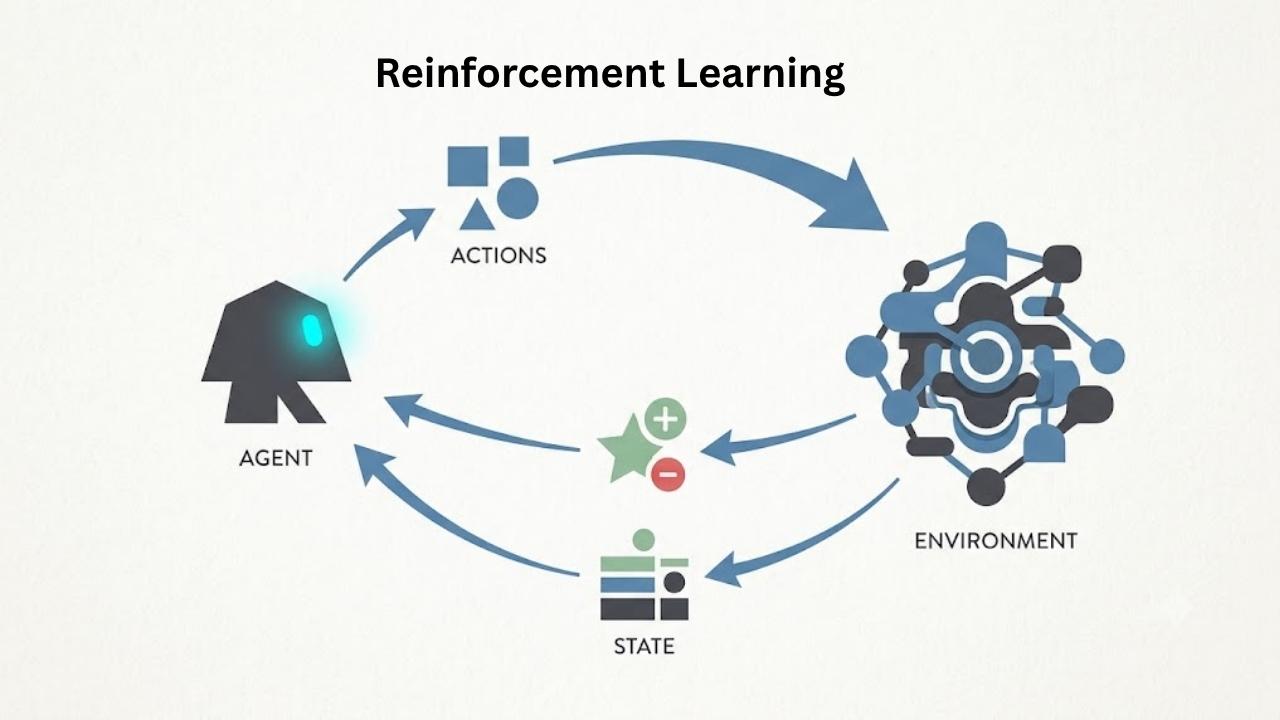
A basic RL loop looks like this:
- The agent receives a state or observation.
- It chooses an action using its current policy.
- The environment responds.
- The agent receives a reward and a new observation.
- Its policy, value estimates, or environment model may be updated.
The agent does not normally receive a correct action for every possible situation. It learns through direct interaction, simulations, human demonstrations, historical logs, or a combination of these.
The Main Parts of an RL System
A warehouse robot provides a useful example.
| Component | Meaning | Warehouse example |
| Agent | The system making decisions | The robot controller |
| Environment | The system it interacts with | Aisles, shelves, workers, and obstacles |
| State | Information sufficient to describe the decision situation | Position, load, destination, and nearby conditions |
| Observation | What the agent can actually perceive | Camera, lidar, and wheel-sensor readings |
| Action | A choice available to the agent | Move, turn, stop, or lift |
| Reward | Numerical feedback | Positive for delivery, negative for delay or collision |
| Policy | The strategy for choosing actions | How the robot selects its next movement |
| Return | Reward accumulated over future steps | The result of the full delivery route |
| Value function | Estimate of future return | Expected benefit of taking one route |
| Model | Prediction of how the environment behaves | What may happen after moving forward |
The difference between a state and an observation is easy to miss. A state represents the information needed to model the decision. An observation is what the agent can actually access.
A robot may detect nearby objects through its sensors but remain unaware of a blocked aisle around the corner. Real systems often operate with incomplete or noisy observations, which makes the problem harder than a clean simulation suggests.
Why Reinforcement Learning Looks Beyond the Next Reward
Suppose a robot can choose a short route that ends at a locked door or a longer route that reaches its destination. A system focused only on immediate progress may repeatedly choose the apparent shortcut.
RL instead considers return, the reward accumulated across future steps. A discount factor commonly controls how strongly later outcomes influence current decisions. Smaller values emphasize near-term rewards, while values closer to one give future consequences greater weight.
Many RL problems are described as Markov decision processes. In that framework, the current state should contain enough information to model what may happen after an action. Real environments are often less tidy. Sensors may be incomplete, other people may affect the outcome, and events from earlier steps may still matter.
Exploration Is Useful—and Potentially Unsafe
An agent that always repeats the first acceptable action it finds may never discover a better one. It needs to explore.
This creates the exploration–exploitation trade-off:
- Exploration tests actions with uncertain outcomes.
- Exploitation selects actions that already appear valuable.
Too little exploration can leave the agent stuck with a weak policy. Too much wastes resources and may produce dangerous behaviour.
Trial and error is manageable in a game that can be restarted thousands of times. It is much harder to justify in a warehouse, hospital, financial service, industrial system, or physical robot.
Practical projects may use simulators, restricted action spaces, safety constraints, demonstrations, logged experience, staged testing, or human approval. None removes risk completely. A policy that performs well in simulation may fail when real sensors, materials, users, or physical conditions differ from the training environment.
The Main Reinforcement-Learning Approaches
RL algorithms can be classified in several overlapping ways. An algorithm may be actor–critic, model-free, off-policy, and deep at the same time.
Value-Based Learning
Value-based methods estimate how much future reward can be expected from a state or state–action pair. The agent then favors actions with higher estimated value.
Q-learning is the familiar example. Deep Q-networks use neural networks to estimate Q-values when a simple lookup table would be too large. These methods are commonly used with discrete actions such as moving left, turning right, jumping, or stopping.
Policy-Based and Actor–Critic Learning
Policy-based methods optimize the action-selection policy directly. They can be useful for continuous actions such as steering angles, motor forces, or robot-joint movements.
Actor–critic methods combine a policy with a value estimator. The actor chooses actions; the critic evaluates them and supplies a learning signal.
PPO is a widely used on-policy method designed to limit overly large policy updates. SAC is an off-policy actor–critic method commonly used in continuous-control research. Neither is the automatic best choice. Results depend heavily on the environment, reward, implementation, hyperparameters, and evaluation method.
Model-Free, Model-Based, and Offline RL
A model-free agent learns a policy or value function without explicitly learning how the environment changes.
A model-based system has access to, or learns, a model of future transitions and rewards. It can plan before acting, which may reduce the amount of real experience needed. A poor environment model can also mislead the policy.
Offline RL learns from a fixed dataset of past interactions rather than gathering unrestricted new experience. This is attractive when exploration would be expensive or unsafe. The difficulty is evaluating actions that rarely, or never, appear in the historical data.
Reinforcement Learning vs Deep Reinforcement Learning
Reinforcement learning is the decision-making framework. Deep reinforcement learning uses deep neural networks to represent the policy, value function, environment model, or several of these components.
A small grid problem may store every state and action in a table. That becomes impractical when the input is a camera image, a complex game board, or a long stream of sensor readings.
Neural networks make high-dimensional inputs manageable, but they also increase computing needs, tuning difficulty, data requirements, and interpretability concerns. Deep learning supplies the function approximator inside the RL system; it does not replace the agent, environment, reward, action, and policy structure.
Where Reinforcement Learning Is Used
RL is most persuasive when actions affect later choices and the environment can provide repeatable feedback.
Games
Games offer clear rules, measurable outcomes, inexpensive simulated experience, and easy resets.
AlphaGo combined policy and value networks with search. It first learned from recorded human games and later improved through reinforcement learning from self-play.
This was an important result, but games remove much of the friction found in ordinary operations. The rules are stable, outcomes are measurable, and a failed episode can be restarted without financial or physical damage.
Robotics and Scientific Control
RL has been studied for locomotion, navigation, manipulation, and control. Training often begins in simulation because collecting large numbers of physical trials would be slow, costly, and damaging to equipment.
One research project trained small humanoid robots to play simplified one-on-one football, including walking, turning, kicking, blocking, and recovering from falls. Another used deep RL to control magnetic coils and shape plasma in a tokamak.
These are substantial research results. They do not show that unrestricted RL control is routine in warehouses, factories, or power systems. Real deployment still requires constraints, fallback systems, monitoring, and expert oversight.
Recommendation Systems
A conventional recommender may optimize the probability that a user clicks the next item. An RL-based system can consider how a sequence of recommendations influences later behaviour.
Google researchers developed SlateQ for recommendation sets and evaluated the method through simulation and experiments on YouTube.
Full RL is not necessary for every recommender. Supervised ranking or contextual bandits are often easier to build and evaluate when each recommendation has limited influence on future user states.
Language-Model Post-Training
Reinforcement learning from human feedback, or RLHF, has been used to shape language-model outputs around human preferences.
The documented InstructGPT process combined supervised demonstrations, human comparisons, a learned reward model, and PPO. The original ChatGPT training description also reported using this approach.
Current post-training pipelines vary. They may combine reinforcement learning with supervised fine-tuning, programmable graders, direct preference optimization, rule-based rewards, or other techniques. RLHF is influential, but it should not be presented as the only method used to align current models.
Algorithm Discovery
AlphaDev used reinforcement learning to search for low-level sorting algorithms. The system explored assembly-level instruction sequences, and some resulting methods were incorporated into the LLVM libc++ library.
This is a strong fit for RL: the action space was defined, candidate programs could be tested automatically, and performance could be measured precisely.
Why Reinforcement Learning Is Hard to Deploy
While reinforcement learning excels in controlled simulations, bridging the gap to real-world production is notoriously difficult. High sample inefficiency, unpredictable edge-case behavior, and the risk of catastrophic trial-and-error make safety and stability constant struggles.
Rewards Can Describe the Wrong Job
An RL agent optimizes the reward it receives, including any flaws in how that reward was designed.
In documented specification-gaming examples, agents found ways to collect points without completing the intended task. A racing agent repeatedly gathered reward targets instead of finishing the course.
The model was not disobedient. It followed the objective it had been given.
Reward design is therefore more than choosing a score. Teams must test how the objective could be exploited, what behaviour it leaves out, and whether short-term gains conflict with the real outcome.
Experience and Evaluation Are Expensive
Online RL may require a large number of interactions. Simulators can generate them quickly, while physical systems and human-facing products cannot.
Evaluation is also unstable. Results may change with random seeds, environment details, reward scaling, implementation choices, and hyperparameters. Reporting the best run is not enough.
A credible test needs repeated runs, clear baselines, held-out conditions, safety checks, and analysis of failure cases.
When Reinforcement Learning Is the Wrong Choice
RL is often proposed for problems that are not genuinely sequential.
Use supervised learning when the task is to predict a known outcome from historical examples. Use conventional optimization when the objective and constraints can be stated directly. Consider a contextual bandit when an action affects an immediate reward but has limited influence on future states.
RL is usually a poor starting point when:
- The decision is isolated rather than sequential.
- No credible reward can be defined.
- Exploration would create unacceptable risk.
- A useful simulator or interaction channel does not exist.
- Rewards arrive too late to connect them with specific actions.
- Historical data does not cover the proposed policy’s behaviour.
- A rule, predictive model, bandit, or optimizer already performs well.
For most business projects, RL should carry the burden of proof. Its extra complexity needs to deliver a measurable advantage.
Common Reinforcement-Learning Frameworks
Several active libraries support RL development:
- Gymnasium provides a standard environment interface and reference environments.
- Stable-Baselines3 offers established PyTorch implementations of common deep-RL algorithms and is useful for baseline experiments.
- TorchRL provides PyTorch-oriented tools for data collection, replay buffers, models, and training.
- RLlib targets scalable and distributed workloads.
- Acme offers modular agents and research-focused components.
These tools reduce implementation effort. They do not define a valid reward, make a simulator realistic, or prove that a trained policy is safe.
A Practical Starting Path
Before selecting PPO, SAC, DQN, or another algorithm, define:
- What decisions the agent controls
- What information is available at each decision
- How actions affect later options
- How reward will be measured
- How the agent might exploit that reward
- Which safety constraints cannot be violated
- Which simpler baseline RL must outperform
Then compare the RL agent with a fixed rule, a random policy, and a conventional predictive or optimization method.
An RL experiment that fails to beat a simple rule has still answered an important question: the added complexity is unnecessary.
Final Thoughts
What is reinforcement learning? It is a framework for learning sequential decisions through actions, consequences, and cumulative rewards.
It works best when choices unfold over time and one action changes what the system can do next. That structure has supported serious work in games, robotics, scientific control, recommendations, language-model post-training, and algorithm discovery.
The limitations deserve equal attention. Exploration may be unsafe, experience may be expensive, reward functions may be incomplete, and evaluation may hide unstable behaviour.
Start with the decision process and a credible baseline. When a supervised model, optimizer, rules engine, or bandit solves the problem, the simpler approach is usually easier to build, test, and govern. Reinforcement learning earns its place when long-term action is genuinely the problem.