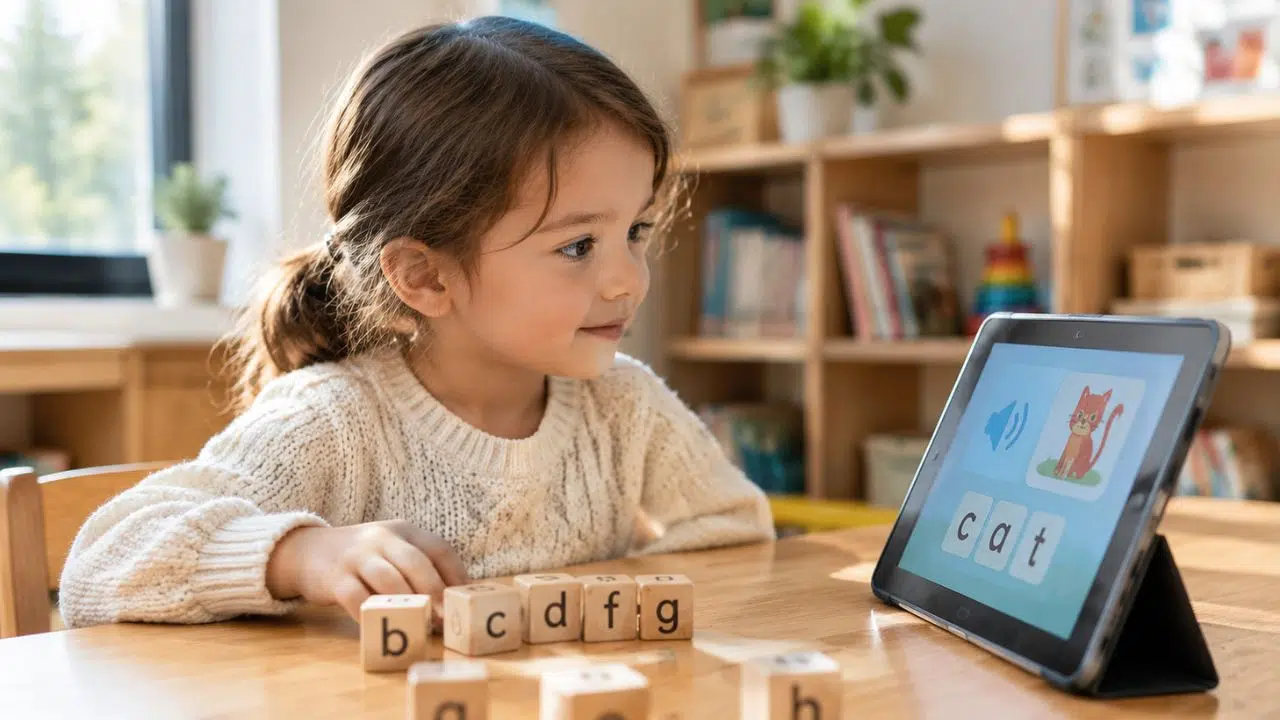
Phonics vs rote learning represents two distinct reading approaches: phonics teaches children how letters map to sounds so they can decode new words independently, while rote learning relies on memorizing whole words or letter names without connecting them to their sounds.
The difference shows up when a child meets a word for the first time. A phonics-trained reader sounds it out. A rote-trained reader stalls, because the word was never memorized.
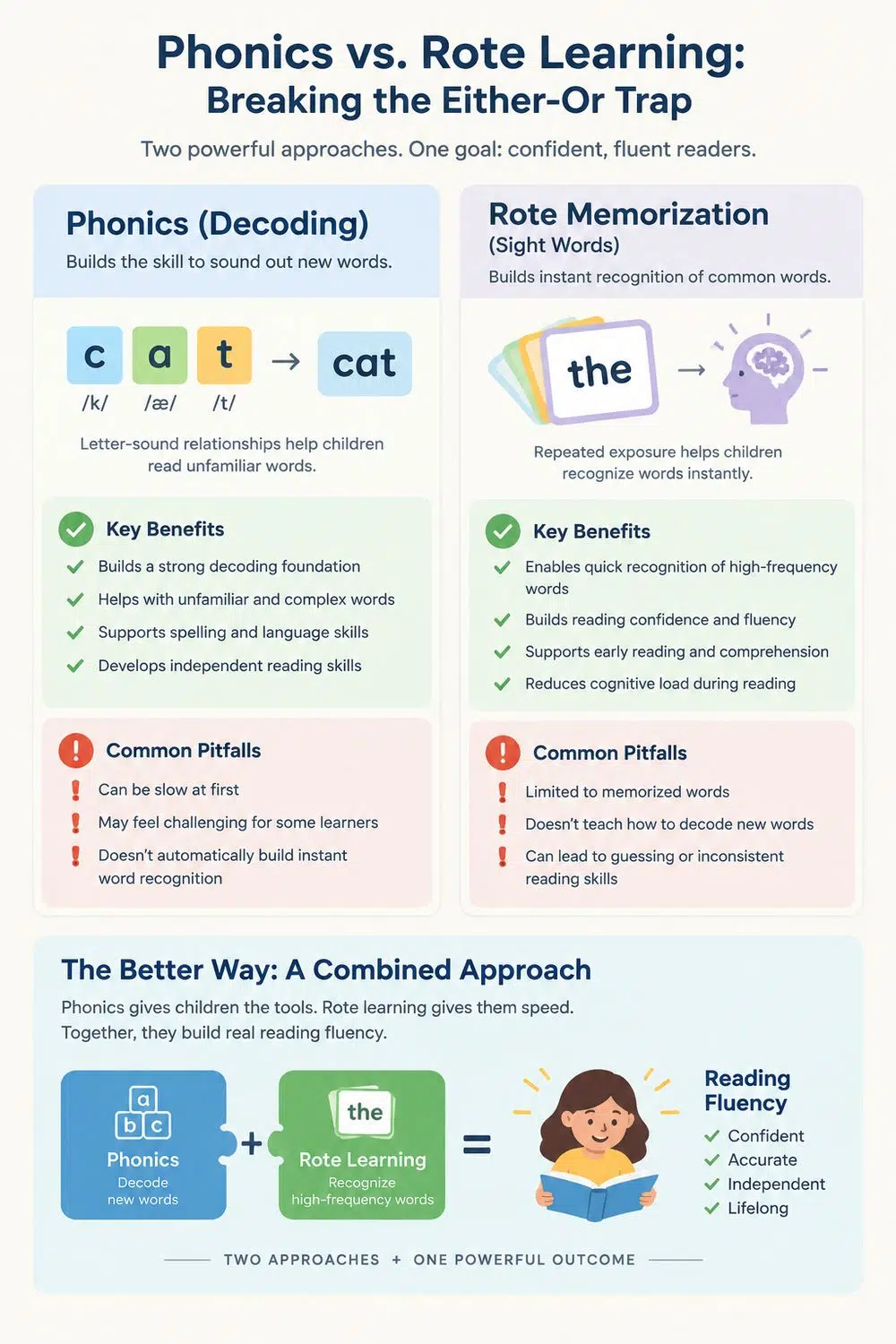
A 2000 National Reading Panel report found phonics instruction was crucial to teaching young readers. Rote memorization means repeating information until a student can recall it without difficulty and is useful for drill. Phonics teaches the relationships between letters and sounds, so each new word becomes solvable rather than memorizable.
Most educators now use both methods together: phonics builds the decoding system, and memorization handles a small set of irregular words that break phonics rules.
Phonics vs. Rote Learning: What Each One Builds
Memorization has its place. Rote learning frequently appears in foundational subjects like the alphabet and multiplication tables, because it commits facts to memory quickly, though it offers no system for attacking unfamiliar material. Phonics creates independent readers. Learning games for toddlers often blend both approaches within alphabet learning activities.
What Is Phonics, in Plain Words?
Once a child learns that the letter “b” makes a /b/ sound and “a” makes an /æ/ sound, they can blend those sounds into “ba” and then “bat”. That blending is phonics in action: sounds (phonemes) connected to written letters (graphemes), forming letter-sound relationships (alphabetics) and spelling (orthographic) patterns. The most effective instruction is systematic and explicit—children learn letter-sound relationships in a clear sequence, starting with simpler skills and moving to more complex patterns. The science of reading, a large body of research on how the brain learns to read, supports this approach. Phonics also builds writing skills, letting children figure out spelling from what they already know about sounds and letters. For a practical look at how apps handle these principles differently, Alphabet Magic Trace and Phonics offers a direct comparison.
Why Rote Still Has a Small Job
English contains high-frequency words that violate phonics rules. A child who tries to decode “one” phonetically will produce /oh-neh/, not /wuhn/. For these irregular words, memorization is faster and more practical than teaching exceptions to phonics patterns. Rote learning is most effective in early elementary classrooms where students need to develop fluency in both reading and math. By definition, rote learning ignores comprehension, so by itself it is an ineffective tool in mastering complex subjects.
Should I Use Phonics or Rote Learning Alone?
The National Reading Panel declared phonics instruction crucial, alongside several related concepts, but crucial is not the same as sufficient. No single approach covers every skill a reader needs. Games to encourage early language skills support multiple early reading methods by embedding phonics and comprehension work in play.
Where Interactive Games Fit
A child who taps the wrong letter hears the incorrect sound and tries again. That immediate feedback builds pattern recognition faster than a worksheet does. Practical alphabet learning activities prioritize engagement and repetition, and children retain more information when they enjoy the process and explore letters at their own pace. Phonics Bloom creates interactive online phonics games that help children understand the relationship between letters and sounds, building skills needed to read and spell with confidence. Research indicates that teaching with phonics is more effective than teaching whole written words. For specific picks, the best alphabet learning games for kids roundup compares top options across platforms and age groups.
What Whole Language Gets Right and Wrong
Children learn by connecting new knowledge to previously learned knowledge, using scaffolding to organize it. Whole language builds on that idea. It emphasizes reading for meaning from the start, drawing on context clues and pictures rather than sounding out individual letters, and it treats reading as a natural process similar to learning spoken language. Kenneth Goodman, a vocal proponent of whole language, described reading as a “psycholinguistic guessing game”. Skipping drills on isolated skills keeps early reading sessions less mechanical. The method stumbles when a child meets an unfamiliar word with no picture or context clue to lean on. Taught only whole language strategies, that child has no decoding tool. The science of reading research consistently finds that explicit phonics instruction produces better reading outcomes than whole language alone.
What the Two Methods Ask of Memory
Phonics and rote learning place different demands on a child’s memory:
| Method | What Children Must Memorize | How It Scales |
|---|---|---|
| Phonics | Phonemes and the letter patterns that represent them, then apply those patterns to thousands of words | One phonics rule unlocks many words |
| Rote learning | Each word as a separate visual unit | One rote lesson teaches only one word; many individual memory tasks with no connective system |
A phonetically trained child who sees “stretch” for the first time can decode it as /s/ /t/ /r/ /e/ /ch/, while a rote-trained child must either have seen “stretch” before or guess from context. Rote learning means repeating information again and again until it can be recalled without difficulty, with the goal of memorizing facts and vocabulary.
A Worked Example: Reading “ship”
Take the word “ship”. Both methods can produce a correct reading of this word, yet the cognitive path and the long-term skill each builds diverge.
The Sound-by-Sound Route
A child using phonics sees “ship” and segments it into four letters. The digraph “sh” is a single sound made by two letters, a pattern she has learned: “s” and “h” together give her /sh/, while “i” makes /ĭ/ and “p” makes /p/. She blends /sh/ /ĭ/ /p/ aloud, adjusting her pronunciation until it matches the spoken word she already knows. “Shop,” “shed,” “shrimp”. The same rule covers them all. She never has to memorize each word separately, because phonics turns one lesson into a transferable tool.
The Memory-First Route
A rote learner looks at “ship” as a whole unit, four letters in a specific sequence to memorize as a picture. Her teacher shows the word card, says “ship,” and asks her to repeat it while looking at the letters. After several repetitions across days, she recognizes “ship” on sight.
Then comes “shop”. The next week, facing this new word, she has no system to decode it and must memorize “shop” as an entirely new unit. The rote method succeeds at teaching individual words but offers no bridge to unfamiliar ones. Learning high-frequency words takes more than rote memorization.
When Memorization Should Take Over
Once a child has decoded “ship” several times using phonics, the word moves into long-term memory and becomes a sight word. At that point she recognizes “ship” instantly, without conscious blending. This is the proper role of memorization: it stores words the child has already decoded and speeds up reading fluency.
Memorization should also handle the small set of irregular words that defy phonics rules, like “said” or “of”. Students with reading difficulties can benefit from repeatedly reading the same text. One meta-analysis gives phonics a positive effect size. Repeated exposure builds automatic recognition, but it works best when phonics has already taught the underlying letter-sound system.
Common Mistakes in the Debate
Parents who choose one method and reject the other often see slower progress or frustration in their children. Confusion can arise when curriculum mandates one approach over another. Check which skills a child has mastered before deciding which method to emphasize next.
The “Either-Or” Trap
Some educators frame phonics vs. rote learning as a binary choice, insisting that only one method should be used. This stance ignores how skilled readers actually work: they use phonics to decode new words and sight memory to recognize familiar ones. One literacy commentator proposes insisting that phonics equals critical thinking (applying knowledge to novel situations), whereas whole language or balanced literacy equals rote memorization (random squiggles disconnected from authentic language).
The “Fun Means Effective” Trap
Interactive games make phonics practice more engaging, but engagement alone does not guarantee learning. A game that rewards children for tapping colorful buttons without requiring them to connect sounds to letters is entertaining but ineffective. Phonics plays an important role in teaching children to read. Effective phonics games require children to make deliberate letter-sound connections, offer immediate corrective feedback, and increase difficulty as skills improve. A game that lets a child guess randomly until they stumble onto the right answer teaches trial and error, not phonics. Parents should check whether a game isolates the phonics skill it claims to teach and whether it requires the child to apply that skill to progress.
Questions About Learning to Read
Balloon Phonics, a game focusing on three-letter words, helps children blend sounds and segment words. Children can explore phonics and recognize phoneme patterns through fun, interactive activities that support early reading. Practical alphabet learning activities also help children build letter knowledge through movement and play.
Should letter names be memorized first?
No. Many phonics programs teach sounds first because children use sounds to decode words. A child who knows the letter “b” makes a /b/ sound can start blending “bat” and “bed” immediately, while a child who only knows the letter is called “bee” has no decoding tool yet. Some programs teach names and sounds together, which works well if the instruction keeps them distinct. Confusion arises when a child tries to sound out “cat” as “see-ay-tee” because she is reciting letter names instead of sounds. The priority is letter sounds, with names added once the sounds are solid, and outdoor alphabet games often reinforce both through movement.
How long should game practice last?
Briefly. Sessions for preschoolers and early elementary students should stop before frustration sets in, because short, frequent practice beats long, occasional sessions—young children’s attention spans are limited, and repetition across days builds stronger memory. A child who plays a phonics game regularly in short sessions will retain more than one who plays infrequently for longer periods. Parents should watch for signs of fatigue, such as yawning or drifting attention, and end the session on a successful note. Games that adapt difficulty keep children in a productive challenge zone where they succeed often enough to stay motivated but struggle enough to learn. Vygotsky identified a “zone of proximal development” where children can learn new things with instruction.
When should a teacher add support?
A teacher should step in when a child makes the same error repeatedly, shows signs of frustration, or stops engaging with the activity. Immediate correction helps more than delayed feedback because the child connects the mistake to the correction while the attempt is still fresh in memory. Support can be as simple as modeling the correct sound, isolating the difficult part of a word, or offering a hint rather than the full answer. If a child consistently struggles with a phonics pattern like “oa” or “ee,” the teacher should drop back to simpler patterns and rebuild the skill in smaller steps. A teacher watching several children play a phonics game should note which mistakes recur and plan targeted practice for those patterns.
The Reading Decision in Practice
Phonics instruction should focus on the systematic patterns in print-to-sound relationships to enhance both reading aloud and comprehension. Rote memorization remains useful for the small percentage of high-frequency irregular words that resist phonics rules. Interactive games accelerate both methods by offering immediate feedback and keeping practice sessions short enough to sustain attention. Parents and teachers who understand the difference between phonics vs. rote learning can choose tools and lessons that match what each child needs at each stage. A beginning reader needs heavy phonics instruction to build the decoding system. A child who already decodes well needs more focus on comprehension. The best reading programs layer these approaches, starting with systematic phonics, adding sight word memorization for irregular words, and wrapping both in engaging activities that keep children motivated as they practice.