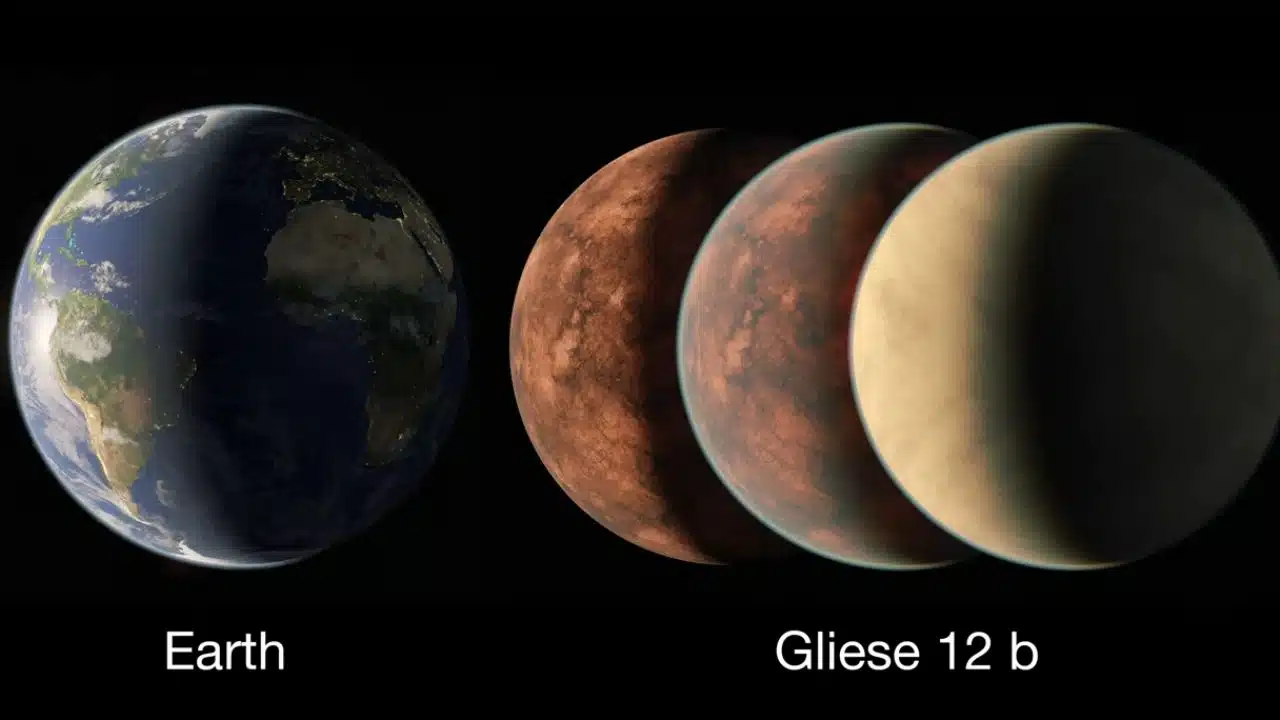
Scientists have discovered a new planet that may be able to support human life, according to a recent study published in the Monthly Notices of the Royal Astronomical Society.
The planet, named Gliese 12 b, is being hailed as the “nearest, transiting temperate, Earth-sized planet found to date,” offering exciting possibilities for future space exploration.
Discovery and Characteristics of Gliese 12 b
An international team of scientists discovered Gliese 12 b using NASA’s Transiting Exoplanet Survey Satellite (TESS). This exoplanet, meaning it is located outside of our solar system, orbits a small, cool red dwarf star approximately 40 light years away.
Gliese 12 b is slightly smaller than Earth and has an estimated surface temperature around 50°F warmer than Earth’s, which makes it potentially habitable.
Comparisons to Earth and Venus
The planet’s proximity to its star results in a year that lasts just 12.8 Earth days. Despite its closeness to the star, Gliese 12 b receives about 1.6 times more energy from its star than Earth does from the sun.
Scientists have drawn comparisons between Gliese 12 b and Venus, often dubbed Earth’s “twin” due to their similar sizes and compositions.
However, Gliese 12’s temperate conditions make it more akin to Earth in terms of habitability potential.
Potential for Human Habitability
The primary factor determining whether Gliese 12 b could support human life is its atmosphere. Scientists need to establish whether the planet has an atmosphere similar to Earth’s that could contain water, essential for sustaining life.
“Thrillingly, this planet is the closest Earth-sized and highest-temperature planet we know,” said Thomas Wilson, one of the study’s authors.
The planet’s temperate conditions and Earth-like size make it a prime candidate for further atmospheric studies.
Challenges in Reaching Gliese 12 b
Despite the promising characteristics of Gliese 12 b, reaching it poses a significant challenge.
At 40 light years away, our current fastest spacecraft would take approximately 300,000 years to reach the planet.
This distance underscores the importance of continued advancements in space travel technology and further exploration of nearby exoplanets.
The Role of Red Dwarf Stars
Gliese 12 b orbits a red dwarf star, which plays a crucial role in its potential habitability.
Red dwarfs are known for their magnetic activity, which can result in powerful X-ray flares. However, initial analysis indicates that Gliese 12’s star shows no signs of extreme behavior, making it a stable environment for the planet.
The storminess of a star is a key factor in whether a planet can retain an atmosphere conducive to life.
Next Steps in Research
The next step for scientists is to conduct a detailed examination of Gliese 12’s atmosphere. This will involve determining whether the planet has a thin, cloud-like atmosphere that could support life or if it lacks an atmosphere altogether.
The findings from these studies could provide invaluable insights into the habitability pathways of planets and the evolution of our own solar system.
Implications for Future Space Exploration
The discovery of Gliese 12 b is significant not only for its potential to support human life but also for advancing our understanding of Earth-like planets across the galaxy.
“Detecting one so nearby is really exciting because it allows us to do follow-up analysis of the atmosphere, so we will be able to learn a lot more about it,” said Larissa Palethorpe from the University of Edinburgh.
As scientists continue to explore and analyze exoplanets like Gliese 12 b, we move closer to answering fundamental questions about the existence of life beyond Earth and the potential for human colonization of other planets.
Final thoughts
The discovery of Gliese 12 b represents a significant milestone in the search for habitable exoplanets. With its Earth-like size and temperate conditions, this newly found planet offers promising potential for supporting human life.
While there are challenges ahead, particularly in terms of distance and technological advancements, the continued study of Gliese 12 b could unlock new possibilities for future space exploration and our understanding of the universe.
The Information is Taken from Time Magazine and SKY News