A year ago, a reader sent our team a short video of a public official saying something shocking. It looked real. The voice matched. But when I asked for the original file, the sender went quiet. That moment showed me how deepfake technology is changing the way we judge digital evidence. A video is no longer proof just because it looks real.
Courts, companies, and families are facing the same problem. In this guide, I explain what has changed, what judges and lawmakers are doing in 2026, and what you can do to keep your own evidence trustworthy.
Why Digital Evidence Used to Feel Safe
For years, a photo, a voice note, or a security clip was strong proof. Faking one took skill, money, and time. Most fakes were easy to spot.
That is why US courts set a low bar to admit this kind of evidence. A witness only had to say the video fairly showed what happened. Retired federal judge Paul Grimm told Duke Law in January 2026 that this is a low barrier in the deepfake era.
Today, free AI tools can clone a voice from a short sample or swap a face in minutes. This is the core of how deepfake technology is changing evidence. The question is no longer “Does this look real?” It is “Can you prove where this came from?”
How Deepfake Technology Is Changing Digital Evidence in Court
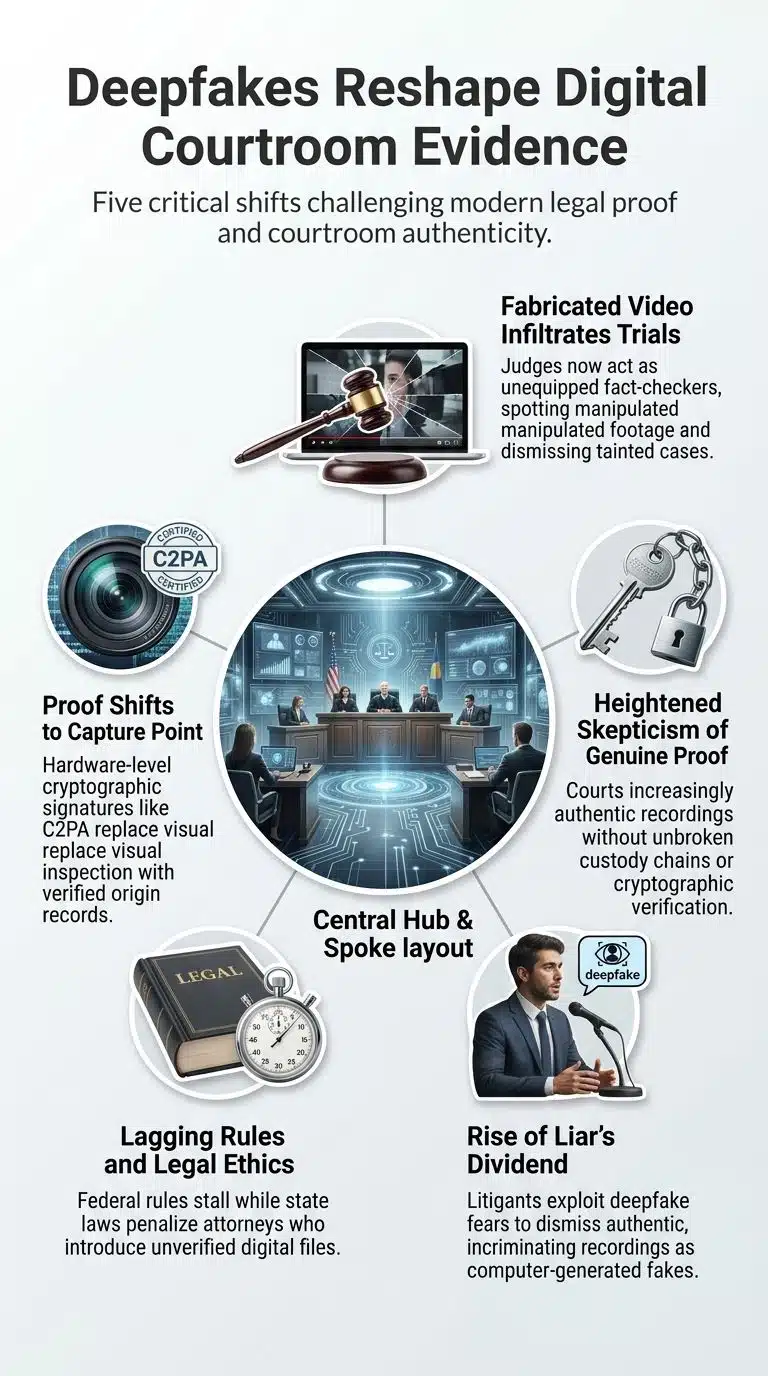
The shift is already visible in real cases. Here are the five biggest changes I have tracked this year.
1. Fake Evidence Is Reaching Real Cases
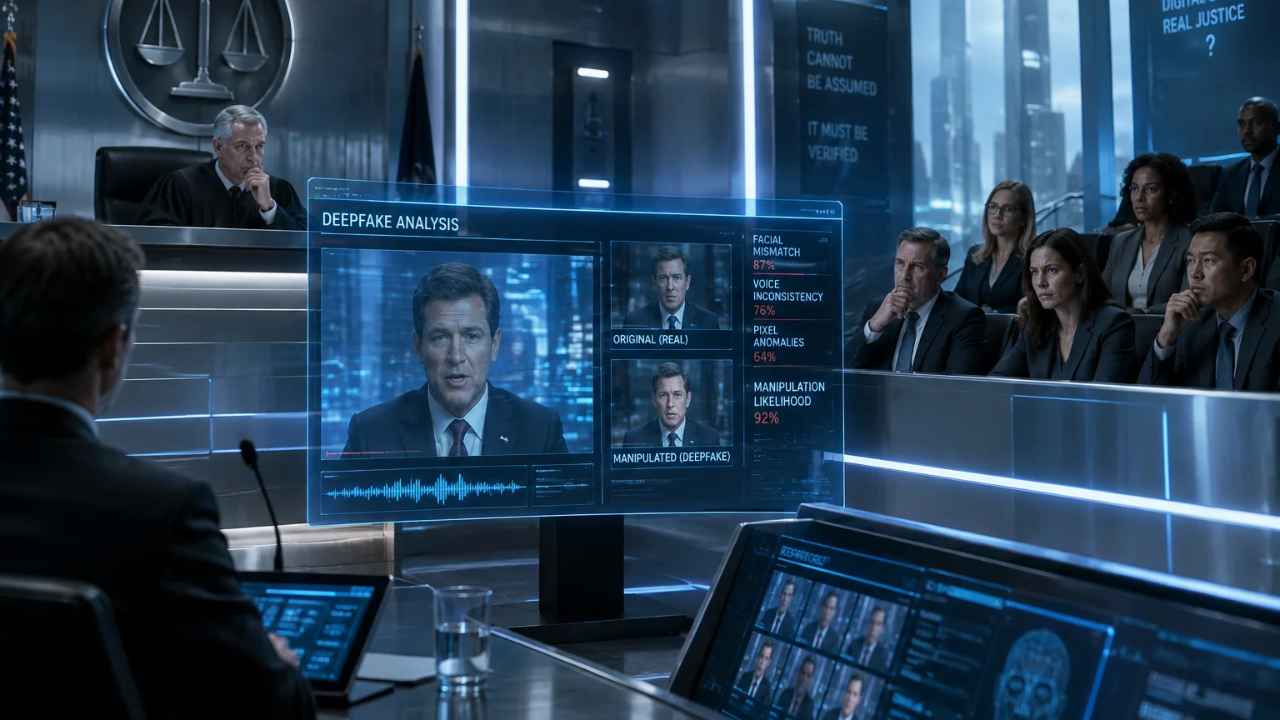
In Mendones v. Cushman & Wakefield, a California housing case, the plaintiffs submitted witness videos to win their motion. Judge Victoria Kolakowski found that two videos were deepfakes. She spotted a looping video feed and lips that did not match the words. She threw out the whole case as a sanction.
She also said she suspected more of the evidence was fake but lacked the time, money, and expertise to check. That detail worries me most. It shows how deepfake technology is changing the workload of courts. Judges must now act as fact-checkers, often without the tools to do it.
2. Real Evidence Now Faces More Doubt
The opposite problem is just as serious. On February 17, 2026, New York’s highest court ruled in Matter of M.S. (M.H.). It threw out video clips used in a child abuse case. The clips came from a hacker’s computer, had no full original file, and had a gap of about two and a half years in their history.
The majority said that matching a room’s details to a video is no longer enough. Because deepfakes exist, the court wanted proof the events were real. Two judges dissented strongly. They warned the ruling could make honest video evidence much harder to use. This case shows how deepfake technology is changing the burden of proof, even for clips nobody proved were fake.
3. The “Liar’s Dividend” Is Growing
Law scholars use the term “liar’s dividend” for this trick: when fakes are common, a guilty person can call real evidence fake. In a 2023 lawsuit, Tesla’s lawyers suggested old videos of Elon Musk might be deepfakes. The California judge rejected the argument and called it deeply troubling.
I expect to see this defense more often. It is a quiet but important part of how deepfake technology is changing trials. A fake does not even need to exist to create doubt.
4. Rules Are Still Catching Up
US federal courts have no final deepfake rule yet. A proposed Federal Rule of Evidence 707 would make AI-generated evidence meet the same reliability test as expert testimony. Public comments closed on February 16, 2026. In May 2026, the advisory committee chose not to advance it yet and planned a fall 2026 meeting for more input. The American Bar Association opposes it as redundant.
States are moving faster. Louisiana’s Act 250, in force since August 1, 2025, requires lawyers to use reasonable diligence to check that evidence is authentic. A lawyer who should have known evidence was manipulated and offers it anyway can face contempt. This is how deepfake technology is changing legal ethics, not just evidence rules.
5. Proof Is Moving to the Moment of Capture
Detection tools try to catch fakes after the fact. A newer approach proves a file is real when it is made. The C2PA standard, shown to users as Content Credentials, adds a signed record of who made a file and how it was edited.
Adoption is real but uneven. The Content Authenticity Initiative says the Google Pixel 10 put this feature in millions of phones, and Sony added it to a professional video camera. In the EU, AI Act transparency rules for AI-generated content start applying in August 2026. For me, this is the hopeful side of how deepfake technology is changing evidence: proof of origin may soon matter more than how a file looks.
What This Means for Businesses and Families
You do not need to be in court to feel this. In 2024, an Arup employee in Hong Kong sent about $25 million to fraudsters after a video call with a deepfaked CFO and coworkers. Cases like this show how deepfake technology is changing proof inside companies too. A familiar face on a screen is no longer enough to approve a payment. If you want to know the common tricks, read our guide on what deepfake scams are.
Schools face it as well. Fake images of students now show up in discipline cases, which is one reason the debate over whether schools should ban AI keeps growing.
Here is what I do now and what I suggest to anyone who may need digital proof later:
- Keep the original file. Screenshots and forwarded copies lose metadata. Save the first version from the device that recorded it.
- Write down its history. Note who recorded it, when, on what device, and who has had it since. Gaps in this chain hurt you, as the New York case showed.
- Turn on Content Credentials. If your phone or editing app supports them, enable them before you need them.
- Verify through a second channel. For money or sensitive requests, call back on a known number. Never trust the video call alone.
- Get expert help when stakes are high. Detection apps are useful for a first check, and our guide on how to detect deepfake videos covers the basics. For a lawsuit, hire a forensic examiner.
None of these steps is hard. Together, they answer the new question courts ask: can you show where this came from?
FAQs on How Deepfake Technology Is Changing Digital Evidence
Can deepfake videos be used as evidence in court?
They can be submitted, but courts punish people who knowingly offer them. In the Mendones case, the judge dismissed the whole lawsuit. This is a clear sign of how deepfake technology is changing the risks of faking evidence.
Is there a federal rule on deepfake evidence in 2026?
Not yet. Proposed Federal Rule of Evidence 707 is still under review, with more input planned for fall 2026. For now, judges use existing authentication rules.
What is the liar’s dividend?
It is when someone calls real evidence fake because deepfakes exist. It is one of the quieter ways how deepfake technology is changing trials, since doubt alone can help a guilty party.
How can I prove my video is real?
Keep the original file, record its chain of custody, and use devices that add Content Credentials. These steps show where the file came from, which matters more than how it looks.
Final Thoughts
The big lesson is simple. Seeing is no longer believing, and proving is now the job. How deepfake technology is changing digital evidence comes down to one shift: courts and companies now care less about how a file looks and more about where it came from.
The rules are still forming. Until they settle, the safest move is to protect your originals, document their history, and verify anything important through a second source. I now do this for every sensitive file that reaches my desk.