

Lights, camera, action! The world of movies has always been a realm of wonder and imagination. But among all the special effects and CGI marvels, there’s one kind of movie magic that never fails to amaze us – the incredible transformations of actors for their roles. From drastic weight changes to unrecognizable makeup, these transformations often leave us wondering, “Is that really the same person?”
In this article, we’re going to dive deep into the world of cinematic transformations. We’ll explore how actors push their bodies and minds to the limit, the techniques used to achieve these stunning changes, and the impact these transformations have on the movies and the actors themselves. So grab your popcorn, sit back, and get ready for a behind-the-scenes look at some of Hollywood’s most jaw-dropping makeovers!
What Makes a Transformation Truly Incredible?
Before we jump into specific examples, let’s break down what makes a transformation stand out:
1. Physical changes: This is often the most obvious part. It could involve significant weight gain or loss, building muscle, or using elaborate makeup and prosthetics.
2. Emotional depth: Great transformations aren’t just skin-deep. They involve actors tapping into new emotional territories, showing sides of themselves we’ve never seen before.
3. Skill acquisition: Many roles require actors to learn entirely new skills. This could be anything from mastering a foreign accent to learning a complex physical skill like ballet or martial arts.
4. Total commitment: The most impressive transformations often involve actors fully immersing themselves in their characters, sometimes for months or even years.
Most Incredible Transformations in Cinema
| Actor | Movie | Year | Physical Changes | Skill Acquisition | Awards/Nominations |
|---|---|---|---|---|---|
| Christian Bale | The Machinist | 2004 | Lost 63 lbs, extreme diet | – | – |
| Robert De Niro | Raging Bull | 1980 | Gained 60 lbs, boxing training | Professional-level boxing skills | Academy Award: Best Actor |
| Charlize Theron | Monster | 2003 | Gained 30 lbs, prosthetics, makeup | Studied serial killer’s mannerisms | Academy Award: Best Actress |
| Heath Ledger | The Dark Knight | 2008 | Makeup, hair dye | Developed unique Joker persona | Academy Award: Best Supporting Actor (posthumous) |
| Rooney Mara | The Girl with the Dragon Tattoo | 2011 | Weight loss, piercings, hair change | Motorcycle riding, computer hacking | Academy Award Nomination |
| Gary Oldman | Darkest Hour | 2017 | Prosthetics, bodysuit | Churchill’s speech pa |
Now, let’s roll out the red carpet for some of cinema’s most incredible transformations!
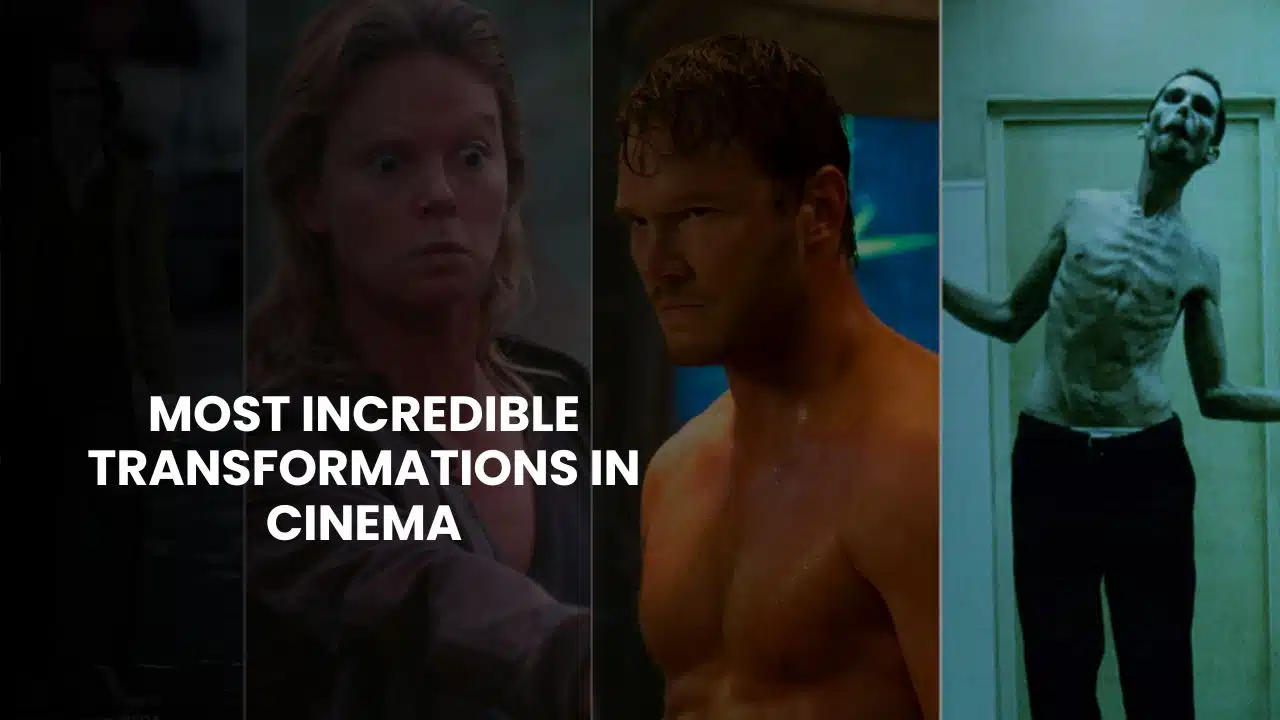
Christian Bale in “The Machinist” (2004): The Incredible Shrinking Man
When it comes to physical transformations, Christian Bale’s preparation for “The Machinist” is often considered the gold standard – or perhaps more accurately, the skeletal standard.
For his role as Trevor Reznik, an industrial worker suffering from severe insomnia, Bale shed an astonishing 63 pounds. He went from his normal weight of about 180 pounds to a gaunt 117 pounds. How did he achieve this dramatic weight loss? Bale’s diet was extreme and definitely not recommended:
• He consumed only one apple and one can of tuna per day.
• He drank excessive amounts of coffee and smoked cigarettes to suppress his appetite.
• He also did intense workouts to burn calories.
The result on screen was shocking and effective. Bale appeared skeletal, with his ribs and spine clearly visible under his skin. His face was gaunt, with sunken eyes that perfectly captured his character’s haunted state of mind.
But the transformation didn’t stop at his physical appearance. Bale also captured the nervous energy and paranoia of a man who hasn’t slept in a year. His twitchy mannerisms and hollow-eyed stare brought the character to life in a way that was both fascinating and disturbing to watch.
It’s important to note that such extreme weight loss can be very dangerous. Bale worked with doctors during this process, but health experts strongly advise against trying to replicate this kind of transformation.
Robert De Niro in “Raging Bull” (1980): The Fighting Weight Gain
If Bale’s transformation for “The Machinist” represents one extreme, Robert De Niro’s preparation for “Raging Bull” stands at the opposite end of the spectrum. De Niro’s portrayal of boxer Jake LaMotta at different stages of his life is a masterclass in physical transformation.
To play the younger, fit LaMotta, De Niro trained extensively with the real Jake LaMotta. He got into such good shape that LaMotta said De Niro could have become a professional boxer. De Niro’s dedication to authenticity was remarkable:
• He fought in three real Brooklyn boxing matches, winning two of them.
• He and director Martin Scorsese used real boxing commentary from the era to choreograph the fight scenes.
• De Niro studied hours of footage of LaMotta to perfect his boxing style and mannerisms.
But the real shock came when De Niro had to portray the older, heavier LaMotta. For these scenes, filmed after a four-month break in production, De Niro gained a whopping 60 pounds. At the time, this was a record for weight gain for a role.
De Niro’s weight gain process was almost as extreme as his boxing training:
• He traveled through Italy and France, indulging in pasta and rich foods.
• He reportedly ate so much that he developed breathing issues.
• The weight gain was so sudden that it actually worried Scorsese, who feared for De Niro’s health.
What made De Niro’s performance truly incredible was how he captured LaMotta’s personality and mannerisms at both stages of his life. He perfectly portrayed both the aggressive, volatile young boxer and the bloated, washed-up older man. This dedication earned De Niro an Academy Award for Best Actor.
Charlize Theron in “Monster” (2003): Beauty and the Beast
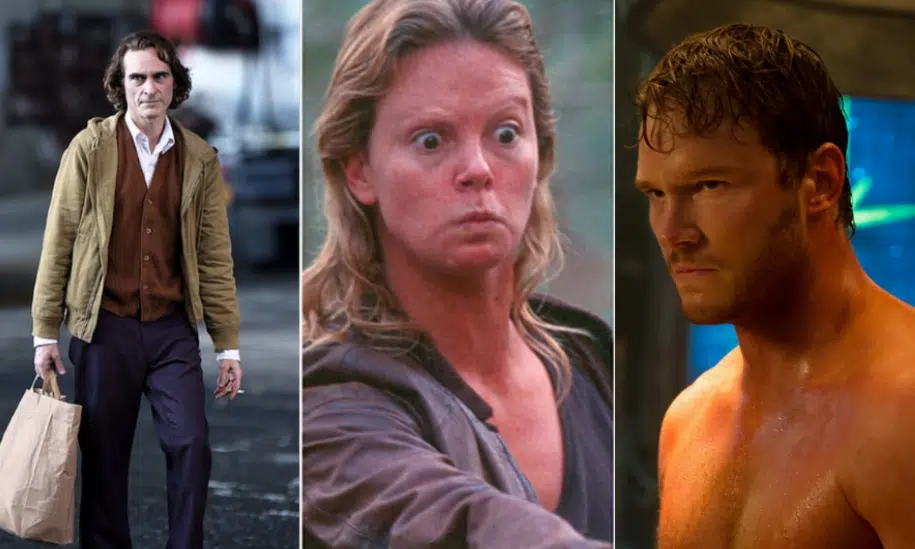
Charlize Theron’s transformation into serial killer Aileen Wuornos in “Monster” is often cited as one of the most dramatic in film history. Known for her stunning beauty, Theron became almost unrecognizable as the troubled and violent Wuornos.
Theron’s physical transformation was extensive:
• She gained 30 pounds for the role, eating a diet high in donuts and potato chips.
• Makeup artists used prosthetic teeth to alter her smile.
• She wore contact lenses that changed her eye color.
• Layers of translucent tattoo ink were applied to her skin to create a weather-beaten look.
• Her eyebrows were partially shaved and bleached.
• Her hair was styled and treated to look damaged and unkempt.
But Theron’s transformation went far beyond the physical. She spent months studying Wuornos:
• She watched hours of interview footage to perfect Wuornos’s distinct speech patterns and mannerisms.
• Theron practiced Wuornos’s walking gait, which she described as “like a big bear.”
• She worked with a dialect coach to master Wuornos’s unique accent.
The result was so convincing that many viewers didn’t realize it was Theron until the credits rolled. Her performance was a complete departure from her previous roles, showcasing a raw, unhinged energy that was both captivating and disturbing.
Theron’s dedication paid off – she won numerous awards for her performance, including an Academy Award for Best Actress.
Heath Ledger in “The Dark Knight” (2008): The Clown Prince of Crime
While many of the transformations we’ve discussed involve dramatic physical changes, Heath Ledger’s transformation into the Joker in “The Dark Knight” was more psychological – but no less impressive.
Ledger’s preparation for the role was intense:
• He isolated himself in a hotel room for a month, developing the Joker’s persona.
• He kept a diary written from the Joker’s perspective, filling it with rants, jokes, and disturbing images.
• He experimented with different voices and laughs until he found the perfect unhinged giggle that would become iconic.
The physical transformation, while less extreme than some others, was still significant:
• Ledger’s hair was dyed green and styled in a messy, unkempt way.
• The Joker’s signature makeup was designed to look smeared and haphazard, as if applied by the character himself.
• Ledger developed a hunched posture and twitchy mannerisms to convey the Joker’s unstable nature.
What made Ledger’s performance truly transformative was his complete inhabitation of the role. He disappeared into the character, creating a Joker that was unpredictable, darkly funny, and genuinely terrifying. His performance was so intense and convincing that it spawned rumors about its effect on his mental health.
Ledger’s portrayal of the Joker is now considered one of the greatest villain performances in cinema history. He was awarded a posthumous Academy Award for Best Supporting Actor for the role.
Rooney Mara in “The Girl with the Dragon Tattoo” (2011): From Delicate to Dangerous

Rooney Mara’s transformation into Lisbeth Salander for “The Girl with the Dragon Tattoo” was a dramatic departure from her previous roles. Known for playing more feminine characters, Mara became the tough, androgynous hacker from Stieg Larsson’s novels.
Mara’s physical transformation was extensive:
• She bleached her eyebrows to make them nearly invisible.
• Her hair was cut short and dyed black.
• She got multiple piercings, including her eyebrow, lip, nose, and nipple.
• She lost weight to achieve Lisbeth’s lean, boyish figure.
• The makeup team used subtle prosthetics to give her face a more angular appearance.
But Mara’s transformation went far beyond her appearance:
• She learned to ride a motorcycle for the role.
• She studied computer hacking to understand Lisbeth’s skills.
• She worked with a dialect coach to perfect a Swedish accent.
• She adopted Lisbeth’s introverted, defensive body language.
Mara’s commitment to the role was so complete that she struggled to shake off Lisbeth’s personality after filming ended. Her performance was a total reinvention, earning her an Academy Award nomination and establishing her as a versatile actress capable of tackling complex roles.
Gary Oldman in “Darkest Hour” (2017): Becoming Churchill
Gary Oldman’s portrayal of Winston Churchill in “Darkest Hour” is a testament to the power of prosthetic makeup combined with extraordinary acting skill. Oldman, who was 59 at the time of filming and naturally slim, transformed into the 66-year-old, heavyset British Prime Minister.
The physical transformation was remarkable:
• Oldman wore a foam bodysuit to add Churchill’s characteristic bulk.
• Prosthetic pieces were applied to his face to create Churchill’s jowls and distinctive profile.
• The makeup process took over three hours each day.
• Careful makeup was applied to complete the illusion, including age spots and Churchill’s famously pink complexion.
But Oldman’s transformation went far beyond his appearance:
• He mastered Churchill’s distinct speaking style, including his lisp and gruff tone.
• He studied hours of footage to capture Churchill’s unique mannerisms and body language.
• He even adopted Churchill’s habits, including drinking whiskey and smoking cigars (though he used nicotine-free herbal cigars for health reasons).
Oldman’s performance was so convincing that many viewers forgot they were watching an actor. His portrayal captured both Churchill’s forceful public persona and his private moments of doubt, creating a fully rounded character. The transformation was so complete that it won Oldman the Academy Award for Best Actor.
The Impact and Future of Incredible Transformations
These transformations do more than just impress audiences – they have a profound impact on cinema and the actors themselves:
1. Elevating storytelling: When an actor truly becomes their character, it adds depth and authenticity to the story, making it more engaging and believable.
2. Showcasing acting range: Dramatic transformations allow actors to break out of typecasting and demonstrate their versatility.
3. Inspiring other actors: These performances set new standards in the industry, inspiring other actors to push their boundaries.
4. Advancing makeup and prosthetic technologies: The demand for realistic transformations drives innovation in makeup and prosthetic techniques.
However, it’s crucial to note that extreme physical transformations can be dangerous. Rapid weight fluctuations, in particular, can have serious health consequences. Many actors work closely with doctors, nutritionists, and trainers to manage these changes as safely as possible. Health experts strongly advise against trying to replicate these transformations in real life.
Looking to the future, we’re seeing new types of transformations emerge thanks to advancing technology:
• Digital de-aging: This technique allows actors to play younger versions of themselves, as seen in Martin Scorsese’s “The Irishman” (2019).
• Performance capture: Actors can now transform into entirely digital characters, like Andy Serkis as Gollum in “The Lord of the Rings” trilogy.
• AI and deepfake technology: While controversial, these technologies are opening up new possibilities for transforming actors on screen.
Despite these technological advancements, there will likely always be a place for practical, physical transformations. The dedication and skill involved in these transformations add a special quality to performances that can’t always be achieved with digital effects.
Takeaways: The Enduring Magic of Transformation
From Christian Bale’s extreme weight loss to Gary Oldman’s prosthetic makeover, the most incredible transformations in cinema continue to captivate and inspire us. They remind us of the power of dedication, the magic of creativity, and the incredible plasticity of the human form and psyche.
These transformations blur the line between actor and character, creating performances that linger in our minds long after the credits roll. They challenge our perceptions, push the boundaries of what’s possible in filmmaking, and often result in some of the most memorable characters in cinema history.
As moviegoers, we’re privileged to witness these extraordinary metamorphoses. They add an extra layer of magic to the moviegoing experience, leaving us in awe of the actors’ commitment to their craft. So the next time you’re watching a film and find yourself wondering, “Is that really the same person?”, take a moment to appreciate the incredible artistry and dedication behind these amazing transformations.
In the end, these transformations remind us of cinema’s unique power – to make us believe in the impossible, to transport us to other worlds, and to show us the limitless potential of the human spirit. And isn’t that why we fell in love with movies in the first place?
























