June 26, 2016. MetLife Stadium in New Jersey was shaking with noise, light and nervous energy. Argentina and Chile had fought through the Copa América Centenario final without scoring, and the title would now be decided on penalties.
Lionel Messi stepped forward to take Argentina’s first kick.
An entire country’s unfinished dream seemed to rest on his left foot. Messi took his shot. The ball flew over the crossbar.
Argentina went on to lose their second consecutive Copa América final to Chile. They had suffered the same fate against the same opponent a year earlier. Before that came the extra-time defeat to Germany in the 2014 World Cup final. Three major finals in three years. Three painful journeys home without a trophy.
After the match, Messi stood in front of the reporters and said his time with the national team was over. He had tried, he explained. He had played in four finals and failed to make Argentina champions. He no longer believed he could do it.
It sounded like a dramatic retirement announcement, but it was really something much more human. It was the voice of a man exhausted by public expectation, relentless criticism and the sharpest kind of ridicule.
Messi was only 29 that night. He was already one of the greatest footballers the game had ever seen, yet his story with Argentina still carried an uncomfortable question mark. Critics said he belonged to Barcelona, not Argentina. They said he did not carry the country’s passion inside him. He did not shout like Diego Maradona, shake teammates awake or deliver fiery speeches after defeat.
His quietness was treated as weakness. His composure was mistaken for indifference. Every failure was framed as a lack of patriotism.
Messi was not retiring from football that night. He was trying to escape an endless public trial.
No one knew that six years later, in another major final decided by penalties, the same man would once again walk forward to take Argentina’s first kick. To understand why that moment would matter so much, though, we have to go further back, to a home in Rosario, where a small boy had no idea that before he could take on the football world, he would first have to fight against the limits of his own body.
The Boy from Rosario
Lionel Andrés Messi was born on June 24, 1987, in Rosario, Argentina. It was a city of family ties, neighbourhood football and the ordinary toughness of working-class life. It was also the kind of place where a small child with a ball could suddenly make everyone nearby stop and watch.
Away from the pitch, Messi was shy and almost painfully quiet. He often looked down when speaking to strangers. Give him a football, however, and his whole body changed. He began playing for local club Grandoli when he was very young, then moved into the youth system at Newell’s Old Boys.
He was smaller than most of the children around him, but his balance, speed and connection with the ball were unusually natural. Bigger opponents tried to use their bodies against him. Messi simply slipped past them before they could set their feet.
Then, when he was around 10 or 11, concerns grew over his physical development. Doctors diagnosed him with a growth hormone deficiency. He needed regular injections, and the treatment was expensive. His family could not afford to carry the cost indefinitely.
That part of Messi’s story is now often told like the beginning of a fairy tale. For the child living through it, there was nothing magical about it. He did not know what the Ballon d’Or meant. He did not know whether he would ever play in Europe or lift a World Cup. He only knew that his body was not developing like those of other children and that his dream of playing football had become tied to a medical bill.
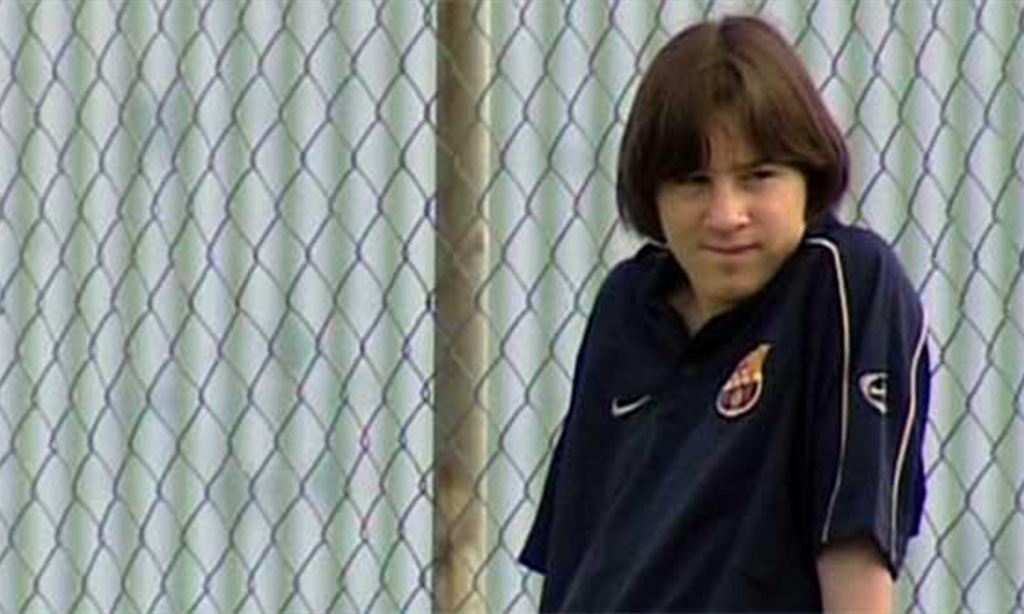
In 2000, at the age of 13, Messi crossed the Atlantic with his family and travelled to Barcelona. His talent quickly impressed the club’s coaches. Barcelona agreed to bring him into their academy and help cover the cost of his treatment.
The opportunity changed his life, but it did not make life easy overnight.
There was a new country, a different culture, distance from home, an uncertain future and the loneliness of growing up away from much of his family. His mother and siblings eventually returned to Rosario, while Messi remained in Barcelona with his father, Jorge.
No one could have known what that decision would come to mean.
Messi moved quickly through the academy levels. In 2004, at 17, he made his La Liga debut for Barcelona’s first team. On May 1, 2005, he scored his first official senior goal against Albacete, lifting the ball over the goalkeeper after a pass from Ronaldinho.
Moments earlier, he had scored in almost exactly the same way, only for the goal to be ruled out for offside. When the chance came again, he did not abandon the idea. He tried it a second time.
The future Messi was already visible in that little finish. He refused to give up on an imaginative solution simply because it had failed once. He had the courage to repeat a difficult choice and the awareness to read the goalkeeper’s position in an instant.
What followed was not just the rise of a gifted footballer. It was the building of an era.
Over the next two decades, that small boy from Rosario would rewrite many of football’s most important records. But his childhood had already offered the first piece of evidence about his greatness. Messi’s story was not simply about natural talent. It was about receiving one chance, holding on to it and turning what looked like a physical limitation into one of his greatest advantages.
A Mountain of Numbers and a Club Empire
Look at Messi’s career statistics and the scale of his achievements can feel almost unreal.
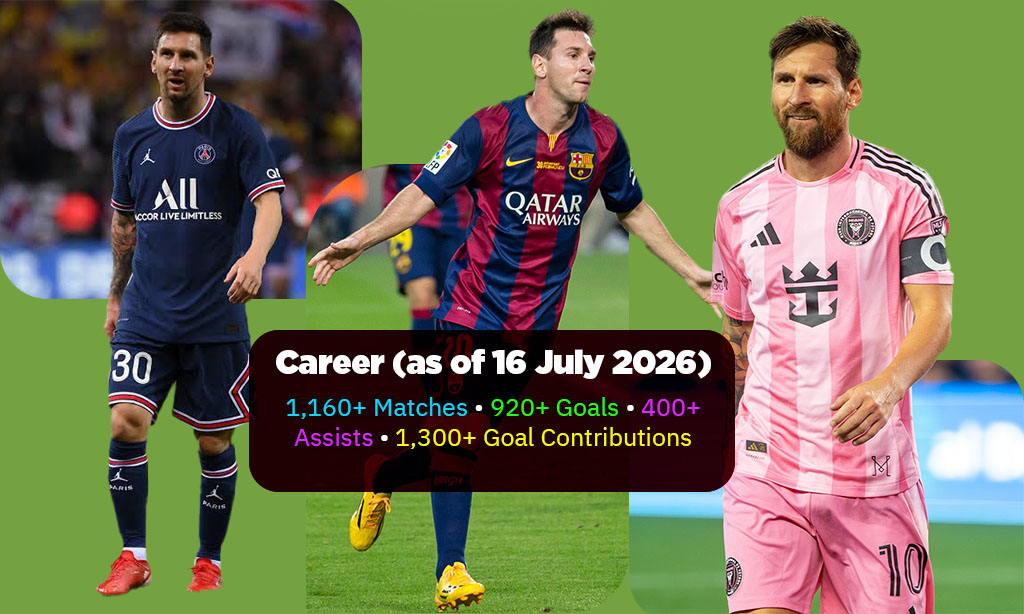
By July 16, 2026, he had played more than 1,160 senior matches for Barcelona, Paris Saint-Germain, Inter Miami and Argentina. He had scored close to 920 goals. Assist totals vary between statistical databases because they use different counting methods, but more than 400 are widely recorded. That puts his direct involvement in goals well beyond 1,300.
In 2012, Messi scored 91 goals in a single calendar year. Seventy-nine came for Barcelona and 12 for Argentina. He broke Gerd Müller’s long-standing record of 85, and the mark remains untouched.
Then there are the other numbers. Eight Ballon d’Or awards, more than any player in history. Six European Golden Shoes. A record 474 La Liga goals. A remarkable 672 competitive goals for Barcelona. More than 120 in the Champions League. He is also Argentina’s all-time leading scorer.
He owns the record for the most goals scored for a single club. He has scored more goals in El Clásico than anyone else and recorded more La Liga hat-tricks than any other player. When he left Barcelona, he was the club’s leading appearance-maker, record scorer and most decorated player.
These numbers are not only huge. They were built and rebuilt over an extraordinary length of time.
Many footballers reach the top for two or three seasons. A few dominate the sport for five years. Messi remained decisive against generation after generation of defenders. He played alongside Ronaldinho, changed the rhythm of the game with Xavi and Andrés Iniesta, and later formed one of football’s most frightening attacking lines with Neymar and Luis Suárez.
As he grew older, he changed again. The explosive forward gradually became a deeper creator, dropping into midfield, controlling the tempo and deciding matches with his passing as much as with his finishing.
Statistics matter when we discuss Messi’s greatness. It would be dishonest to pretend otherwise. His numbers are not decoration. They are hard evidence of a level of consistency very few athletes in any sport have reached.
But it is just as important to understand what numbers cannot tell us.
A goal is the final result of an attacking move. On the scoreboard, its value is simple. One goal. Yet the imagination, balance, timing and rhythm that make the goal possible do not appear in the final score.
Judging Messi only by goals and statistics is like judging a novel by its word count.
Football Beyond the Goal
Messi’s statistics are so overwhelming that they can hide the most important part of his game.
People ask how many goals he has scored, how many assists he has made and how many Ballon d’Or awards he has won. They place his numbers next to those of another player and search for a neat answer.
To understand Messi, though, you have to look away from the scoreboard for a moment.
The goal is the final result. Messi’s art begins much earlier.
He walks during matches. That walk has been discussed and criticised for years. On television, it can sometimes look as though he has drifted out of the game. His teammates are running, opponents are pressing and Messi is moving slowly near midfield, quietly changing his position.
But he is not resting. He is collecting information.
He watches which defender is staring too closely at the ball. He notices where each player has placed his weight. He sees when a full-back has moved forward and left space behind. He studies the distance between the midfield and defensive lines. He reads the exact moment when a teammate might begin a run.
Then, suddenly, one decision changes the speed of the entire match.
Messi’s relationship with the ball cannot be fully explained by saying that he has excellent control. With him, body and ball seem to move in the same rhythm. Every tiny touch prepares the next movement. By the time a defender stretches out a leg to tackle, the ball is no longer there.
He does not overpower defenders. He plays against their balance.
A slight drop of the shoulder, a twist of the waist, a glance in the wrong direction. The defender believes Messi is going one way and shifts his weight. In that instant, Messi is gone in the other direction.
His 2007 goal against Getafe remains one of the most famous examples. He collected the ball near midfield and went past player after player before rounding the goalkeeper. But the beauty of the goal was not simply that he beat five opponents. Every touch opened the next door. Nothing was wasted. Nothing was there only for show.
Barcelona supporters later voted it the greatest goal in the club’s history.
There was the run against Real Madrid in the 2011 Champions League semifinal. The 2015 moment against Bayern Munich, when a subtle shift left Jérôme Boateng falling backwards before Messi lifted the ball over Manuel Neuer. The goal against Athletic Bilbao after weaving past three players near the touchline. The header against Manchester United in the Champions League final. The long-range free kick against Liverpool.
These were not just entries on a goals list. Each one felt like a short study in movement, balance, space and decision-making.
Even then, dribbling is only one part of Messi’s identity.
He is a scorer and a creator at the same time. He can start on the right, move inside and finish. He can drop into midfield and control the speed of the passing. He can receive the ball between defensive lines, turn in a crowded space and send a teammate through on goal. He can attract four defenders toward him and release someone on the opposite side of the pitch.
He can pass between a goalkeeper and a defender with the pace of a shot and the softness of an invitation.
That is why his assist numbers are so remarkable. Even those numbers fail to capture everything he creates. If Messi breaks the first defensive line and the next pass produces a goal, his original contribution may disappear from the record. If he drags three defenders away and creates the space that someone else uses, the scoresheet will not include his name.
The match has still changed because of him.
A goal total can tell us how effective a finisher is. Messi, however, is not only the final point of an attack. He can be its beginning, its rhythm and its last decision.
At different moments, he has controlled games like Xavi, escaped pressure like Iniesta and finished like a pure number nine. Sometimes he has done all three in the same match.
That range is what separates him.
Goals are football’s most important events, of course. But greatness is not only about how many times the ball reaches the net. It is also about how the presence of one player changes the positions of the other 21. How deep the opposition retreats. How much courage his teammates gain. Why thousands of people rise from their seats the moment the ball reaches his foot.
Messi scores goals. More importantly, he turns the moments before a goal into art.
The Defeats That Shaped Him
The more Messi won at club level, the heavier Argentina’s shirt became.
Each Ballon d’Or seemed to create another question about his national-team career. If he could change matches so easily for Barcelona, why could he not lead Argentina to a major title?
At the 2014 World Cup, Messi helped take Argentina to the final. He scored important goals in the group stage, played a decisive role in the knockout rounds and carried much of the team’s attacking burden. In the final at the Maracanã, however, Mario Götze scored in extra time to give Germany the trophy.
Messi received the Golden Ball. He did not receive the World Cup.
In 2015, Argentina lost the Copa América final to Chile on penalties. In 2016, it happened again. Same opponent, same method, and this time Messi missed his own kick. That defeat pushed him to announce his international retirement.
The pressure was not only about missing trophies. Messi was constantly compared with one particular version of Maradona, the man who had driven Argentina to the 1986 World Cup title. It was as though the only acceptable way to prove greatness in a team sport was to recreate another legend’s story exactly.
Messi eventually returned because staying away from Argentina did not bring him peace. Yet the 2018 World Cup offered no release. A disorganised Argentina lost 4-3 to France in the round of 16.
Those defeats did not weaken Messi’s claim to greatness. They made his story more human.
Even the greatest players face nights when talent is not enough. The wrong team, the wrong tactical setup, crushing pressure and a little bad luck can close the door on a trophy.
The real shift came under Lionel Scaloni.
Scaloni did not ask Messi to carry an entire nation alone. He built a side that could use Messi’s genius, cover the spaces around him and fight for him when necessary. Rodrigo De Paul, Emiliano Martínez, Cristian Romero, Lautaro Martínez and later Julián Álvarez did not treat Messi like a distant god.
To them, he was the most loved man in the team.
That relationship changed everything.
Maracanã Tears and the Beginning of Freedom
The 2021 Copa América final took place at the Maracanã. Argentina faced Brazil. Ángel Di María scored, and Argentina spent the rest of the match protecting the lead with everything they had.
When the final whistle blew, Messi dropped to the ground. His teammates ran toward him, surrounded him, lifted him and threw him into the air.
There were tears again.
But the tears at MetLife in 2016 and those at the Maracanã in 2021 were not the same. The first came from emptiness. The second came from release.
It was Messi’s first major senior international title with Argentina. More than a trophy, it was a door opening after years inside a mental prison. The argument that he could never win with his country had finally lost its foundation.
A year later, Argentina defeated European champions Italy 3-0 at Wembley to win the Finalissima. Messi created two goals and was named player of the match. The victory showed that the Copa América had not been one emotional night. Scaloni’s team was now organised, confident and built for the biggest occasions.
The Copa América was one piece of proof. The Finalissima was another.
One final question remained.
Could he win the World Cup?
The Night in Lusail and the End of an Unfinished Story
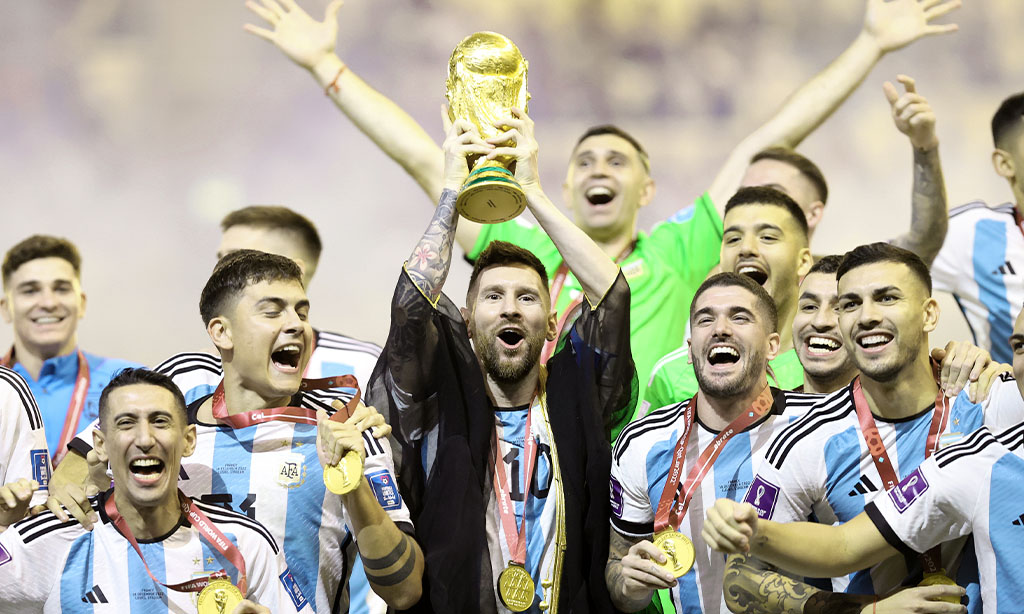
Argentina’s 2022 World Cup began with a 2-1 defeat to Saudi Arabia. Their long unbeaten run ended without warning, and old doubts immediately returned. Was Messi’s final World Cup going to collapse in its opening week?
Argentina struggled for a long time in the next match against Mexico. Their passing was tense and their movement uncertain.
Then Messi struck a low left-footed shot from outside the box.
That goal taught the team how to breathe again.
From there, Messi slowly turned the tournament into his own story. He scored against Australia. Against the Netherlands, he delivered a pass to Nahuel Molina through a route that was difficult to see even from the television camera above the pitch. In the semifinal against Croatia, he twisted Joško Gvardiol around on the right before creating a goal for Julián Álvarez.
The explosive speed of the younger Messi had faded slightly. His understanding of the match had grown deeper.
December 18, 2022. Lusail Stadium. Argentina against France in the World Cup final.
Messi scored from the penalty spot. Di María added a second. Argentina led 2-0, and for a while it seemed football might finally allow a simple ending.
Then Kylian Mbappé scored twice in two minutes.
Messi struck again in extra time. Mbappé equalised from another penalty. The score was 3-3, and one of the most dramatic finals in World Cup history went to a shootout.
Messi walked forward to take Argentina’s first penalty.
Six years earlier in New Jersey, he had sent Argentina’s first kick over the crossbar against Chile. After that defeat, he said his journey with the national team was finished.
Now Hugo Lloris stood in front of him. Behind him, an entire nation held its breath.
Messi began his run-up. There was no panic and no attempt to overpower the goalkeeper. He watched Lloris and calmly rolled the ball into the net.
The failure of 2016 and the freedom of 2022 met on the same white spot.
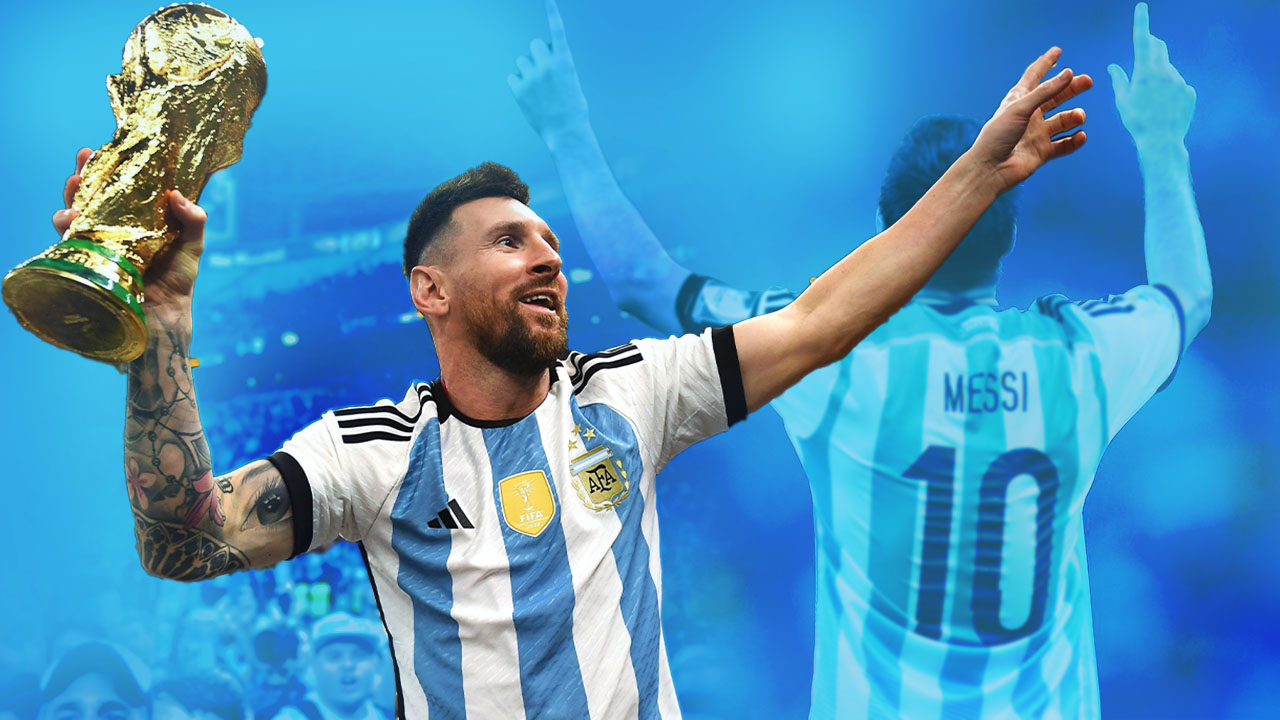
When Gonzalo Montiel converted the final penalty, Messi fell to his knees. His teammates covered him. Not long after, he lifted the World Cup, the trophy whose absence had been used as the final argument against his career.
Messi finished the Qatar tournament with seven goals and three assists. He scored twice in the final and converted his kick in the shootout. He also won the World Cup Golden Ball for the second time, becoming the first player to receive the award twice.
The World Cup did not suddenly make him great. He had been great for years.
What the trophy did was remove the most repeated objection from his story. The words “he cannot do it for his country” were buried in the grass at Lusail.
A Full Circle Completed by Four Titles
Messi’s story could have ended in Qatar without feeling incomplete. There was nothing left for him to prove.
Still, the 2024 Copa América added another important layer to his international career.
In the final against Colombia, Messi suffered an ankle injury and had to leave the pitch. He sat on the bench in tears, his swollen ankle clearly visible.
In 2016, he had cried because of his own failure. In 2024, he cried because he could no longer help the team finish the match.
This time, Argentina did not collapse without him.
Lautaro Martínez scored in extra time to win the final. Once again, Messi’s teammates carried the trophy to him.
The 2021 Copa América, the 2022 Finalissima, the 2022 World Cup and the 2024 Copa América made it four consecutive international titles. A career once defined by lost finals had become the centre of Argentina’s most successful sustained era.
The 2024 victory also offered a different kind of proof about Messi’s leadership. It is easy to make a team dependent on you. It is much harder to help create a team that can lose its captain and still find a way to win for him.
Once, Argentina had looked to Messi for release. By 2024, Argentina had learned how to give some of that freedom back to him, and they had learned it with Messi at the heart of the process.
Still Controlling Time at 39
After Qatar, people wondered whether Messi would play at the 2026 World Cup. Even if he did, how much could he really offer? Most attacking players have already retired by 39, or they are surviving on reputation while quietly negotiating with the limits of the present.
Messi did not negotiate. He adapted.
When he joined Inter Miami, many assumed the highest level of his competitive career was over. Yet he returned from the United States to the world stage and remained central to Argentina.
By July 16, 2026, Argentina had reached a second consecutive World Cup final. In the semifinal against England, they were trailing 1-0 before Messi helped create both late goals. His pass began the move for Enzo Fernández’s equaliser, and his cross led to Lautaro Martínez’s winner in stoppage time.
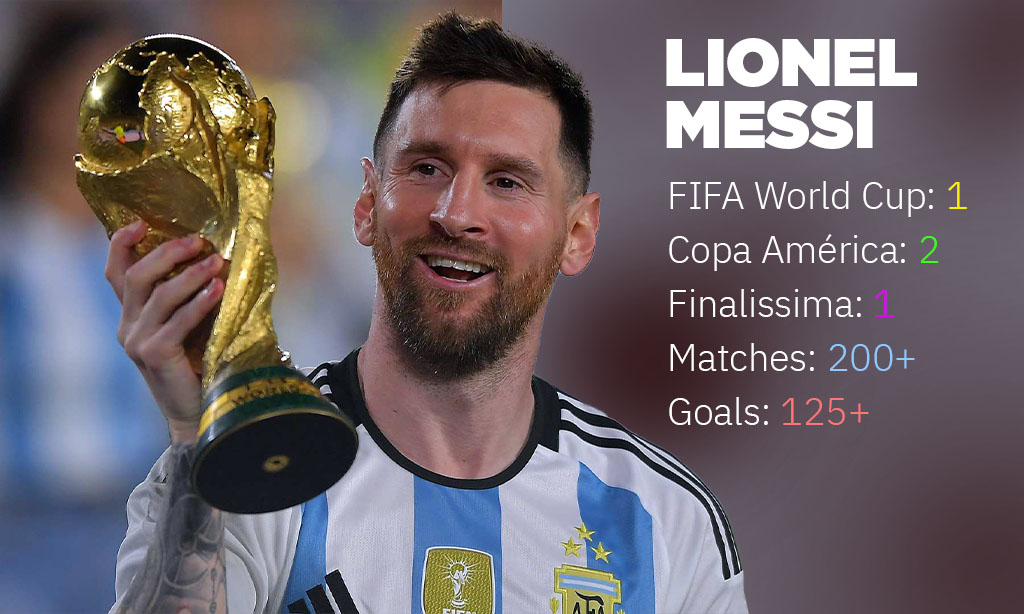
After seven matches, Messi had eight goals and four assists at the tournament. His career World Cup total had reached 21 goals, the most in the competition’s history.
Before the semifinal, people had praised him for scoring. Against England, he changed the result without scoring at all.
That is the central argument for his greatness. Messi can be the most important player in a match even when his name does not appear beside a goal, because his influence does not begin or end with the scoreboard.
The Messi of 2012 could collect the ball and run past four defenders. The Messi of 2026 does not attempt that every five minutes. He waits. He studies the opposition’s shape. He sees who is tired, who is becoming too aggressive and where space is beginning to appear.
Against England, he moved away from the crowded centre and searched for room on the right. When England narrowed their defensive block, Messi began receiving the ball outside it. From there came the two decisive passes.
His body has slowed, but his mind has become sharper.
He now creates more danger with fewer runs. He opens more doors with fewer touches. Physical speed once carried him past defenders. Timing now does the same work.
The 2026 World Cup is therefore not only evidence of longevity. It is evidence of adaptation. Messi has shown that truly great players do not dominate an era with only one weapon. They remain influential even after those weapons change.
He is not fighting time. He is making time play to his rhythm.
The Quiet Responsibility Beyond the Pitch
Messi’s public personality is not as dramatic as his football. He does not give long speeches. He does not share an opinion on every issue. He rarely turns his charitable work into an advertisement for his personal brand.
But quietness is not the same as inaction.
The Leo Messi Foundation, established in 2007, supports children through health care, education and access to sport. As a UNICEF Goodwill Ambassador, Messi has also been involved in initiatives related to children’s health and education.
The real meaning of that work is not found in a list of institutions, funding totals or official campaigns. It is found in the lives of children for whom a classroom or medical treatment was never guaranteed.
In war-torn Syria, support from his foundation helped create 20 temporary but fully equipped classrooms. More than 1,600 children were given the chance to return to education. Many had lost their homes. War had taken away ordinary mornings, familiar streets and the safety of childhood.
A classroom did not only give them books. For a few hours each day, it gave them back a sense of normal life.
The foundation has also supported childhood cancer treatment and research. Yet the deeper meaning is not in the names of hospitals or the size of individual projects. When a family is trapped between medical bills, waiting rooms and uncertainty, help means more than money.
It means one more chance to keep trying.
Messi understands that feeling.
He was once a child whose story might have stopped if treatment had become impossible. Barcelona did not simply give him a shirt. The club helped make it possible for him to continue receiving medical care.
One opportunity changed his physical development, his career, his family’s life and, eventually, football history.
Perhaps that is why children remain at the centre of his work. He did not turn the vulnerability of his childhood into decoration for his legend. He used the memory to open a path for someone else.
On the pitch, Messi sees gaps that appear closed to everyone else. Away from football, his most human work follows the same idea. When every path seems blocked for a child, he tries to help keep at least one open.
That, too, is a form of proof.
Greatness is not only the ability to make the world look at you. It is also the willingness to look back at people whom most of the world does not have time to see.
There Is Only One Messi
There is no perfect machine for deciding the greatest footballer of all time. There is no single, universally accepted measurement. Eras change. Rules change. The pace of the game changes.
Pelé transformed his time. Maradona carried a nation’s imagination in his body. Ronaldinho brought an unforgettable sense of joy and magic to the game. Cristiano Ronaldo set an extraordinary standard for goals, discipline and longevity.
Messi does not need any of them to be diminished for his greatness to stand.
The final proof in his favour is not one trophy, one goal or one record. It is spread across the whole journey.
The undersized boy from Rosario lived through medical uncertainty and crossed an ocean to join Barcelona. There, he broke scoring records without becoming only a scorer. With his passing, rhythm, dribbling and imagination, he expanded football’s language.
He lost repeatedly with Argentina. He broke down, retired and returned. He found release at the Maracanã and answered the final question in Lusail. At 39, he showed that a World Cup semifinal could still be written by his feet even when he did not score.
And after all of it, he never forgot what it felt like to be a child who simply needed a chance.
Perhaps that is why statistics can never fully contain him. The numbers speak powerfully in his favour, but they cannot hold everything he is. The trophies decorate his career, but they cannot explain what it feels like to watch him play.
One day, one of his records will fall. A future player may score more goals, run faster or remain at the top for even longer.
But breaking records and changing the language of a sport are not the same thing.
Lionel Messi did not simply rewrite football’s records. He changed the language of how football is played and how it is watched.