Why does the entire planet freeze for a leather ball every four years? Why does a single goal make millions cry tears of joy while others sink into total heartbreak? The answer lives on football’s biggest stage—the exact place where immortal FIFA World Cup records are born.
Back in 1930, Uruguay hosted a scrappy little 13-team tournament. Fast forward to 2026, and that modest competition has exploded into a 96-year epic featuring a sprawling, 48-nation battle royal. Over the decades, these pitches have seen absolute heart, blood, tears, and unbelievable human feats. And the 2026 FIFA World Cup has already shattered FIFA World Cup records that stood for generations.
In this deep dive, you’re getting the complete breakdown of World Cup history from day one to the ongoing 2026 tournament. We’ll walk through the World Cup history and timeline, every single champion, incredible team and player stats, and the unforgettable stories that define the game. Whether you’re a die-hard supporter or just tuning in for the hype, consider this your ultimate football playbook.
Tournament History & Timeline: 1930 to 2026
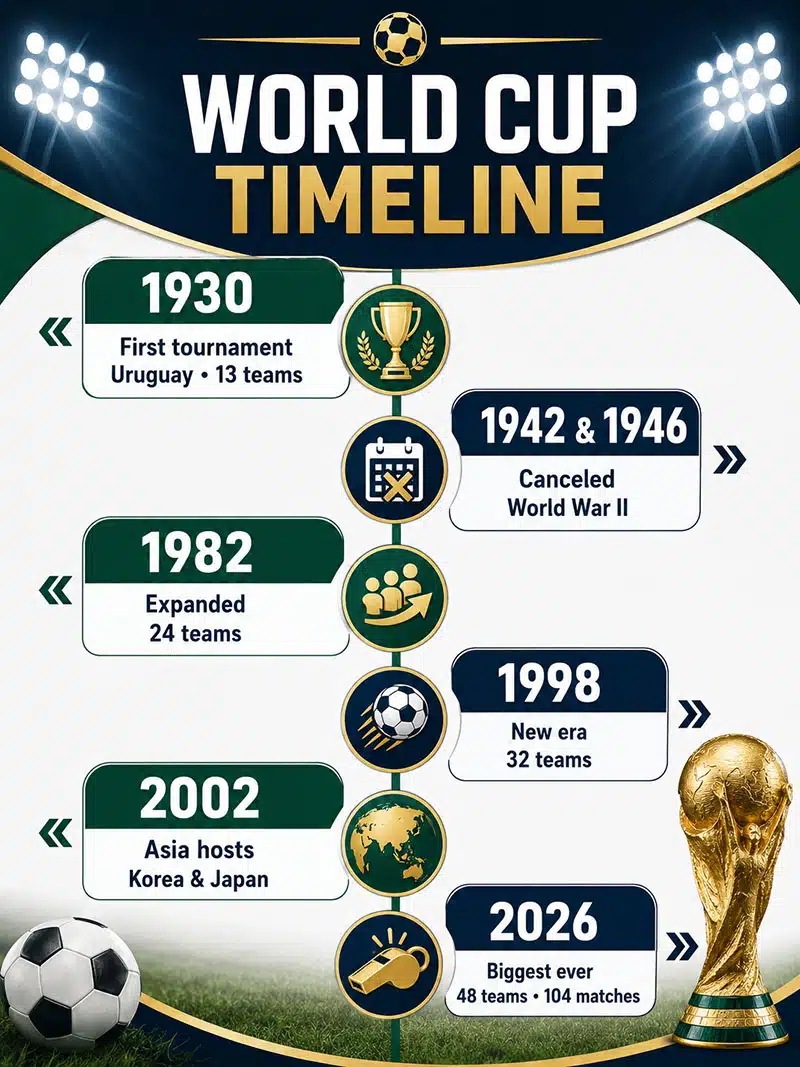
The story begins in 1930. Driven by the vision of former FIFA President Jules Rimet, the very first World Cup kicked off in Uruguay. The hosts rode their home-field advantage all the way to the final, crushing Argentina 4–2 to lift the inaugural trophy.
Dark days interrupted the tournament’s momentum soon after. World War II forced FIFA to cancel the 1942 and 1946 editions entirely. When peace returned, football did too, roaring back to life on Brazilian soil in 1950.
The tournament’s format hasn’t stopped evolving since. We went from 13 teams in 1930 to 16 in 1934. Spain hosted a 24-team expansion in 1982, and France ushered in the 32-team era in 1994. Now, the 2026 World Cup has rewritten the rulebook with a massive 48-team roster competing across 104 matches.
Major Milestone Tournaments
- 1950: Uruguay breaks nearly 200,000 Brazilian hearts at the Maracanã.
- 1966: Football comes home as England wins its first and only world title.
- 1970: Brazil plays arguably the most beautiful football ever seen, retiring the original Jules Rimet Trophy.
- 1986: Diego Maradona puts on a one-man masterclass in Mexico.
- 1994: A World Cup final ends in a penalty shootout for the very first time.
- 2002: Asia co-hosts the tournament for the first time in South Korea and Japan.
- 2022: Qatar delivers what many call the greatest, most chaotic final in history.
- 2026: Three nations (USA, Canada, Mexico) join forces to host the biggest World Cup ever, breaking group-stage goal records almost immediately.
Quick Glance: Every Tournament at a Glance
| Year | Host Nation(s) | Teams | Champion | Runner-up | Final Score |
| 1930 | Uruguay | 13 | Uruguay | Argentina | 4–2 |
| 1934 | Italy | 16 | Italy | Czechoslovakia | 2–1 (AET) |
| 1938 | France | 15 | Italy | Hungary | 4–2 |
| 1950 | Brazil | 13 | Uruguay | Brazil | 2–1 |
| 1954 | Switzerland | 16 | West Germany | Hungary | 3–2 |
| 1958 | Sweden | 16 | Brazil | Sweden | 5–2 |
| 1962 | Chile | 16 | Brazil | Czechoslovakia | 3–1 |
| 1966 | England | 16 | England | West Germany | 4–2 (AET) |
| 1970 | Mexico | 16 | Brazil | Italy | 4–1 |
| 1974 | West Germany | 16 | West Germany | Netherlands | 2–1 |
| 1978 | Argentina | 16 | Argentina | Netherlands | 3–1 (AET) |
| 1982 | Spain | 24 | Italy | West Germany | 3–1 |
| 1986 | Mexico | 24 | Argentina | West Germany | 3–2 |
| 1990 | Italy | 24 | West Germany | Argentina | 1–0 |
| 1994 | USA | 24 | Brazil | Italy | 0–0 (3–2 pens) |
| 1998 | France | 32 | France | Brazil | 3–0 |
| 2002 | S. Korea/Japan | 32 | Brazil | Germany | 2–0 |
| 2006 | Germany | 32 | Italy | France | 1–1 (5–3 pens) |
| 2010 | South Africa | 32 | Spain | Netherlands | 1–0 (AET) |
| 2014 | Brazil | 32 | Germany | Argentina | 1–0 (AET) |
| 2018 | Russia | 32 | France | Croatia | 4–2 |
| 2022 | Qatar | 32 | Argentina | France | 3–3 (4–2 pens) |
| 2026 | USA/Canada/Mexico | 48 | Ongoing | Ongoing | Decided July 19 |
All-Time Champions List: The Exclusive Club
Across 96 years and over two dozen tournaments, only eight countries have ever lifted the trophy. European and South American powerhouses lock down this exclusive club entirely; no team from any other continent has ever survived long enough to reach a final. Look at the FIFA World Cup Records list of the champions, and one nation clearly sits on the throne: Brazil.
The Seleção boast a record 5 titles. Hot on their heels are European giants Germany and Italy, each holding 4 trophies. Argentina pushed their count to 3 after winning the thriller in Qatar back in 2022. Rounding out the winners circle are France and Uruguay with 2 titles apiece, alongside England and Spain with 1 each.
Of course, the World Cup can be brutally unfair. Just ask the Netherlands. The Dutch have reached the final 3 times (1974, 1978, 2010) and walked away empty-handed every single time. Czechoslovakia and Hungary also share that heartbreak, both falling short in two separate finals.
Team Records: Dominance, Goals, and Iron Defenses
Most Appearances and Consistency
Only one country has shown up to every single party: Brazil. They hold the absolute FIFA World Cup records by qualifying for all 23 tournaments from 1930 through 2026. Germany takes a comfortable silver medal here, having played in 21 editions.
Most Matches Played and Win Percentages
When it comes to sheer volume of matches played, Brazil and Germany run neck and neck, both sitting well over 110 World Cup games. Brazil edges them out on pure success, maintaining the highest win count and a dominant win rate of roughly 70%.
The Final Match Records
- Most Finals Reached: Germany leads the pack, making it to the biggest match of all 8 times.
- Most Consecutive Finals: Brazil (1994, 1998, 2002) and Germany (1982, 1986, 1990) share this honor, each making 3 straight finals.
- Most Frequent Matchup: Argentina vs. Germany is the ultimate World Cup rivalry, clashing in the final 3 times (1986, 1990, 2014).
- Biggest Blowout in a Final: Brazil smashed Sweden 5–2 in 1958, a margin tied by France when they routed Brazil 3–0 in 1998.
Team Scoring Records
- Most Total Goals: Brazil holds the all-time scoring crown across all tournaments combined.
- Highest-Scoring Single Tournament: Back in 1954, Hungary went on an absolute rampage, scoring 27 goals in just 5 games.
- Highest-Scoring Single Match: Austria defeated Switzerland 7–5 in 1954, packing an insane 12 goals into 90 minutes.
- Biggest Margin of Victory: Hungary obliterated El Salvador 10–1 during the 1982 group stages.
Defensive Records
- Fewest Goals Conceded in a Tournament: Switzerland played the 2006 tournament without letting in a single goal during regular play, only exiting after losing a penalty shootout.
- Longest Clean-Sheet Streak: Spain’s goalkeeper Unai Simón rewrote the history books in 2026, going 519 consecutive minutes without conceding a goal, breaking Walter Zenga’s 36-year-old record (518 minutes).
Individual Goalscoring Records: The Goal Machines
Football is all about putting the ball in the back of the net. Do it on the World Cup stage consistently, and you become a legend. For 12 years, the World Cup goalscoring records were ruled by Germany’s Miroslav Klose and his 16 goals. Then came 2026.
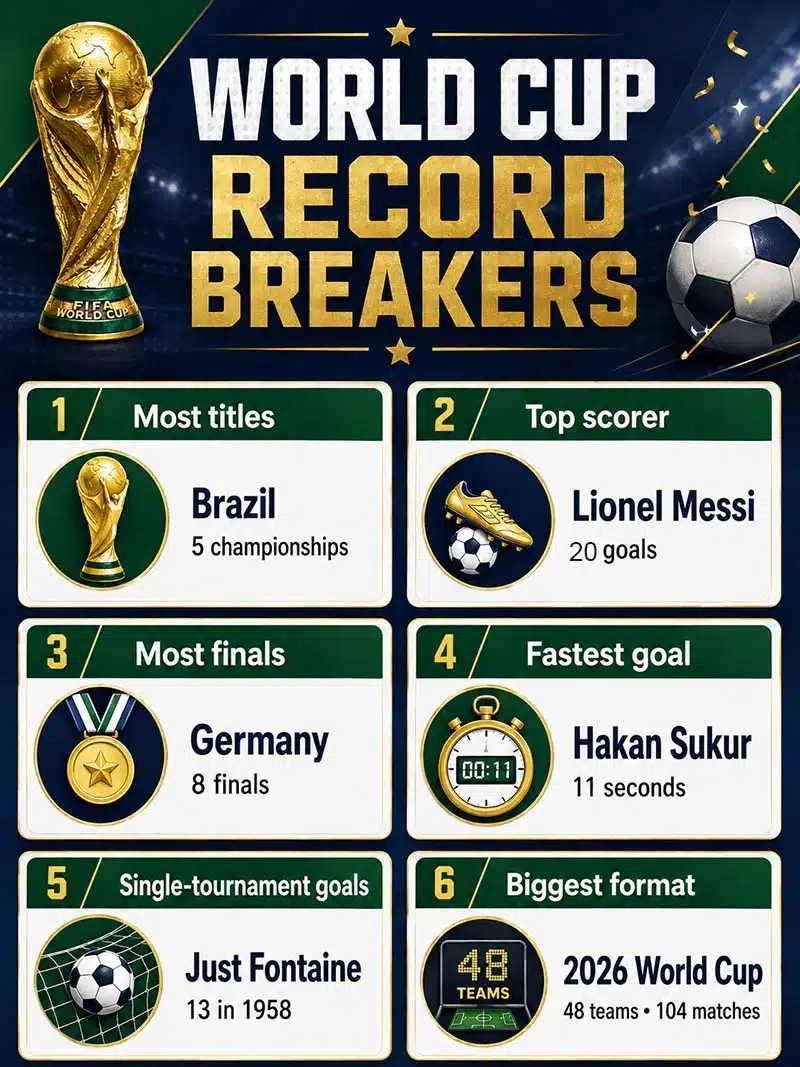
Argentine maestro Lionel Messi rewrote football history during the 2026 tournament. Playing with vintage brilliance, he pushed his career World Cup tally to 20 goals (July 4, 2026), cementing himself as the undisputed all-time top scorer.
Still, nobody touches French striker Just Fontaine when it comes to a single tournament explosion. In 1958, Fontaine scored a jaw-dropping 13 goals in just 6 games—a record that feels practically immortal today. For single-game dominance, look to Russia’s Oleg Salenko, who scored 5 goals in one match against Cameroon in 1994.
More Incredible Scoring Milestones
- Fastest Goal Ever: Turkey’s Hakan Şükür stunned South Korea in 2002, scoring just 11 seconds after the opening whistle.
- Youngest Goalscorer: A 17-year-old Pelé announced himself to the world in 1958, scoring against Wales at just 17 years and 239 days old.
- Oldest Goalscorer: Cameroon icon Roger Milla found the net against Russia in 1994 at 42 years and 39 days old.
- Most Career Hat-Tricks: Sándor Kocsis (Hungary), Just Fontaine (France), Gerd Müller (West Germany), and Gabriel Batistuta (Argentina) all share this top spot with 2 hat-tricks each.
All-Time Top 10 World Cup Goalscorers (Updated for 2026)
| Rank | Player | Country | Total Goals | Tournaments Played |
| 1 | Lionel Messi | Argentina | 20 | 5 (2006–2026) |
| 2 | Kylian Mbappé | France | 18 | 3 (2018–2026) |
| 3 | Miroslav Klose | Germany | 16 | 4 (2002–2014) |
| 4 | Ronaldo Nazário | Brazil | 15 | 4 (1994–2006) |
| 5 | Gerd Müller | West Germany | 14 | 2 (1970–1974) |
| 6 | Just Fontaine | France | 13 | 1 (1958) |
| 7 | Pelé | Brazil | 12 | 4 (1958–1970) |
| 8 | Harry Kane | England | 11 | 3 (2018–2026) |
| 9 | Sándor Kocsis | Hungary | 11 | 1 (1954) |
| 10 | Jürgen Klinsmann | Germany | 11 | 3 (1990–1998) |
Appearance Records: The Marathon Men
Surviving at the international level long enough to play in multiple World Cups takes insane dedication. A tiny, elite club of players has stepped onto the pitch across 5 different World Cups. That list includes Germany’s Lothar Matthäus, Mexico’s Antonio Carbajal, Rafael Márquez, Andrés Guardado, and modern legends Lionel Messi and Cristiano Ronaldo.
When we look at total matches played, Lionel Messi sits alone at the top. By extending his run into the 2026 tournament, he pushed his record to an astonishing 29 matches played. Hot on his heels is Cristiano Ronaldo, racking up 26 appearances of his own.
If you measure durability by minutes on the pitch, Italy’s legendary defender Paolo Maldini is king. Maldini logged an exhausting 2,217 minutes of World Cup action. As for racking up victories, Miroslav Klose and Lionel Messi share the record for most individual match wins as players.
Age Records: Teenage Phenoms and Ageless Wonders
The World Cup doesn’t care about birth certificates. We’ve watched 17-year-old kids run circles around veterans, and we’ve seen guys in their mid-40s anchor national defenses. Northern Ireland’s Norman Whiteside remains the youngest player to ever step onto the pitch, making his debut in 1982 at just 17 years and 41 days old.
At the other end of the spectrum is Egyptian goalkeeper Essam El-Hadary. He took the field against Saudi Arabia in 2018 at a staggering 45 years and 161 days old.
The 2026 tournament brought its own age-defying history. Portugal’s Cristiano Ronaldo became the oldest player to feature in a World Cup knockout match, suiting up against Croatia at 41 years and 147 days old. He also nailed a penalty in that match, making him the oldest knockout stage goalscorer ever. Meanwhile, Lionel Messi became the oldest player to score a World Cup hat-trick at 38 years and 357 days old.
Goalkeeper Records: The Brick Walls
You simply don’t win a World Cup without an elite shot-stopper guarding the net. The record for most career clean sheets is a tie between England’s Peter Shilton and France’s Fabien Barthez, both shutting out the opposition in 10 separate matches.
For single-game heroics, look at American keeper Tim Howard. In 2014, Howard put on a super-human performance against Belgium, making a record 16 saves in a single match. When it comes to the high-stakes drama of penalty shootouts, Argentina’s Sergio Goycochea, Croatia’s Danijel Subašić, and Dominik Livaković share the crown, each saving 4 penalties in a single tournament.
Awards Records: The Best of the Best
When the final whistle blows, FIFA hands out hardware to the tournament’s standout performers. The best overall player takes home the Golden Ball, the top scorer gets the Golden Boot, and the top keeper earns the Golden Glove.
Lionel Messi stands as the only player in football history to win the Golden Ball twice, taking it home in both 2014 and 2022. Winning the Golden Ball and the Golden Boot in the exact same tournament is extremely rare, achieved only by Italy’s Salvatore Schillaci (1990), Argentina’s Mario Kempes (1978), and Brazil’s Garrincha (1962).
Cards & Discipline Records: Seeing Red
Football tensions run high, and sometimes that passion boils over into pure chaos. Uruguay’s José Batista holds the embarrassing record for the fastest red card in history. In 1986, he wiped out Scotland’s Gordon Strachan just 56 seconds into the match and was sent straight to the showers.
If you want absolute chaos, look up the 2006 clash between Portugal and the Netherlands—better known as the “Battle of Nuremberg.” Russian referee Valentin Ivanov lost control of a brutal, foul-heavy match, handing out a world-record 16 yellow cards and 4 red cards.
As for taking a beating, nobody suffered more than Diego Maradona. Opponents fouled the Argentine genius an eye-popping 53 times during the 1986 tournament alone.
Coach & Referee Records: Leaders on the Touchline
Managing a national team under World Cup pressure takes serious guts. Brazil’s Carlos Alberto Parreira is the ultimate touchline veteran, managing across 6 different World Cups with five different nations. Germany’s Helmut Schön holds the record for most total matches managed, coaching 25 games.
The 2026 tournament rewrote the record books for seasoned managers. Curaçao coach Dick Advocaat became the oldest manager in World Cup history at 78 years and 271 days old. Not long after, South Africa’s Hugo Broos became the oldest coach to actually win a World Cup match at 74 years and 75 days old. On the officiating side, Uzbekistan referee Ravshan Irmatov holds the record for most games blown, taking charge of 11 matches.
Stadium & Attendance Records: Packed Stands and Roaring Crowds
Nothing beats the atmosphere of a packed World Cup stadium. The biggest single-game crowd in history crammed into Brazil’s legendary Maracanã Stadium back on July 16, 1950. Official estimates say 199,854 fans packed the concrete bowl to watch Uruguay break Brazilian hearts.
For decades, the USA 1994 tournament held the overall attendance record, pulling in nearly 3.6 million fans across 52 games. But the 2026 World Cup completely blew that out of the water. With the tournament expanding to 104 matches across massive North American stadiums, the 2026 group stage alone packed in over 4.64 million fans, setting a brand-new benchmark for global attendance.
Host Nation Records: Home-Field Advantage
Hosting the World Cup is a massive boost for any team. Uruguay (1930), Italy (1934), England (1966), West Germany (1974), Argentina (1978), and France (1998) all rode that home-crowd energy all the way to lifting the trophy.
Of course, hosting doesn’t guarantee success. South Africa (2010) and Qatar (2022) both suffered the sting of getting knocked out in the group stages on their own soil. In 2026, co-hosts USA, Canada, Mexico all put on strong displays, with Mexico becoming the first CONCACAF team to string together four consecutive World Cup match wins.
Economic & Global Impact: A Multi-Billion Dollar Game
Back in 1930, there wasn’t a massive prize pool waiting for the winners—just a trophy and bragging rights. Today, the World Cup is an absolute financial monster. The 2022 Qatar tournament handed out $440 million in prize money across the teams.
The 2026 World Cup smashed every financial and viewership record on the books. FIFA bumped the winner’s payout to a cool $50 million. Viewership hit jaw-dropping heights too; hundreds of millions streamed games digitally, making the 2026 tournament the most lucrative and widely watched sports event in human history.
Unforgettable Moments: Stories That Defined the World Cup
Stats tell part of the story, but magic moments make the World Cup immortal. Here are the unforgettable World Cup moments that shaped football history:
The Hand of God (1986)
June 22, 1986. Argentina faces England at the Azteca Stadium with the Falklands War lingering heavily in the background. In the 51st minute, Diego Maradona leaps into the air alongside English keeper Peter Shilton. Instead of heading the ball, Maradona slyly punches it into the net with his left hand. The referee misses the infraction completely and awards the goal. Afterward, Maradona cheekily credited “a little with the head of Maradona, and a little with the hand of God.”
Goal of the Century (1986)
Just four minutes after his infamous handball, Maradona delivered pure football perfection. Picking up the ball inside his own half, he sprinted 60 meters, dancing past five English defenders before leaving Shilton flat-footed and tapping the ball home. In 2002, FIFA voters officially named it the “Goal of the Century.”
Mineirazo: Brazil’s Darkest Day (2014)
Playing without their injured star Neymar, hosts Brazil faced Germany in the 2014 semifinal at the Mineirão Stadium. What followed was total shock. Germany tore Brazil’s defense apart, scoring five goals in the first 29 minutes. The match ended in a crushing 7–1 defeat, marking the most humiliating loss in Brazilian football history.
Zidane’s Infamous Headbutt (2006)
The 2006 final served as the last professional match for French genius Zinedine Zidane. Deep into extra time against Italy, Italian defender Marco Materazzi said something that made Zidane snap. The French captain turned around and drove his head straight into Materazzi’s chest. The referee pulled out a red card immediately. The sight of Zidane walking past the World Cup trophy with his head bowed remains one of football’s saddest images.
The Battle of Nuremberg (2006)
When Portugal met the Netherlands in the 2006 second round, football took a backseat to sheer brutality. Players launched reckless, dangerous tackles right from the opening whistle. Referee Valentin Ivanov handed out 16 yellow cards and 4 red cards, turning the pitch into a complete war zone as nine-man Portugal scraped out a 1–0 win.
Pelé’s Historic Triple Crown (1958, 1962, 1970)
No player has dominated the World Cup quite like Pelé. He broke onto the scene as a 17-year-old prodigy in 1958, scoring twice in the final. He picked up a second winner’s medal in 1962 despite battling injuries. Then, in 1970, he led what many consider the greatest football team ever assembled, dismantling Italy 4–1 to win his third World Cup.
Geoff Hurst’s Controversial Hat-Trick (1966)
Locked at 2–2 in extra time during the 1966 final against West Germany, English striker Geoff Hurst fired a shot that bounced off the crossbar and slammed straight down onto the goal line. Soviet linesman Tofiq Bahramov signaled for a goal—a call fans still argue about today. Hurst added one more late in the match to seal a 4–2 win and complete the first-ever World Cup final hat-trick.
Mbappé’s Heroic Final Hat-Trick (2022)
Trailing Argentina 2–0 with just ten minutes left in the 2022 final, France looked completely dead and buried. Then Kylian Mbappé took over. He scored twice in 97 seconds to force extra time, where he scored again to complete a historic hat-trick. Even though France fell short in the penalty shootout, Mbappé’s performance was nothing short of legendary.
Messi’s Crowning Glory (2022)
For years, Lionel Messi carried the weight of an entire nation on his shoulders, haunted by a heartbreaking final defeat in 2014. In 2022, at 35 years old, he delivered a masterclass tournament. Scoring seven goals—including two in the final—he dragged Argentina to a penalty shootout victory over France, finally lifting the one trophy that had eluded him.
Ronaldo Scores Across Six Tournaments (2026)
Already holding the record for scoring in five World Cups, Cristiano Ronaldo arrived at the 2026 tournament ready for more. By finding the back of the net once again, he became the first and only player in human history to score in six different World Cups (2006, 2010, 2014, 2018, 2022, and 2026). It’s a testament to longevity that we will likely never see broken.
Roger Milla’s Corner Flag Dance (1990 & 1994)
Cameroon striker Roger Milla came out of retirement at age 38 to light up the 1990 World Cup. Every time he scored, he ran over to the corner flag and did a joyful, hip-shaking dance that charmed the world. Four years later, he did it again at age 42, proving that age is just a number.
The Greatest Penalty Shootouts
Penalty shootouts are football’s ultimate pressure cooker. In 2006, Italy held their nerve to beat France 5–3 from the spot after David Trezeguet rattled the crossbar. Fast forward to 2022, and Argentina’s quarterfinal against the Netherlands delivered unbearable tension, with keeper Emiliano Martínez making two unbelievable saves to keep Messi’s World Cup dream alive.
The Biggest Upsets in History
- 2002: World champions France get stunned 1–0 by World Cup debutants Senegal.
- 2022: Saudi Arabia pulls off a massive 2–1 shocker against a heavily favored Argentina team.
- 1990: Nine-man Cameroon shocks Diego Maradona’s reigning champion Argentina 1–0.
- 1950: A ragtag group of American amateurs beats football originators England 1–0.
Fun, Weird & Unique Records: Stats Built to Last
Over 96 years, the FIFA World Cup records generated some wonderfully weird trivia. For example, the 2018 tournament in Russia saw a baffling 12 own goals scored—by far the most in a single competition. The 2026 tournament hit a massive milestone when Japan faced Tunisia in what officially marked the 1,000th match in World Cup history.
Here are 5 records that will probably stand until the end of time:
- Just Fontaine’s 13 Goals in One Tournament: Modern defenses are simply too organized for one player to score 13 times in a single month.
- Pelé’s Three World Cup Titles: International football is too competitive now for one player to ride three separate championship eras.
- Hakan Şükür’s 11-Second Goal: Scoring faster than 11 seconds requires a literal miracle right off the opening kickoff.
- Maradona’s Solo Run: Dribbling past five world-class defenders from your own half in a knockout game happens once every hundred years.
- Ronaldo Scoring in Six World Cups: Staying at peak international fitness for 24 years straight is super-human territory.
The Next Chapter of World Cup History
From the scrappy pitches of 1930 Uruguay to the sprawling stadiums of the 2026 North American tournament, the FIFA World Cup remains the greatest spectacle on earth. The genius of Maradona, the dominance of Pelé, the consistency of Klose, Messi’s 19-goal record, and Ronaldo’s six-tournament scoring streak remind us why we love this game.
As the expanded 48-team era moves forward, new players will inevitably step up to challenge the history books. Records are made to be broken, and the next football legend might already be tying their boots.
Which World Cup record do you think is the hardest to break? What’s your favorite World Cup memory of all time? Drop a comment below, and don’t forget to share this article with your football-obsessed friends!
FAQ
1. Who is the all-time top goalscorer in FIFA World Cup history?
Argentine legend Lionel Messi holds the all-time record. After an incredible run through the 2026 World Cup, he pushed his career total to 19 goals, officially surpassing Germany’s Miroslav Klose (16 goals).
2. Which country has won the most World Cups?
Brazil holds the record with 5 World Cup championships (1958, 1962, 1970, 1994, and 2002). Germany and Italy sit tied for second place with 4 titles each.
3. What major World Cup records does Lionel Messi hold?
Lionel Messi holds the record for most World Cup appearances, racking up 29 matches played through the 2026 tournament. He is also the all-time top goalscorer with 19 goals and the only player to win the Golden Ball award twice (2014 and 2022).
4. Who scored the most goals in a single World Cup tournament?
French forward Just Fontaine owns this record. He scored an unbelievable 13 goals in just 6 games during the 1958 tournament in Sweden.
5. What is the fastest goal ever scored in World Cup history?
Turkey’s Hakan Şükür scored the fastest goal ever, finding the back of the net just 11 seconds into a match against South Korea during the 2002 World Cup.
6. Who is the oldest player to score in a World Cup knockout match?
Cristiano Ronaldo holds this record. He scored a penalty against Croatia in the Round of 32 during the 2026 World Cup at 41 years and 147 days old.
7. How did the format change for the 2026 FIFA World Cup?
Co-hosted by the USA, Canada, and Mexico, the 2026 tournament expanded from 32 teams to 48 teams, pushing the total number of matches played to 104.