US banking for Bangladeshi founders has become a test of whether a cross-border business can turn a legitimate sale into usable money. A US company and a tax identifier do not guarantee a dependable banking route. But the evidence also does not support the conclusion that every Bangladeshi-owned LLC is finished.
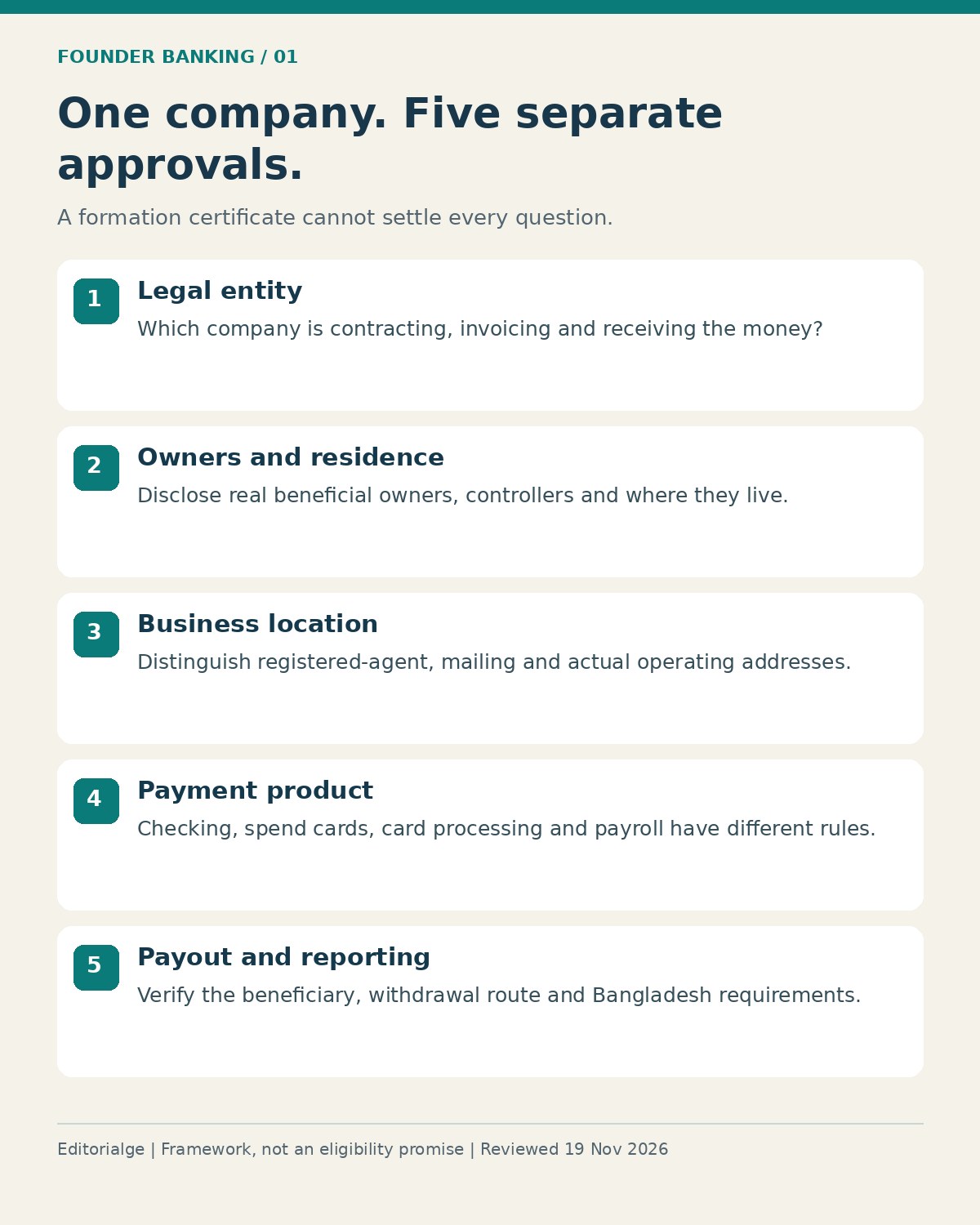
The immediate problem is more specific: incorporation, owner eligibility, business-address verification, payment acceptance, and payouts are separate approvals. A business can pass one and fail another. Its future depends on connecting all five honestly—and deciding whether the US company remains the right entity to make the sale.
I previously explained why my US customers do not make my LLC’s banking automatic. Our earlier US LLC banking account-closure guide compared India and Bangladesh. This follow-up examines the Bangladesh-specific problem through Editorialge Media LLC’s correspondence with Mercury and Priyo and the alternatives that deserve investigation now.
What My Records Show—and What They Do Not
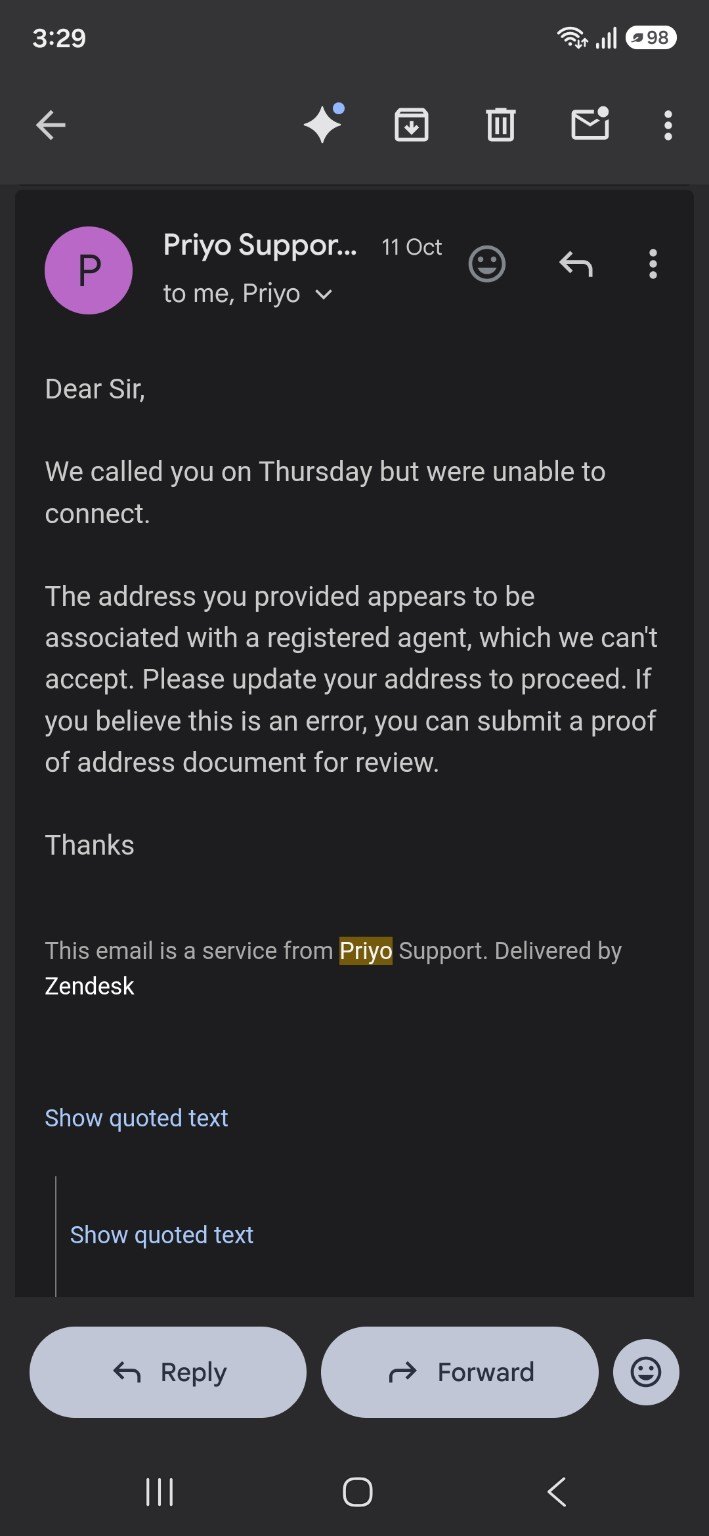
This founder analysis draws on my account history and correspondence supplied for editorial review: a redacted Mercury closure notice dated May 2, 2026; a nine-message Priyo email thread from October 11–12; and screenshots of a November 5 card-application rejection. Public provider policies were checked on November 19, 2026. The correspondence has not been independently authenticated through the providers’ systems. Alternative services below were researched, not opened or transaction-tested for this article.
Personal identifiers are excluded from the public evidence. These are my company’s records, not evidence that every other founder received the same decision.
| Record | Supported finding | Limit |
|---|---|---|
| Mercury, May 2, 2026 | Editorialge Media LLC’s account and IO credit card account had closed; the notice described returning remaining funds by check. | The reproduced notice does not state the closure reason. |
| Priyo, October 11, 2026 | Support rejected the registered-agent address and required a genuine US physical operating address. | This correspondence does not establish a universal US-government requirement. |
| Priyo/Stripe, November 5 | The card application was rejected after identity could not be verified within 30 days. | It is a card decision, not proof that all Priyo accounts or services closed. |
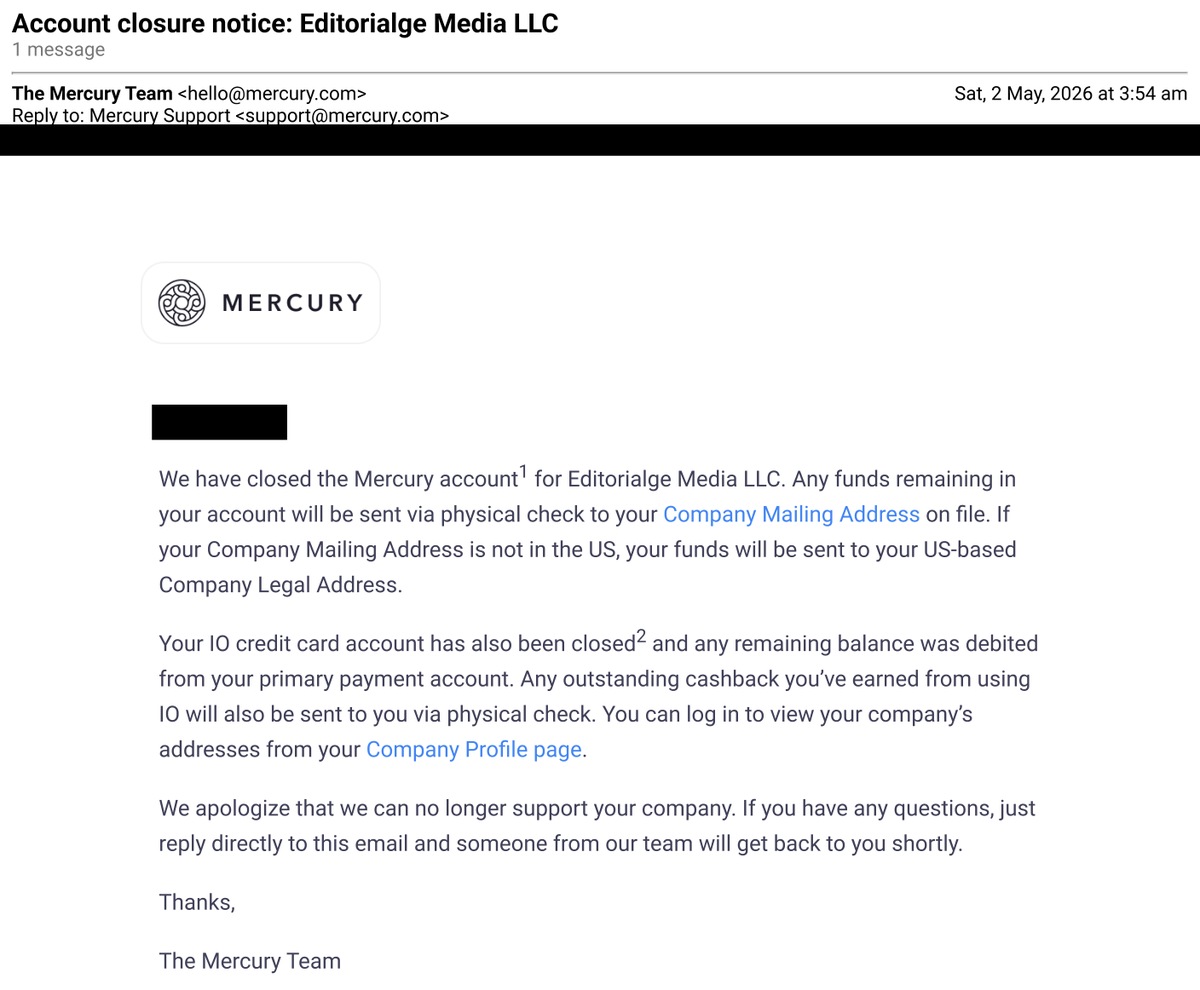
The difference matters. Mercury’s present country policy helps explain the obstacles a Bangladesh-resident applicant faces today. It cannot, by itself, retrospectively prove why my May account closed.
US Banking for Bangladeshi Founders: Three Different Barriers
1. Residence Restrictions Can Defeat an Otherwise Valid Company
Mercury currently lists Bangladesh among its prohibited countries. Its policy addresses where founders live and where a business operates or does business, rather than nationality alone. A Bangladeshi citizen living elsewhere may be eligible for review, but the company’s operating footprint still matters.
For a founder living and running the business in Dhaka, another Wyoming formation certificate does not resolve that restriction. Nor does acquiring a US mailing address change the founder’s residence.
Wise’s USD-account-details guidance also excludes Bangladesh addresses and specifically identifies restrictions involving a US business with a Bangladesh address or a personal profile with a Bangladesh address. This is a documented product restriction. Saying “Wise has banned everything involving Bangladesh” would go beyond that evidence.
2. Priyo’s Operating-Address Requirement Is a Separate Test
On October 11, I told Priyo that our Wyoming address belonged to our registered agent. The correspondence explained that the company’s actual operations and team were outside the United States. We had no US office, leased premises or employees. I explicitly declined to present the registered-agent address as our operating location.
Priyo’s response said its banking partner required a valid US physical business operating address unique to the business, excluding virtual and registered-agent addresses. Its next reply confirmed that a US physical operating address was mandatory for opening the business account.
Our thread then asked whether a relative’s house would qualify. Support did not approve that proposal; it declined to provide specific guidance. The record therefore gives me no basis to tell another founder to borrow a relative’s address or identity documents.
A genuine representative working from a real location is a different situation from borrowing an address. Before spending money, disclose the actual activity, occupancy arrangement, representative’s authority, and owners’ residences, and ask the provider what evidence it accepts. A family relationship alone answers none of those questions.
3. Cards, Checking, and Merchant Processing Are Different Products
The November screenshot says the application for cards through Priyo Payments LLC was rejected because identity verification was not completed within 30 days. It identifies Stripe and Priyo Payments LLC acting on behalf of Celtic Bank.
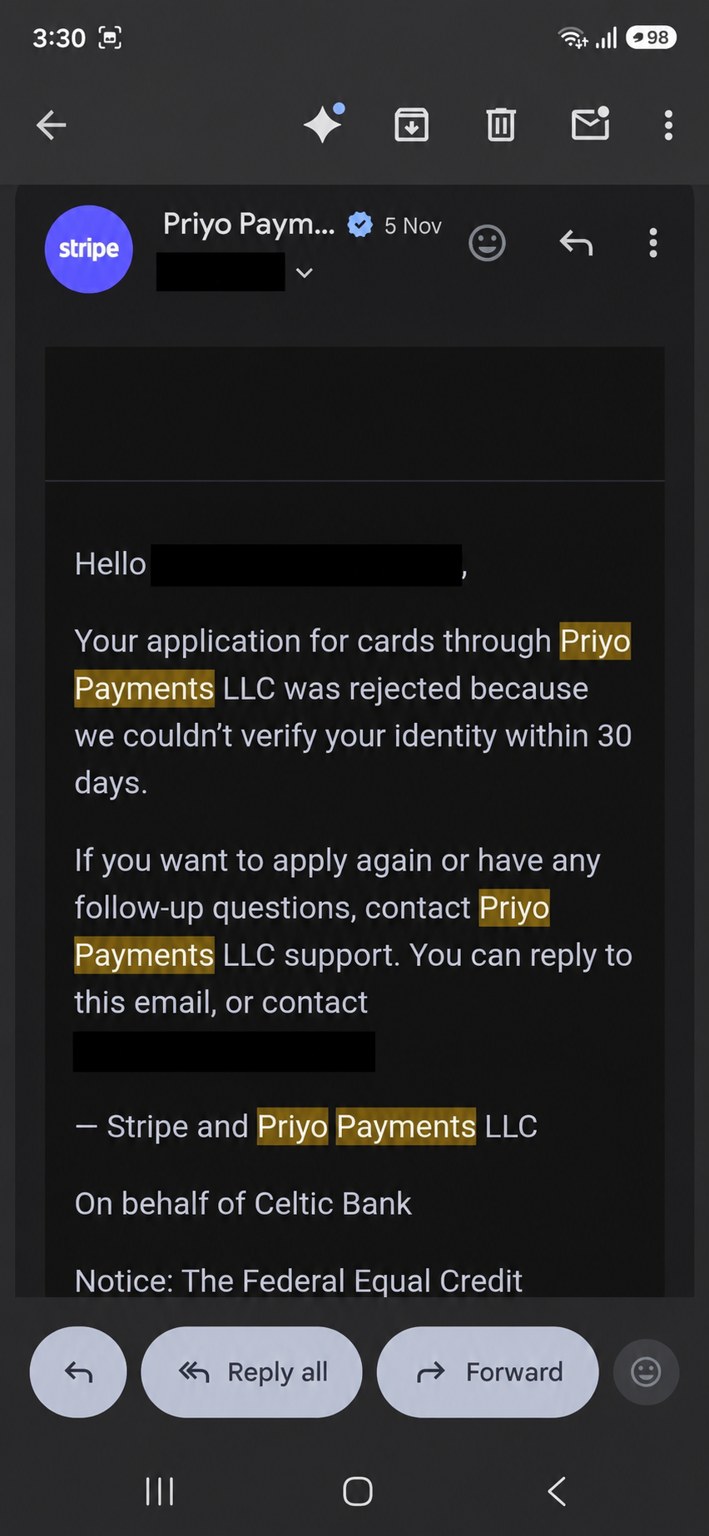
That is frustrating, but it should be described accurately. The screenshot does not say that Stripe rejected our merchant-processing account, that Priyo ceased operating, or that a US government agency prohibited our company.
Priyo’s current website still markets US business accounts and other services. Its business guidance requires a US operating address. My case demonstrates a verification barrier within that offering; it does not establish that the company’s wider services have failed or that a specific government order caused my rejection.
Why an ITIN Alone Does Not Solve the Problem
An ITIN helps identify a taxpayer. It does not establish where a business operates, prove a founder lives in the United States, or compel a financial company to approve an application. The IRS explains that an ITIN is for federal tax purposes and does not establish immigration status or a right to work in the country.
PayPal’s US agreement distinguishes individuals from businesses: individuals must satisfy its US-residence requirement, while businesses must be organized in, operating in, or resident in the US or its territories. That business wording is not a guarantee that my particular account, representative, and withdrawal arrangement will pass verification.
So I would not claim that an ITIN is useless. I would say that selling it as a banking passport creates the wrong expectation. A tax identifier is one document in a much larger decision.
Which Alternatives Deserve Attention?
The useful question is not “Which service accepts Bangladesh?” It is “Which service accepts this legal seller, these owners, this operating location, this product, and this payout destination?” The following is an investigation shortlist, not an approval ranking. No provider here has approved Editorialge’s exact replacement arrangement as part of this research.
| Route | Potential use | Important limitation |
|---|---|---|
| Relay | US-company business account | Bangladesh is absent from its reviewed prohibited list, but address and SSN/ITIN guidance conflict. Written clarification required. |
| Airwallex | Account services for an eligible US entity | US registration eligibility does not settle Bangladesh-resident ownership or operating-address acceptance. |
| nsave Business | Receiving funds and paying a genuine team | Currently payroll-focused; general business accounts are paused in its onboarding guidance. |
| Payoneer | Approved B2B receipts and withdrawal routes | Payment requests are not consumer e-commerce checkouts; the entity and beneficiary must fit the approved account. |
| Stripe Payments | Card acceptance by a qualifying US company | Merchant approval and a compliant payout destination remain separate requirements. |
| Paddle | Merchant-of-record sales for eligible software | Software/product review and supplier payout approval remain necessary. |
| SSLCOMMERZ | International card collection for an approved Bangladesh merchant | Not automatically a settlement account for an unrelated US LLC. |
| Bangladesh authorized dealer bank | Documented export receipts through banking channels | Confirm seller, payment purpose, documents, and currency treatment with the bank. |
Relay: A Serious Inquiry, With Unresolved Documentation Questions
Relay’s prohibited-country list reviewed for this article does not include Bangladesh. Its address-verification page says non-US residents can use a registered-agent business address while supplying each beneficial owner’s genuine residential address.
However, another opening guide says every beneficial owner needs an SSN, while its application blog discusses ITINs and a US address. Those differences are material for nonresident applicants. Applicants should ask Relay to reconcile them in writing for their actual residence, tax documentation and operating location before paying an intermediary or redirecting revenue. Absence from a country blacklist is encouraging, not a complete eligibility decision.
Airwallex: Registration Is Only the Starting Point
Airwallex lists supported incorporation jurisdictions, including the United States, and warns that geographic eligibility does not guarantee approval. Bangladesh incorporation is not listed. A US LLC therefore raises a different application question from a Bangladesh company, but the public registration list does not resolve an individual applicant’s residence and operational circumstances. I would keep it in the written-inquiry column, not the ready-to-use column.
nsave: A Narrower Business Route Than “A Replacement Bank”
nsave lists Bangladesh for individual account availability, but personal eligibility is not corporate eligibility. Its current business onboarding guide limits applications to payroll use and says general business accounts are paused until January 30, 2027. Its business overview describes receiving funds and paying freelancers, contractors and remote employees.
That could justify an inquiry for a publisher with a real team. It does not justify creating artificial payroll to obtain an account. Its Bangladesh local-payout guide also says that the described route supports individual recipients, not company accounts. The exact corporate receiving and payout arrangement needs separate confirmation; a personal wallet is not an interchangeable destination for LLC revenue.
Payoneer: Relevant for B2B Payments, With Real Costs to Compare
Payoneer’s payment-request service supports business-client payments through available methods such as cards, ACH debit and transfers. It explicitly says this is not consumer ecommerce checkout. Its guidance also excludes Bangladesh-registered Payoneer accounts from receiving payment requests through the PayPal payer method.
Payoneer’s Bangladesh presence is supported by its bKash relationship. bKash’s instructions require matching customer names; they do not establish that a US LLC can send corporate receipts into its owner’s personal wallet. An existing Payoneer account is useful only within its approved entity, transaction and withdrawal rules.
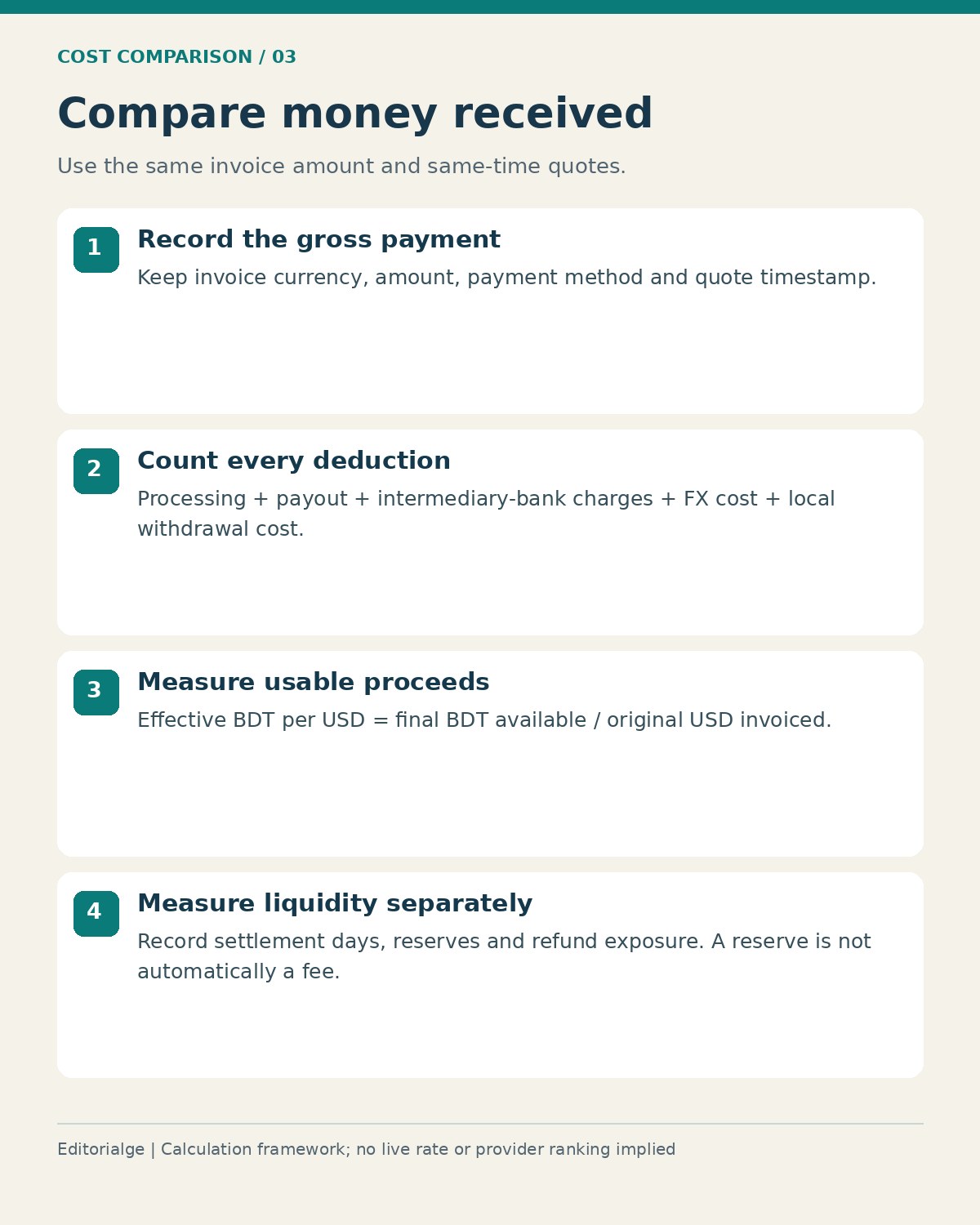
For my business, the decisive comparison would be the amount ultimately available in Bangladesh, supported by an actual quote and receipt. The advertised transfer fee alone cannot show that.
Stripe: Keep Merchant Acceptance Separate From Banking
Bangladesh is not on Stripe’s direct Payments availability list. Its US-account guidance nevertheless distinguishes registered US businesses operating abroad from unregistered businesses, and requires the real physical location of business activity. That is more nuanced than assuming every foreign founder needs a US-resident nominee.
A qualifying US company should disclose its Bangladesh operations accurately and obtain approval for its payout arrangement. Do not assume that a foreign bank account or another person’s account can simply replace the existing US payout destination. A working checkout without a verified settlement path is not a completed solution.
Paddle and Local Acquiring Change the Route
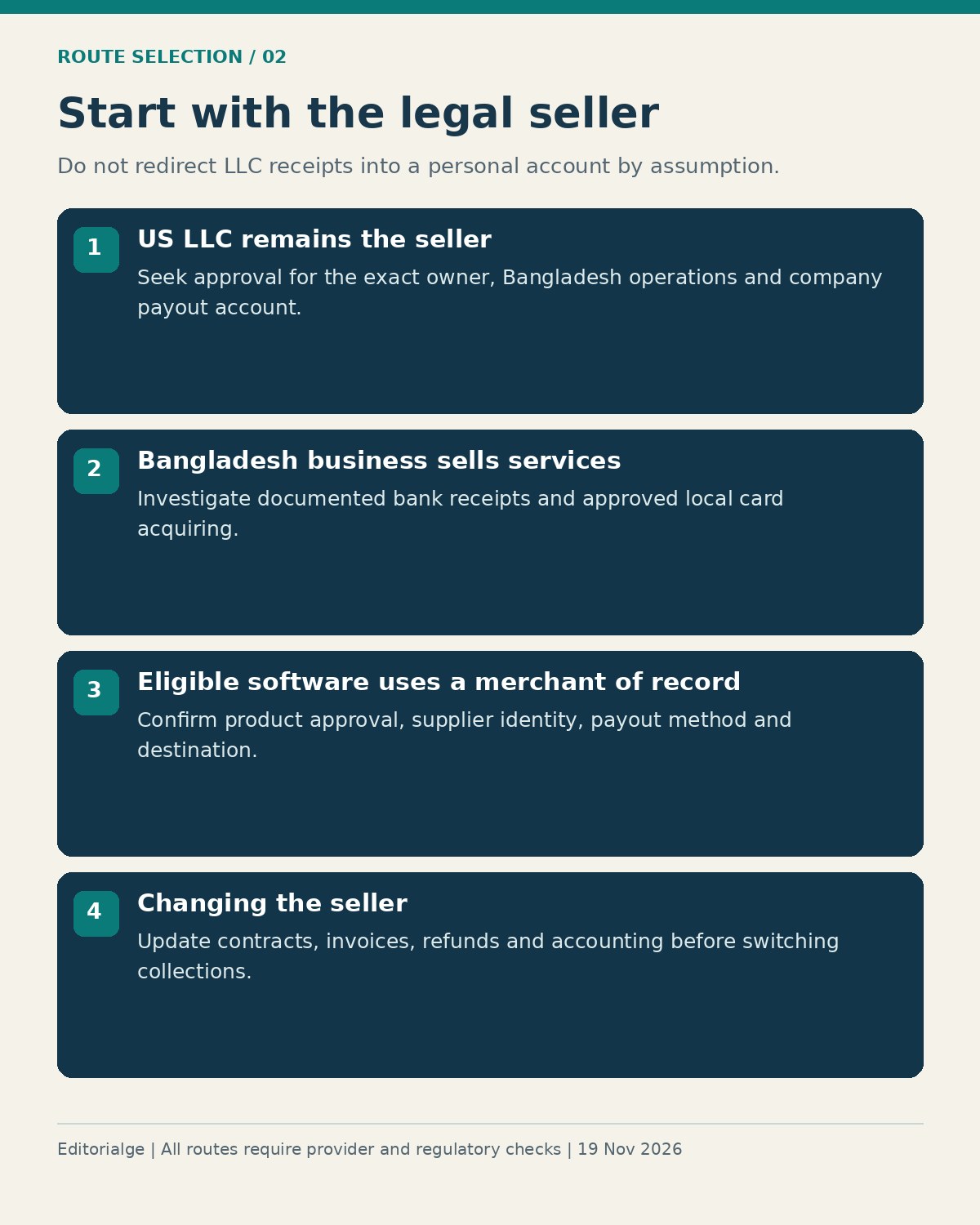
Paddle’s supplier-country guidance says it works with software businesses outside its excluded jurisdictions; Bangladesh is not on the reviewed exclusion list. Its payout documentation describes wire transfer and Payoneer. This makes it worth investigating for eligible software—not an automatic fit for advertising services, agency invoices or every publishing product.
As merchant of record, Paddle handles the customer-facing sale under its model and pays the approved supplier. The supplier identity and beneficiary still need approval. Switching from a US company to a Bangladesh seller requires an actual contractual and accounting change, not a different name entered into checkout settings.
SSLCOMMERZ advertises international transactions and payment links. For an approved Bangladesh operating business, local acquiring may offer a more direct route. Confirm foreign-card activation, product eligibility, settlement currency, recurring-payment support, refunds and reserves before choosing it.
One familiar recommendation is already outdated: Lemon Squeezy’s migration notice says new user and store sign-ups stopped on November 16, 2026, with transaction processing ending March 31, 2027. Its historical Bangladesh payout listing should not be used to recommend a new account today.
Bringing the Money Home Is Part of the Design
Bangladesh Bank’s July 30, 2026 consolidated export circular provides channels for service-export receipts through authorized dealers, acquiring and qualifying payment operators. Its specific small-value OPGSP route has a US$10,000 transaction limit; that is not a universal ceiling on all export receipts. The circular also addresses merchant/notional accounts, repatriation and permitted foreign-currency retention. Later instructions must be read alongside it.
Before implementing a route, I would ask the receiving bank which provisions apply to the actual seller and receipts, what records it needs, and whether an eligible export-retention-quota account can cover legitimate foreign-currency business expenses. Export revenue should not be relabelled as family remittance. A platform advertising stablecoins does not establish a lawful Bangladesh repatriation route.
A second review concerns the US company itself: how ownership was funded, how intercompany transactions are documented, and what local tax and foreign-exchange obligations apply. A US incorporation service cannot answer all of those Bangladesh-side questions.
The Plan I Would Use Before Moving Another Dollar
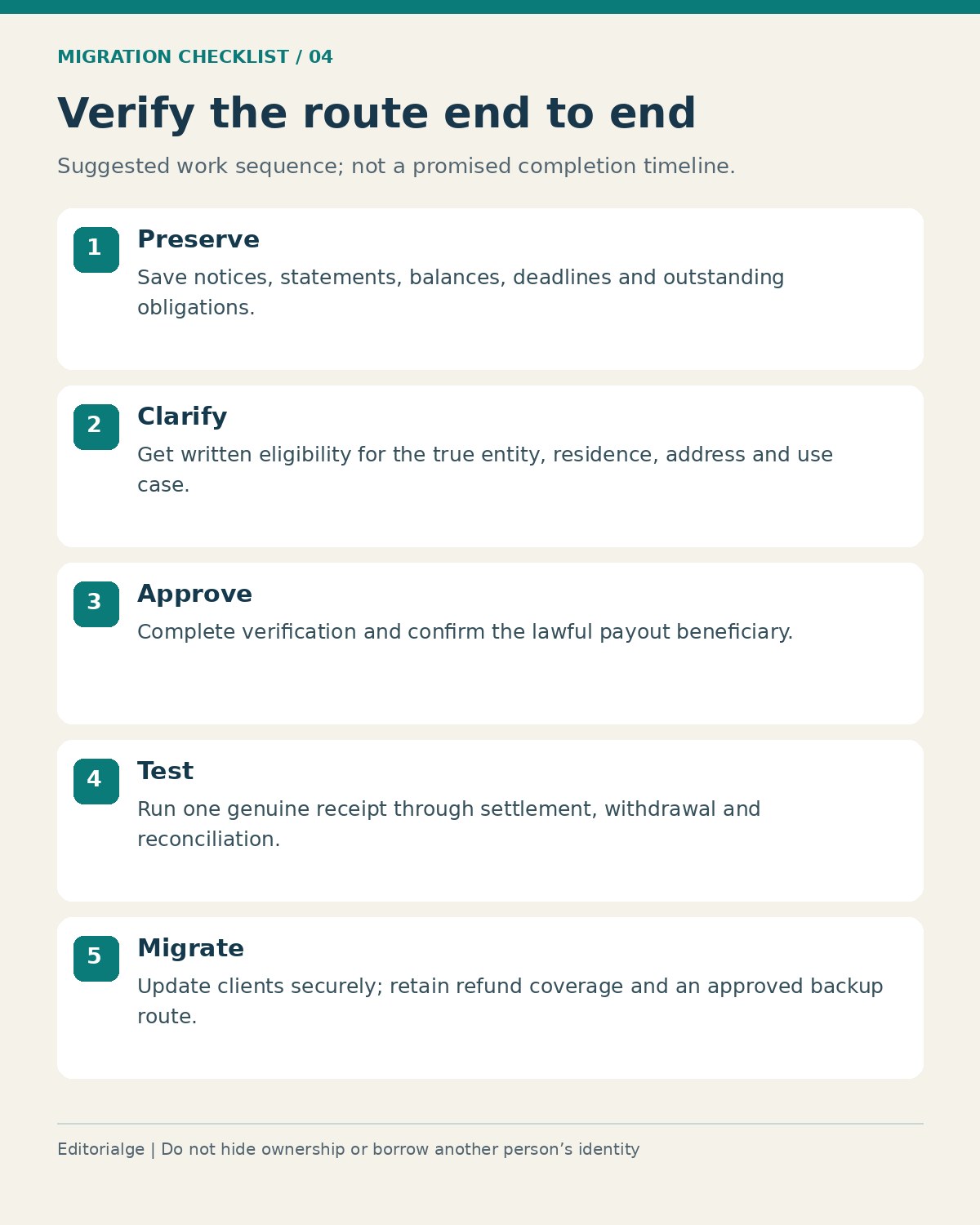
- Separate active receivables from new sales. Record which legal entity issued each invoice, where it is meant to settle, and any closure, refund or dispute deadline.
- Preserve statements and support correspondence. For money returned by check, confirm the payee, delivery address and a legitimate deposit route; a check is not immediately usable payroll.
- Send prospective providers one consistent factual file: US entity documents, ownership, actual Bangladesh residence and operations, product, customers, volumes and intended beneficiary. Share sensitive identifiers only through their approved channels.
- Ask for explicit acceptance of that arrangement. Clarify company versus personal accounts, physical-address requirements, supported receipts and withdrawals. Keep the written answer.
- Build a lawful fallback around the actual operating business. For a Bangladesh seller, investigate direct invoicing and local acquiring; for eligible software, investigate a merchant of record. Obtain customer consent and document any change of contracting entity.
- After approval, test one genuine transaction through settlement, withdrawal, reconciliation and any required reporting. Do not declare migration complete at signup or at the first successful card charge.
- Retain a refund and dispute plan, update clients securely, and keep a separately approved backup route where economical. Two app logos may still depend on the same underlying financial partner.
Should a Bangladeshi Founder Keep the US LLC?
I would keep it if it has a defensible commercial purpose—contracts, investment, ownership of assets or genuine US activity—and a verified way to receive and use its money at a sustainable cost. Losing one provider does not dissolve the company or erase its obligations.
I would reassess it if its main purpose was to unlock a fintech account that is no longer available. Paying formation renewals and compliance costs while repeatedly buying unsuitable address services is not a business strategy.
Restructuring can be sensible. New contracts might belong with a legitimate Bangladesh operating business while the US entity retains a narrower role. But existing contracts, intellectual property, customer liabilities and money cannot simply be reassigned informally. US and Bangladesh advisers need to assess the actual structure.
Even an inactive company can have reporting obligations. For example, IRS guidance requires certain foreign-owned US disregarded entities with reportable transactions to file Form 5472 attached to a pro forma Form 1120. Corporations and other LLC tax classifications need their own analysis. Banking inactivity is not a tax-filing exemption.
If the company no longer has a viable purpose, an orderly wind-down may be better than abandonment. Resolve receivables, refunds, taxes, contracts and required filings before treating the matter as finished.
Our Future Requires a Payment Route We Can Defend
What troubles me most is the gap between being allowed to form a company and being able to operate it. A founder can be honest about residence, submit genuine documents and still face a commercial dead end. Providers should explain the decisive requirements before founders spend on formation, tax identifiers and integrations.
The evidence supports a difficult conclusion, but not a hopeless one. Some familiar routes are closed for our circumstances; some are conditional; others require a different seller or product model. None should be presented as a guaranteed replacement.
For me, the future of US banking for Bangladeshi founders starts with a stronger question than “Can I open another account?” It is whether the company, its real operating location, the approved payment product and the lawful destination of the money fit together. If they do, the US business may still be worth keeping. If they do not, changing the structure can protect the enterprise we built.
Founder disclosure: The author is founder and CEO of Editorialge Media LLC, the company discussed in this article. This is a first-person founder analysis based on supplied records and dated policy research. It is not an account-approval guarantee or individualized legal or tax advice.