

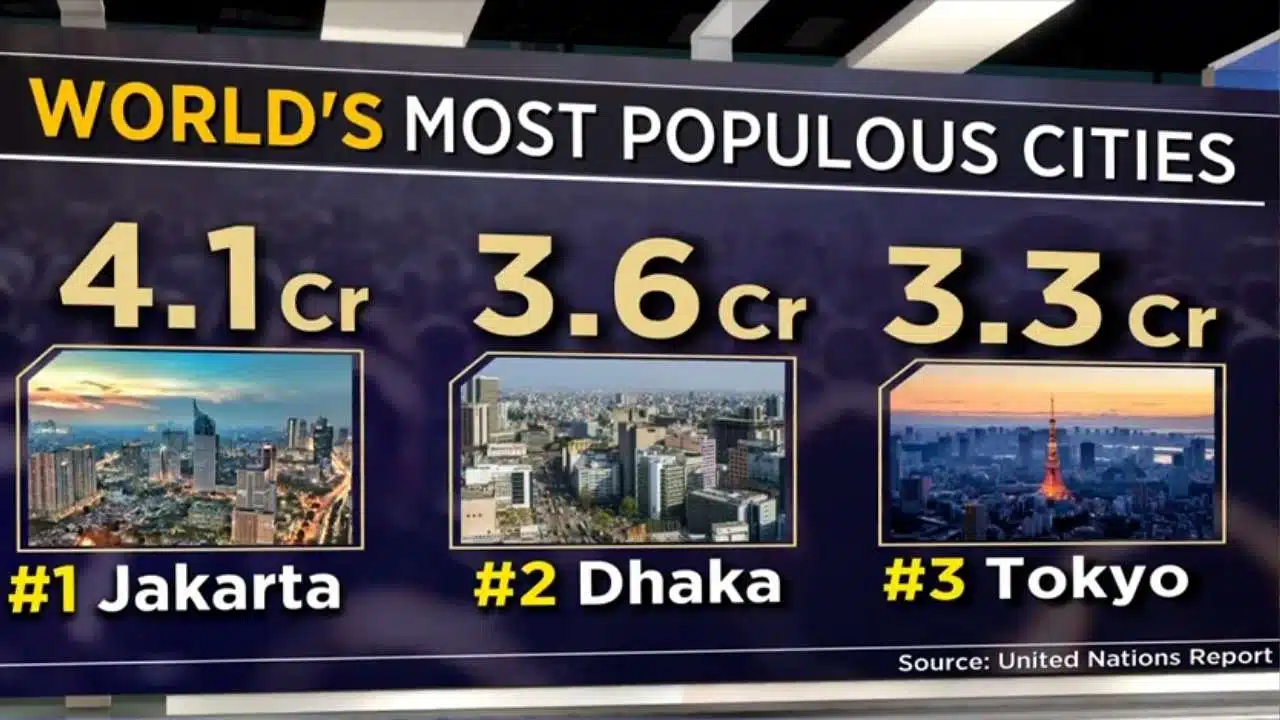
Jakarta has officially become the world’s most populous city, marking a historic shift in global urban rankings. According to the latest United Nations World Urbanization Prospects 2025 report, the Indonesian capital now has an estimated 42 million residents, overtaking Tokyo for the first time in several decades. This change represents a dramatic rise from Jakarta’s position in the 2018 UN rankings, where it stood at 33rd with around 11 million people.
The updated calculations reflect not only population growth but also a profound change in how the UN measures urban populations. The report shows that Tokyo’s metropolitan area — once unrivaled for decades — has experienced a relative decline, placing it third with roughly 33 million residents. Dhaka, the fast-growing capital of Bangladesh, now holds second place with an estimated 37 million people.
Jakarta’s sudden leap to the top spot highlights how quickly urban landscapes can transform when demographic trends, migration patterns, and improved measurement methods converge. The new findings also emphasize Jakarta’s importance as a regional economic hub and a center of internal migration within Indonesia, drawing millions from surrounding provinces in search of work, education, and better living standards.
How New UN Urban Definitions Transformed the Population Count
The most significant reason behind Jakarta’s surge is the new UN methodology applied in the 2025 report. This framework, called the Degree of Urbanization, uses high-resolution satellite imagery and standardized density thresholds to define what constitutes a “city.” The method identifies clusters of one-square-kilometer grid cells that meet two criteria: a minimum population density of 1,500 inhabitants per square kilometer and a total population of at least 50,000.
For Jakarta, this approach dramatically expanded the city’s boundaries beyond earlier administrative limits. The updated mapping now includes densely populated informal settlements, known locally as kampungs, which were previously excluded because they did not fit traditional definitions of urban zones. These neighborhoods are home to tens of millions of people who contribute to Jakarta’s economy and social fabric but were historically undercounted in official records.
The new method aligns global measurements more accurately by removing inconsistencies between countries that previously used different standards. As a result, Jakarta’s true urban footprint has finally been recognized. This recognition adds roughly 30 million additional residents to the city’s population count.
The recalibration not only impacts Jakarta but also reorders the global ranking of cities by size. It offers a clearer picture of urban concentration, especially in countries where rapid development and informal housing have redefined living patterns far beyond official city boundaries. The Degree of Urbanization framework is also expected to guide future policymaking, resource allocation, and global planning efforts.
Asia Dominates the List of Global Megacities
The UN report underscores a broader phenomenon shaping global demographics: the accelerating rise of megacities, defined as urban areas with populations exceeding 10 million people. In 1975, only eight megacities existed. By 2025, this number has climbed to 33, with more expected in the coming decades.
Asia accounts for 19 of the world’s megacities, reflecting the region’s rapid urbanization, population growth, and economic expansion. Nine of the ten largest cities in the world are now located in Asia. Beyond Jakarta, Dhaka, and Tokyo, the list includes New Delhi, Shanghai, Guangzhou, Manila, Kolkata, and Seoul — each with populations ranging from the mid-20 million to more than 30 million.
The only non-Asian city to appear in the global top ten is Cairo, Egypt, which currently has an estimated 32 million residents. This shift toward Asian urban dominance mirrors decades of industrialization, migration from rural areas, expanding labor markets, and large youth populations across the continent.
The rise of megacities also reflects the changing character of global development. Many of these large urban centers face similar challenges — overcrowding, climate pressures, traffic congestion, pollution, housing shortages, and rising living costs. At the same time, they remain indispensable engines of economic growth, cultural exchange, and technological innovation.
Future Urban Trends: Dhaka Rising and Tokyo Slowing
The UN’s long-term projections point toward continued changes in global urban rankings. Dhaka — already the second largest city — is expected to keep growing at a rapid pace and could become the world’s largest city by 2050. High birth rates, rural-to-urban migration, and economic centralization in Bangladesh continue to drive its expansion.
Meanwhile, Tokyo’s population is projected to decline in the coming decades due to Japan’s aging population, low fertility rates, and declining immigration levels. This demographic shift reflects a broader trend of population stagnation in developed countries. Unlike many Asian megacities that are still expanding, Tokyo is entering a period of stabilization or slow contraction.
The UN report also highlights that 45% of the world’s 8.2 billion people now live in cities, compared with just 20% in 1950. By 2050, the majority of global population growth is expected to occur in urban regions, particularly in Asia and Africa. These findings indicate that countries with rapidly growing cities — including Indonesia, Bangladesh, India, Nigeria, and the Philippines — will play an increasingly central role in shaping the world’s future urban landscape.
As city populations grow, the pressure on infrastructure, transport systems, clean water availability, public housing, and climate resilience strategies will intensify. Governments will need to adopt more sustainable urban planning models to adapt to rising demands.
What Jakarta’s New Status Means for the World
Jakarta’s emergence as the world’s most populous city is more than a demographic milestone — it reflects evolving global patterns in urbanization, mobility, and economic development. The recognition of millions of previously uncounted residents highlights long-standing inequalities in access to services and underscores the urgency of inclusive city planning.
For Indonesia, these new figures could influence future national policies, investment strategies, and the allocation of resources to the greater Jakarta region. The data could also reshape how international agencies and development partners support infrastructure, transportation, housing, and environmental protection efforts in the city.
On a global scale, the redefinition of cities through standardized methodologies like the Degree of Urbanization may significantly influence how governments understand their urban populations. It brings new clarity to global comparisons, highlights the importance of informal settlements in urban economies, and encourages more targeted action to improve living conditions.
The rise of megacities — and Asia’s overwhelming dominance among them — is likely to redefine global markets, supply chains, labor forces, and migration patterns for decades to come. As urbanization accelerates, the world must grapple with both the opportunities and challenges that come with densely populated, rapidly evolving cities.






















