

As fuel costs rise and climate concerns intensify, the search for practical clean energy is accelerating. Green hydrogen fuel is emerging as a powerful solution for critical sectors where batteries struggle, including heavy industry, global shipping, fertilizers, and commercial transport.
Despite its massive potential, the market remains in its earliest stages. According to a recent International Energy Agency review, clean hydrogen accounted for less than one percent of total global production in 2023.
Understanding this rapidly developing landscape requires clear facts before making significant investments. This comprehensive breakdown explores the underlying science of electrolysis, tracks current strategic movements within the dynamic United States market, and highlights the major infrastructure and cost barriers limiting widespread global adoption.
What Is Green Hydrogen?
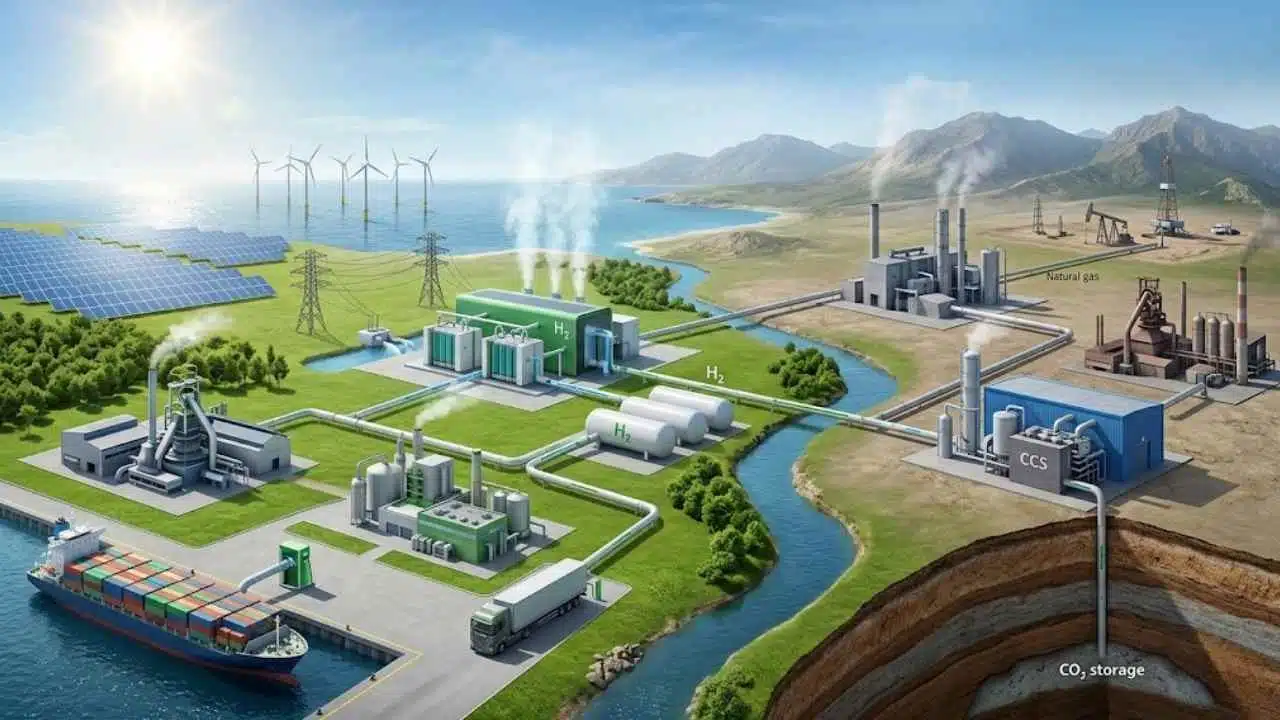
Green hydrogen is hydrogen made by splitting water with renewable electricity, usually from wind, solar, hydro, or sometimes nuclear-backed clean power. In simple terms, it is a way to turn clean electricity into a fuel you can store, move, and use later, which is why people often call hydrogen an energy vector or energy carrier.
That matters because most hydrogen production today still comes from fossil fuels, especially natural gas through steam methane reforming. When green hydrogen replaces that older supply, it can lower carbon emissions in refineries, fertilizer plants, steelmaking, and other industrial processes that are hard to clean up.
Definition and characteristics
Hydrogen counts as green when producers use electrolysis and low-carbon power to split water into hydrogen and oxygen. If that electricity is truly clean, the production step creates little to no direct greenhouse gas emissions.
At the point of use, a fuel cell running on hydrogen produces electricity, heat, and water. If hydrogen is burned in turbines or furnaces, it still avoids carbon dioxide, though those high-temperature systems may still need controls for nitrogen oxides.
For U.S. readers, one of the biggest advantages is energy security. Hydrogen can be made from domestic renewable energy, water, and existing industrial know-how instead of imported oil and gas.
Green hydrogen works best as a bridge between clean electricity and the parts of the economy that are hardest to electrify directly.
How it differs from other types of hydrogen (gray, blue, etc.)
The color labels are really shorthand for how the hydrogen is made. What matters most is the production method, the lifecycle emissions, and whether the fuel solves a real problem better than the alternatives.
| Type | How It Is Made | Carbon Profile | Best Fit Today | Main Drawback |
|---|---|---|---|---|
| Green Hydrogen | Water is split by electrolysis using renewable electricity or other very low-carbon power. | Lowest emissions when the power source is genuinely clean and the project is well matched to the grid. | Heavy industry, clean hydrogen hubs, seasonal energy storage, synthetic fuels, and premium low-carbon products. | Higher cost today and limited delivery infrastructure. |
| Gray Hydrogen | Usually made from natural gas by steam methane reforming, with no carbon capture. | Highest emissions of the main commercial pathways. | Low-cost supply for refining and ammonia where climate rules are weak. | Large greenhouse gas footprint. |
| Blue Hydrogen | Made from fossil fuels, then paired with carbon capture and storage. | Lower than gray hydrogen, but actual results depend on capture rate, methane leakage, and storage performance. | Industrial clusters that already use gas and have carbon management infrastructure. | Still tied to fossil supply chains and not zero-emission across the full lifecycle. |
How Is Green Hydrogen Produced?
Green hydrogen starts with water, electricity, and an electrolyzer. The electrolyzer uses electricity to split water into hydrogen and oxygen, and the whole climate value of the process depends on how clean that electricity is.
The U.S. Department of Energy has made this pathway a core priority through the Hydrogen Shot, with technical targets aimed at roughly $2 per kilogram by 2026 and $1 per kilogram by 2031 for PEM electrolysis. That is a big reason so much investment now focuses on cheaper stacks, longer equipment life, and higher operating hours.
Electrolysis powered by renewable energy
Electrolyzers work best when they can tap low-cost, steady clean power. In practice, that means co-locating projects near large wind and solar sites, strong grid connections, hydropower, or clean nuclear generation that can keep equipment running more hours each day.
Water supply matters too. DOE notes that electrolysis uses about 3.8 gallons of water to produce 1 kilogram of hydrogen, so siting is not just a power question. In dry parts of the U.S., developers need a plan for water treatment, recycled water, or desalination before a project makes economic sense.
Technology choice also changes how a project performs. PEM electrolyzers respond quickly and fit variable wind and solar well, while alkaline electrolyzers are proven and often cheaper for large steady plants.
A good U.S. example is Nine Mile Point in New York, where clean hydrogen production tied to nuclear power showed how round-the-clock electricity can improve utilization. That kind of steady supply is useful when the buyer needs dependable hydrogen for industry or storage, not just occasional output.
Advances in production technology
- PEM systems are getting better at flexible operation. That makes them useful where solar and wind output changes hour by hour.
- Alkaline systems still matter for scale. They are a practical choice when a project has steady power and wants lower equipment cost.
- Solid oxide electrolyzers use heat to save electricity. That makes them interesting for sites with high-temperature industrial waste heat or nuclear energy, though they are still less mature commercially.
- Manufacturing is expanding fast. The International Energy Agency estimated global electrolyzer manufacturing capacity at about 41 gigawatts per year in 2024, which matters because scale is one of the few reliable ways to cut stack cost.
- Project design now matters as much as the hardware. The best-performing plants are close to both cheap power and a real buyer, such as an ammonia plant, refinery, or freight depot, which cuts delivery and hydrogen storage costs.
Key Drivers Behind the Rise of Green Hydrogen
Green hydrogen is rising for a simple reason: some major sectors cannot clean up with electricity alone. If a business needs very high heat, chemical feedstocks, or long-duration storage, hydrogen starts to look less like an experiment and more like a useful tool.
Decarbonization of major industries
Heavy industry is one of the strongest drivers because many plants already use hydrogen today. DOE’s January 2025 commercial liftoff update said U.S. chemicals and refining still rely on about 10 million metric tons per year of unabated fossil-based hydrogen, which gives clean hydrogen a clear first market.
That is a major advantage over brand-new fuel systems. A refinery, ammonia plant, or methanol facility does not need to learn what hydrogen is, it needs a cleaner way to buy it.
Steel is another important case. Hydrogen can replace coal or fossil-derived syngas in some direct reduction pathways, which is why steelmakers, equipment suppliers, and DOE-backed industrial decarbonisation efforts keep watching this space closely.
Global push for renewable energy adoption
As more wind and solar come online, grids need more flexible demand and more storage. Electrolyzers can act like controllable electricity buyers, soaking up clean power when generation is abundant and turning it into a fuel that can be stored or shipped.
The latest IEA dashboard estimated global installed electrolyzer capacity at about 5.2 gigawatts in 2024, up roughly ninefold from 2021. That kind of growth is still small compared with the size of the energy system, but it shows that renewable energy and hydrogen development are starting to reinforce each other.
Government policies and incentives
- Federal funding is large enough to shape the market. The Bipartisan Infrastructure Law set aside $9.5 billion for hydrogen programs, including $8 billion for Regional Clean Hydrogen Hubs, $1 billion for electrolysis research and demonstration, and $500 million for manufacturing and recycling research.
- The 45V tax credit changes project math. In a January 2025 update, Treasury and the IRS finalized the clean hydrogen production tax credit rules, and DOE describes the incentive as worth up to $3 per kilogram for qualifying projects over 10 years.
- Lifecycle emissions now decide eligibility. Under the federal rules, hydrogen must come in at no more than 4 kilograms of carbon dioxide equivalent per kilogram of hydrogen to qualify as clean hydrogen for 45V.
- Regional hubs reduce first-mover risk. The seven U.S. hubs are meant to link producers, pipelines, storage, and buyers in the same region, which is much more practical than building isolated projects with no local demand.
- Early public spending is also reaching ports and freight. In 2024, the EPA’s Clean Ports selections included more than $475 million for hydrogen-based port operations, which gives maritime transport and cargo handling a stronger real-world test bed.
For most businesses, the smartest first move is to join an industrial cluster or hub instead of trying to build a stand-alone hydrogen supply chain from scratch. Delivery cost, permitting, storage, and offtake get easier when multiple users share the same backbone.
Benefits of Green Hydrogen as a Clean Fuel Source
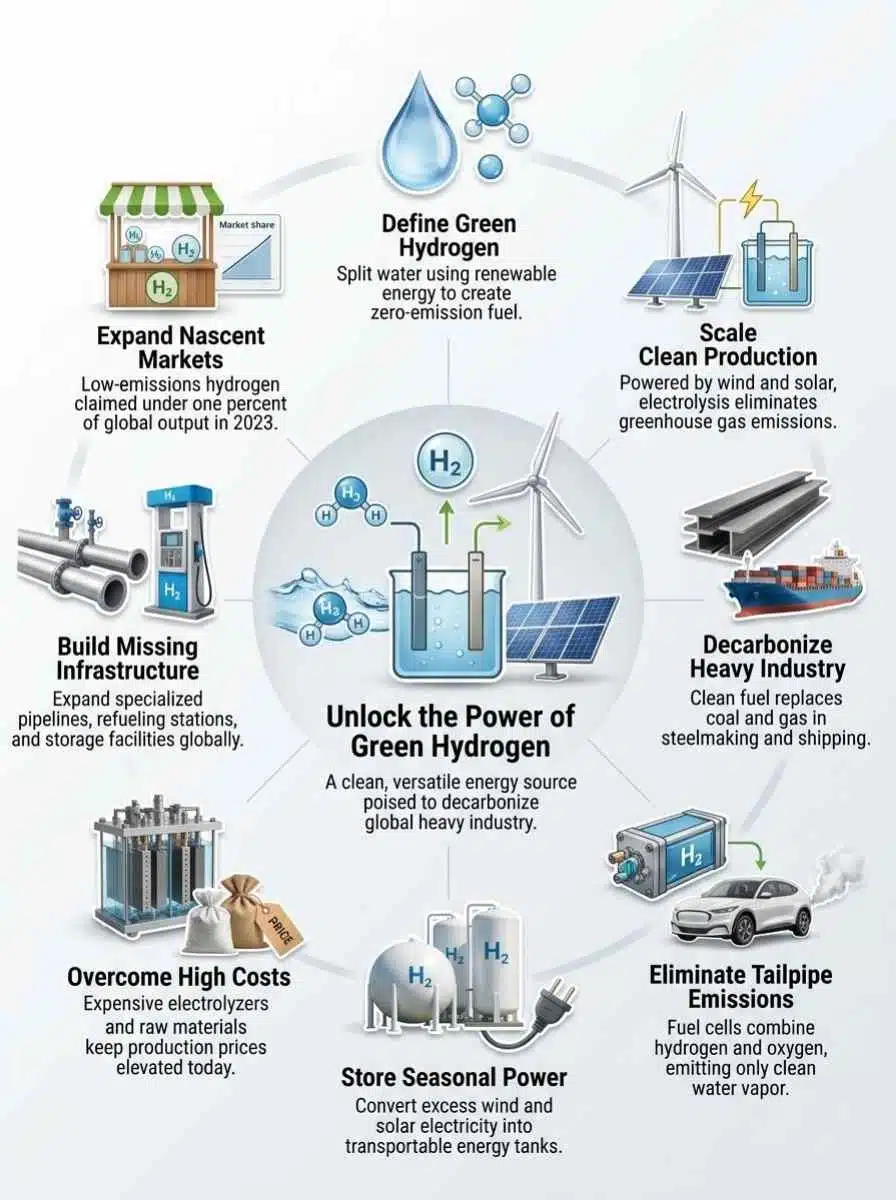
The best case for green hydrogen is not that it does everything. The best case is that it solves a few very hard energy problems better than the main alternatives.
Zero carbon emissions
When producers use clean electricity for electrolysis, green hydrogen can be made with very low lifecycle emissions. In a fuel cell, it generates electricity with water and heat as the byproducts, which is why it is attractive for air-quality-sensitive uses such as warehouses, transit, and some freight routes.
It is worth being precise here. A hydrogen fuel cell can avoid local air pollutants at the point of use, but hydrogen combustion systems still need good burner or turbine design to control nitrogen oxides.
Green hydrogen also gives the U.S. another domestic clean energy option. That matters for energy security because hydrogen can be made from local power and local water instead of imported fossil fuels.
Versatility across multiple sectors
| Sector | Why Green Hydrogen Helps | Best First Use |
|---|---|---|
| Heavy Trucks and Buses | Fuel cell vehicles can refuel in about five minutes and DOE says many offer more than 300 miles of range. | Depot fleets, transit, drayage, and routes with centralized fueling. |
| Refining and Chemicals | Plants already use hydrogen as a feedstock, so clean supply can cut emissions without rebuilding the whole facility. | Ammonia, methanol, and refining units that already buy large hydrogen volumes. |
| Steel and High-Heat Industry | Hydrogen can replace some fossil fuels in direct reduction and high-temperature processes where electrification is tough. | Pilot lines and facilities selling premium low-carbon material. |
| Power Generation and Storage | Hydrogen stores excess renewable electricity for days, weeks, or seasons and can later be used in turbines or fuel cells. | Long-duration backup and grid balancing where batteries alone are too short-lived. |
| Shipping and Synthetic Fuels | Green hydrogen can be converted into ammonia or other synthetic fuels for vessels and hard-to-electrify transport. | Ports, export corridors, and fuel production hubs near renewables. |
Passenger cars show both the promise and the limit. The 2025 Toyota Mirai carries an EPA-estimated 402-mile range, which proves the technology works, but the public refueling network is still too thin for most casual drivers outside a few markets.
Energy storage potential
Hydrogen is especially useful when you need to move clean electricity across time. Batteries usually win for short daily balancing, but hydrogen becomes more attractive for multi-day backup, seasonal storage, and situations where the stored energy also needs to serve transport or industry.
That is why large infrastructure players keep testing it. DOE’s January 2025 liftoff update highlighted a $504.4 million loan guarantee to an electrolysis and energy storage project led by Mitsubishi Power Americas, Magnum Development, and Haddington Ventures, a sign that utilities see a role for hydrogen where long-duration storage matters.
Use batteries for short, frequent shifting. Use hydrogen when you need clean energy to wait longer, travel farther, or serve more than one end use.
Challenges and Barriers to Green Hydrogen Adoption
Green hydrogen is promising, but it is not cheap or simple yet. The main barriers are cost, infrastructure, and the need to manage leaks and safety with much more discipline than early hype sometimes suggests.
High production costs
Cost is still the biggest issue. DOE’s January 2025 commercial liftoff update estimated electrolytic hydrogen at about $5 to $7 per kilogram before 45V tax credits, which is why many projects still struggle to reach final investment decision.
The biggest cost drivers are not mysterious. Cheap electricity, higher equipment utilization, lower stack cost, and nearby buyers matter more than flashy branding or oversized pilot announcements.
If you are comparing project ideas, start with the local power price and the expected run time of the electrolyzer. Those two factors can make the difference between a serious business case and a very expensive science project.
Infrastructure limitations
Hydrogen needs compressors, storage, transport, and end-use equipment that can handle the gas safely. DOE notes that gaseous hydrogen is commonly delivered by tube trailers or pipelines, but both options add cost if projects are far from demand.
Storage is a real engineering issue because hydrogen has high energy by weight but low energy by volume. For vehicles, DOE points to high-pressure tanks at roughly 5,000 and 10,000 psi, which helps range but also raises system cost.
Some pipeline blending can happen sooner. DOE says converting natural gas lines to carry blends of up to about 15% hydrogen may require only modest modifications in some cases, but pure hydrogen service usually needs far more work on compressors, valves, seals, meters, and end-use equipment.
Hydrogen leakage concerns
Hydrogen is a small molecule, so leak management matters from both a safety and climate standpoint. DOE also notes that hydrogen is much lighter than air and can disperse quickly, but it has a wide flammable range and burns with a nearly invisible flame, which makes sensor quality and ventilation essential.
Monitoring technology is improving fast. In September 2024, ARPA-E announced $18 million for H2SENSE projects aimed at finding and quantifying hydrogen emissions across the supply chain, including leaks at concentrations down to parts per billion.
- Do not treat leak detection as a late add-on. Specify sensors, ventilation, and maintenance routines at the design stage.
- Do not overbuild isolated stations. Early infrastructure works best in clusters where multiple users share storage and delivery assets.
- Do not ignore water planning. In dry regions, water treatment and sourcing can slow or kill a project.
- Do not assume clean power is always available. A project tied to expensive or carbon-heavy grid power can miss both cost and emissions targets.
Current Market Trends and Future Projections
The market is growing, but the gap between announced projects and projects that are truly financed is still wide. That is the clearest sign that hydrogen has moved past pure hype and into the harder stage of commercial proof.
Market size and growth potential
| Metric | Latest Data | What It Means |
|---|---|---|
| Global low-emissions hydrogen production | Less than 1 million metric tons in 2023 | The market is still tiny compared with conventional hydrogen. |
| Year-over-year production growth | About 6% from 2022 to 2023 | Progress is real, but still slow. |
| Global installed electrolyzer capacity | About 5.2 GW in 2024 | Manufacturing and project experience are building from a low base. |
| Announced electrolyzer projects by 2030 | About 558 GW | The development pipeline is huge on paper. |
| Electrolyzer capacity at final investment decision | About 20 GW globally | Many announced projects have not yet crossed the financing line. |
| Announced U.S. clean hydrogen production capacity | About 14 million metric tons per year | The U.S. pipeline is large enough to matter if policy and offtake hold. |
| Forecast operational U.S. capacity by 2030 | About 7 to 9 million metric tons per year | Expect a meaningful market, but slower buildout than the headline pipeline suggests. |
Regional insights into adoption rates
For U.S. readers, the strongest near-term adoption zones are the Gulf Coast, California freight and port corridors, Appalachia, and the Midwest fertilizer and manufacturing belt. Those regions already have some mix of industrial demand, storage potential, clean power, skilled labor, and transport infrastructure.
Europe still has strong policy momentum and certification work, while China has pushed hard on electrolyzer manufacturing scale. In the U.S., the biggest commercial advantage is the combination of hubs, tax credits, and large industrial buyers that can sign long-term offtake deals.
Applications of Green Hydrogen
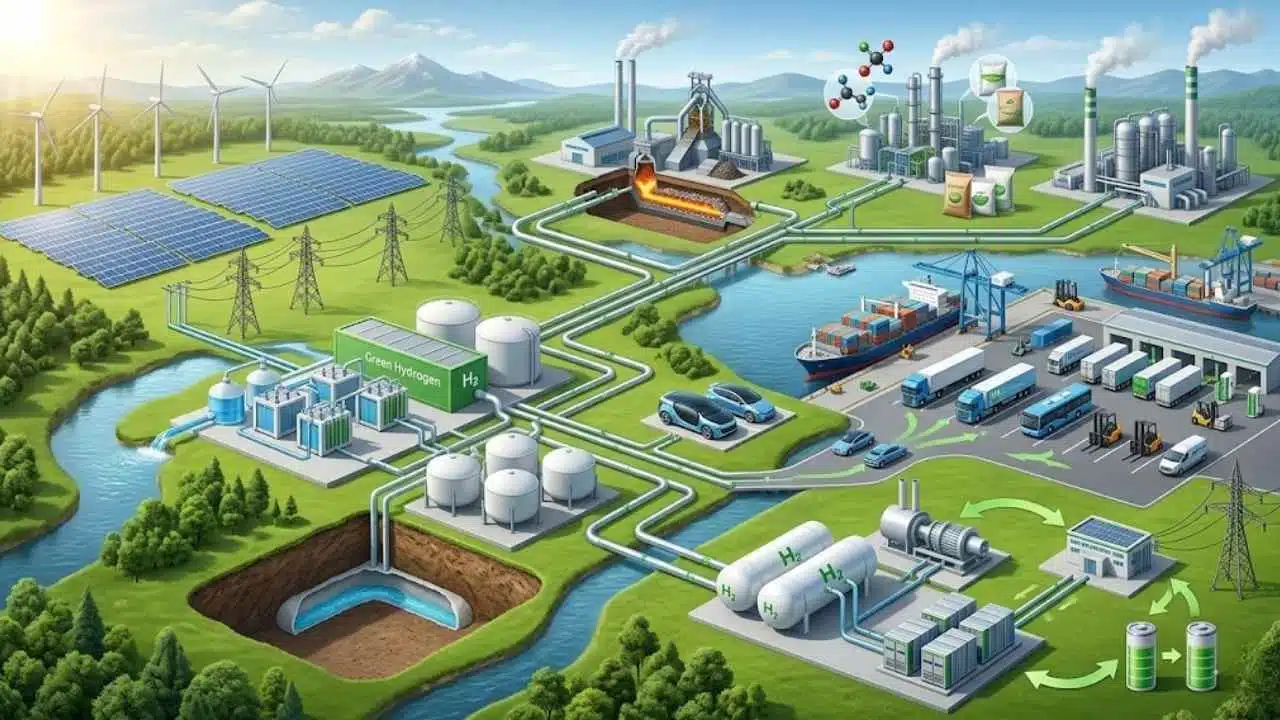
Green hydrogen makes the most sense where electricity alone cannot do the job well enough, cheaply enough, or fast enough. If you look at real use cases that way, the list becomes much clearer.
Transportation (fuel cells and EVs)
Hydrogen works best in transport when vehicles need fast refueling, high utilization, and long range. DOE’s Alternative Fuels Data Center says fuel cell vehicles can refuel in about five minutes and many exceed 300 miles of range, which is why fleets, buses, and regional trucks get more attention than personal cars.
That said, public infrastructure is still limited. For most businesses, hydrogen transport is a stronger fit for depot-based fleets, ports, and warehouse equipment than for open public fueling across the whole country.
Industrial processes and manufacturing
Industry is where green hydrogen often has the cleanest business case. Refineries, ammonia plants, methanol facilities, and some steel operations already use hydrogen or can use it without redesigning every part of the plant.
This is also where green hydrogen can move fastest in the U.S. because the buyer already exists. Replacing fossil-based feedstock hydrogen is usually easier than trying to create a whole new consumer market from zero.
Power generation and storage
On the power side, hydrogen can absorb excess renewable electricity, sit in tanks or caverns, and then return as electricity through fuel cells or turbines later. That makes it useful for backup power, grid resilience, and long-duration storage that stretches beyond the sweet spot of lithium-ion batteries.
It is still not the cheapest way to shift a few hours of solar power into the evening. It becomes more interesting when the storage window gets much longer, or when the same hydrogen can also serve industry, transport, or synthetic fuels.
- Best fit: existing hydrogen users in chemicals, refining, and fertilizers.
- Strong second fit: ports, heavy-duty fleets, and logistics hubs with centralized fueling.
- Good strategic fit: regions with abundant curtailed renewable electricity or steady clean nuclear power.
- Weaker fit for now: casual passenger vehicle fueling in regions without reliable stations.
Final Thoughts
Green hydrogen will not replace every fuel, and it does not need to. Its best role is in the toughest parts of the energy transition: heavy industry, long-haul transport, synthetic fuels, and long-duration storage.
If you are weighing green hydrogen for a business, start with four questions. Do you have cheap clean electricity, reliable water, a nearby buyer, and policy support that lasts long enough to justify the build?
When those pieces line up, green hydrogen becomes more than a climate story, it becomes a practical clean fuel source.
Frequently Asked Questions (FAQs) About Green Hydrogen Fuel
1. What is green hydrogen, and why is it called a clean fuel?
Green hydrogen is hydrogen made with renewable energy, using electrolysis to split water, and it is a clean fuel because its use emits no carbon emissions.
2. How is green hydrogen produced?
Hydrogen production uses electrolysis, powered by renewable energy, to split water into hydrogen and oxygen.
3. Where can we use green hydrogen?
You can use green hydrogen in fuel cells to power vehicles, and industry can use it for heat and chemical processes. It also serves as a clean fuel source for sectors that are hard to electrify.
4. Is green hydrogen ready to replace fossil fuels now?
Not yet, costs, hydrogen storage, and transport infrastructure need work, and we must scale up production. As electrolysis gets cheaper and renewable energy grows, green hydrogen can cut carbon emissions and play a big role.





















