

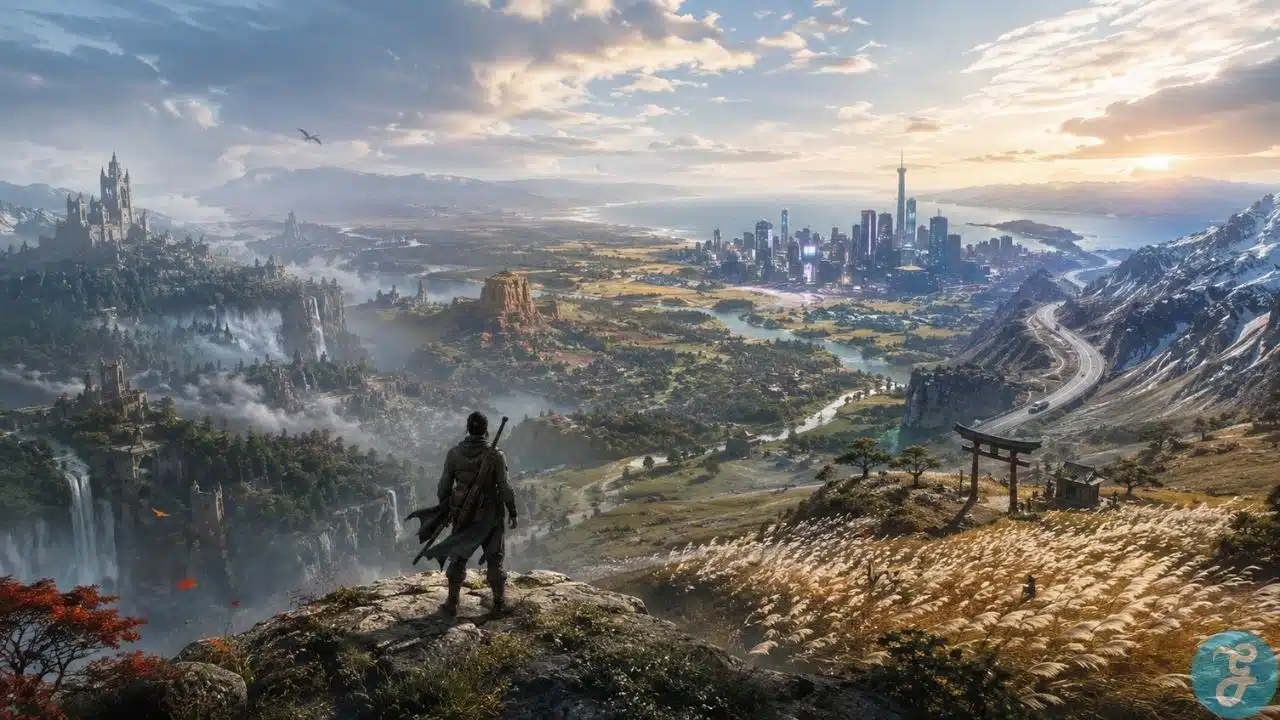
Open-world games can be amazing. They can also be exhausting digital shopping lists with towers, map icons, copy-paste camps, and enough collectibles to make you question your life choices. A big map is not impressive by itself anymore. We have seen big maps. Some of them are emptier than a group chat after someone asks for money.
The open-world games done right are different. They make exploration feel natural. They reward curiosity. They use the world for storytelling, gameplay, atmosphere, danger, freedom, or discovery. They do not just ask, “How many kilometers can we add?” They ask, “Why would the player care about going there?”
This list focuses on open-world games that still feel worth playing because their worlds have identity. Some are brutal. Some are peaceful. Some are story-heavy. Some are about driving fast through beautiful roads. But all of them understand one thing: an open world should feel like a place, not a checklist wearing grass textures.
Our Selection Criteria
A great open-world game needs more than size. It needs purpose. The map should support the game’s strongest ideas, whether that means exploration, roleplay, survival, travel, combat, storytelling, or freedom.
I looked for games that use their worlds well, not just games with large maps. The best picks reward curiosity, create memorable journeys, and give players strong reasons to move through the world without feeling dragged by icons.
| Selection Factor | What It Means |
|---|---|
| World Design | The map feels meaningful, readable, and worth exploring |
| Exploration Value | Players are rewarded for curiosity, not just checklist clearing |
| Atmosphere | The world has mood, identity, and strong environmental detail |
| Gameplay Fit | The open world supports combat, travel, quests, survival, or creativity |
| Replay Value | The game gives players reasons to return |
| Modern Relevance | The game still feels worth playing today |
Whom This Is For
This list is for players who love getting lost in game worlds but hate when open-world design becomes bloated nonsense. It is also for anyone who wants games where exploration feels satisfying instead of mandatory.
You will enjoy these picks if you like meaningful side quests, hidden discoveries, beautiful landscapes, strong atmosphere, freedom of approach, and worlds that feel alive even when nobody is shouting mission instructions at you.
9 Best Open-World Games Done Right
These games are not ranked only by map size. That would be silly. By that logic, a parking lot could win if it was large enough. The games below earn their place because they make their worlds matter.
1. Elden Ring
Elden Ring is one of the strongest examples of modern open-world design because it trusts players more than most games dare to. Bandai Namco lists it as a 2022 FromSoftware RPG set in the Lands Between, where the shattered Elden Ring becomes the center of a dark fantasy journey.
What makes Elden Ring special is how little it babysits you. You see something strange in the distance, ride toward it, regret that decision, die, come back later, and somehow feel like a genius. The world is not built around constant instructions. It is built around curiosity, danger, and discovery.
The map works because it feels layered. Caves, castles, underground areas, hidden bosses, strange NPCs, and terrifying surprises keep the world from feeling empty. Every direction has the possibility of reward or punishment. Often both.
Best for: Players who want open-world exploration with danger, mystery, and build freedom.
Why We Chose It:
- It makes exploration feel natural instead of checklist-driven.
- The world rewards curiosity with weapons, bosses, secrets, and lore.
- Player freedom is huge, from builds to route choices.
- It changed how many players now judge open-world action RPGs.
Things to consider:
- It can be punishing for beginners.
- The story is indirect, so players who need clear narrative guidance may struggle.
2. Red Dead Redemption 2
Red Dead Redemption 2 is open-world storytelling at its most patient and detailed. Rockstar describes it as an epic tale of life in America’s unforgiving heartland, and that phrase fits because the world feels like a dying era, not just a cowboy playground.
The game’s strength is not only scale. It is texture. Mud, weather, horses, towns, camps, strangers, wildlife, trains, lawmen, and random road encounters all make the world feel lived in. You can spend hours hunting, fishing, riding, gambling, helping strangers, robbing people, or simply watching the landscape change under the light.
Arthur Morgan’s story works because the world supports it. The open world is beautiful, but it is also harsh, slow, and morally tired. That matches the story perfectly. Red Dead Redemption 2 does not rush. It wants you to live inside its world long enough to feel what is being lost.
Best for: Players who want a slow, immersive, story-rich open world.
Why We Chose It:
- The world feels alive through tiny details and random encounters.
- Exploration supports the emotional tone of the story.
- Wildlife, towns, camps, and travel systems create strong immersion.
- Arthur Morgan’s journey feels tied to the world around him.
Things to consider:
- The pace is slow.
- Players who want fast movement and instant action may find it heavy.
3. The Legend Of Zelda: Tears Of The Kingdom
The Legend of Zelda: Tears of the Kingdom takes Hyrule and expands it vertically. Nintendo describes the game as letting players explore the land, sky, and depths of Hyrule, with improved presentation on the Switch 2 edition.
The genius of Tears of the Kingdom is that the world is not only a place to travel through. It is a toy box. You build machines, solve physics problems, climb, fly, dive, experiment, fail, laugh, and then build something even uglier that somehow works. That is open-world freedom at its best.
The map rewards creativity as much as exploration. A mountain is not just a mountain. It is a launch point. A ruin is not just decoration. It may become a puzzle. A pile of parts is not clutter. It is the beginning of either a brilliant vehicle or a crime against engineering.
Best for: Players who want playful exploration, physics creativity, and freedom.
Why We Chose It:
- The world encourages experimentation instead of simple route-following.
- Sky islands and the Depths give Hyrule more vertical variety.
- Physics tools make exploration personal and creative.
- It rewards curiosity with puzzles, resources, shrines, and surprises.
Things to consider:
- Players who dislike crafting or building may prefer Breath of the Wild.
- The freedom can feel overwhelming early on.
4. The Witcher 3: Wild Hunt
The Witcher 3: Wild Hunt remains one of the best examples of open-world quest design. CD Projekt RED describes it as a dark-fantasy open-world RPG where Geralt of Rivia travels through places like Velen, Novigrad, and Skellige while searching for Ciri.
The reason it still works is simple: side quests matter. A random notice board contract can become a tragedy. A monster hunt may turn into a moral question. A village problem may reveal politics, grief, poverty, or plain human ugliness. Lovely vacation material, really.
The world feels strong because it is not clean. Velen is miserable. Novigrad is tense. Skellige feels wild and proud. Each region has its own mood, culture, conflicts, and problems. That gives the map identity beyond visual variety.
Best for: Players who want story-rich open-world RPG quests.
Why We Chose It:
- Side quests often feel handcrafted and meaningful.
- Each region has a strong identity.
- Geralt’s role as a monster hunter fits the world beautifully.
- The expansions add even more excellent open-world storytelling.
Things to consider:
- Combat is not the strongest part of the game.
- The map can feel large if you try to clear every marker.
5. Cyberpunk 2077
Cyberpunk 2077 had one of gaming’s messiest launches, but the version available today is a much stronger open-world RPG. CD Projekt RED describes the Cyberpunk universe as centered on Night City, with the base game and the spy-thriller expansion Phantom Liberty forming its major game experience.
Night City is the reason this game belongs here. It is dense, loud, ugly, beautiful, violent, stylish, and morally rotten in all the right cyberpunk ways. Even when you are not doing missions, the city has presence. Neon signs, stacked buildings, back alleys, corporate towers, clubs, markets, and broken districts make the world feel like it is swallowing people alive.
The 2.0 update and Phantom Liberty era also improved the game’s systems and helped Cyberpunk 2077 feel closer to what it always wanted to be. CD Projekt RED officially showcased Update 2.0 as a major gameplay overhaul alongside Phantom Liberty in 2023.
Best for: Players who want a dense sci-fi city with strong atmosphere and RPG action.
Why We Chose It:
- Night City has one of the strongest visual identities in open-world games.
- The world supports crime, politics, body modification, and corporate decay.
- Phantom Liberty adds a tighter spy-thriller experience.
- The improved modern version feels far better than the launch version.
Things to consider:
- It is still more city-focused than wilderness exploration.
- Some players may remember the launch issues and hesitate.
6. Ghost Of Tsushima Director’s Cut
Ghost of Tsushima Director’s Cut is a great example of an open world that understands beauty and direction. PlayStation describes it as an open-world action adventure where players uncover the hidden wonders of Tsushima.
The world design works because it reduces visual clutter. Instead of burying the player under ugly UI markers, the game uses wind, animals, smoke, landmarks, and environmental cues to guide exploration. That sounds small, but it makes a huge difference. You are not just chasing icons. You are reading the landscape.
Tsushima also has a strong visual rhythm. Golden forests, stormy fields, quiet shrines, bamboo groves, war-torn villages, and sweeping coastlines make exploration feel cinematic without becoming too noisy. It is one of the best examples of style serving open-world readability.
Best for: Players who want cinematic samurai action and beautiful exploration.
Why We Chose It:
- The guiding wind system feels elegant and natural.
- The island is visually memorable without feeling overcomplicated.
- Combat, stealth, and exploration fit the samurai fantasy well.
- The Director’s Cut adds Iki Island and improves the overall package.
Things to consider:
- Some side activities repeat after a while.
- The open-world structure is more traditional than Elden Ring or Zelda.
7. Horizon Forbidden West
Horizon Forbidden West is open-world spectacle done with technical confidence. PlayStation describes the Forbidden West as an immersive open world filled with adventure, culture, and opportunity, with the game originally released in 2022.
The world stands out because of its machine ecology. Giant robotic creatures are not just enemies standing around waiting to be farmed. They move through the landscape, interact with terrain, and create combat puzzles. Fighting them makes the open world feel dangerous and mechanical in a way few games manage.
The map is also visually strong. Jungles, deserts, underwater areas, ruins, mountains, settlements, and machine habitats give the world variety. It is not the most radical open-world game, but it is one of the most polished.
Best for: Players who want beautiful exploration, strong combat, and sci-fi creature design.
Why We Chose It:
- Machine encounters make the world feel dangerous and active.
- Visual variety keeps exploration interesting.
- Combat rewards planning, targeting, traps, and weapon choice.
- The world mixes tribal culture, ruins, and sci-fi mystery effectively.
Things to consider:
- It can feel busy with icons and systems.
- The story works better if you played Horizon Zero Dawn first.
8. No Man’s Sky
No Man’s Sky deserves credit because it turned a rough launch into one of gaming’s best long-term redemption stories. Hello Games describes it as a game about exploration and survival in an infinite procedurally generated galaxy, available across PlayStation, Xbox, PC, Mac, and Nintendo Switch platforms.
This is open-world design stretched into open-universe design. You travel between planets, scan lifeforms, build bases, upgrade ships, trade, survive, explore, and decide what kind of space traveler you want to be. Some planets are beautiful. Some are weird. Some look like nature had a bad dream and refused to explain.
The reason it belongs here is not because every planet is perfect. It belongs because the game understands the fantasy of endless discovery. It gives players space, literally and mechanically, to create their own journey.
Best for: Players who want space exploration, survival, base-building, and discovery.
Why We Chose It:
- The scale is enormous without forcing one fixed path.
- Base-building, ships, survival, and exploration give players many goals.
- Long-term updates have made the game much richer.
- It captures the feeling of lonely, strange space travel well.
Things to consider:
- Procedural worlds can sometimes feel repetitive.
- Players who need strong authored storytelling may prefer other games.
9. Forza Horizon 5
Forza Horizon 5 proves open worlds are not only for RPGs, survival games, and people carrying swords. Xbox describes it as an open-world racing adventure across Mexico with hundreds of cars and vibrant, evolving landscapes.
The map works because driving is the point. Roads, dirt trails, beaches, jungles, cities, deserts, ruins, and volcano routes are not just scenery. They are playgrounds for speed. Xbox also highlighted Mexico’s mix of deserts, jungles, historic cities, ruins, beaches, canyons, and a snow-capped volcano when presenting the game.
Forza Horizon 5 understands flow. You can race seriously, drift badly, explore casually, collect cars, take photos, join events, or just drive with music on and pretend fuel prices do not exist. It is one of the best examples of an open world built around movement joy.
Best for: Players who want open-world freedom without RPG systems or heavy story.
Why We Chose It:
- The world is built around driving pleasure.
- Mexico gives the map strong visual and terrain variety.
- Events, cars, roads, and exploration all support the core fantasy.
- It is easy to enjoy casually but still deep enough for racing fans.
Things to consider:
- It is not for players who need narrative depth.
- Some progression systems may feel too generous or busy.
An Overview Of Open-World Games Done Right
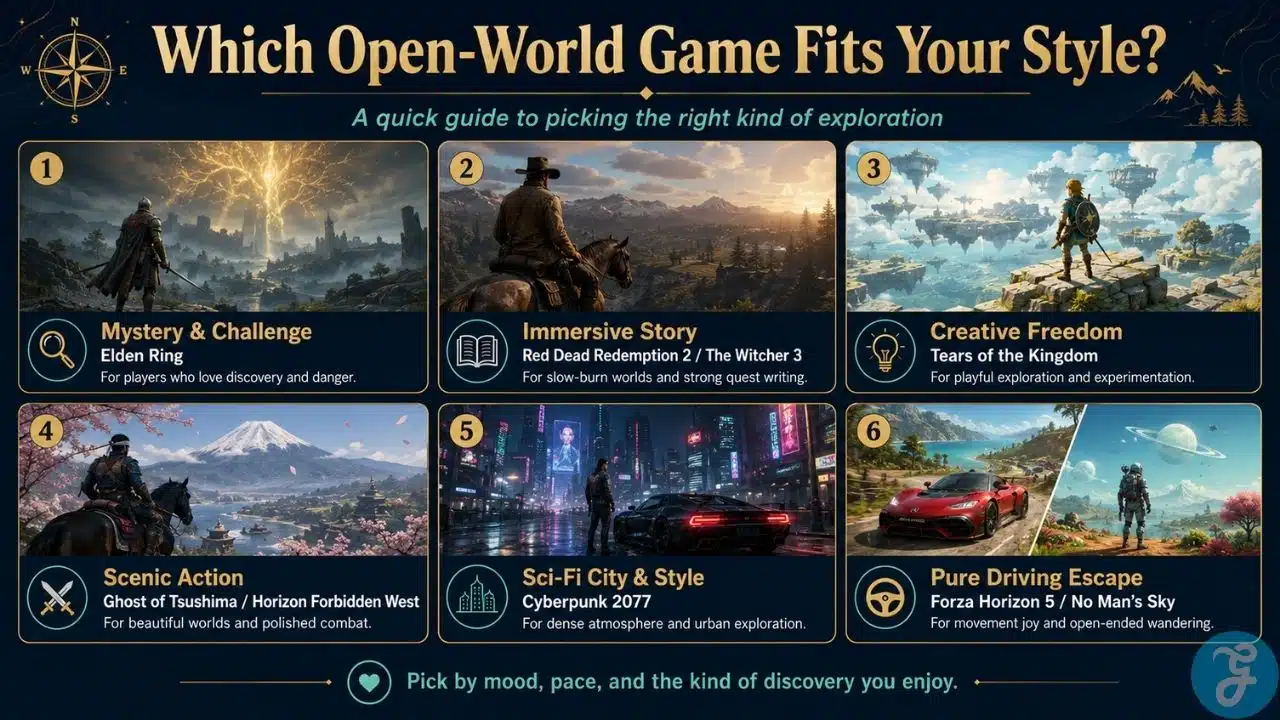
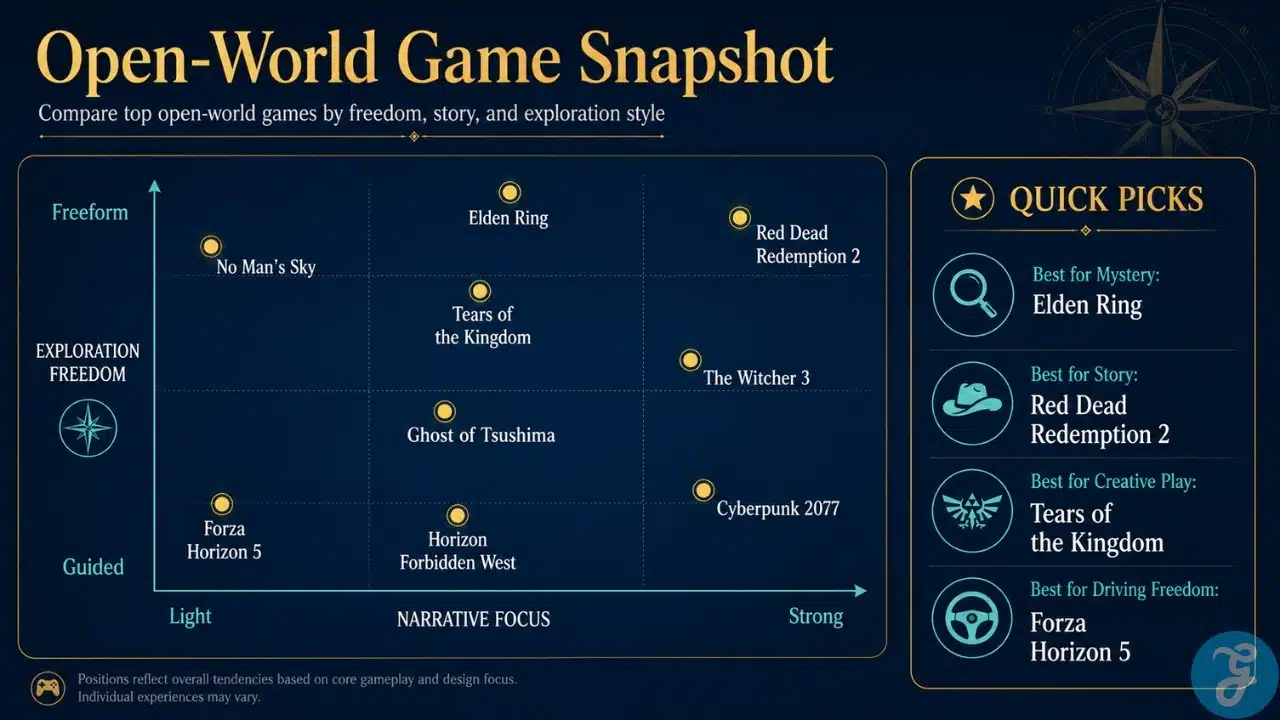
The best open-world games are not all trying to solve the same problem. Elden Ring makes mystery and danger the main reward. Red Dead Redemption 2 makes immersion and character drama the point. Tears of the Kingdom turns the world into a physics playground. The Witcher 3 proves side quests can carry a map. Cyberpunk 2077 shows how a city can become the main character.
That variety matters. A good open world is not always about freedom alone. Sometimes it is about atmosphere. Sometimes it is about systems. Sometimes it is about travel. Sometimes it is about the simple joy of seeing something far away and thinking, “Fine, I’ll go there.”
Overview Comparison
| Game | Open-World Strength | Best For |
|---|---|---|
| Elden Ring | Mystery, danger, exploration | Players who want challenge and discovery |
| Red Dead Redemption 2 | Immersion and character drama | Slow-burn open-world storytelling |
| Tears of the Kingdom | Physics and creative freedom | Experimentation and playful exploration |
| The Witcher 3 | Side quests and regional identity | Story-focused RPG fans |
| Cyberpunk 2077 | Dense city atmosphere | Sci-fi RPG fans |
| Ghost of Tsushima | Beautiful guided exploration | Cinematic samurai action |
| Horizon Forbidden West | Machine combat and visual variety | Polished sci-fi adventure |
| No Man’s Sky | Endless space exploration | Survival and discovery |
| Forza Horizon 5 | Driving freedom | Open-world racing fans |
Our Top 3 Picks And Why?
If I had to recommend only three, I would pick Elden Ring, Red Dead Redemption 2, and The Legend of Zelda: Tears of the Kingdom.
Elden Ring is the best for discovery. Red Dead Redemption 2 is the best for immersion. Tears of the Kingdom is the best for creative freedom. Together, they show three very different ways an open world can be done right.
| Pick | Why It Stands Out |
|---|---|
| Elden Ring | Best mystery-driven open-world design |
| Red Dead Redemption 2 | Best immersive open-world storytelling |
| Tears of the Kingdom | Best creative open-world freedom |
How To Choose The Right Open-World Games By Yourself
Choosing an open-world game depends on what you want from the it. Do you want danger? Beauty? Story? Freedom? Driving? Space? A giant map alone does not answer that.
The trick is to pick based on the type of exploration you enjoy. Some players want to uncover secrets. Some want strong quests. Some want atmosphere. Some want movement. Some want to ignore the main story for 70 hours and call it “emergent gameplay.” We respect the illness.
The Selection Framework
- Choose by exploration style: Pick Elden Ring for mystery, Zelda for experimentation, and No Man’s Sky for endless discovery.
- Choose by story: Pick Red Dead Redemption 2, The Witcher 3, or Cyberpunk 2077 if you want strong narrative identity.
- Choose by atmosphere: Pick Ghost of Tsushima for beauty, Horizon Forbidden West for sci-fi landscapes, and Cyberpunk 2077 for city density.
- Choose by movement: Pick Forza Horizon 5 for driving freedom and Tears of the Kingdom for climbing, flying, building, and chaos engineering.
The Final Checklist
Before choosing your next open-world game, ask yourself:
- Do I want freedom, story, challenge, or atmosphere?
- Do I like map markers, or do I prefer natural discovery?
- Do I want combat-heavy exploration or relaxed travel?
- Do I want a huge world or a dense world?
- Am I ready for a long game, or do I just want casual wandering?
The Last Marker Before You Close The Map
The best open-world games do not waste space. They make the world itself part of the reason you play. A forest should feel like a place, not filler. A city should have an attitude. A mountain should invite curiosity. A road should make travel feel worthwhile.
For mystery and challenge, play Elden Ring. For immersion, play Red Dead Redemption 2. For creative freedom, play Tears of the Kingdom. For story quests, play The Witcher 3. For sci-fi atmosphere, play Cyberpunk 2077. For pure driving joy, play Forza Horizon 5.
The open-world games done right are the ones that make you forget the map for a while. You stop chasing icons. You start following curiosity. And that is when an open world finally earns its size.
Frequently Asked Questions About Open-World Games Done Right
What Is The Best Open-World Game Overall?
Elden Ring is one of the best overall picks because it rewards exploration, mystery, combat mastery, and player freedom. For players who prefer story and immersion, Red Dead Redemption 2 may be the stronger choice.
Which Open-World Game Has The Best Story?
Red Dead Redemption 2 and The Witcher 3 are the strongest story-focused open-world picks. Red Dead Redemption 2 is better for character drama, while The Witcher 3 is better for quest writing and moral choices.
Which Open-World Game Is Best For Beginners?
Forza Horizon 5, Ghost of Tsushima, and Horizon Forbidden West are more approachable than Elden Ring. They give players clearer direction while still offering freedom and exploration.
Which Open-World Game Has The Best Exploration?
Elden Ring is best for mysterious discovery, while Tears of the Kingdom is best for creative exploration. No Man’s Sky is best if you want huge-scale space exploration.
Are Open-World Games Still Worth Playing In 2026?
Yes. Open-world games are still worth playing when the world has purpose. The weak ones feel bloated, but the best ones use exploration, atmosphere, systems, and storytelling to create memorable player-driven experiences.





















