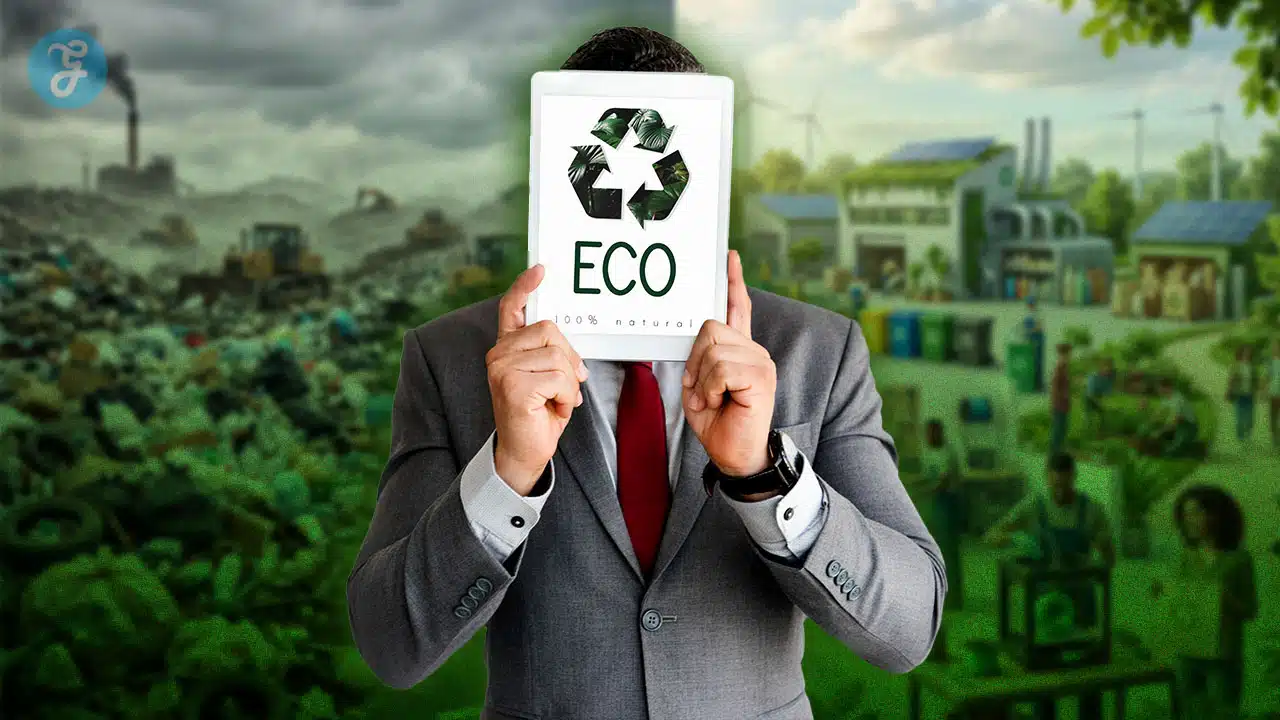
Understanding circular economy basics reveals an uncomfortable truth: most waste stems from initial design choices rather than consumer disposal habits. Instead of blaming poor recycling, it is essential to recognize that waste is often built into the product itself.
The traditional take-make-waste linear model is fundamentally failing today. The EPA reports that food waste remains the single most common material sent to landfills and incinerators, highlighting a massive systemic flaw.
Solving this crisis requires smarter upstream design rather than downstream damage control. Innovative companies are already proving this proactive approach works. Real-world examples like Notpla, Apeel, Lush, and the DyeCoo case study clearly demonstrate how intelligent, sustainable engineering can successfully replace the entirely outdated concept of waste.
What Is a Circular Economy?
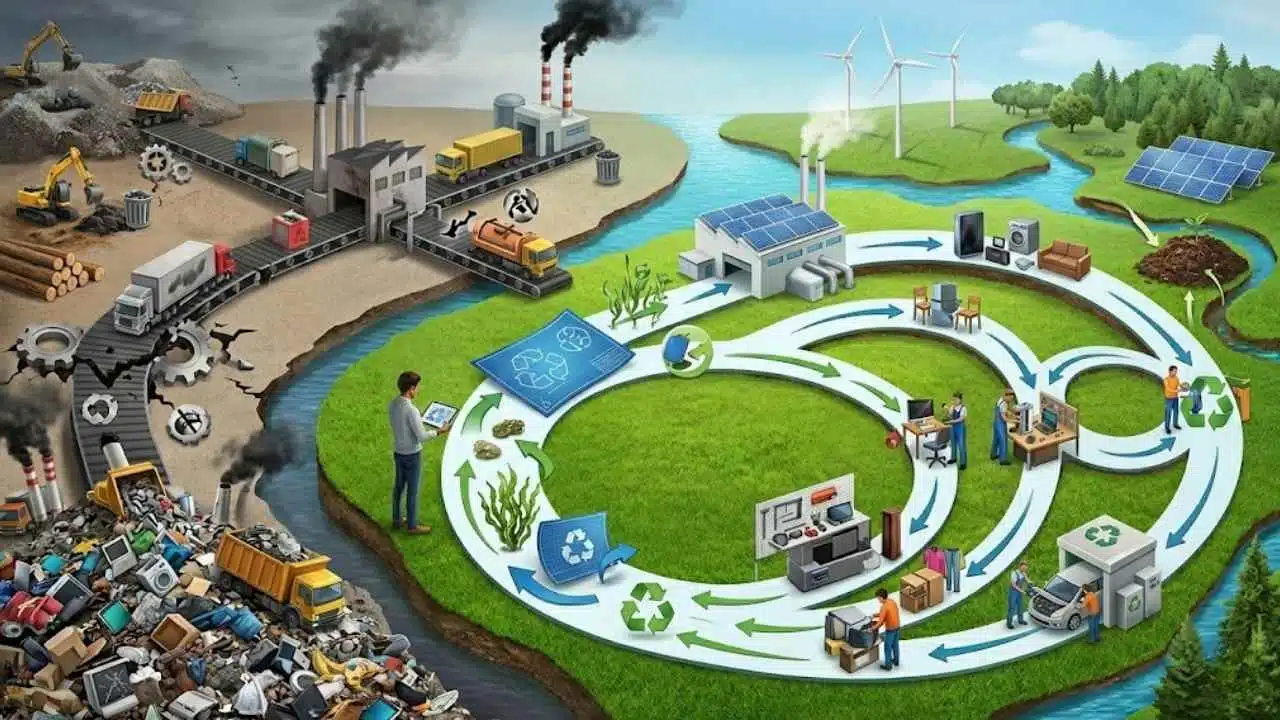
A circular economy is a system built to keep materials useful for as long as possible. Instead of taking resources, making products, and throwing them away, it aims to prevent waste, protect value, and reduce pollution from the start.
In EPA’s latest circular economy guidance, the idea is straightforward: use fewer materials, redesign products to be less resource intensive, and recapture what used to be treated as waste. That is why circular thinking starts with product design and sustainable materials management, not with a full trash bin.
The Ellen MacArthur Foundation explains the model through three circular economy principles: eliminate waste and pollution, circulate products and materials at their highest value, and regenerate nature.
| Model | How it works | What usually happens |
|---|---|---|
| Linear economy | Extract, make, use, discard | More landfills, incinerators, and resource loss |
| Circular economy | Design out waste, reuse, repair, remanufacture, recycle last | More value kept in products and materials |
This matters for climate change as much as waste management. EPA says more than 40% of U.S. emissions come from the production, transportation, use, and disposal of material goods, so every material choice carries environmental impact.
The Problem: Waste as a Design Flaw
The traditional take-make-waste model relies on the flawed assumption that planetary resources are both infinite and disposable.
By prioritizing short-term convenience over long-term sustainability, manufacturers inadvertently engineer trash directly into the product lifecycle long before it reaches consumers.
Transitioning to sustainable practices requires the realization that mass pollution is not an inevitable byproduct, but rather a reversible design failure.
The linear economy’s “take-make-waste” system
The linear economy treats raw materials as cheap, abundant, and disposable. That mindset turns products into short-lived purchases instead of long-term assets.
EPA’s national waste data shows the scale of the problem: in 2018, the U.S. generated 292.4 million tons of municipal solid waste, landfilled about 146.1 million tons, and combusted 34.6 million tons with energy recovery. The recycling rate, including composting, was 32.1%, which tells you disposal still dominates the system.
Buildings and construction show the same pattern. In EPA’s 2018 construction and demolition data, the U.S. generated about 600 million tons of debris, and more than 143 million tons still went to landfills, often because materials were hard to separate cleanly after demolition.
Why waste is a result of poor design
A widely used ecodesign rule of thumb says roughly 80% of a product’s environmental impact is influenced during the design phase. In practice, that means material choice, assembly method, packaging format, and repairability often decide whether something stays useful or becomes trash.
When designers ignore end of life, the result is predictable: mixed films that block recycling, glued assemblies that block repair, and single-use packaging that adds volume without adding value. This is why waste reduction depends so heavily on upstream design.
- Mixed materials: Laminates and bonded layers can make plastic packaging and crisp-style packs hard to sort or recycle.
- Permanent adhesives: Glue-heavy assembly raises repair costs and pushes products toward replacement.
- Proprietary parts: Unique components and locked-down repairs shorten product lifespan.
- Oversized packaging: Extra layers add shipping weight, cost, and disposal without improving performance.
Once a product is sealed, contaminated, or impossible to disassemble, the cheapest option often becomes landfill, downcycling, or incineration. That makes waste look inevitable when it was really designed in from the start.
Principles of a Circular Economy
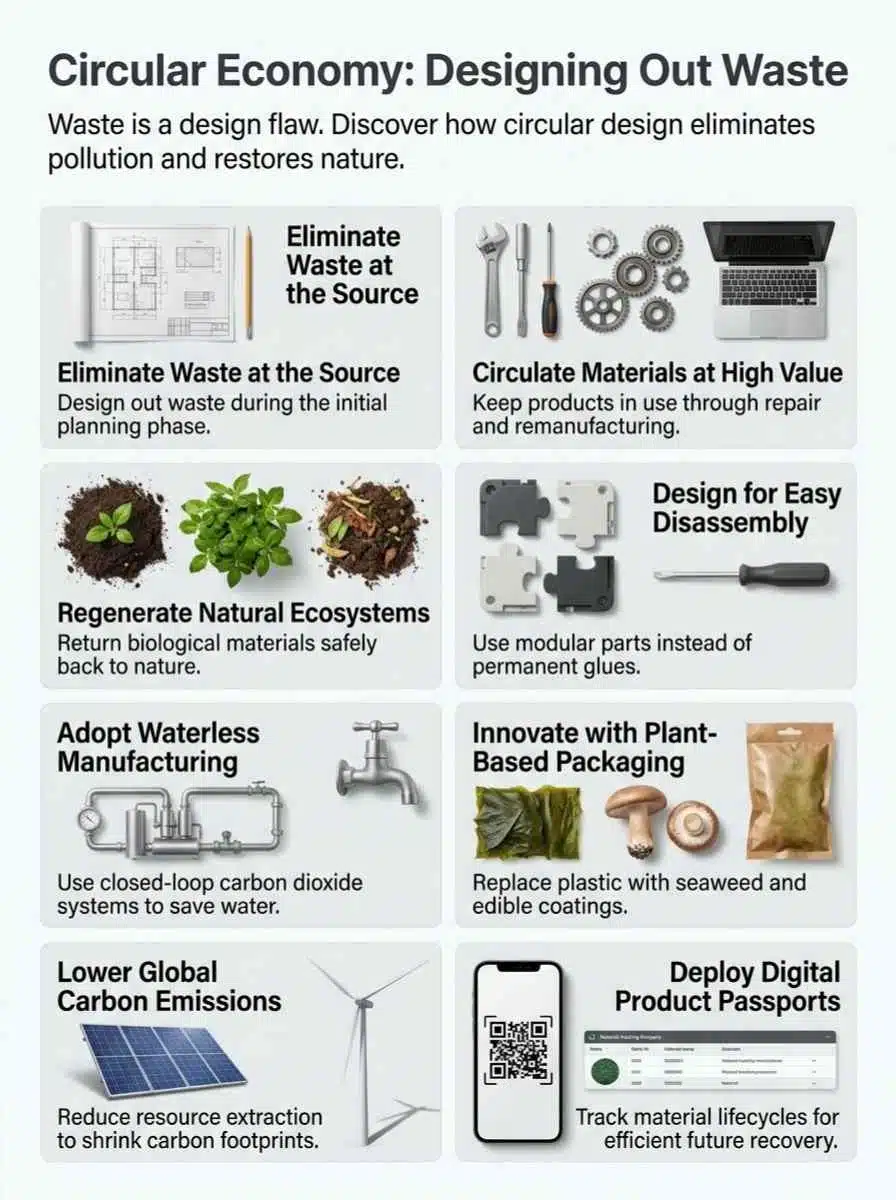
The circular economy rests on three simple aims, and each one helps you make better design choices. If you keep these principles in view, you can spot waste before it enters the supply chain.
Eliminate waste and pollution
In a strong circular system, recycling is the fallback, not the main plan.
This principle asks designers to stop creating avoidable waste in the first place. That can mean cutting unnecessary plastic packaging, choosing mono-material formats, removing toxic additives, or switching from disposable packs to refill or reuse models.
Food-contact packaging is a good example. After FDA announced in 2024 that grease-proofing agents containing PFAS were no longer being sold in the U.S. for paper and paperboard food packaging, brands had a clear signal to move toward PFAS-free options and cleaner material choices.
Circulate products and materials
This is the part most people picture first: maintenance, sharing, reuse, repair, refurbishment, remanufacturing, and then recycling as a last step. The goal is to keep technical materials in circulation at the highest value for as long as possible.
A useful real-world example is Framework. Its laptops have repeatedly earned top repairability scores from iFixit because batteries, ports, and boards can be swapped with basic tools, which keeps electronics useful longer and reduces pressure on critical minerals.
- Maintain: Keep the product working so replacement is delayed.
- Reuse: Move the same product to another user with minimal processing.
- Repair: Replace a failed part instead of the whole unit.
- Remanufacture: Recover key components and rebuild to working condition.
- Recycle: Recover material only after the higher-value options are exhausted.
Regenerate natural systems
Biological materials need a different loop from metals, plastics, and electronics. Food scraps, compostable organics, and safe agricultural residues should return nutrients to soil and support healthier ecosystems.
EPA’s current food waste research shows wasted food is the single most common material landfilled and incinerated in the U.S. In the sectors it tracks, about 66 million tons of wasted food are generated, yet only around 1% is managed through anaerobic digestion while 75% is still landfilled or incinerated.
That gap matters because burying organics creates methane risk, while composting and digestion can support soil health, water retention, and lower biodiversity loss over time. This is where circular design meets regeneration in a very practical way.
From Linear to Circular: The Shift in Design Thinking
Moving from a linear economy to a circular one changes the questions designers ask. Instead of asking, “How cheaply can we make this once?” the better question is, “How many useful lives can this product or material support?”
Designing for reuse, repair and recycling
EPA’s National Recycling Strategy keeps pointing back to the same idea: prevention comes first. For designers, that means thinking about service, spare parts, take-back, and material recovery before the first unit ships.
| Design choice | Linear result | Circular benefit |
|---|---|---|
| Fasteners instead of adhesives | Harder to open and repair when glued shut | Faster repair and cleaner disassembly |
| Modular parts | Whole product replaced when one part fails | Easy upgrades, repair, and remanufacturing |
| Mono-material packaging | Sorting and recycling become harder | Higher chance of recovery in real systems |
| Published repair guides and spare parts | Shorter product life | Lower replacement demand and better reuse |
The pattern is simple once you see it. Screws beat glue, standardized parts beat one-off parts, and clear material labeling beats mystery composites every time.
Innovations in materials and processes
New materials and processes matter only if they solve a real waste problem. The best examples tie a named innovation to a clear result.
- Notpla: Its seaweed-based food packaging uses a plastic-free, PFAS-free coating. Notpla says it has replaced 31,258,359 single-use plastic units to date, and its reviewed life cycle data shows up to 79% less embodied carbon than conventional polypropylene alternatives.
- Apeel: Its produce coatings are a food waste play more than a packaging play. Apeel says Edipeel is made from plant-based mono- and diglycerides, while Organipeel adds citric acid and baking soda, helping produce hold moisture and slow oxidation.
- Lush: Its solid formulations, especially shampoo bars and other packaging-free products, show the cleanest circular move of all: remove the bottle entirely when the product can work without it.
- DyeCoo: The waterless dyeing case study remains one of the clearest examples in textiles. The process uses reclaimed carbon dioxide in a closed loop, recycles 95% of the CO2, reaches more than 98% dye uptake, and the Ellen MacArthur Foundation has estimated one machine can process 800 tons of polyester a year while saving 32 million liters of water and avoiding 160 tons of chemicals.
The useful test is this: ask what waste stream the innovation avoids, what infrastructure it needs, and whether it makes reuse, repair, composting, or recycling easier in the U.S. market. If it does not improve one of those outcomes, it is probably not a strong circular move.
Real-World Examples of Circular Economy in Action
Circular ideas can sound abstract until you see them in real products and factories. These examples make the shift easier to picture.
Circularity in packaging
Packaging is often the fastest place to spot a design flaw because you use it for minutes and then have to manage it for months, years, or longer. A better packaging decision saves material, lowers shipping waste, and improves the odds that the package fits a real recovery route.
| Example | What changed | Why it helps |
|---|---|---|
| Notpla | Seaweed-based coating instead of plastic lining | Helps reduce plastic packaging, avoids PFAS, and can work in paper or compost paths depending on use |
| Apeel | Edible plant-based produce coating | Extends freshness and helps reduce food waste before disposal is even needed |
| Lush | Packaging-free solid bars | Removes the container, which is often better than trying to recycle it later |
The practical lesson is to judge packaging by the whole system, not just the label. A recyclable or compostable claim means far less if the local waste management infrastructure cannot actually process the material.
Sustainable fashion and textiles
Fashion carries a heavy footprint because water, dyes, finishing chemicals, and blended fibers all shape end of life. If you want better outcomes, you have to design the textile system, not just the garment look.
The DyeCoo example is helpful because it attacks one of the dirtiest steps directly. Its waterless dyeing process removes process water, avoids wastewater treatment, and cuts chemical handling, which makes circular manufacturing more realistic for polyester-based production.
- Favor fibers and trims that can be separated without destroying the fabric.
- Use waterless dyeing or lower-toxicity finishing where performance allows.
- Design garments for repair, not just for first sale.
- Build take-back only after you know the material can be reused or recovered.
The common pitfall is easy to miss: brands launch collection programs for clothes that were never designed to be repaired, sorted, or recycled. Collection alone is not circularity if the material still has nowhere useful to go.
Circular manufacturing systems
Circular factories treat scrap, spare parts, and returned products as assets instead of losses. That mindset changes procurement, production planning, and after-sales service all at once.
A 2020 EPA recycling economic report found that recycling and reuse activities supported 681,000 U.S. jobs and $37.8 billion in wages. That is why circular manufacturing is not just a climate or compliance story, it is also an operations and labor story.
- Track materials and parts with simple IDs or barcodes.
- Set aside clean streams for reuse, not just mixed scrap for recycling.
- Design service loops for returned components and warranty parts.
- Use life cycle assessment to compare redesign options before scaling them.
Benefits of Adopting a Circular Economy
The biggest benefits show up in three places at once: resource use, greenhouse gas emissions, and long-term business resilience. That is what makes circularity more useful than a narrow recycling plan.
Reducing resource extraction and pollution
EPA points to the 2019 Global Resources Outlook from the United Nations Environment Programme’s International Resource Panel, which estimated that up to half of global emissions stem from extracting and processing materials, fuels, and food. That is a strong reason to focus on design choices, reuse, and material recovery before new extraction.
Keeping products and materials in play reduces pressure on forests, farms, mines, and waterways. It also lowers the odds that plastic packaging, food waste, and contaminated residues end up in landfills, incinerators, or the wider environment.
Lowering carbon emissions
Renewable energy is essential, but it does not solve the emissions tied to cement, steel, aluminum, plastics, and food. The Ellen MacArthur Foundation has popularized a useful benchmark here: about 45% of global greenhouse gas emissions come from making products and food and from land use, which is exactly where circular design can help.
That is why reuse, remanufacturing, composting, repair, and waterless dyeing count as real climate actions. They reduce the need to remake the same value from scratch.
Every product you keep in use longer avoids another round of extraction, manufacturing, packaging, and transport.
Promoting long-term economic sustainability
Circular systems help businesses rely less on constant virgin inputs. That can make supply chains steadier when material prices rise or shortages hit.
The labor opportunity is larger than many people realize. The International Labour Organization says its latest global baseline estimates that 121 to 142 million people already work in fully or partially circular activities, from repair and refurbishment to reuse and recycling.
- Lower exposure to raw material price swings
- New revenue from repair, resale, and refurbishment
- More local service and technical jobs
- Better alignment with biodiversity loss, climate change, and waste reduction goals
Challenges in Transitioning to a Circular Economy
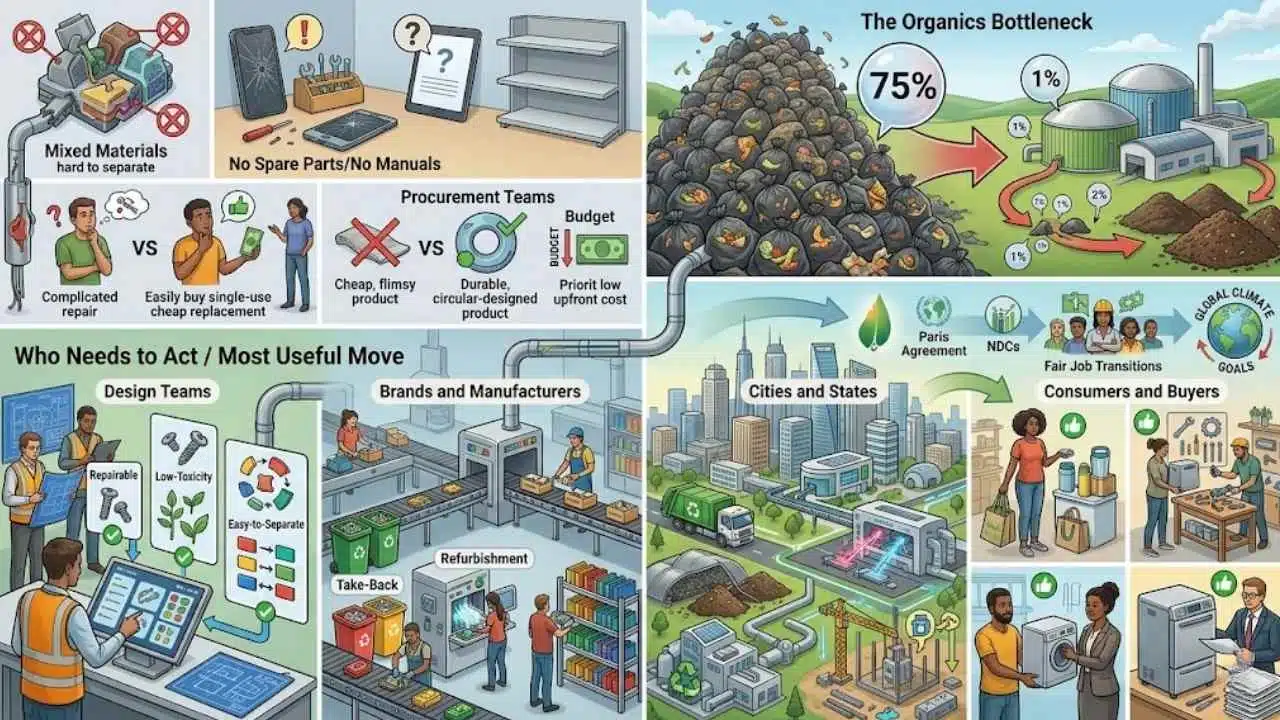
The shift sounds logical, but it is still hard. Most barriers come from weak design, weak infrastructure, or weak incentives, and sometimes all three show up at once.
Barriers in design, infrastructure, and consumer behavior
Even well-meant circular products can fail if the system around them is not ready. A reusable pack needs return logistics, a repairable device needs parts and manuals, and compostable organics need actual collection and processing capacity.
- Too many products still use mixed materials that are hard to separate.
- Many brands do not sell spare parts or publish repair instructions.
- Local collection systems often cannot handle specialized materials.
- Consumers still default to convenience when repair feels slow or confusing.
- Procurement teams often buy for lowest upfront cost instead of longest useful life.
- Small businesses may lack the capital to redesign products or reverse logistics.
The U.S. organics data makes the gap clear. EPA says only about 1% of the wasted food it tracks goes to anaerobic digestion, while 75% is still landfilled or incinerated, which shows the bottleneck is often infrastructure rather than intent.
The role of policy and collaboration
Policy helps move circularity from isolated pilots into normal practice. The Save Our Seas 2.0 Act authorized EPA’s Solid Waste Infrastructure for Recycling program, and the Infrastructure Investment and Jobs Act provided $275 million for those grants across fiscal years 2022 through 2026.
There is still much more demand than support. In the 2025 second round for political subdivisions, EPA received 307 applications seeking about $1.072 billion, which is a useful reminder that cities and businesses want better systems faster than current funding allows.
| Who needs to act | Most useful move |
|---|---|
| Design teams | Choose repairable, low-toxicity, easy-to-separate products |
| Brands and manufacturers | Offer take-back, refurbishment, and spare parts where possible |
| Cities and states | Build collection, sorting, composting, and recycling infrastructure |
| Consumers and buyers | Reward durability, repair, refill, and reuse over disposable convenience |
That kind of collaboration also makes it easier to connect circular economy work with the Paris Agreement, nationally determined contributions (NDCs), and fair job transitions, which is where UNEP and the International Labour Organization keep pushing the conversation.
Final Thoughts
The circular economy starts with a simple idea: waste is usually a design choice before it becomes a waste management problem. When you eliminate waste, keep products and materials in use, and regenerate natural systems, you cut greenhouse gas emissions, ease pressure on critical minerals and other natural resources, and create more durable business value.
Examples like Notpla, Apeel, Lush, and the DyeCoo case study show that better design choices already exist. The real opportunity now is to make those choices standard, so fewer materials end up in landfills and more stay useful for longer.
Frequently Asked Questions (FAQs) on Circular Economy
1. What is the circular economy?
The circular economy keeps materials in use, it cuts waste in the product lifecycle, and it boosts resource efficiency.
2. Why say waste is a design flaw?
When makers design for throwaway, waste is built in. Treat waste as a design flaw, and you redesign for reuse, repair, and recycling.
3. How does it help businesses and people?
Companies save money, they use fewer raw materials, and they cut risk in supply chains. People get products that last longer, and communities see less landfill. It is a win, it is practical, not a pie-in-the-sky idea.
4. How can I start, as a designer or shopper?
Designers should plan for repair, pick durable materials, and map the full product lifecycle. Shoppers can buy long-lasting items, avoid single-use packaging, and back brands that favor reuse and recycling.