In a surprising and strategic move, OpenAI has publicly released two powerful open-source AI models—gpt-oss-120b and gpt-oss-20b. These models are now freely available for developers, researchers, and organizations around the world. The larger 120-billion parameter model is optimized for advanced AI infrastructures, while the smaller 20-billion parameter model is lightweight and efficient enough to run on consumer-grade laptops and desktop systems.
This is the first major open-weight model release by OpenAI since GPT-2 in 2019, and it represents a significant pivot in OpenAI’s long-term strategy. By making these models available under an Apache 2.0 license, OpenAI is opening the door to a future where accessible, transparent, and ethical AI development is no longer limited to large corporations.
What Are gpt-oss-120b and gpt-oss-20b?
Both gpt-oss models belong to the family of transformer-based large language models (LLMs)—similar in architecture to GPT-3 and GPT-4, but purpose-built to support community-driven development. The naming—gpt-oss—stands for “GPT Open Source Series,” highlighting OpenAI’s shift toward open collaboration and global developer support.
- gpt-oss-120b: Designed for advanced users with access to high-end GPUs or cloud infrastructure. It offers near-GPT-4 levels of performance on many tasks, especially in reasoning and tool-assisted tasks.
- gpt-oss-20b: Created for general users, small teams, and researchers. This version is highly optimized for performance on consumer laptops and local servers, giving small developers access to high-performing models without cloud dependency.
Reinforcement Learning and Multi-Agent Collaboration
What sets these models apart from previous open-source releases is their training methodology. OpenAI used reinforcement learning from human feedback (RLHF) along with multi-agent cooperation strategies to improve reasoning and tool-use capabilities. In practice, this allows multiple instances of the model to collaborate on a single task, sharing intermediate steps and refining outcomes in real time.
For instance, one AI agent can search the web for context while another writes code, and a third refines the final answer. This technique, known as multi-agent alignment, is believed to be the future of scalable, safe AI development.
These models can also run Python scripts, access external data sources, and perform complex task planning—a major leap from simple text generation.
No Image or Audio Support—Yet
While these models are impressive in natural language processing, they do not support multimodal tasks like image creation or audio transcription. That means tools like DALL·E, Whisper, or Sora are still separate and closed-source.
However, given the open release, it’s possible that third-party developers may build extensions or plug-ins in the future to add visual or audio support on top of these models.
Why This Release Is Important
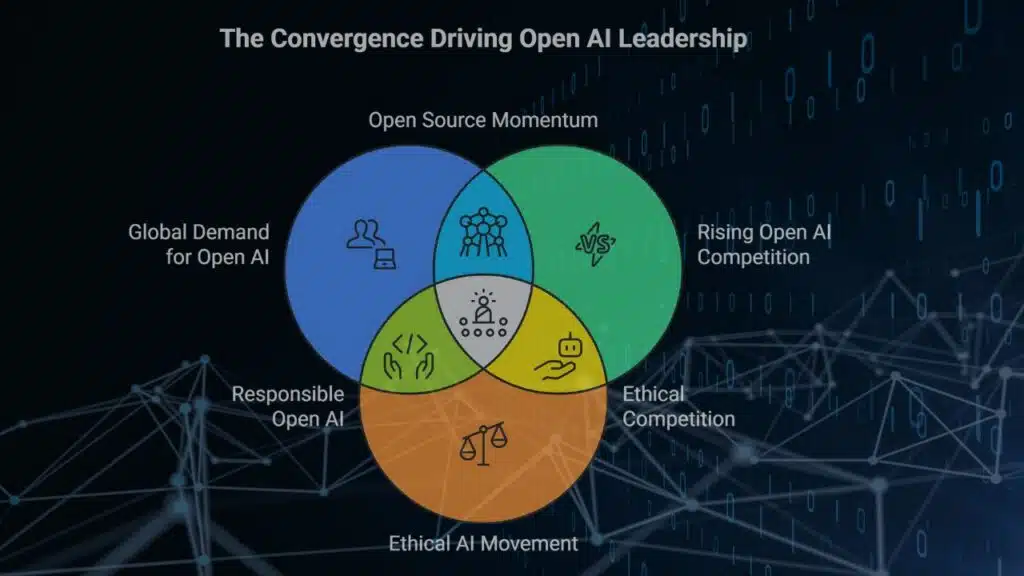
OpenAI’s decision to release these models openly comes at a time when the AI industry is under growing pressure to embrace transparency, fairness, and decentralization. This shift reflects several strategic and ethical motivations:
- Global demand for open AI: Developers across the world have asked for models they can fine-tune, deploy locally, and study in detail without corporate or API restrictions.
- Rising competition: Companies like Meta (with LLaMA and Code LLaMA) and Mistral AI have gained traction by offering free and open alternatives to commercial models.
- Ethical AI movement: There’s a global push for AI systems to be aligned with democratic values, ensuring equity, privacy, and accountability in deployment.
OpenAI’s move helps maintain its leadership by responding directly to all three forces.
Commercial Use Is Allowed
One of the most developer-friendly aspects of this release is the Apache 2.0 license. This license allows users to:
- Use the models for any purpose, including commercial applications
- Modify or fine-tune the models
- Distribute derivative models or products
- Retain full ownership of their modifications
This is especially beneficial for startups and independent developers who want to build custom AI solutions, create AI-powered applications, or even launch products without paying for expensive commercial APIs or cloud credits.
Limitations and Cautions
Despite their power and flexibility, OpenAI is honest about the shortcomings of these models. The company emphasizes that:
- These models may generate false or misleading information more often than GPT-4 or ChatGPT.
- They are more vulnerable to prompt injection attacks and adversarial misuse if not implemented carefully.
- Their safety mechanisms are basic, compared to commercial-grade models.
In addition, OpenAI chose not to release the training dataset, citing concerns about copyright infringement, misinformation, and data misuse. This decision aligns with responsible AI practices, though some researchers argue that transparent datasets are key to building truly accountable AI systems.
Comparison With Other Open Models
| Feature | gpt-oss-120b | LLaMA 3 (Meta) | Mistral 7B | GPT-4 |
| Parameters | 120B | 70B | 7B | Estimated 1T+ |
| Open Source | Yes | Yes | Yes | No |
| License | Apache 2.0 | LLaMA License | Apache 2.0 | Proprietary |
| Multimodal | No | No | No | Yes |
| Fine-Tunable | Yes | Yes | Yes | Limited (API only) |
As the table shows, OpenAI’s gpt-oss models are some of the largest and most permissively licensed models available to date—particularly suitable for developers who want full control over deployment and customization.
Download and Use Instructions
The models can be downloaded directly from:
- OpenAI’s official GitHub repository
- Model hosting platforms like Hugging Face and Docker Hub
- Community mirrors with tutorials and setup guides
These models are compatible with standard frameworks like PyTorch, TensorFlow, and Hugging Face Transformers, and can be run with:
- NVIDIA A100/RTX 4090 GPUs (for 120B)
- Local CPUs or mid-tier GPUs (for 20B)
OpenAI also encourages users to follow best practices in prompt design, output filtering, and user feedback collection to avoid misuse.
A Strategic Move With Global Impact
OpenAI’s release of the gpt-oss series could spark a new wave of innovation across the AI ecosystem. By enabling researchers, students, startups, and small businesses to access state-of-the-art tools without cost, the company is redefining what’s possible in an increasingly centralized and monetized AI landscape.
This release empowers:
- Developing countries with limited tech infrastructure
- AI educators and non-profits
- Innovators building AI-driven products in healthcare, education, legal tech, and finance
Moreover, it brings OpenAI closer to its original mission—to ensure that artificial general intelligence (AGI) benefits all of humanity.
OpenAI’s new open-weight models—gpt-oss-120b and gpt-oss-20b—mark a historic return to openness after years of closed-system development. These models are powerful, flexible, and free to use, offering an ideal platform for responsible AI experimentation and innovation.
By prioritizing accessibility and ethical use, OpenAI is inviting a broader, more inclusive wave of developers to shape the future of AI—together.
The Information is Collected from CNBC and MSN.