Cold email is not dead. Bad cold email is dead. Actually, bad cold email is not dead either; it is alive, well, and currently sitting in someone’s spam folder with a subject line like “Quick question?” for the 900th time.
Cold Email in 2026 is harder because inboxes are stricter, buyers are more tired, and AI has made it embarrassingly easy to send thousands of mediocre emails that sound personal but feel like a robot wearing a fake mustache. The old game was volume. The new game is relevance, trust, deliverability, timing, and not annoying people so quickly that mailbox providers decide your domain deserves exile.
The good news is that cold email can still work. The bad news is that it works only when it is done like a real business conversation, not a digital leaflet drop with mail merge.
Why Cold Email Changed So Much In 2026
Cold email used to be more forgiving. You could send more, personalize a little, follow up aggressively, and still get some replies if the offer was decent. In 2026, that lazy setup gets punished faster.
Mailbox providers now care more about authentication, complaint rates, sender reputation, unsubscribe handling, domain alignment, and user engagement. Google’s sender guidelines say senders should authenticate email, avoid impersonation, make unsubscribing easy, and keep spam rates low. Google’s FAQ says senders should keep spam rates below 0.1% and prevent them from ever reaching 0.3% or higher.
Yahoo’s sender guidance also tells senders to keep spam rates below 0.3%, maintain valid forward and reverse DNS records, follow email standards, and meet bulk sender requirements. In other words, the inbox is no longer impressed by “spray and pray.” It has standards now. How inconvenient.
The legal side matters too. The FTC’s CAN-SPAM guidance says commercial email must avoid misleading header information, avoid deceptive subject lines, identify the message as an ad when required, include a valid physical postal address, and provide a clear way to opt out.
What Actually Works In Cold Email In 2026
The cold emails that work now feel researched, specific, short, and useful. They do not pretend to be warm when they are clearly cold. They do not open with fake flattery. They do not ask for “15 minutes” before giving the recipient a reason to care.
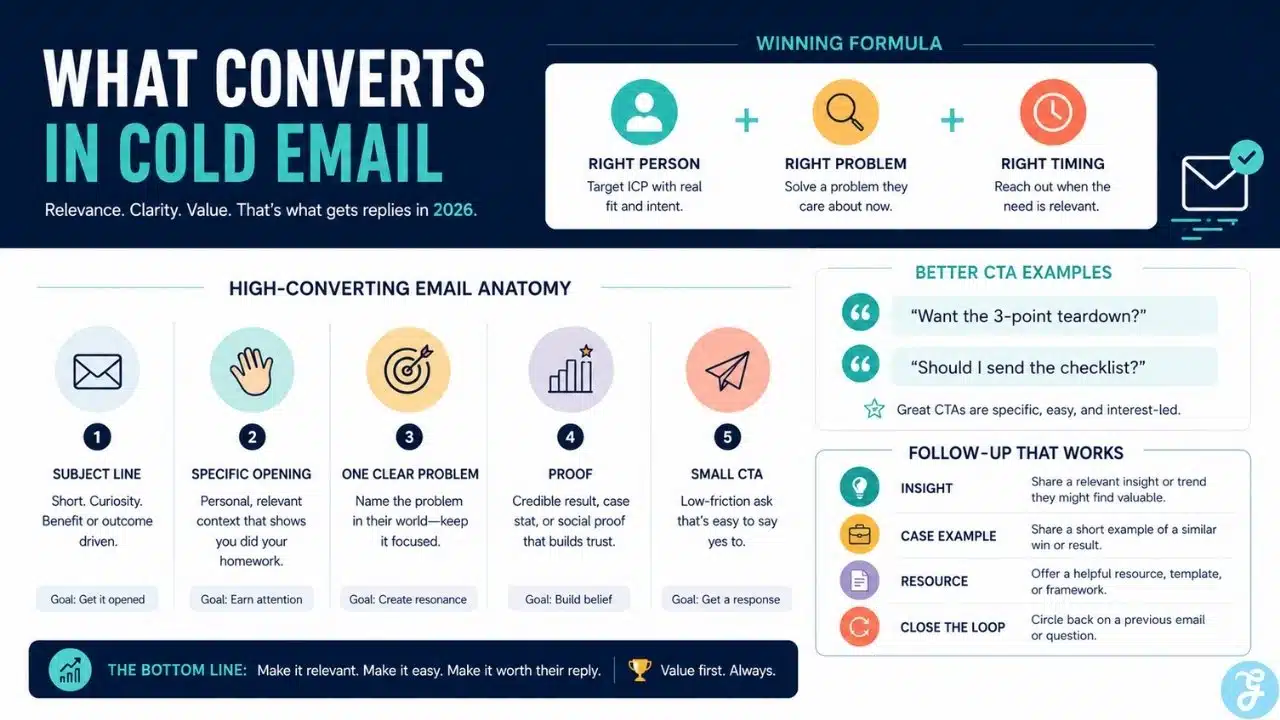
The strongest cold emails usually have five things:
- A real reason for reaching out.
- A clear connection to the recipient’s business, role, trigger, or problem.
- One specific pain or opportunity.
- Proof that the sender understands the space.
- A low-friction CTA.
That last point matters. A cold email should not ask the prospect to do emotional labor. “Let me know your thoughts” is lazy. “Worth sending a 3-point teardown?” is better. It gives the person a small, clear choice.
Industry benchmark data should always be treated carefully because platforms measure differently, but one 2026 cold email benchmark from Instantly reported an average reply rate of 3.43%, with top performers exceeding 10%. The useful takeaway is not the exact number; it is the gap between average campaigns and well-targeted campaigns. Relevance still beats volume.
What Lands Cold Emails In Spam
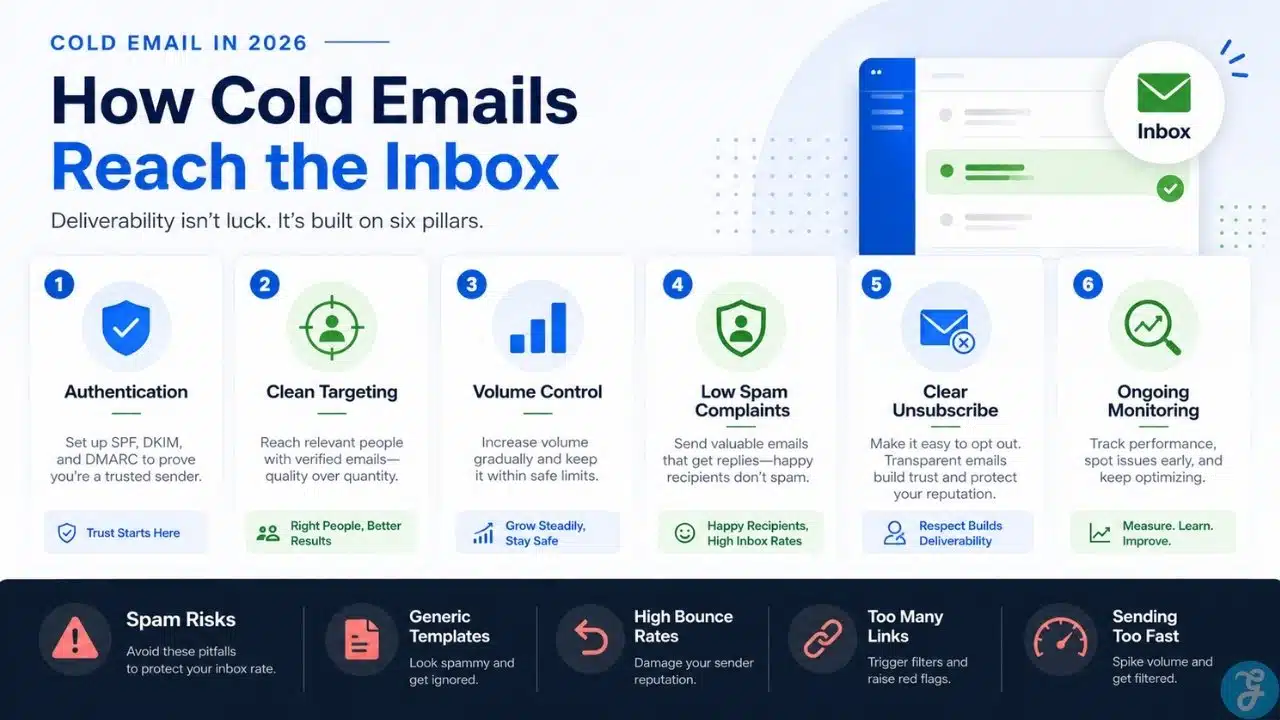
Spam placement is rarely caused by one thing. It is usually a pile-up of technical mistakes, reputation problems, poor targeting, bad copy, and recipient frustration. Basically, death by a thousand lazy decisions.
Here are the most common problems.
| Spam Risk | Why It Hurts |
|---|---|
| No SPF, DKIM, or DMARC setup | Mailbox providers cannot trust the sender identity |
| New domain sending too much too fast | Looks suspicious and unnatural |
| High bounce rates | Signals poor list quality |
| High spam complaints | Damages sender reputation fast |
| Misleading subject lines | Triggers complaints and legal risk |
| Too many links or attachments | Looks promotional or risky |
| Generic AI copy | Feels mass-produced and irrelevant |
| No unsubscribe option | Creates frustration and compliance risk |
| Scraped, irrelevant lists | Leads to poor engagement and complaints |
| Sending the same template to everyone | Makes personalization look fake |
Google’s guidelines say bulk senders must support one-click unsubscribe for marketing and subscribed messages if they send more than 5,000 messages per day. Google also explains that easy unsubscribe options can improve open rates, click-through rates, and sending efficiency.
So yes, making it hard to unsubscribe is not clever retention. It is a complaint generator with a bad attitude.
What Converts In Cold Email In 2026
Conversion in cold email does not start with the CTA. It starts with the list. If the targeting is wrong, even good copy becomes polite spam.
The emails that convert usually match three things:
- Right person: The recipient has the role, authority, or influence to care.
- Right problem: The message connects to a problem they likely have now.
- Right timing: There is a trigger, change, growth phase, hiring signal, funding event, product launch, market pressure, or operational pain.
Without these, the email becomes “I sell something, please care.” Stunning strategy. Boldly useless.
A strong cold email in 2026 usually looks like this:
| Email Element | What Works |
|---|---|
| Subject line | Clear, calm, and relevant |
| Opening line | Specific reason for reaching out |
| Body | One problem, one insight, one offer |
| Proof | Short result, example, or credibility signal |
| CTA | Small, direct, easy to answer |
| Follow-up | Adds value instead of repeating “just checking in” |
The best CTAs are not always “book a call.” Sometimes the better CTA is “Should I send the checklist?” or “Want me to show where this is leaking?” Cold email works better when the first yes is small.
Cold Email Copy That Still Works
Good cold email copy is not complicated. It is just disciplined.
A practical structure:
Subject: simple and relevant
Opening: why this person, why now
Problem: one specific pain
Proof: one line of credibility
Offer: what can you help with
CTA: one small next step
Example:
Subject: quick idea for your demo flow
Hi [Name], I noticed your team is driving paid traffic to the demo page, but the page asks for a lot before showing much value.
I help B2B teams reduce friction in demo flows so more qualified visitors actually reach sales.
I spotted 3 quick fixes that could make the page feel less “form-first” and more buyer-friendly.
Want me to send them over?
This works because it is specific, useful, and does not immediately demand a meeting like the sender is collecting calendar invites for a sport.
Cold Email Copy That Fails
Bad cold emails usually fail because they sound like it was written for “Dear Business Human.”
Avoid this stuff:
- “I hope this email finds you well.”
- “We are a leading provider of innovative solutions.”
- “I came across your company and was impressed.”
- “Can we schedule 30 minutes this week?”
- “Just circling back.”
- “Any thoughts?”
- “I know you’re busy, so I’ll be brief,” followed by six paragraphs.
- Fake personalization like mentioning the company name and pretending that is research.
AI has made this worse. Many cold emails now sound polished but empty. They are grammatically fine and strategically dead. The recipient can feel that no human actually thought about them.
Deliverability Rules You Cannot Ignore
Deliverability is not just an IT task anymore. It is part of the sales and marketing strategy. If your email does not reach the inbox, the best copy in the world is just a diary entry with tracking pixels.
At a minimum, cold email senders should check:
- SPF
- DKIM
- DMARC
- TLS
- Domain alignment
- Bounce rate
- Spam complaint rate
- Sending volume
- Unsubscribe process
- List quality
- Reply rate
- Engagement trend
Google’s sender guidelines require authentication practices and say bulk senders must meet additional requirements such as DMARC, one-click unsubscribe, and aligned sending domains. Yahoo gives similar bulk-sender guidance around authentication, complaint rate, and proper DNS setup.
Microsoft also planned an Exchange Online external recipient rate limit of 2,000 external recipients per day, but its Exchange Team Blog notes that implementation was canceled and did not go into effect. That is a useful reminder that platform rules can change, so serious senders should monitor provider updates rather than trusting old cold-email playbooks forever.
Compliance Is Not Optional
Cold email rules depend on location, recipient type, and data handling. This is not legal advice, but the basic principle is simple: do not mislead people, do not hide who you are, and give people a way to opt out.
In the U.S., CAN-SPAM requires accurate header information, non-deceptive subject lines, a valid physical address, and a clear opt-out mechanism.
In the UK, the ICO says UK GDPR still applies to B2B marketing when personal data is processed, such as a named person’s business email. The ICO also says organizations must respect people’s data protection rights, including their absolute right to stop their data being used for direct marketing.
The ICO’s electronic mail marketing guidance says marketing emails generally require consent for individuals, while companies can receive marketing emails, with good practice being to maintain a do-not-email list for companies that object.
Translation: if someone opts out, remove them. Do not “follow up one last time” because your sequence tool is emotionally attached.
What A Strong Cold Email System Looks Like
One good email is not enough. Cold email works best as a system.
A good 2026 setup includes:
- Clean domain setup.
- Warmed and protected sending infrastructure.
- Verified, relevant lists.
- Segmented messaging by buyer type.
- Small sending volumes per inbox.
- Plain-text style copy.
- Short email length.
- Clear opt-out.
- Light personalization with real relevance.
- Follow-ups that add new value.
- CRM tracking.
- Reply-quality review.
- Weekly deliverability checks.
The best teams do not just ask, “How many emails did we send?” They ask, “Who replied, why did they reply, what segment performed best, and what should we stop sending?”
That is the difference between outreach and noise.
Cold Email Follow-Ups That Do Not Annoy People
Follow-ups still work, but only when they add something. Repeating the same message with “just bumping this” is not persistence. It is inbox loitering.
A good follow-up can include:
- A useful observation.
- A short case example.
- A relevant resource.
- A different angle on the same problem.
- A softer CTA.
- A polite close-the-loop option.
Example:
Quick follow-up, [Name].
One thing I noticed: your landing page explains the product well, but the CTA appears before the strongest proof point.
That can make colder visitors hesitate.
Want me to send the 3 fixes I noticed, or should I close the loop?
This is much better than “any update?” because it gives value before asking again.
Cold Email In 2026: What To Do And Avoid
Here is the clean practical version.
| What Works | What Fails |
|---|---|
| Specific targeting | Huge scraped lists |
| Relevant trigger-based outreach | Generic AI-written templates |
| Short, clear copy | Long pitch-heavy emails |
| One small CTA | Asking for a meeting too soon |
| Strong domain authentication | Sending from poorly configured domains |
| Clean unsubscribe process | Making opt-out difficult |
| Follow-ups with value | “Just checking in” spam |
| Low-volume quality sending | Mass blasting from new domains |
| Proof and context | Empty claims and buzzwords |
| Regular deliverability checks | Waiting until the domain is burned |
Cold email in 2026 rewards restraint. Imagine that. The channel built on outreach now works better when people stop acting like inbox arsonists.
The Final Cold Email Checklist
Before sending a campaign, check this:
- Is the list relevant?
- Is the email legally appropriate for the target market?
- Are SPF, DKIM, and DMARC set up?
- Is the domain reputation healthy?
- Is the subject line honest?
- Is the opening line specific?
- Is the offer clear?
- Is the CTA easy to answer?
- Is there an unsubscribe or opt-out path?
- Is the follow-up adding new value?
- Are you tracking replies, not just opens?
- Would you send this email manually to one person?
That last question is the filter. If you would be embarrassed to send it manually, do not automate it to 5,000 people. That is not scale. That is public humiliation with a send button.
The Inbox Is Not Dead. Lazy Outreach Is
Cold email still converts in 2026, but only when it respects the inbox. The winners are not the people sending the most emails. They are the people sending the most relevant emails to the right people with a clean technical setup, useful copy, and a clear reason to start a conversation.
The losers will keep blaming spam filters, AI, buyers, inbox rules, and “the market” while sending the same tired templates to people who never asked for them.
Cold email is not dead. It is just less forgiving now.
And honestly, that is probably a good thing.